

Porsche’s All-Electric 718 Boxster Enters Final Development Phase Ahead of 2027 Debut

Updated:
Readtime: 10 min
Every product is carefully selected by our editors and experts. If you buy from a link, we may earn a commission. Learn more. For more information on how we test products, click here.
- Porsche has completed approximately four million kilometres of testing across more than 20 countries.
- The electric 718 Boxster uses an 800-volt battery mounted behind the seats in a bespoke E-Core architecture.
- Its 40:60 front-to-rear weight distribution replicates the balance of a mid-engined sports car.
- The flagship model will accelerate from 0-100 km/h in less than three seconds and exceed 250 km/h.
- Porsche has scheduled the world premiere for the first quarter of 2027, with production taking place in Stuttgart-Zuffenhausen, Germany.
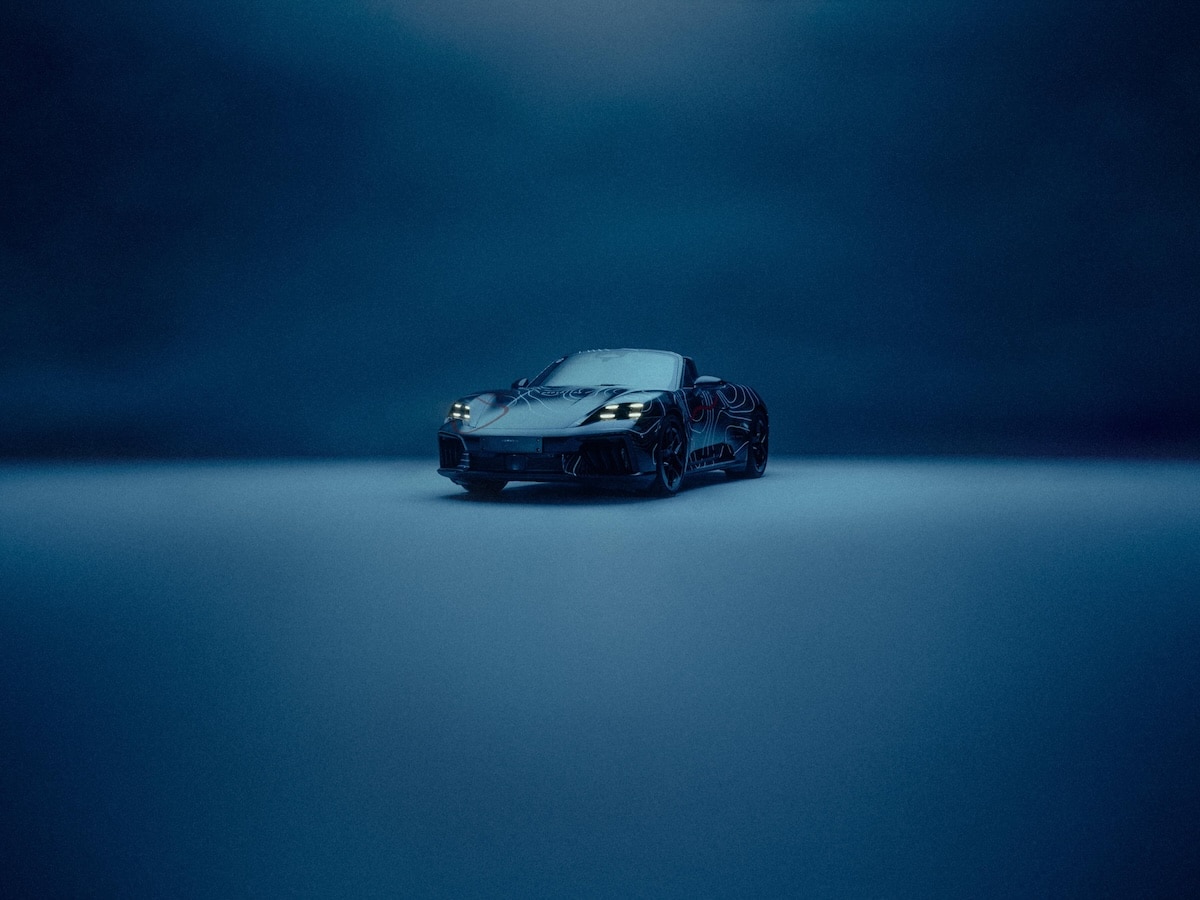
It’s been years in the making, with more than a handful of false starts and cancellations, but the first fully electric version of the Porsche 718 Boxster sports car is in its final stages of preparation ahead of a planned 2027 debut.
The German manufacturer has spent several years now refining the electric platform, with a particular focus on preserving the driving characteristics associated with its mid-engined roadster, and it’s finally coming to fruition. The announcement follows an extensive testing programme involving prototype vehicles across a variety of climates, road conditions and altitudes. How extensive? Porsche says its engineers have covered approximately four million kilometres, testing everything from battery performance and charging compatibility to everyday usability and driver assistance systems.
The defining feature of the electric Boxster is Porsche’s bespoke E-Core architecture, which places the high-voltage battery behind the seats to replicate the weight distribution of a conventional mid-engined sports car. With some facts and figures finally detailed, let’s check out the platform details, performance targets, chassis technology and simulated transmission system ahead of the car’s scheduled world premiere.
2027 Porsche 718 Boxster: Key Specifications
| Specification | Confirmed Details |
| Powertrain | Fully electrc |
| Battery Architecture | 800-volt |
| Battery Location | Behind the seats |
| Platform | Bespoke E-core |
| Drivetrain | Rear-wheel drive |
| Weight Distribution | 40:60 front to rear |
| 0-100km/h | Under 3 seconds, flagship |
| Top Speed | Over 250km/h |
| Transmission | Simulated seven-speed PDK |
| Recuperation | Three selectable stages |
| Testing Distance | Approx. 4 million km |
| Countries Tested | More than 20 |
| World Premiere | Q1 2027 |
| Production Location | Stuttgart-Zuffenhausen, Germany |
Four Million Kilometres of Testing to Create the Ultimate EV Sports Car
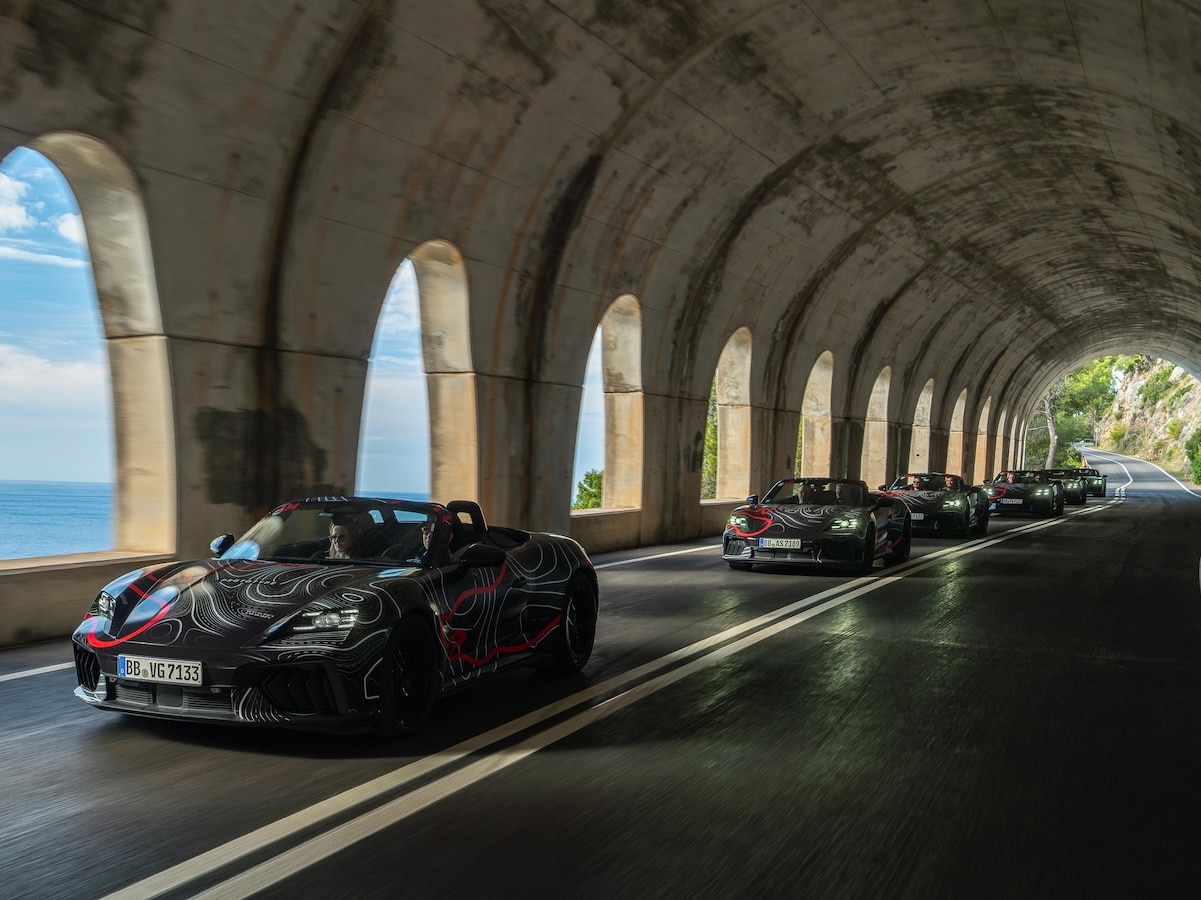
Porsche’s EV Boxster development programme has covered more than 20 countries, with engineers and test drivers putting the electric 718 through approximately four million test kilometres.
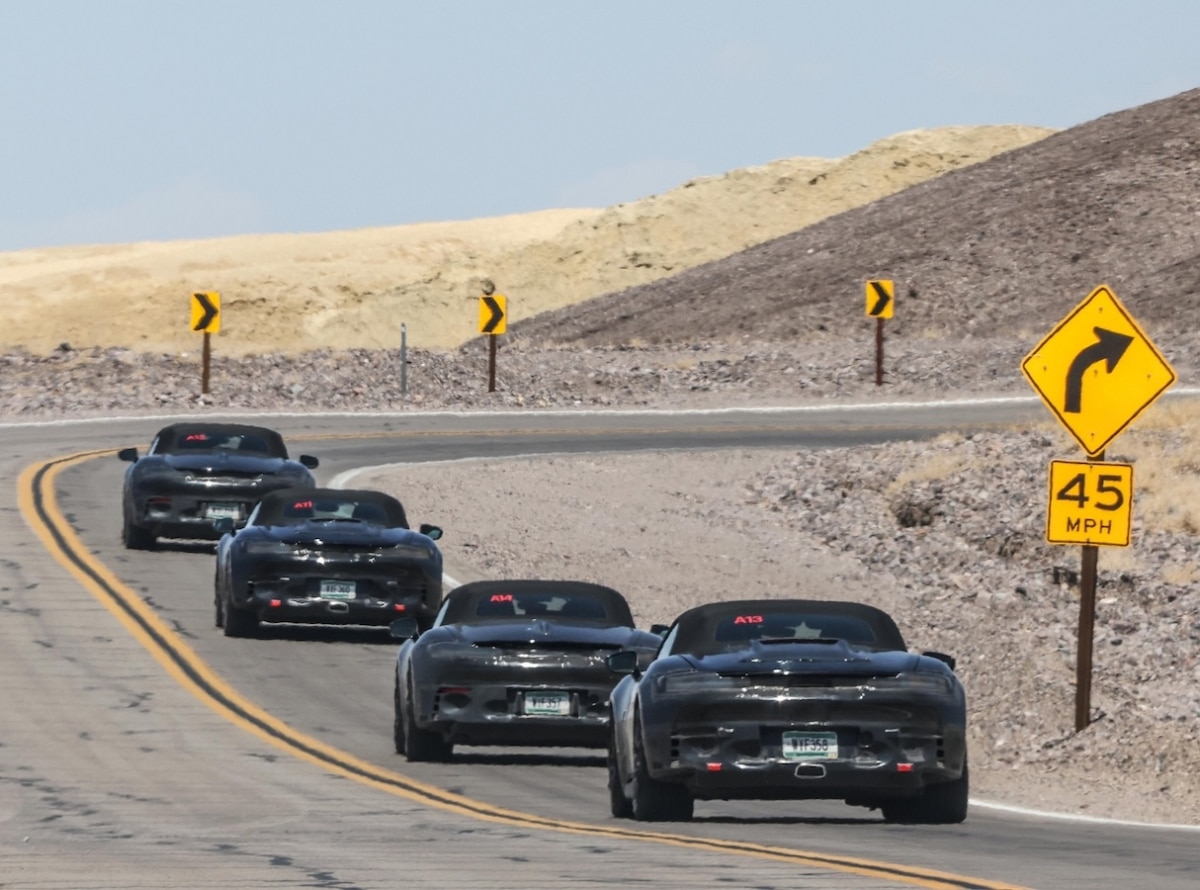
This programme included winter testing in Sweden at temperatures as low as -30 degrees Celsius, alongside high-temperature testing in Death Valley, California, where temperatures reached 51 degrees Celsius. But busy urban environments were also considered, including Las Vegas, Los Angeles and Shanghai, where Porsche notes that it spent time specifically focused on everyday usability and driver assistance systems.
Prototypes were also tested across various altitudes, from 86 metres below sea level to 2,750 metres above sea level.
Charging was another important part of the programme, with Porsche putting the prototypes through their paces using five different charging standards. The 800-volt architecture is particularly interesting here, as it gives Porsche the electrical foundations for high-power DC charging while helping manage the current required by the system. We still don’t have a maximum charging speed, battery capacity or driving range to work with, but those figures will go a long way towards determining whether the electric Boxster can be as usable on longer trips as it promises to be entertaining on a winding road.
E-Core Architecture Preserves Mid-Engined Weight Distribution
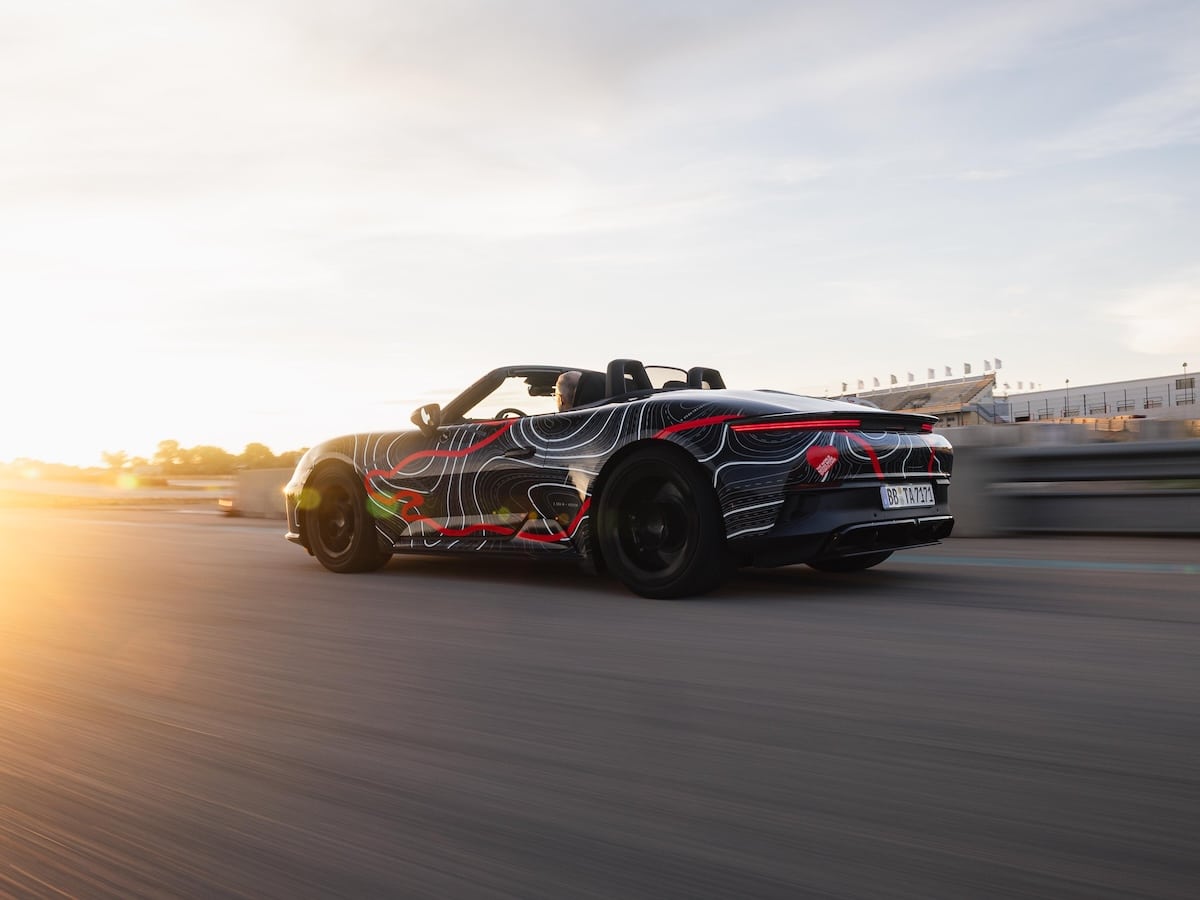
While EVs tend not to excite enthusiasts, this little detail might be the game changer. It’s called the E-Core architecture, and it’s been developed specifically for the electric 718 platform. Rather than placing the battery underneath the passenger compartment in a conventional skateboard configuration, Porsche has positioned its 800-volt battery directly behind the seats, occupying the area traditionally reserved for the combustion engine.
This arrangement allows Porsche to maintain a low seating position while concentrating mass towards the centre of the vehicle.
The resulting weight distribution is 40 per cent over the front axle and 60 per cent over the driven rear axle. Porsche says this replicates the balance of its traditional mid-engined sports cars, and we have to give them some credit here because they could have easily chased a 50:50 weight distribution by using the traditional skateboard platform seen in other sporty EVs like the Taycan and even the MG Cyberster.
Porsche also claims its lightweight construction techniques have kept overall vehicle weight similar to current 911 Cabriolet models equipped with the T-Hybrid powertrain, but they haven’t disclosed an official kerb weight for the electric Boxster. That comparison will be worth revisiting when final production specifications become available.
Of course, there’s still the elephant in the room, and that’s weight. Even with Porsche going to considerable lengths to keep the battery mass concentrated around the middle of the car, an electric sports car has a considerable amount of battery hardware to carry around. That’s going to be particularly important for a model like the Boxster, which has built much of its reputation on agility and the sort of immediate response that comes from a relatively lightweight chassis. Porsche’s weight comparison with the 911 Cabriolet is encouraging, but we’ll reserve judgement until the official kerb weight arrives.
There’s a little more good news when it comes to practicality, too. Prototype reporting has indicated that Porsche has retained luggage compartments at both ends of the car, with storage available under the bonnet as well as behind the passenger compartment. That’s a useful outcome given the unusual battery packaging, and means the electric Boxster should retain some of the everyday appeal that has always made the petrol-powered roadster an easy car to live with.
The Most Powerful 718 Boxster Yet
Porsche says the electric 718 Boxster will become the most powerful version of the model ever produced, but we still don’t know what that exact power figure is.
What we do know is that the flagship variant is targeting acceleration from 0-100 km/h in less than three seconds, alongside a top speed exceeding 250 km/h. Every version will use rear-wheel drive, but Porsche has not yet confirmed the electric motor configuration, maximum power, torque figures or individual performance differences between variants. There is also no published battery capacity or WLTP driving range.
For now, the acceleration and top-speed figures are the most substantial performance benchmarks available.
The brand has also confirmed that several chassis components are derived from the 911, which can only be a good thing, and will at least give owners something to talk about when the chat at the local cars and coffee dries up quickly. The steering system draws on the 911 Carrera GTS, while rear-axle steering will be available in the 718 Boxster for the first time.
The wheel and tyre dimensions, braking system and electronically controlled PTV+ limited-slip differential also draw on 911 technology.
There’s some interesting hardware hiding underneath those prototype body panels, too. Car and Driver has reported staggered 20-inch front and 21-inch rear wheels, with Pirelli P Zero R Elect tyres measuring 255/35ZR-20 at the front and 305/30ZR-21 at the rear. That’s a fairly serious tyre package, particularly at the back, where the electric drivetrain will need all the mechanical grip it can get when putting its power down out of slower corners.
The rear-axle steering is another feature worth getting excited about. It’s a technology that can make a surprisingly big difference to how a car feels, helping it turn more readily at lower speeds while improving stability when travelling faster. Combine that with Porsche’s PTV+ limited-slip differential, which helps manage torque delivery across the driven rear axle, and you’ve got a fairly comprehensive collection of chassis technology borrowed from the company’s more expensive sports cars.
E-Shift Introduces Virtual Seven-Speed PDK Gearing
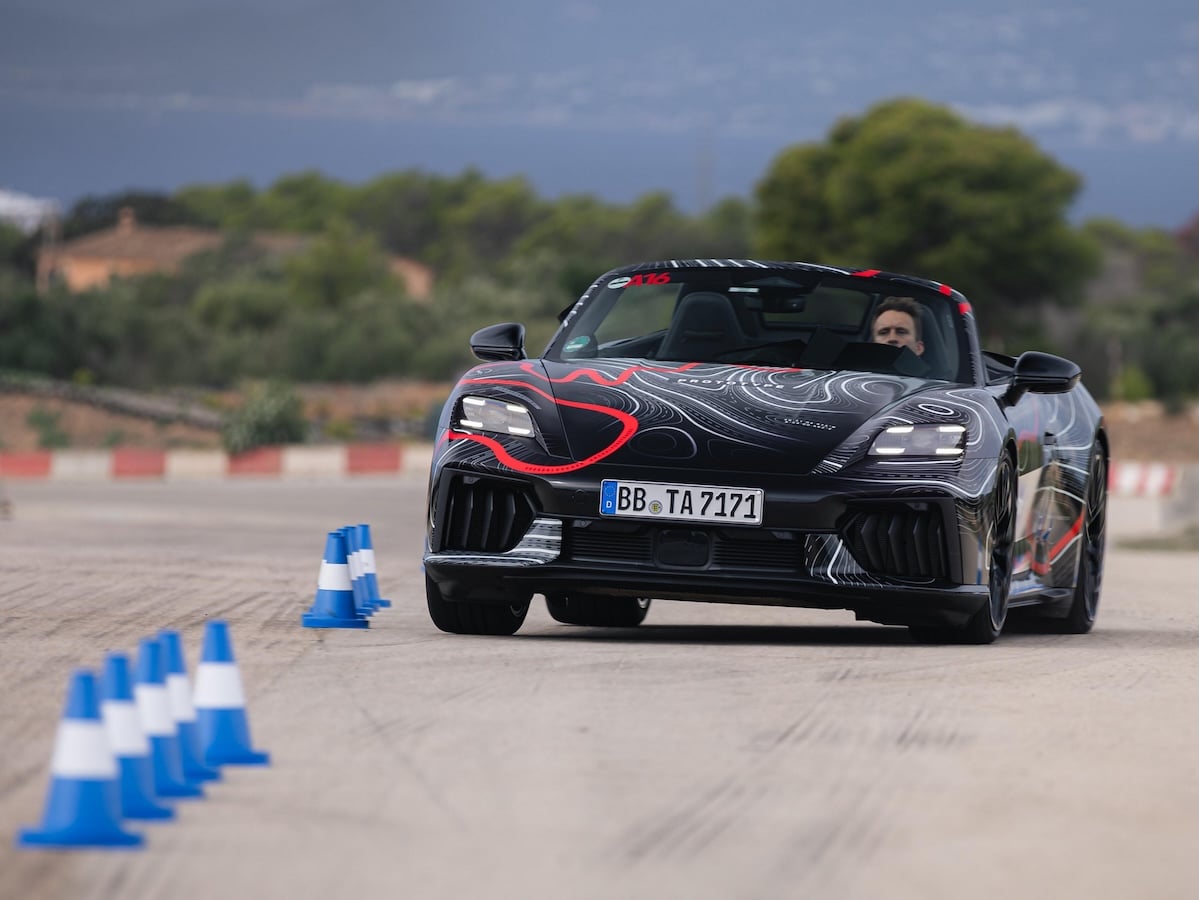
One of the more unusual features confirmed for the new Boxster is E-Shift, which will come standard across the range.
The system recreates the operating characteristics of a seven-speed PDK transmission through software, something that was introduced to the Taycan models with their most recent update. Drivers can activate virtual gear changes and choose between automatic operation or manual shifting using paddles behind the steering wheel. These simulated shift characteristics also vary according to the selected driving mode. Porsche says the system introduces a targeted increase in torque during the shifting process, maintaining identical performance whether E-Shift is activated or deactivated. With E-Shift switched off, the steering-wheel paddles instead control three stages of regenerative braking.
There’s also an acoustic component. When E-Shift is active, the simulated transmission produces a recreated six-cylinder boxer engine sound based on the 981-generation Boxster GTS. Clearly, they’re preserving the sound of the GT4 RS for the moment.
What’s particularly interesting is that Porsche isn’t attempting to turn the electric Boxster into a mechanical replica of its petrol-powered predecessor. The electric motor still delivers its power as an electric motor would, with E-Shift layering simulated gear changes, torque variations and engine sounds over the experience. In other words, you’re getting the familiar interaction of a PDK gearbox without sacrificing the underlying performance of the electric drivetrain. It’s a fairly clever compromise, particularly for drivers who enjoy working through the gears rather than simply burying their right foot and waiting for the speed to build.
Much like the Hyundai IONIQ 5 N that helped popularise this approach, and the IONIQ 6 N and Genesis GV60 Magma that followed it, it’s another attempt to preserve familiar driver experiences and interactions in an electric sports car. Its effectiveness will ultimately depend on how naturally the simulated gear changes integrate with the electric powertrain.
Hyundai’s N e-Shift system has already shown that simulated gearing can have a place in performance EVs, particularly when drivers are looking for more feedback on a circuit. Porsche is taking a slightly different route by basing its sound and shifting experience on the specific character of the 981-generation Boxster GTS. Whether that proves more convincing is something we’ll have to wait to experience ourselves, but at least Porsche is making an effort to give drivers something to interact with beyond the accelerator and brake pedals.
However, two-time World Rally Champion Walter Röhrl has already praised the development car’s handling and feedback, specifically highlighting the E-Shift system:
“The 718 Boxster gives you more feedback than I’ve ever experienced with any other all-electric car.”
Production and 2027 World Premiere
Porsche has confirmed that the electric 718 Boxster will be manufactured at its main production facility in Stuttgart-Zuffenhausen, Germany. The world premiere is scheduled for the first quarter of 2027.
While the announcement provides a clearer timeline for the electric successor following the end of production planning for the previous petrol-powered 718 generation, several commercial details remain outstanding:
- Australian launch timing and allocation.
- Local pricing and on-road costs.
- Battery capacity and WLTP driving range.
- Charging speeds and compatible charging infrastructure.
- Cabin design and technology.
- Final model grades and power outputs.
- Warranty coverage and battery warranty terms.
There’s a bigger commercial question hanging over the project, too. Porsche is making this transition at a time when the premium EV market has become considerably more complicated than many manufacturers initially anticipated. Customer demand has been uneven across regions, particularly among buyers who still associate sports cars with the sound, feel and mechanical connection of a combustion engine. The electric 718 therefore has a fairly difficult job ahead of it, especially when its audience includes some of the most traditional sports car enthusiasts in the business.
These details will be important in determining how the new Boxster succeeds in the premium sports car market as an EV. History is certainly not in its favour.
Related Porsche reads:



























Comments
We love hearing from you. or to leave a comment.