

Updated:
Readtime: 7 min
Every product is carefully selected by our editors and experts. If you buy from a link, we may earn a commission. Learn more. For more information on how we test products, click here.
The animals that frighten us and the animals that actually kill us are almost entirely different lists. Sharks, bears and crocodiles carry the movies and barely register in the mortality data. The deadliest animal on earth is a mosquito, and the runner-up is us.
The comparison video below, from Reigarw Comparisons, is what started this piece off. Every figure underneath it has since been re-checked against the primary source rather than the video, and where the two disagree we have gone with the agency that collects the data.
How to read these numbers
One caveat before the list, because it is the thing most often mangled in write-ups of this kind. When you see a figure like “one in every 154,000”, it is a share of the people alive, not a share of everyone who dies. There are roughly 8.2 billion people on the planet and around 62 million deaths a year from all causes, so the two framings differ by more than a hundredfold. Every ratio below is per head of world population, and every one has been recalculated against the current figure rather than the 7.7 billion the original video used.
Mosquitoes: the deadliest animal on earth
Mosquitoes do not kill by biting. They kill by transmitting disease, and malaria is by far the biggest of them. The World Health Organization put malaria deaths at 610,000 in 2024, up from 598,000 the year before. Malaria on its own is about one death for every 13,000 people alive, or one every 52 seconds.
Add dengue, yellow fever, Japanese encephalitis and lymphatic filariasis and the total climbs higher again. The widely repeated figure of 725,000 mosquito-borne deaths a year traces back to a Gates Foundation blog post rather than to a single agency dataset, so it is best treated as an estimate rather than a count.
Humans: the runner-up
The UN Office on Drugs and Crime recorded 458,000 homicides worldwide in 2021, which works out at 52 an hour. That is one death for every 18,000 people alive, or roughly one a minute. The count covers murder and manslaughter only. Wars and accidental deaths sit outside it, which is why the number is lower than you might expect.
Snakes: far deadlier than the movies suggest
The WHO estimates that between 81,410 and 137,880 people die of snakebite envenoming each year, with around three times that many left with amputations or permanent disability. Call it one death for every 60,000 to 100,000 people alive, or one somewhere in the world every four to six minutes.
Almost all of it falls on rural South Asia and sub-Saharan Africa, and the limiting factor is rarely the snake. It is antivenom supply, cold-chain storage and the distance to a clinic.
Dogs kill more people than every large predator combined
Almost none of it is mauling. The WHO estimates 59,000 rabies deaths a year, with dogs transmitting the virus in up to 99 per cent of human cases. That is about one death for every 140,000 people alive, or one every nine minutes.
Rabies is very close to 100 per cent fatal once symptoms appear, and very close to 100 per cent preventable through vaccination of dogs and prompt treatment of bites. That combination is what makes the number so grim.
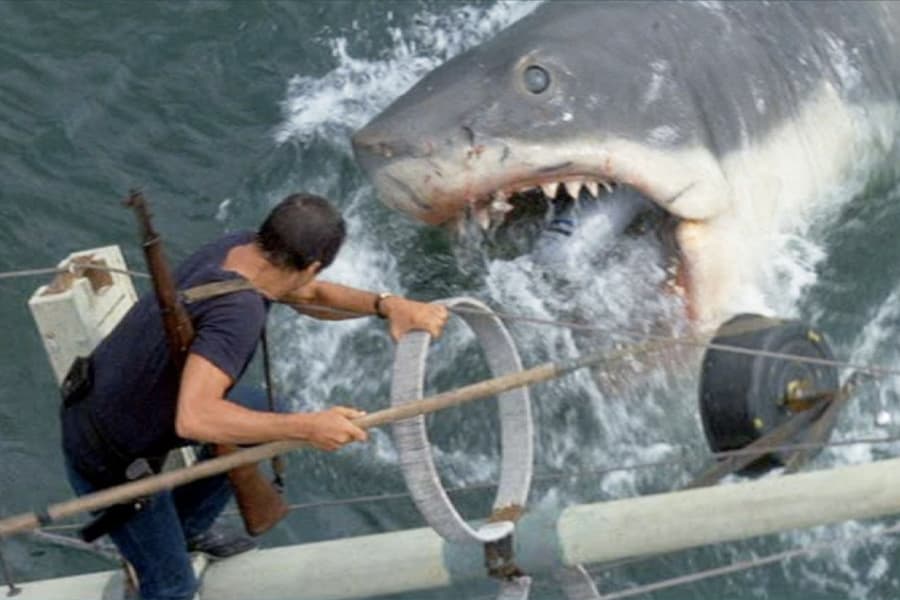
Sharks: about eight deaths a year
The International Shark Attack File confirmed 65 unprovoked bites worldwide in 2025 and nine deaths, against an average of eight unprovoked fatalities a year over 2020 to 2024. Eight deaths a year is roughly one for every billion people alive. Australia takes a disproportionate share of the fatal ones, at a little over half the global total in 2025, largely white shark encounters with surfers.
Do moose really kill more people than sharks?
This is the line from the original comparison that gets quoted most often, and it is the hardest one to pin down, because no agency anywhere publishes a global moose death toll.
Here is what is actually documented. Sweden’s Nationella Viltolycksrådet, the national wildlife accident council, logged 6,771 moose collisions in 2024, part of 77,003 wildlife collisions across all species. Moose are the single most dangerous animal to hit in a car, and the reason is geometry rather than temperament: the body sits above bonnet height, so the legs give way on impact and roughly half a tonne of animal comes through the windscreen at head height. In the United States, the Insurance Institute for Highway Safety counted 210 deaths from collisions with animals of all species in 2024, up from 89 in 1975.
Moose attacks, as distinct from collisions, are a different matter. They are reasonably common in Alaska and very rarely fatal. The Alaska Department of Fish and Game describes moose as not normally aggressive but dangerous if provoked, and points to vehicle collisions as the main hazard.
So the honest answer is that moose almost certainly do kill more people than sharks, once you add up Sweden, Norway, Finland, Canada and the northern United States. But it rests on collision statistics rather than on any published global count, and anyone quoting you a precise worldwide moose figure is quoting an estimate.
Cows, and the numbers that travel further than their sources
The line that cows kill around 20 people a year does the rounds constantly. It comes from a CDC review of American occupational deaths, which found 108 cattle-related deaths across 2003 to 2007, or about 22 a year. Most victims were farm workers over 60, and most died of blunt force trauma while working with cattle in enclosed spaces.
It is a United States farm-safety figure, not a global one, so dividing it by the world’s population produces a number that means nothing. The same caution applies to the very small counts that circulate for spiders, ants and bees: no agency collects them globally, and the totals you see quoted are extrapolations.
The tsetse fly is no longer on this list
One entry from the original comparison is now badly out of date and worth correcting outright. African sleeping sickness, carried by the tsetse fly, once killed in the tens of thousands and is still widely quoted at around 10,000 deaths a year. Sustained control has cut new cases by about 97 per cent over twenty years, and the WHO has recorded fewer than 1,000 reported cases annually since 2018. It is now a candidate for elimination rather than a leading killer, and it is one of the genuine public health wins of the past two decades.
The takeaway
Risk and fear come apart almost completely here. The things that kill people at scale are small, common and largely a function of where you were born: a mosquito, an untreated dog bite, a snake and no antivenom within reach. The animals that carry the horror films account for a handful of deaths a year between them. If you want to worry about something in the water, worry about the drive there.
Watch: world’s deadliest animals (YouTube)
Correction, 24 August 2026: an earlier version of this article described its ratios as a share of all deaths, for example “one in every 154,000 deaths”. They are a share of the living world population, not of annual deaths, and they have been relabelled and recalculated against a current population of about 8.2 billion. Several figures carried over from the source video, including those for snakes, dogs, sharks and the tsetse fly, were out of date and have been re-anchored to the World Health Organization, the UN Office on Drugs and Crime, the International Shark Attack File, the CDC and the Insurance Institute for Highway Safety. Our thanks to the reader who wrote in and flagged it.
























Comments
We love hearing from you. or to leave a comment.