

Updated:
Readtime: 9 min
Every product is carefully selected by our editors and experts. If you buy from a link, we may earn a commission. Learn more. For more information on how we test products, click here.
- Powered by an 838 HP (625 kW) 5.2-litre twin-turbo V12 engine.
- Claims title as the most powerful front-engined Aston Martin in history.
- Features a coach-built carbon-fibre body, saving up to 110 kg.
- Debuts a bespoke 3D-printed quad titanium exhaust system.
- Production strictly limited to 150 examples worldwide, priced from USD$2 million.
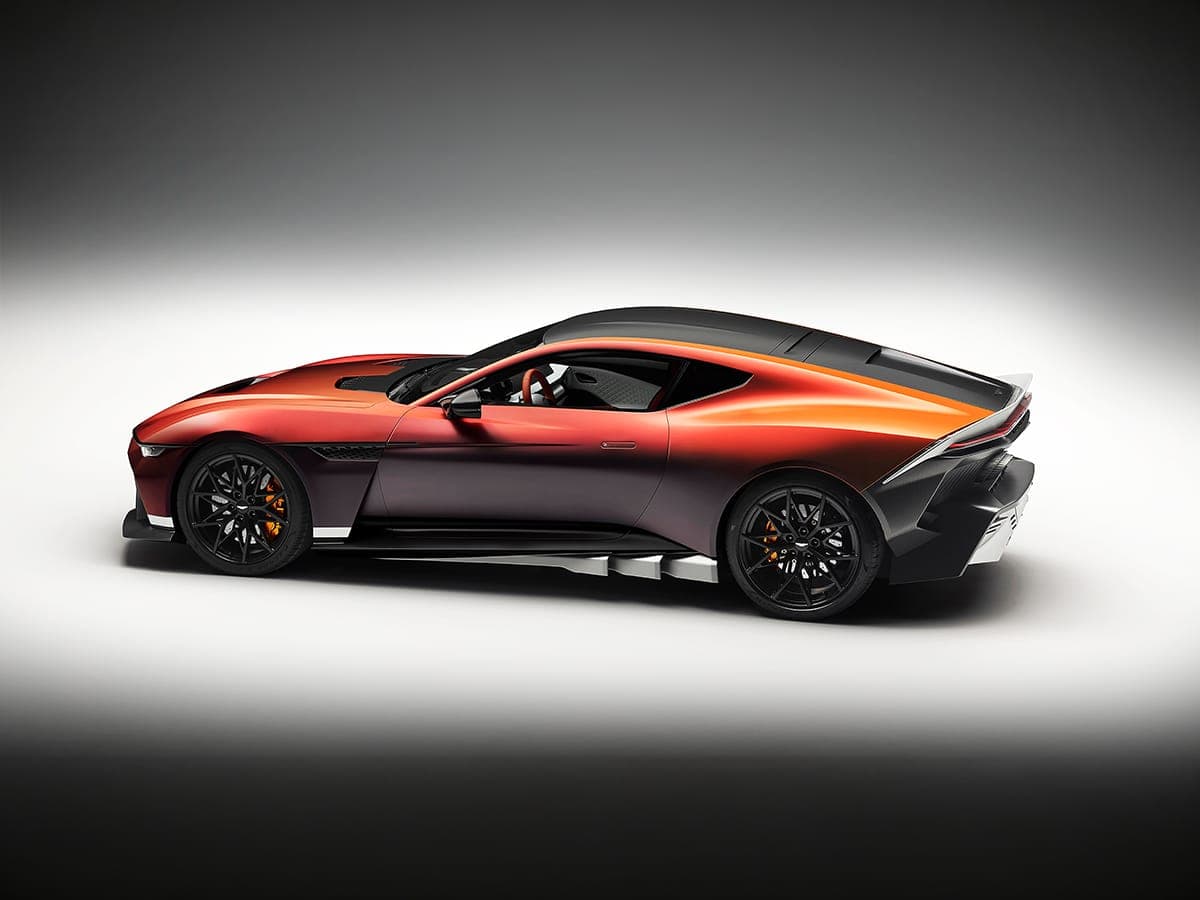
Unveiled at Monterey Car Week, the all-new Aston Martin Valen (from USD$2 million) arrives as not only the British marque’s most powerful front-engined supercar to date, but the most powerful front-engined production car ever made. Created by the brand’s bespoke Q by Aston Martin division alongside the newly formed Special Vehicle Operations (SVO) department, the Valen serves as the capstone to Aston’s twelve-cylinder lineage. Derived from the Latin valens, meaning “strong” or “powerful,” the coupe pairs a coach-built carbon-fibre body with race-derived hardware.
Strictly limited to 150 units total, the special series follows in the footsteps of ultra-exclusive creations like the Valour, Valiant, and DBR22. Reflecting on the launch, Aston Martin CEO Adrian Hallmark noted that the car’s output required an equally aggressive visual presence, stating, “With more power, less weight, and a spectacular soundtrack, the dramatic design is backed up by equally dramatic performance.”
Underneath the long, long carbon-fibre bonnet, an upgraded 5.2-litre twin-turbocharged V12 sends 838 hp (625 kW) and 1,000 Nm (738 lb-ft) of torque exclusively to the rear wheels. However, they’ve done more than just turn up the boost, as the Valen has undergone a comprehensive weight-saving diet of up to 110 kg (243 lbs), allowing it to sprint from 0-60 mph (0-96 km/h) in 3.0 seconds (0-100 km/h in 3.1 seconds) before reaching an electronically limited top speed of 214 mph (345 km/h).
| Specification | |
| Engine | 5.2-Litre Twin-Turbocharged V12 |
| Power Output | 838 hp (625 kW / 850 PS) @ 6,500 rpm |
| Peak Torque | 1,000 Nm (738 lb-ft) @ 2,500–5,000 rpm |
| 0–100 km/h (0–62 mph) | 3.1 seconds |
| 0–96 km/h (0–60 mph) | 3.0 seconds |
| Top Speed | 214 mph (345 km/h) (Electronically Limited) |
| Transmission | Rear-Mounted 8-Speed ZF Automatic |
| Drivetrain | Rear-Wheel Drive with Electronic LSD |
| Weight Reduction | Up to 110 kg (243 lbs) lighter than standard |
| Brakes | Carbon Ceramic Discs (F: 410 mm / R: 360 mm) |
How the Valen Outpowers Historical Aston Martin Flagships
By generating 838 hp (625 kW / 850 PS) and 1,000 Nm of torque, the Valen surpasses every flagship front-engined road car that came before it.
Even when stacked against the 2015 Vulcan, a track-only hypercar built on a dedicated race chassis, the road-legal Valen holds an 18 HP (19 PS) advantage. Compared to the 2009 One-77, which debuted as the brand’s original modern front-engined V12 supercar, the Valen delivers an additional 88 HP (90 PS) and an extra 250 Nm of torque. It even outpaces the final 2022 V12 Vantage by 148 HP (150 PS), establishing it as the clear benchmark for the manufacturer’s front-mid-engine layout.
| Model | Engine Architecture | Power Output |
| Aston Martin Valen (2026) | 5.2-Litre Twin-Turbo V12 | 838 hp (850 PS / 625 kW) |
| Aston Martin Vulcan (2015) | 7.0-Litre Naturally Aspirated V12 | 820 hp (831 PS / 611 kW) |
| Aston Martin One-77 (2009) | 7.3-Litre Naturally Aspirated V12 | 750 hp (760 PS / 559 kW) |
| Aston Martin V12 Vantage (2022) | 5.2-Litre Twin-Turbo V12 | 690 hp (700 PS / 515 kW) |
 1/9
1/9Motorsport Grade V12 Calibration and Weight Reduction
Reinforcing its position at the top of the lineup, the Valen’s 5.2-litre twin-turbo V12 is paired with a recalibrated eight-speed ZF automatic transmission. The gearbox utilises shift strategies developed directly for Aston Martin’s Vantage GT4 motorsport program, delivering sharper gear changes across Sport, Sport+, and Track driving modes. Throttle mapping is also drive-mode-specific, shortening pedal travel in road modes while extending travel in Track mode for precision when left-foot braking.
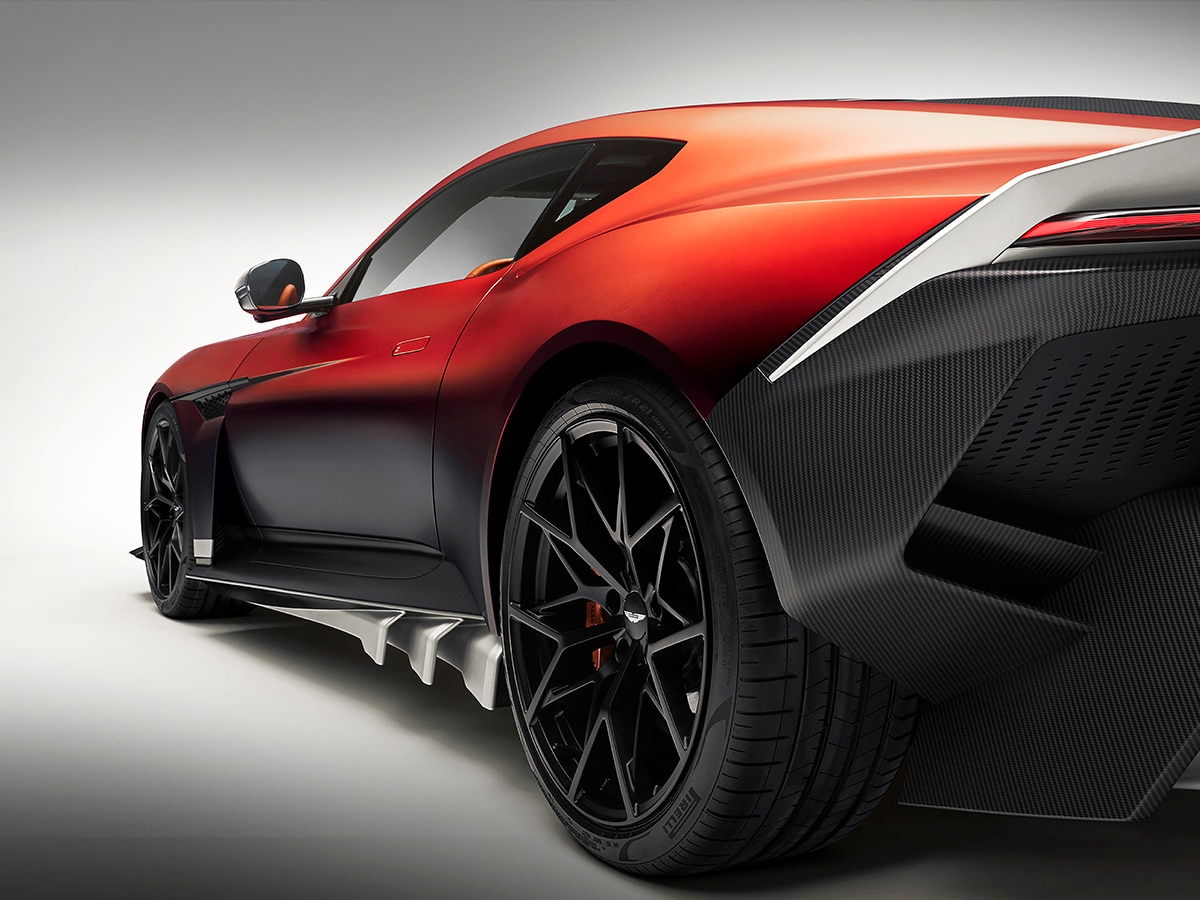
To translate that 838 HP (625 kW) output to the tarmac, the Valen rides on bespoke 21-inch magnesium wheels wrapped in Aston Martin-tuned Pirelli P Zero R tyres (275/35 ZR21 front, 325/30 ZR21 rear). It also incorporates Pirelli’s Cyber Tyre technology, using integrated sensors co-developed with Bosch Engineering to transmit real-time tyre temperature and pressure data directly to the ESP, ABS, and traction control units.
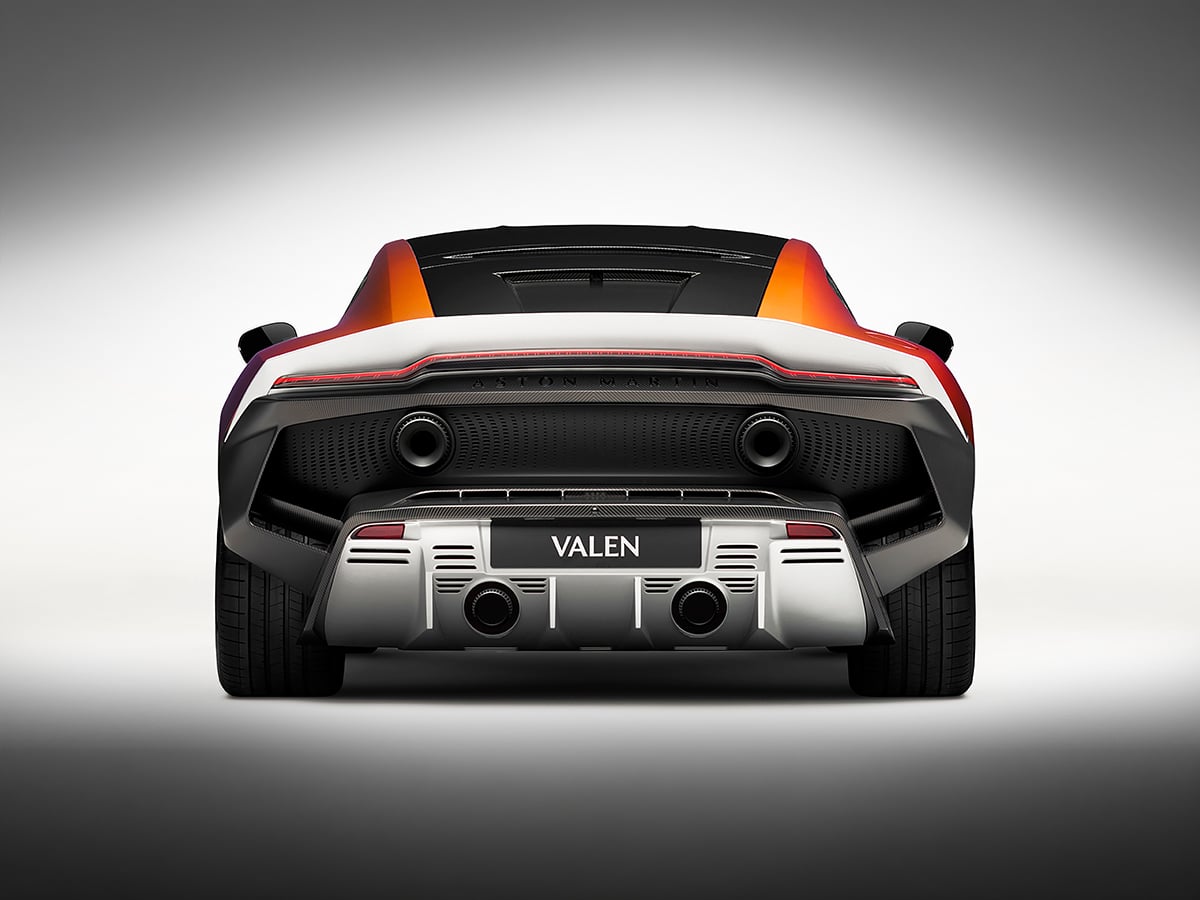
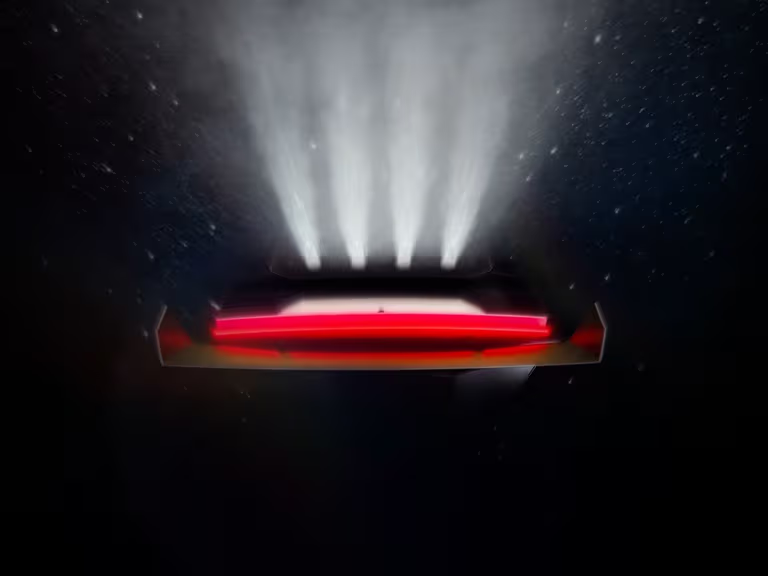
One of our favourite elements is a bespoke quad-exhaust system featuring 3D-printed titanium tailpipe finishers. Split into two upper and two lower outlets, the upper pipes remain permanently open and are acoustic-tuned like organ pipes to resonate at high revs, while the lower outlets feature active valves that open according to the selected drive mode. According to Alex Long, managing director of SVO Aston Martin Lagonda, the Valen is “50 per cent louder than the Vanquish.”
To cut the weight, carbon fibre bodywork, a bonded aluminium structure, standard magnesium wheels, and a titanium exhaust system deliver big savings. Meanwhile, the optional Lightweight Pack shaves an additional 16.9 kg (37.3 lbs) by replacing chassis hardware with machined-from-solid aluminium suspension arms, knuckles, and titanium bolts.
Simon Newton, Director of Vehicle Performance, explained that tuning the platform was focused on dynamic focus, noting that “everything we’ve done to the powertrain and chassis has been driven by the same objective, to intensify the character and capability to deliver a truly thrilling experience that’s accessible to all skill levels.”
 1/6
1/6Coachbuilt Carbon Bodywork and Aggressive Aerodynamics
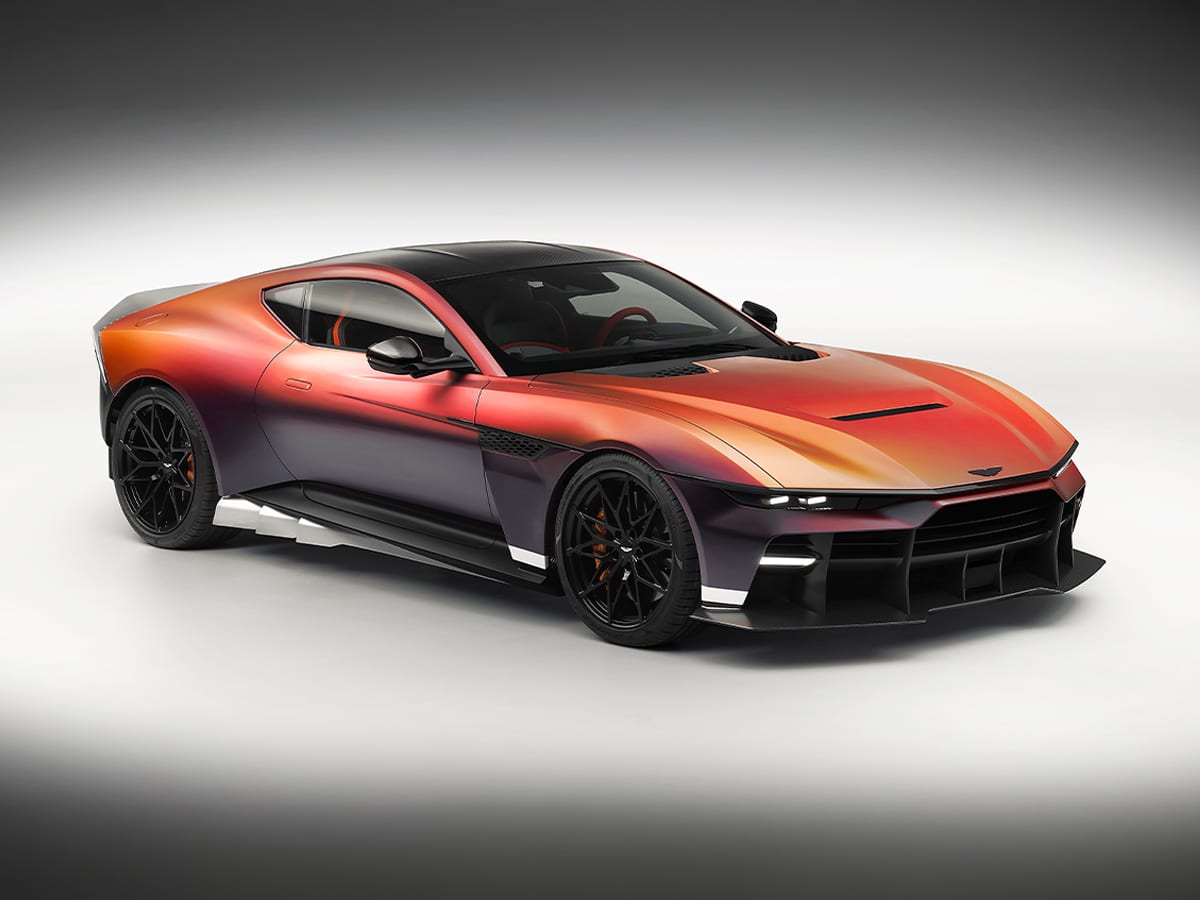
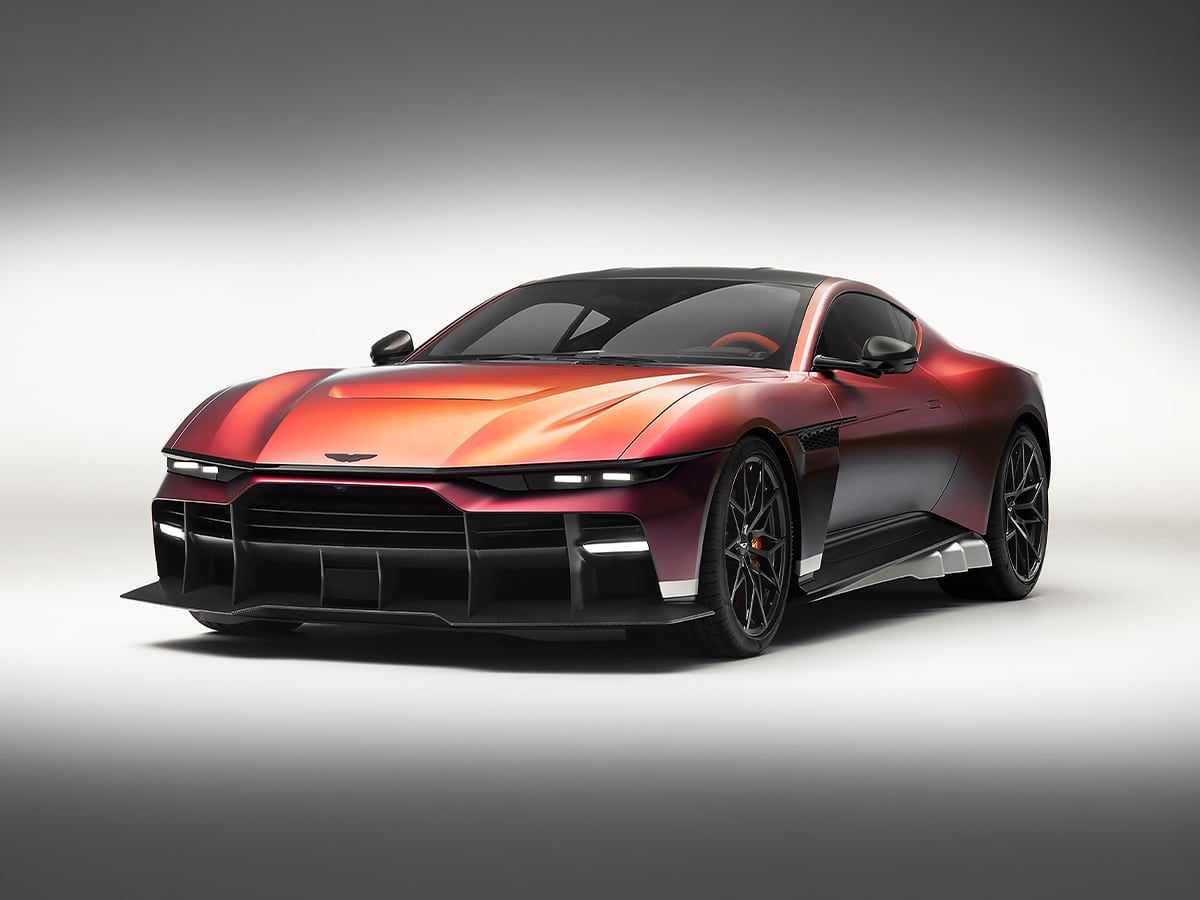
Visually, the Valen introduces an impressive reinterpretation of Aston Martin’s classic front-mid-engined proportions. It gives us Valour vibes, but is clad entirely in coachbuilt carbon fibre. The front end is defined by deeply recessed slimline headlamp units sheltered beneath a sharp, plunging bonnet line. Meanwhile, a single top bonnet vent extracts heat, while elongated side strakes draw high-pressure air directly out of the front wheel arches. Down the flanks, stepped side sills feature saw-tooth vortex generators designed to pull high-speed airflow from beneath the car, reducing front-end lift.
Moving rearward, the traditional glass rear window and boot lid are replaced by a solid carbon-fibre tailgate featuring an integrated aerodynamic wing. Despite the aggressive styling, the tailgate opens to reveal a 170-litre boot designed to accommodate an optional bespoke luggage set for longer GT drives. You’ll also notice the full-width LED light bar spans the tail, acting as a functional Gurney flap to generate downforce without needing a prominent rear wing. Perforated rear mesh panels sit beneath the light bar to evacuate engine bay heat around the high-mounted quad tailpipes.
Discussing the design approach, Marek Reichman, Executive Vice President and Chief Creative Officer, stated that “Valen gave us the opportunity to explore and express more extreme emotions through a new form language and surface treatment… a provocative front-engined supercar exuding increased potency and sporting intent.”
Buyers can specify the Valen in a Q Ultra-developed Satin Andromeda Red paint finish, which uses Chromaflair pigments to shift from deep red and copper to blue undertones as light changes. Alternatively, an exposed carbon-fibre exterior option features herringbone weave detailing running down the central axis of the car, available in custom-tinted gloss or satin lacquers.
 1/6
1/6Drivers Cockpit and 3D Printed Interior Architecture
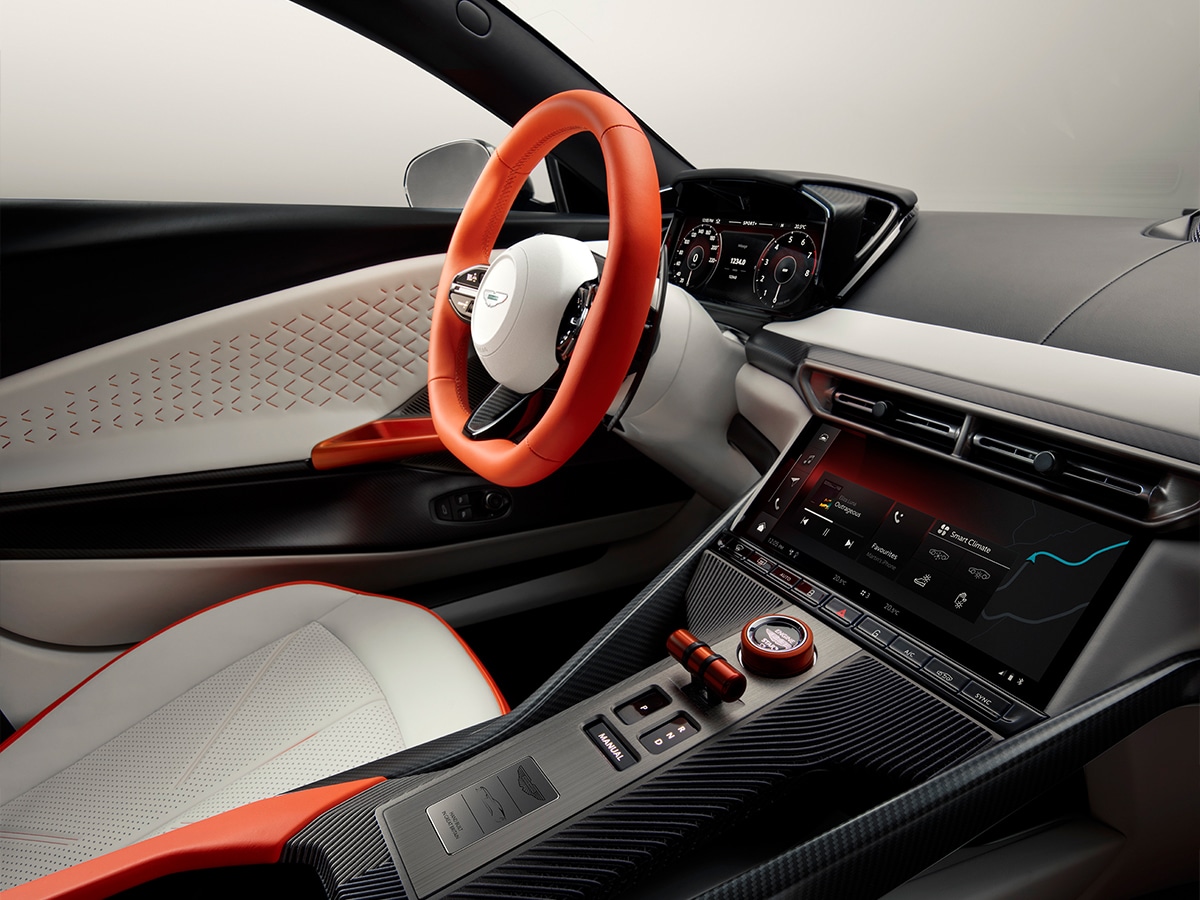
Inside the cabin, the Valen strikes a good balance between a track-focused supercar and a tailored one. The centre console incorporates lightweight 3D-printed components and a driver-angled switchpack derived directly from the Valhalla hypercar. The central touchscreen is angled to integrate cleanly into the pared-back dashboard layout.
Cockpit seating can be configured with supportive Sports Plus seats for grand touring or lightweight carbon-fibre bucket seats. Aston Martin introduced a streamlined material base for the Valen, which allows owners to choose between Semi-Aniline Leather and Alcantara or full Semi-Aniline Leather across five distinct colour splits (Monotone, Duotone, Light Duotone, Tritone, and Driver Focused).
Perforated 3D-printed details are found across the air vents and console trim to mirror the exterior cooling grilles. Customisation options provided by Q by Aston Martin include a palette of anodised interior switchgear colours and contrast accent packs. Essentially, you can have your Valen anyway you like.
Price and Availability
Production of the Aston Martin Valen is strictly capped at 150 units worldwide, with initial customer deliveries set to commence in Q2 2027. While official pricing remains available exclusively upon application, build slots are priced at USD$2,000,000 (approx. $3,000,000 AUD) prior to individual Q by Aston Martin personalisation and local duties.
Prospective buyers can explore build configurations via Aston Martin, linked below.
























Comments
We love hearing from you. or to leave a comment.