


Updated:
Readtime: 6 min
Every product is carefully selected by our editors and experts. If you buy from a link, we may earn a commission. Learn more. For more information on how we test products, click here.
- Piaget says its new Polo Minute Repeater produces 64dB of sound, alongside three harmonic partials and a damping factor of 2,600.
- Its automatic Calibre 1290P measures just 4.8 mm thick, while the 18K white gold case is only 9.3 mm thick.
- Only five numbered examples will be produced each year, with pricing available on request.
Minute repeaters are a flex in and of themselves, but Piaget decided standard flexing wasn’t enough with its new Polo Minute Repeater. With three harmonic partials and a 2,600-damping factor, this watch feels as big a feat in traditional horology as it does in acoustic engineering.
But, in this timepiece, the minute repeater is barely scratching the surface. What’s more impressive is how Piaget managed to squeeze one into its modern Polo collection using the ultra-thin automatic Calibre 1290P, which measures just 4.8 mm thick. And it sits within an equally slender 9.3 mm white-gold case. Very fetching indeed.
Piaget calls the result its “Sound of Excellence”, saying the watch can produce 64 decibels of intensity, three harmonic partials and that aforementioned damping factor of 2,600. For anyone who paid more attention in music class than I did, the hours are struck at G-sharp and the minutes at A-sharp, both in the fifth octave.
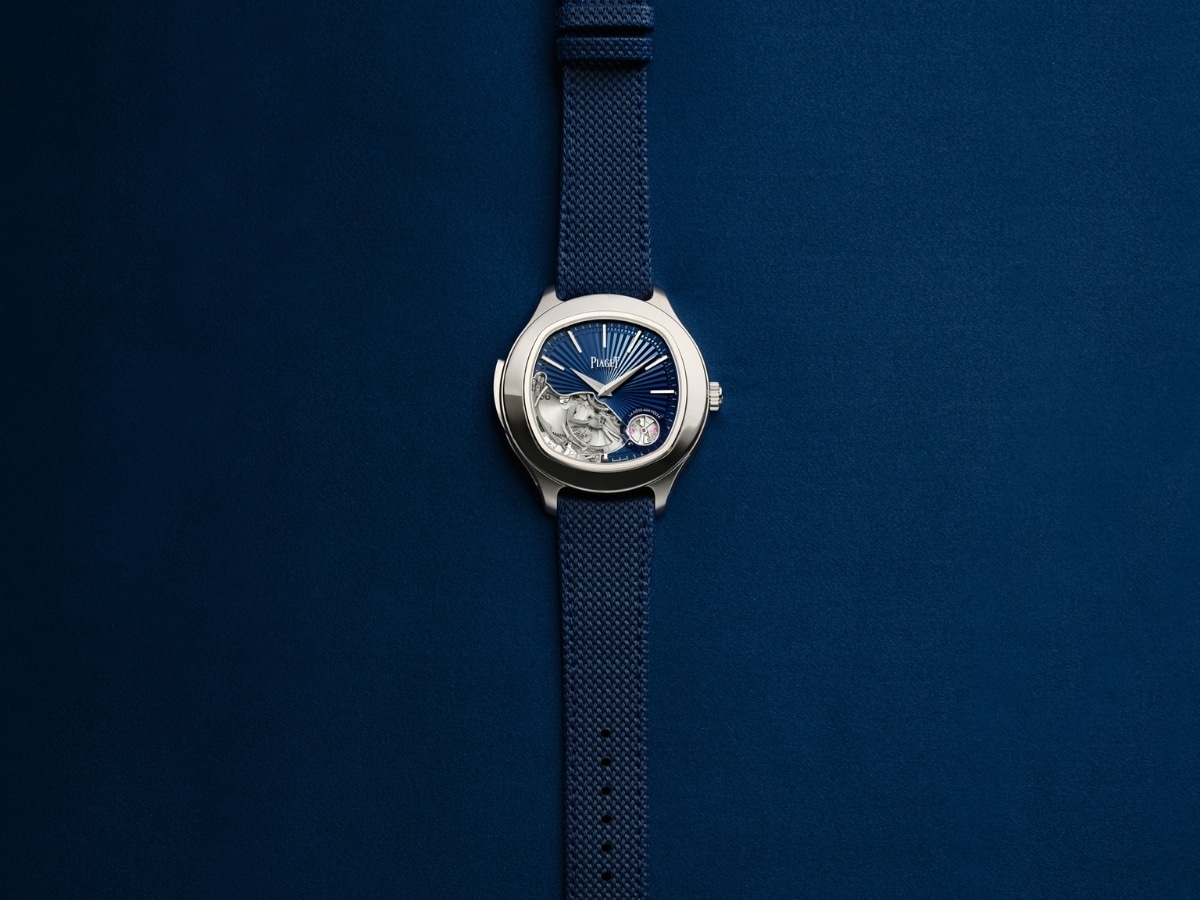 1/6
1/6Piaget Polo Minute Repeater – Key Specs
- Reference: G0A51038
- Case: 18K white gold
- Diameter: 48 mm
- Thickness: 9.3 mm
- Movement: Automatic Piaget Calibre 1290P
- Movement thickness: 4.8 mm
- Power reserve: 40 hours
- Water resistance: 3 bar
- Production: Five numbered pieces per year
- Price: Available on request
What Does Piaget Mean by the ‘Sound of Excellence’?
Piaget’s “Sound of Excellence” comes down to what a minute repeater is ultimately judged by: its voice. Piaget says it worked extensively on both the movement’s mechanics and how the case itself resonates, because the case does more than simply protect what’s inside. It effectively becomes part of the acoustic system, helping transmit the tiny mechanical chimes beyond the movement and out into the world.
Piaget says the chimes’ 64dB delivers volume that’s about the same as a normal conversation. That’s a lot of sound to produce mechanically inside a watch measuring just 9.3 mm thick.
Those three harmonic partials refer to the additional frequencies accompanying the fundamental notes you hear from the watch. Basically, those frequencies are part of what gives each chime its particular tone and character.
As for the damping factor, it relates to how the sound decays after each strike. Piaget quotes a damping factor of 2,600, which the brand says contributes to the chime’s clarity and duration. In other words, Piaget doesn’t just want the note to be loud. It wants it to ring clearly and then fade naturally rather than disappearing almost immediately.
Then there are the pitches. The hours ring at G-sharp and the minutes at A-sharp, both pitched in the fifth octave. The chiming slide sits at nine o’clock and activates downward, a setup Piaget says came from reworking the movement architecture around the complication.
At four o’clock, a smoked blue sapphire ring sits over the inertia wheel, part of a dedicated regulator that controls the pace of the chiming sequence. Yup, even the speed at which the watch tells you the time is mechanically managed.
 1/4
1/4Piaget Had to Fit Everything Into a 9.3 mm Polo
Now, the Calibre 1290P isn’t itself new. Piaget first introduced it in 2013 inside the Emperador Coussin Ultra-Thin Minute Repeater, which at the time was billed as the world’s thinnest self-winding minute repeater.
More than a decade later, the movement still measures about 4.8 mm thick, but Piaget has managed to squeeze it into a Polo case measuring just 9.3 mm. The movement may be tiny, but the watch certainly isn’t. The Piaget Polo Minute Repeater measures a pretty enormous 48 mm across, with an 18-karat white-gold case and partially openworked gold dial.
Then there’s the dial. It’s made from gold and hand-guilloché with Piaget’s soleillé sunray finish, while open sections reveal parts of the repeater mechanism underneath. That already gives you plenty to look at without the regulator sitting underneath the smoked blue sapphire ring at four o’clock.
There’s plenty more watchmaking theatre beyond that, too. Instead of a full-sized rotor sitting over the calibre, Piaget uses a platinum micro-rotor integrated into it. Platinum’s density provides useful winding mass in a smaller package, helping keep the automatic calibre down to just 4.8 mm. Then there are the hand-bevelled bridges and mirror-polished repeater hammers.
Piaget says more than 150 hours went into developing the dial alone, with another 50 hours dedicated to hand finishing each piece. And I thought my days were long. Though, as is often the case with watches of this pedigree, the level of work that went into bringing it to life ultimately determines how many people will actually get one. Piaget says it will produce just five numbered Polo Minute Repeaters per year. That’s not because Piaget decided five sounded suitably exclusive. The brand says it’s simply a consequence of how much work goes into producing each one.
Related reads


























Comments
We love hearing from you. or to leave a comment.