
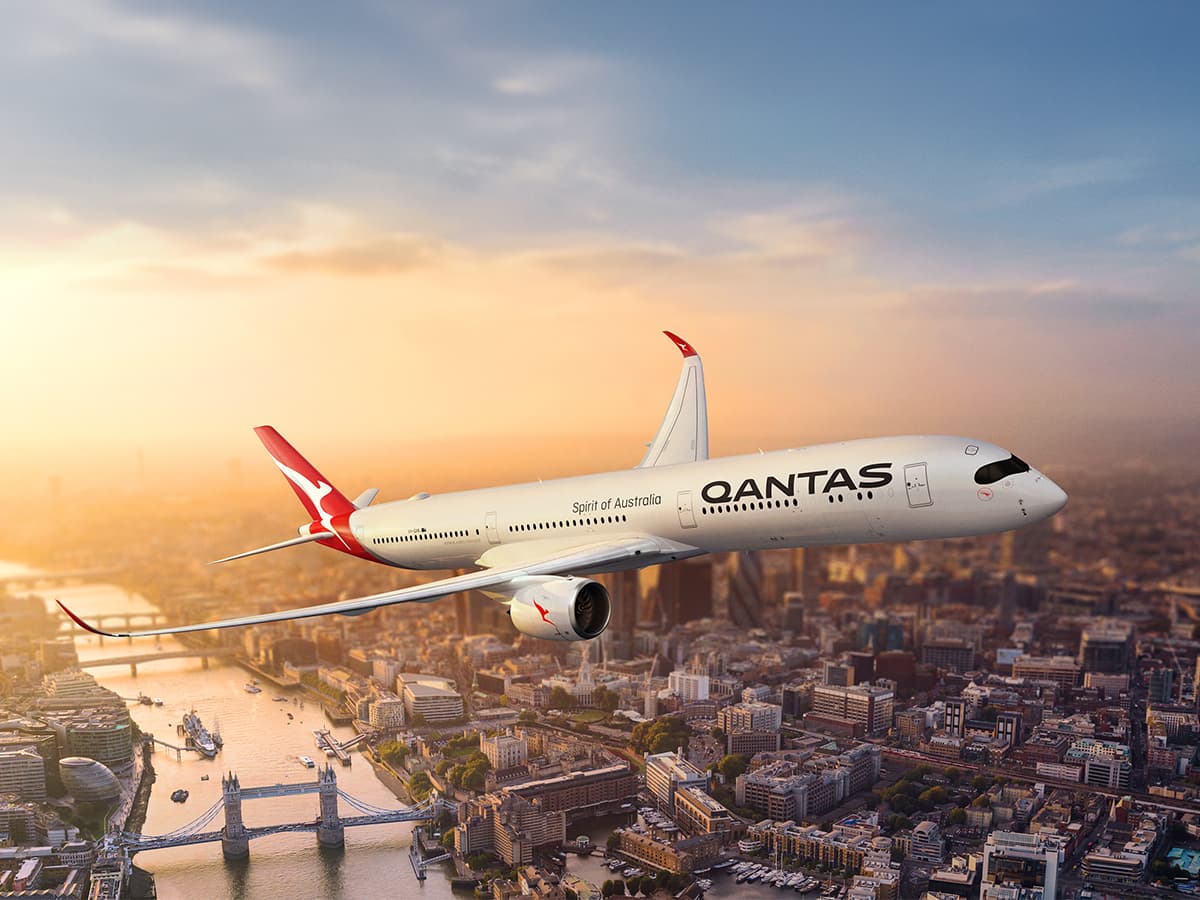
Inside The Airbus A350: How It’s Making 22-Hour Flights, Like Qantas Project Sunrise, Possible

Updated:
Readtime: 9 min
Every product is carefully selected by our editors and experts. If you buy from a link, we may earn a commission. Learn more. For more information on how we test products, click here.
Dawn has broken somewhere high above the Indian Ocean. The flight map tells the story: 19 hours airborne, just a couple more to go. Oddly, your eyes aren’t bloodshot, your throat isn’t parched, and that pressure headache never turned up. Somehow, after nearly an entire day at 38,000 feet, you feel unexpectedly… human. And, without having made a single stop, you’re suddenly quite close to the other side of the world.
Ultra-long-haul travel without stopping was once a pipedream. Now, we’re on its doorstep.
Making it possible has required decades of engineering aimed at a deceptively simple proposition: how do you make the longest commercial flights on Earth not only viable, but genuinely appealing for the people on board?
At the heart of the solution is the Airbus A350, whose extensive use of composite materials and advanced technology has helped redefine what a long-haul aircraft can do.
The Final Frontier of Aviation?
For decades, long-haul travel, particularly from Australia to pretty much anywhere beyond the region, came with an unavoidable compromise: the stopover. That meant stretching your legs for a few hours somewhere in Asia, before the rise of Middle Eastern hubs transformed the global aviation map.
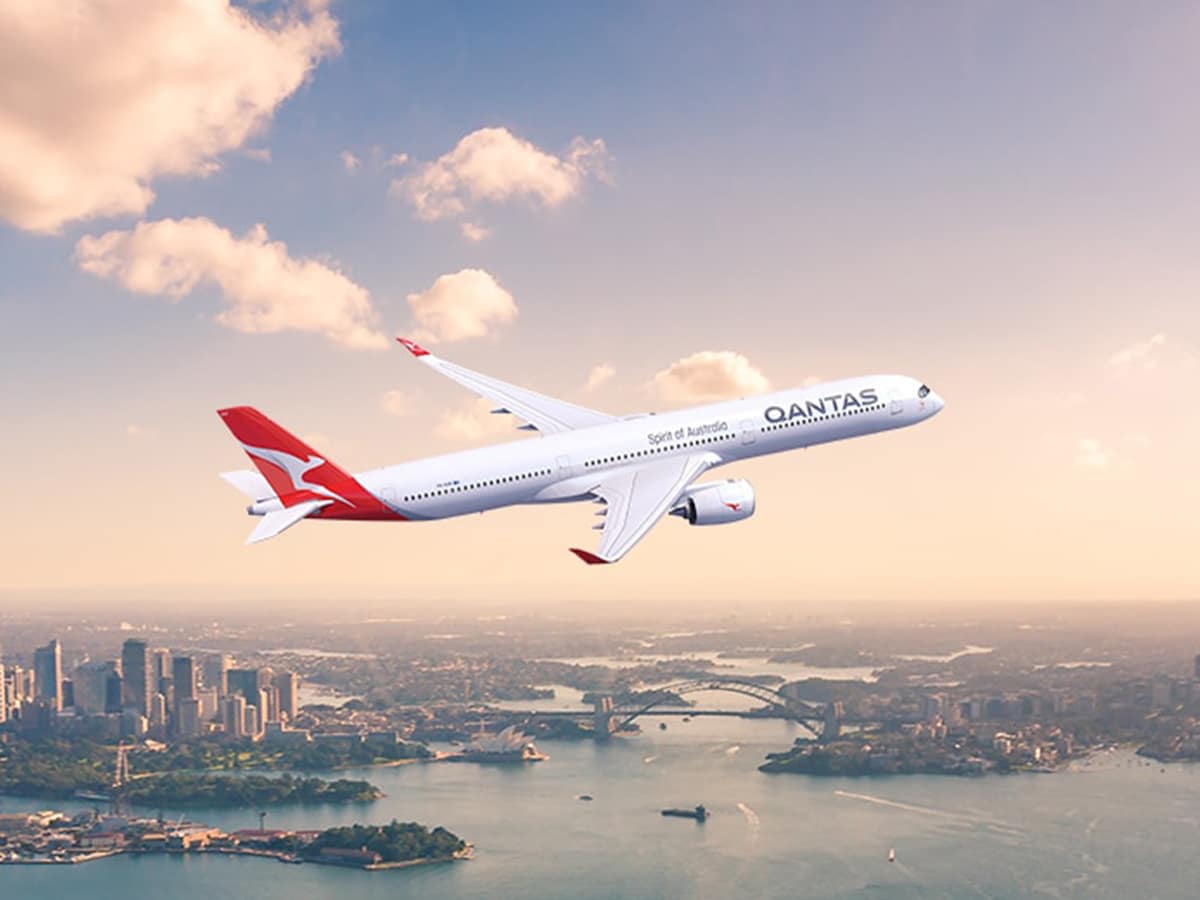
In recent years, a new era of ultra-long-haul travel has begun to emerge. Singapore Airlines has already pushed the boundaries with non-stop routes between Singapore and New York, while Qantas is preparing for the next leap with Project Sunrise: direct flights connecting Australia with destinations including London and New York. In 2027, flights lasting 18 to 22 hours will no longer be a novelty exercise, but a repeatable reality.
Extending an aircraft’s range is only one piece of that reality: the challenge isn’t simply to carry enough fuel to cross an ocean, but to carry enough passengers, comfortably enough, for airlines to make the economics work. Ultra-long-haul travel required engineers to solve two very big problems at once: how to make the aircraft fly further, and how to make the human experience genuinely comfortable rather than a feat of endurance.

Why the A350 Changed Everything
The Boeing 747 reigned as queen of the skies for almost four decades. Built primarily from aluminium and powered by four engines, it defined the golden age of long-haul aviation. But as fuel prices rose and airlines demanded greater efficiency, the economics of moving hundreds of passengers across the globe began to change.
The first major shift came with Boeing’s 787 Dreamliner, which demonstrated what extensive carbon-fibre composite construction could do at commercial scale. The Airbus A350 arrived soon after, taking a similar philosophy and combining it with a larger airframe and a new generation of engines.
With 53 per cent of its airframe made from composite materials, the A350 combined lighter construction with advanced aerodynamics, extraordinary range, and Rolls-Royce Trent XWB engines designed specifically for the aircraft. Its fuel burn per seat is around 25 per cent lower than that of previous-generation wide-body aircraft, helping to make ultra-long-haul routes economically viable.
The benefits weren’t confined to the cockpit or the balance sheet. Composite construction also allowed engineers to rethink the cabin environment, creating new possibilities for the passenger experience.
Engineering for the Human Body
It’s all well and good to have a vessel that can transport 250 people from the antipodes to the Old World in a single dash. But if the experience is too strenuous or intense, it won’t bode well for returning clientele.
Long-haul travel is challenging enough even with a layover. 20 hours or more without touching down puts the body and mind under serious strain: dehydration, dry air, disrupted sleep, noise, restricted movement. No one wants to step off at Heathrow feeling like they’ve gone ten rounds in a ring.
This is where the A350’s engineering becomes particularly interesting. The composite fuselage doesn’t just help the aircraft fly further: it allows engineers to create a cabin environment that is far less punishing on the body.
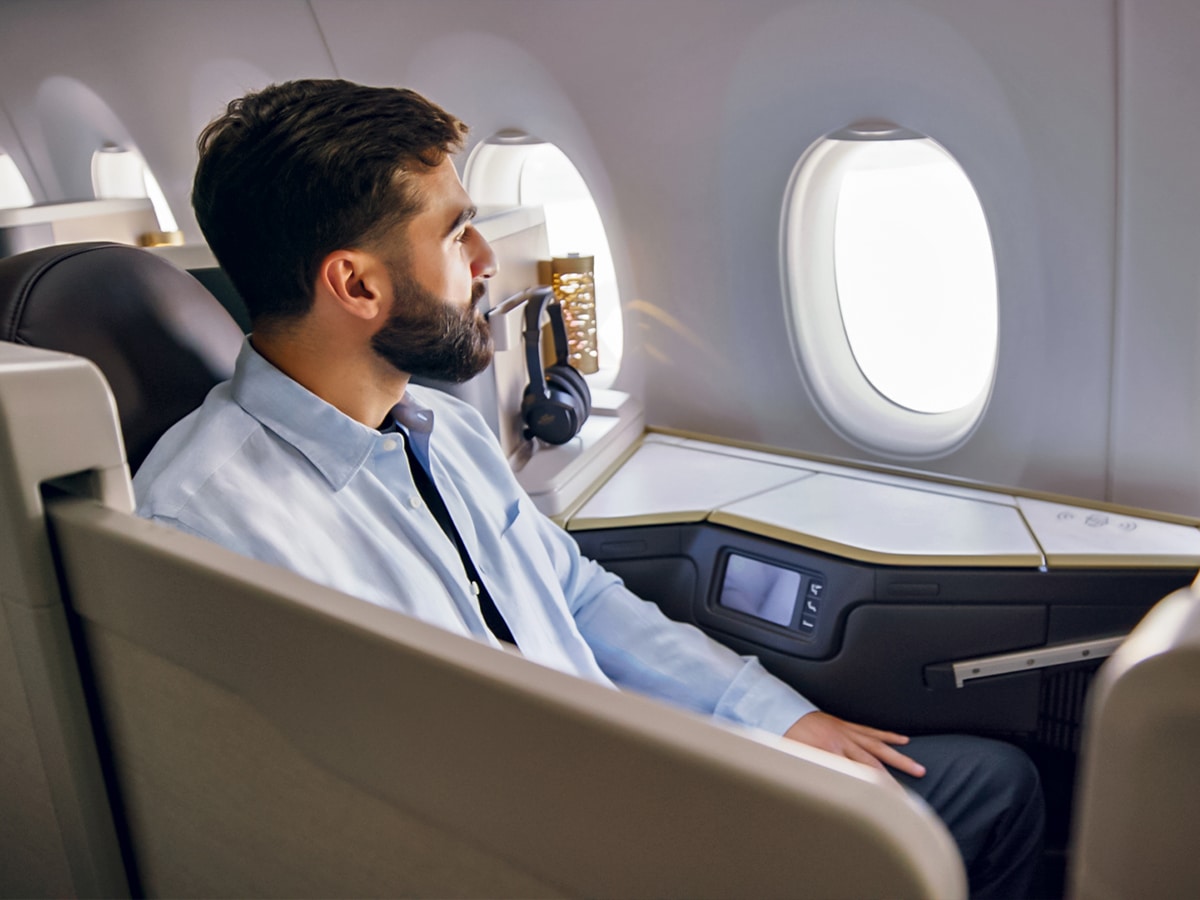
Cabin altitude is one of the biggest differences. The A350’s composite fuselage allows it to maintain a lower cabin altitude: around 6,000 feet compared with the roughly 8,000 feet typical of many older aircraft. That difference may sound modest, but over 18 or 20 hours it adds up. More oxygen available in the cabin makes the journey less of a burden on the body.
The second is humidity. Composite construction reduces some of the corrosion concerns associated with higher humidity, allowing the A350 to maintain slightly higher humidity levels in cruise. The cabin air is still dry, but less punishing than on many older aircraft. For the eyes, skin and airways, the difference matters.
Noise is another big one. The A350’s Trent XWB engines, aerodynamic refinements and extensive acoustic insulation contribute to a much quieter cabin experience – easier sleep, conversation, and a sense of baseline normality.
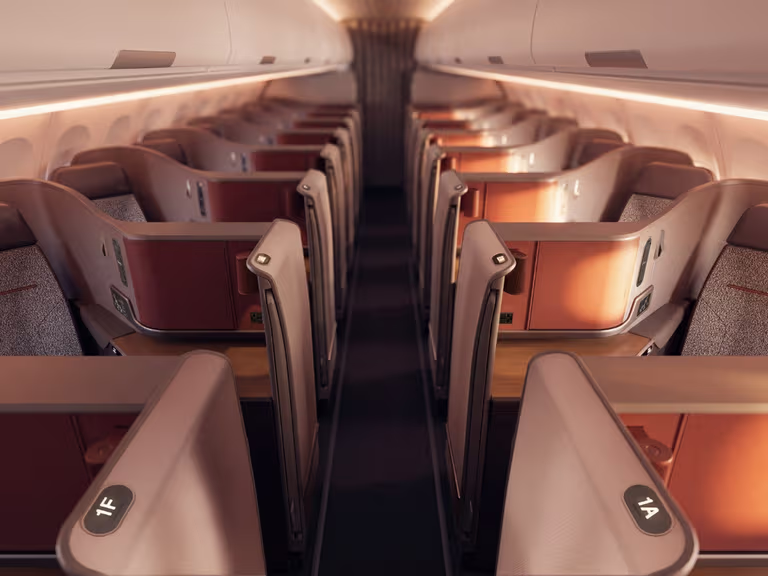
When it comes to space, the A350’s wide-body cabin allows airlines to choose from a range of seating layouts.
The A350’s lighting systems can also be programmed to support different phases of the journey – on an ultra-long-haul, light becomes a lot more than just ambience. As one of the strongest cues governing the body’s circadian rhythm, carefully timed changes in cabin lighting help passengers orient themselves toward the destination’s time zone.
None of these features make a 20-hour flight feel like a wellness retreat. But together, they change the conditions of the game pretty significantly.
The End of the Four-Engine Era
For decades, there was an implied logic to long-haul aviation: to fly a long way, you needed a lot of engines. The Boeing 747 embodied that thinking. Four engines provided the power and backup capability needed to carry hundreds of passengers across oceans, while its enormous range and capacity made it the defining long-haul aircraft of its era.
Then came the Airbus A380, which pushed the same philosophy to its logical conclusion. With four engines and two full-length passenger decks, it embodied a vision of ever-larger aircraft carrying ever-greater numbers of people between major hubs.
Yet just as the A380 was getting bigger, the economics of aviation were moving in the opposite direction.
The crucial development wasn’t simply better engines. It was the growing confidence, among regulators and airlines, that twin-engine aircraft could safely operate longer routes. As modern turbofan engines became more reliable, regulators increasingly allowed twin-engine aircraft to operate routes that had once effectively required four. ETOPS, or Extended Operations, progressively opened the world’s oceans and remote regions to suitably certified twin-engine aircraft.
It was a game changer. A four-engine aircraft doesn’t simply have twice as many engines as a twin: it carries more weight, creates more drag, burns more fuel and requires more maintenance. When two engines can safely perform the same mission, the case for carrying four becomes much harder to justify.
The result was a fundamental shift in long-haul aviation. Instead of concentrating passengers into enormous aircraft flying between a relatively small number of global hubs, airlines could operate smaller, highly efficient twin-engine aircraft directly between more destinations.
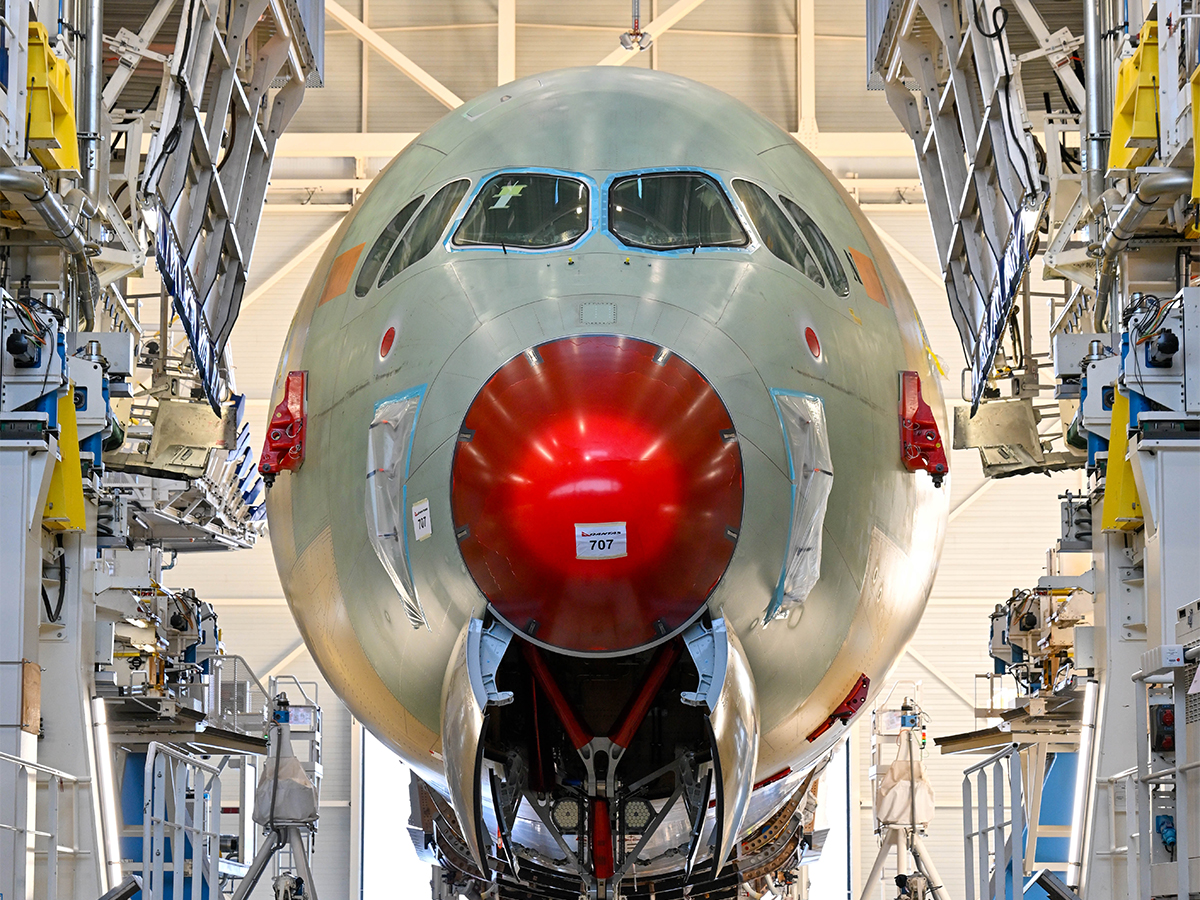
The 787 and A350 arrived at precisely the right moment. Their efficient engines, lighter composite structures, advanced aerodynamics and longer range made it possible to fly routes that would previously have required much larger aircraft, while carrying fewer passengers and burning considerably less fuel per seat.
The 747 didn’t suddenly become a bad aircraft. The A380 didn’t fail because four engines were somehow obsolete overnight. Instead, the industry discovered that it no longer needed four engines to do the jobs that four engines had once been required to perform. And once that happened, the future of long-haul aviation began to look considerably smaller, lighter, and more flexible.
Where Do We Fly From Here?
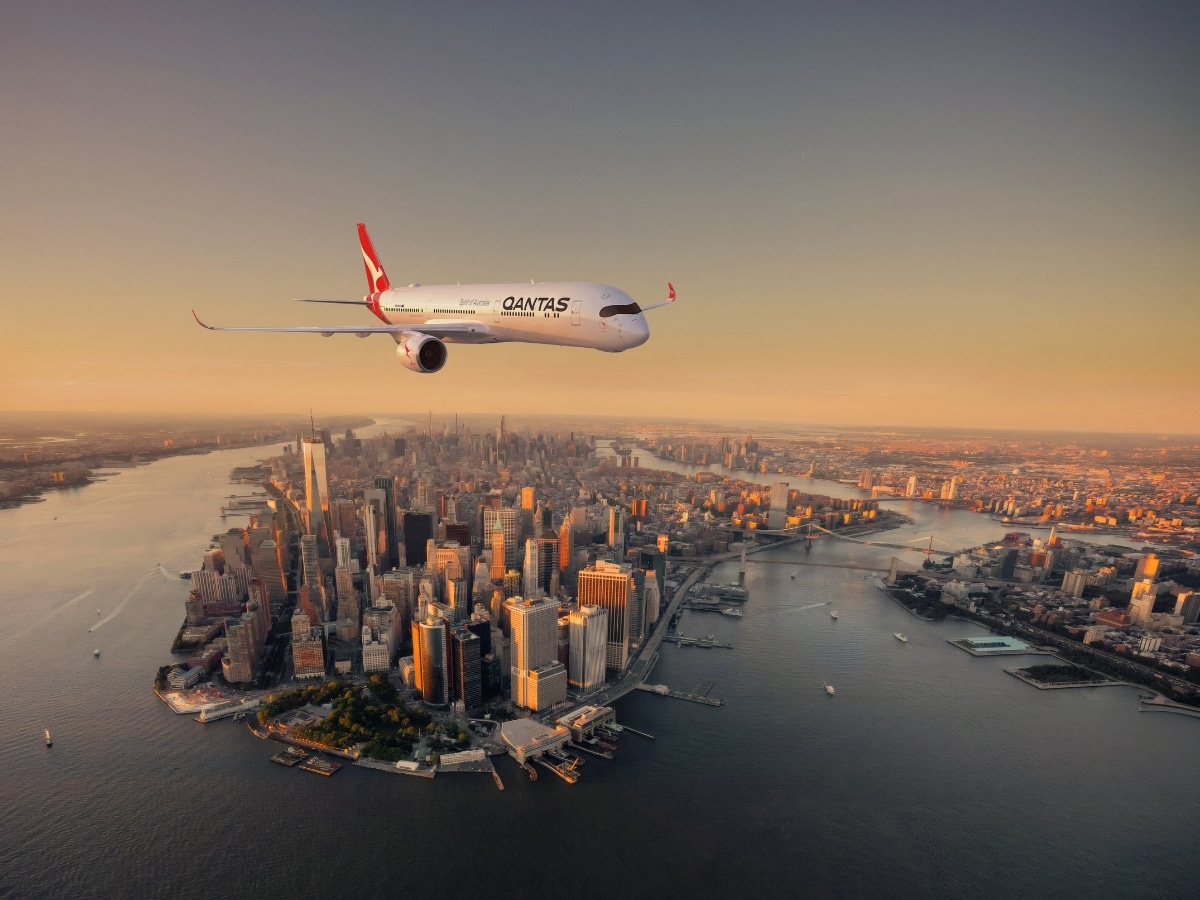
In October 2027, Qantas is scheduled to launch its first ultra-long-haul passenger services as part of the much-anticipated Project Sunrise program. For the first time, passengers will be able to board an Airbus A350-1000ULR in Sydney and remain in the sky until London Heathrow comes into view almost 10,000 nautical miles later.
Project Sunrise represents a significant threshold crossing. Until now, ultra-long-haul has largely been a demonstration of what modern aircraft can achieve. Qantas is about to turn that capability into a regular commercial operation.
The A350-1000ULR has been extensively modified for the demands of the mission. Its most obvious change is fuel capacity: a permanently installed 20,000-litre rear centre fuel tank pushes total usable fuel capacity past 175,000 litres, giving the aircraft the extra endurance required.
The fuel comes with a weight penalty, so the aircraft has also been structurally reinforced to accommodate a higher maximum take-off weight. The fuel distribution system has been modified, while other systems, including the galley cooling architecture, have been adapted for the unique demands of the journey. The 747 once expanded the possibilities of long-haul travel by making enormous passenger loads and intercontinental distances commercially viable. The A350 represents a different kind of breakthrough: an aircraft light and efficient enough to make extreme distances far less of a constraint.
Sydney to London is not simply another long-haul route. It’s a useful test of where the practical limits of commercial aviation now sit. At more than 19 hours in the air, the journey pushes fuel capacity, engine endurance, crew duty limits, passenger comfort, and airline economics as far as they’ve ever gone.
The future of ultra-long-haul travel may be a continuation of this. It’s not a sudden breakthrough that makes 30-hour flights commonplace, but gains that come piece by piece: more efficient engines, lighter structures, smoother aerodynamics, smarter cabins, and better ways of managing the human body over long periods in the air.



























Comments
We love hearing from you. or to leave a comment.