


Updated:
Readtime: 12 min
Every product is carefully selected by our editors and experts. If you buy from a link, we may earn a commission. Learn more. For more information on how we test products, click here.
There comes a point in every man’s life when he must make some important decisions. Whether to buy property. Whether to have kids. Whether spending $800 on a very nice jacket is an investment or simply spending $800 on a very nice jacket.
And, increasingly, whether he should get his ears pierced.
If you’ve found yourself lingering for far too long on a photo of Jacob Elordi wearing a tiny hoop, or staring at an exceptionally well-accessorised earlobe of a guy at the pub and wondering whether you too could pull it off, we have good news: you can.
Men’s earrings are hardly new, of course, but they’ve well and truly escaped the confines of teenage rebellion, rock stars and that one uncle who came back from Thailand pre-2000s with a single silver hoop, a tiny tattoo, and a new outlook on life.
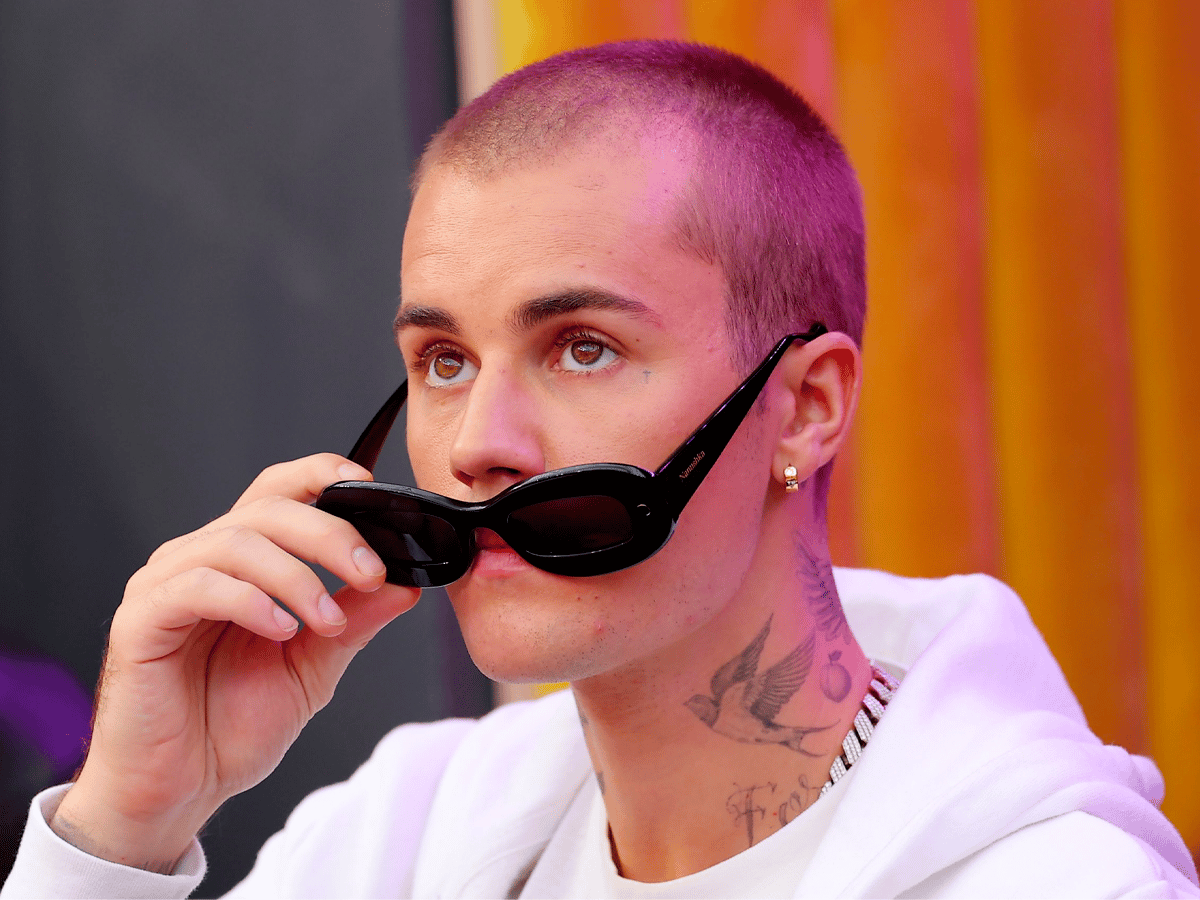
These days, studs, huggies, hoops and full-blown ear stacks are all fair game. In fact, earrings have become something of a celebrity favourite, spotted on the likes of Jacob Elordi, David Beckham, Paul Mescal, Morgan Freeman, Justin Bieber, and Michael B. Jordan, while Harry Styles famously went so far as to pierce his own ear (allegedly) to wear a pearl earring to the 2019 Met Gala. Oh, Harry, the icon that you are.
So now you know it’s entirely possible for men to pull off an earring; you now need to decide what you want pierced. Your lobe? Helix? Tragus? Conch? And do you pierce one ear? Both ears? Multiple piercings on one ear? And does it still mean something if you pierce your right ear?
Ah boy, decisions, decisions. But don’t fret. Before you hand over your lobes to a stranger with a needle, here’s everything the modern man needs to know about getting his ears pierced (and looking bloody good once they are).

When Did Every Guy Start Wearing Earrings?
Men’s earrings aren’t exactly a recent invention. In fact, guys have been decorating their ears for thousands of years.
But in modern men’s style, earrings have changed from something that once felt relatively subcultural to a pretty standard part of men’s jewellery.
A lot of that comes down to the broader loosening of the rules around men’s accessories. Rings are everywhere. Necklaces are everywhere. Bracelets have escaped the leather-braided hell in which they were trapped for much of the early 2000s. And now, men’s earrings are an easy way to add something interesting to an outfit without completely changing your style.
A little silver hoop with a white tee? Great. Gold huggie with a suit? Stunner. Diamond stud with your gym gear? Look, if it’s good enough for professional athletes, it’s good enough for your Wednesday back and bis sesh.

The Celebrity Case for Getting Your Ears Pierced
If you need evidence men’s earrings are undoubtedly cool, just look to Hollywood. Jacob Elordi has made a very convincing case for the close-fitting hoop, as has Paul Mescal, while Michael B. Jordan has long worked earrings into a wardrobe that otherwise leans pretty classic.
Then, of course, there’s Harry Styles. Styles’ single pearl earring at the 2019 Met Gala became one of the defining details of an already fairly memorable outfit: sheer Gucci blouse, high-waisted trousers, heeled boots, rings, tattoos, the works.
We’re not saying you need to copy any of these guys exactly. What we are saying is that there’s no longer one particular men’s earring look. A tiny hoop can be understated. A diamond stud can lean polished. A pearl or drop earring can be the entire outfit.
Your ear is, quite literally, a blank canvas. A very small, fleshy blank canvas, but still.
Which Ear Should a Guy Get Pierced?
Ah yes. The question. If you grew up sometime before the noughties, there’s a decent chance someone at school informed you (with the unwavering confidence of a 13-year-old who had absolutely no idea what he was talking about) that there was a right and wrong ear for a guy to pierce.
More specifically, you might remember being told that piercing your right ear meant you were gay, while the left meant you were straight.
There actually is some history behind the association. A right-ear piercing was used by some gay men as a discreet signal at a time when being openly gay could carry considerably greater social and personal risk. But that supposed code was never universal, and accounts differed between places and communities about which ear meant what. Over time, it became muddled with stereotypes, playground folklore and the increasingly mainstream popularity of men’s earrings.
So, which ear should a guy pierce in current times? Whichever bloody ear you want.
There’s no modern rule that says straight men should pierce one side and gay men another. If you’re only doing one ear, make the decision based on things like which side you prefer aesthetically, your haircut, any other jewellery you wear and the overall look you’re going for.
You could even consider which side you normally sleep on, because remembering you’ve just put a needle through your ear every time you roll over is not exactly conducive to eight hours of quality rest.

To Pierce One Ear… Or to Pierce Both?
Look, you could just save yourself the existential crisis and pierce both. And whether you should or not comes down to the look you want.
A single piercing has a little more attitude to it because the asymmetry is deliberate. However, piercing both lobes gives you more flexibility.
You can wear a matching pair of studs or hoops when you want something balanced, wear jewellery in just one when you don’t, or eventually start adding second and third piercings without having to begin from scratch.
If you’re torn, getting both lobes pierced is probably the more versatile option because it’s not like you’re not legally required to keep an earring in every available hole at all times.
How Many Ear Piercings Should You Get?
How long is a piece of string? How many watches should a man own? How many beers constitute “just popping in for one”?
The point is, there’s no correct number. For someone getting their ears pierced for the first time, one piercing in each lobe is probably the best starting point. It gives you plenty of jewellery options, and once everything has healed, you can decide whether you want more.
A second lobe piercing is commonly the next move. It lets you pair a hoop with a tiny stud or wear two progressively smaller hoops without changing the overall look too much
From there, you can head upwards into helix, tragus, conch and other cartilage piercings if you decide your ears deserve their own jewellery collection.
The trick with multiple piercings is to think about the ear as a whole rather than choosing five earrings independently because you liked each one in the shop.
Just remember to vary the size, and leave a little breathing room. A good piercer will be able to help you decide and place your earrings if you choose to fill up your ear. In terms of the jewellery you choose, you might have a slightly chunkier hoop in your first lobe, a smaller huggie in the second and a tiny stud above that.
Stud vs Hoop vs Huggie Men’s Earrings
Once your piercing has healed and your piercer has given you the all-clear to change the jewellery (because FYI, the earring you get pierced with is always a stud for healing purposes), this is where things get fun.
Stud Earrings
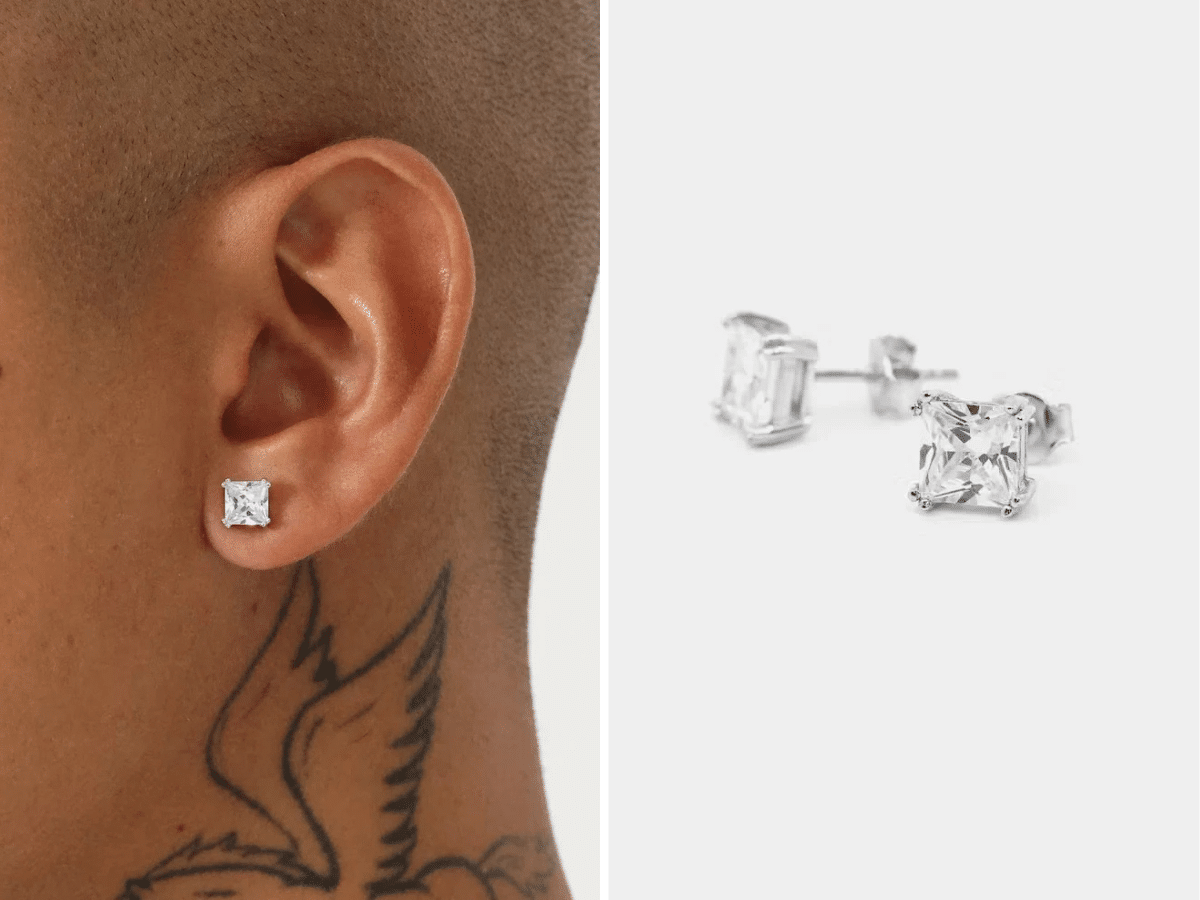
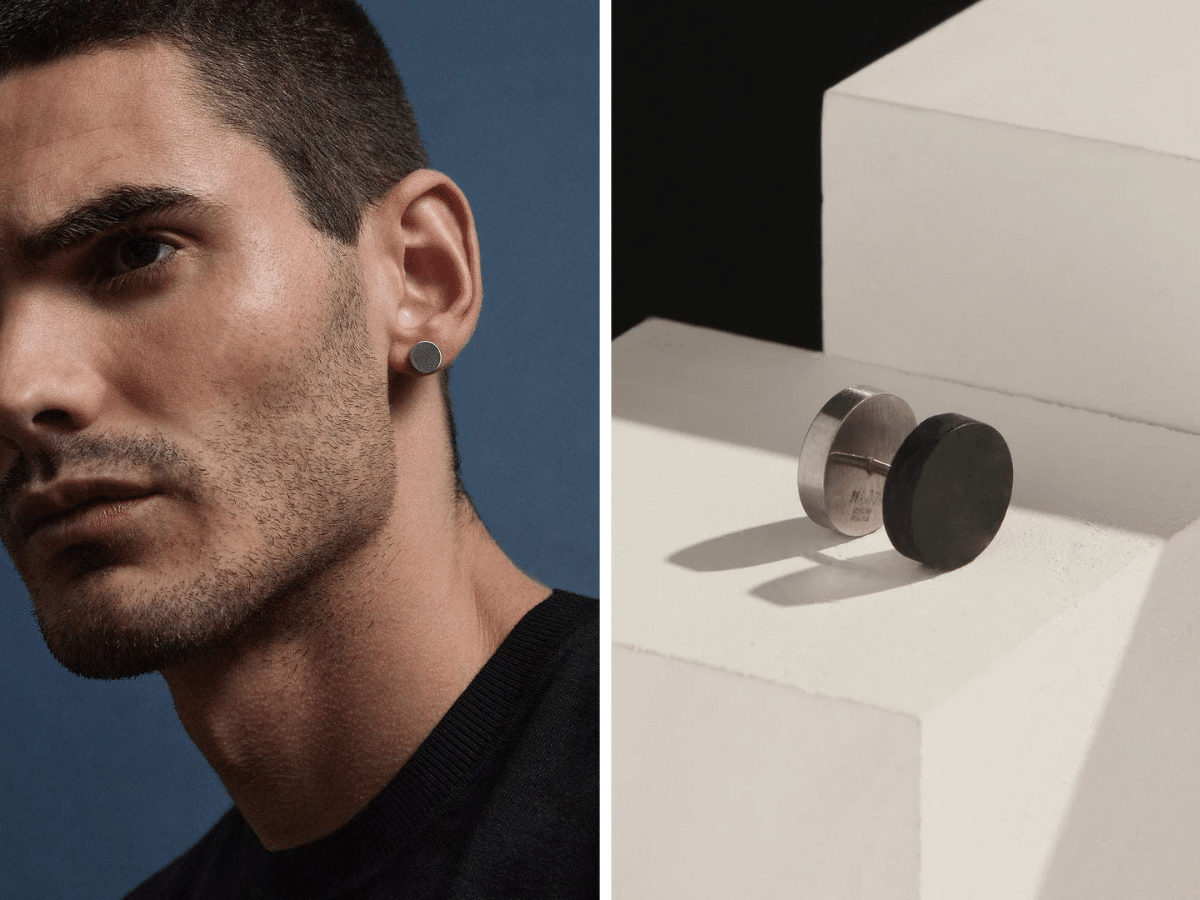
If you’re nervous about suddenly becoming ‘An Earring Guy’, start with a simple stud. Studs sit directly against the ear, so they’re pretty inconspicuous. A tiny silver, gold or black stud is cool enough for people to notice, but the first thing they notice when you walk into a room. They also work particularly well if the rest of your style is fairly classic.
Then there are diamond studs. A small stone can look incredibly cool, and while a big diamond stud can also look sharp, it’s not for wallflowers; you have to wear it and wear it with confidence.
Hoop Earrings
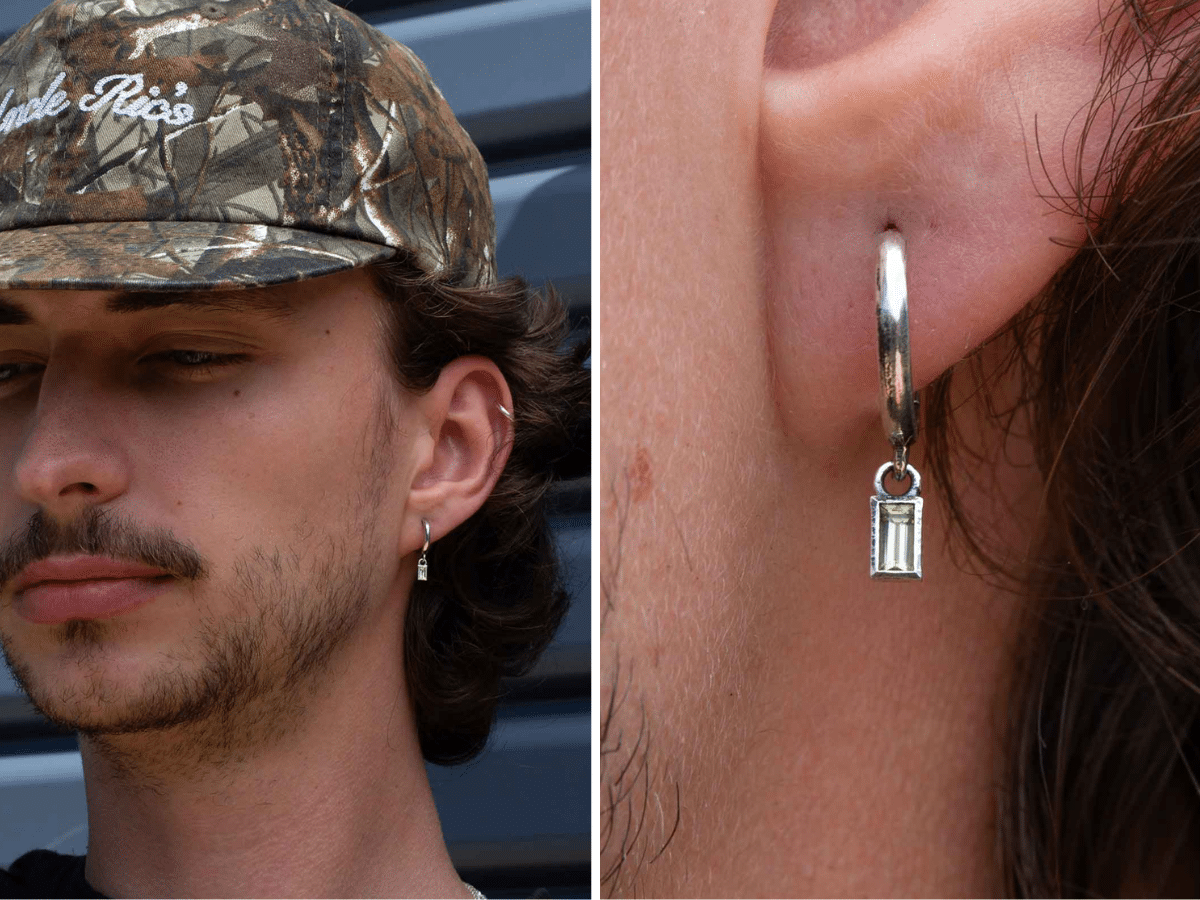
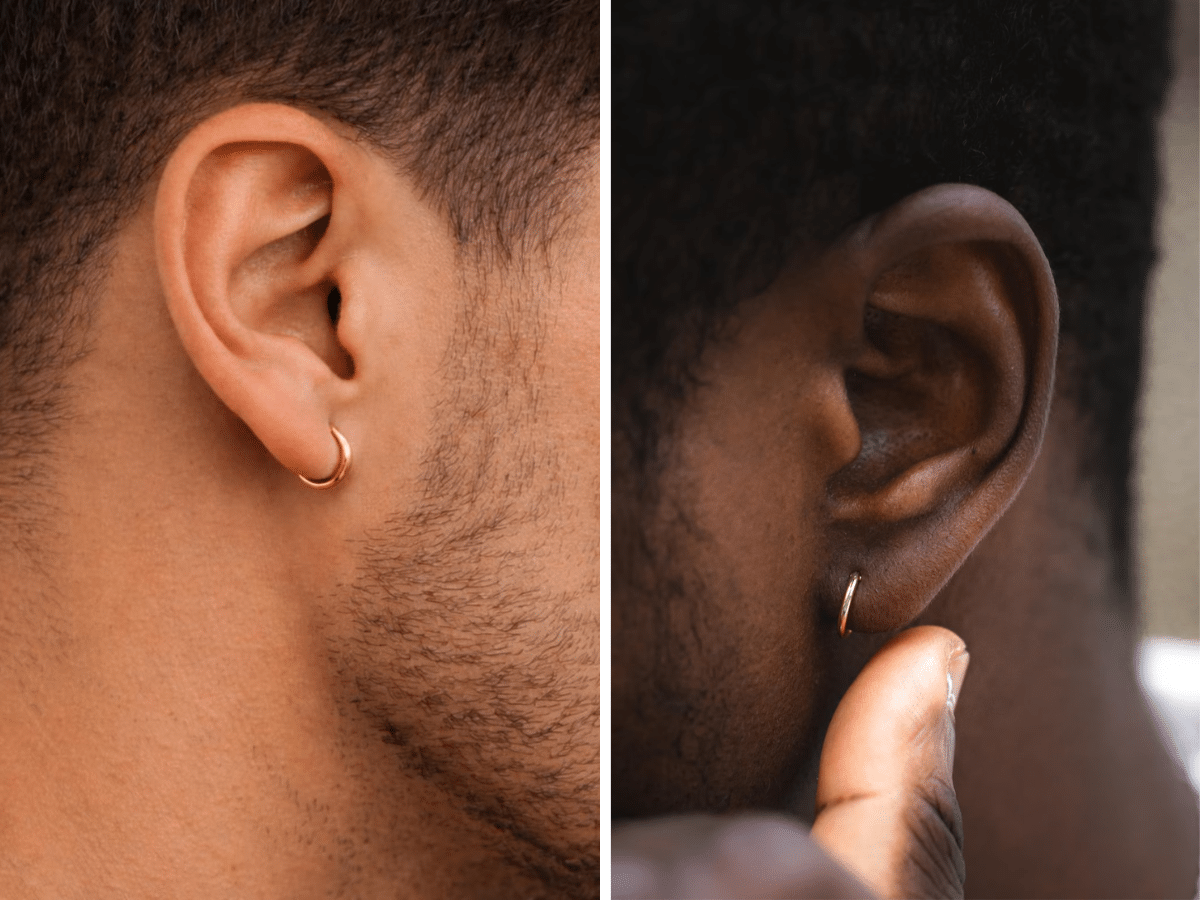
A hoop earring is the next level up. The classic men’s hoop is generally fairly small rather than something that’s going to become entangled in your shirt collar, but even within that category you can play with thickness, diameter, metal and details.
A thin silver hoop is relaxed and easy; a slightly thicker gold hoop has more presence to it, while adding a charm or pendant makes the earring much more of a feature.
There’s a reason the little hoop is everywhere right now: it occupies a very handy middle ground between boring and look at my earring!
Huggie Earrings
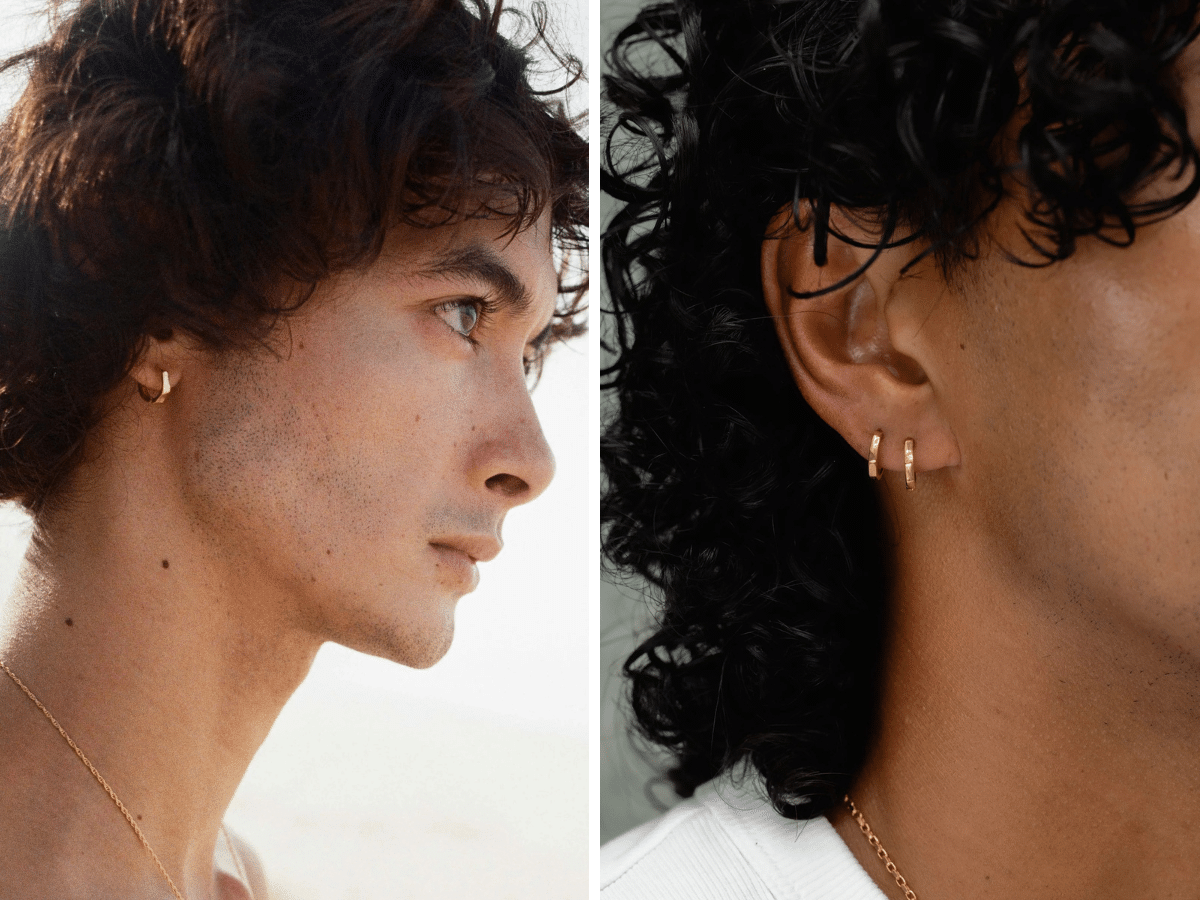
A huggie is essentially a small hoop designed to sit closely around the earlobe (hence the name – it hugs your ear). Très cute.
Huggies are particularly good if you like the idea of a hoop but don’t want much space between the jewellery and your lobe. If you need some inspo, Jacob Elordi is a big fan of the huggie.
Gold or Silver Men’s Earrings?
The old answer to this question would have involved looking at your skin’s undertones followed by someone holding different coloured fabrics next to your face.
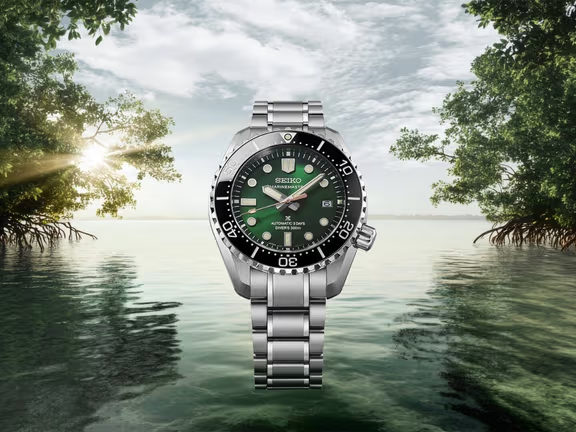
The much simpler answer is to look at the jewellery (or watch) you already wear. If your everyday watch has a silver-toned case, you wear a silver chain, and your rings are all silver, silver earrings will slot straight in.
If you already gravitate towards gold jewellery, go gold. You can absolutely mix metals, too.
The easiest way to make the mixed metals look work is to repeat it somewhere else. If you have a silver hoop in one ear and a gold stud in the other, have both metals appear in your rings, necklace, or watch too.
But ultimately, put both against your face and see which one you prefer. Scientific? No. Effective? Very.
So… Should You Get Your Ears Pierced?
Getting your ears pierced is one of those things that can feel disproportionately enormous before you just do it. Maybe that’s because the jewellery sits right next to your face. Maybe it’s because plenty of men grew up with weird rules about who could wear earrings, which ear they were supposed to go in and what they apparently told the world about you.
Thankfully, most of those rules simply do not exist anymore. You can wear a tiny stud. You can wear two gold huggies. You can build an entire ear stack. You can channel Harry Styles and dangle a bloody pearl from one side if the mood takes you.
And if you hate it? Take the earring out once it’s safe to do so and move on with your life. But if you’ve spent the last six months noticing earrings on other men and thinking, Could I pull that off? Well, it’s time to pull the trigger and go get pierced.
FAQs
Needle. A reputable professional piercing studio should use a sterile, single-use piercing needle rather than reusable piercing guns. Before you get pierced, check that the needles, tools and jewellery supplied are sterile and ask your piercer to talk you through the procedure, risks, healing and aftercare.
Pain is obviously subjective, but lobe piercings are generally less painful than cartilage piercings because the lobe is soft tissue with fewer nerves. The actual piercing is typically over very quickly and can feel like a sharp pinch followed by some tenderness or throbbing. Cartilage is another story. It tends to hurt more and take considerably longer to heal.
Earlobe piercings typically take around six to eight weeks to heal, while cartilage piercings can take six months to a year. Healing varies from person to person, and something that looks fine from the outside may still be healing internally. And remember: leave the initial jewellery in for the period recommended by your piercer and wait until the piercing is fully healed before changing it.
Your piercer should give you aftercare instructions, and those instructions trump whatever your mate Josh reckons worked for him in Year 10. You need to wash your hands before touching the piercing, use sterile saline wound wash while it heals and then leave the jewellery alone. You don’t need to twist or spin your earrings while cleaning them. In fact, doing so can irritate the piercing.
Some initial redness, tenderness and swelling can be normal, but worsening pain, significant redness, swelling or discharge can indicate an infection. If you’re worried about how a piercing is healing, speak to your piercer and seek medical advice if needed.























Comments
We love hearing from you. or to leave a comment.