


Updated:
Readtime: 7 min
Every product is carefully selected by our editors and experts. If you buy from a link, we may earn a commission. Learn more. For more information on how we test products, click here.
- Ring Drone Cam weighs 165 grams and flies ten-minute patrols.
- Dual cameras provide 2K forward vision and downward 1080p scanning.
- Cloud processing keeps hardware costs down to two hundred and fifty dollars.
- Commercial Ring Rover features a four-foot periscope and 4K optics.
- Hardware range includes hand-rechargeable smart locks and updated 4K cameras.
Ring has officially launched the Ring Drone Cam (USD$249.99), introducing a 165-gram autonomous flying security camera designed to patrol household corridors and investigate all of your domestic blind spots on demand. It arrives today alongside the enterprise-focused Ring Rover Cam, a hand-rechargeable smart lock, four new 4K cameras, and a pan-tilt indoor model. Unlikely to be the next BIG THING in smart homes, the quadcopter is a halo product for the commercial debut of the new Ring Robotics division.
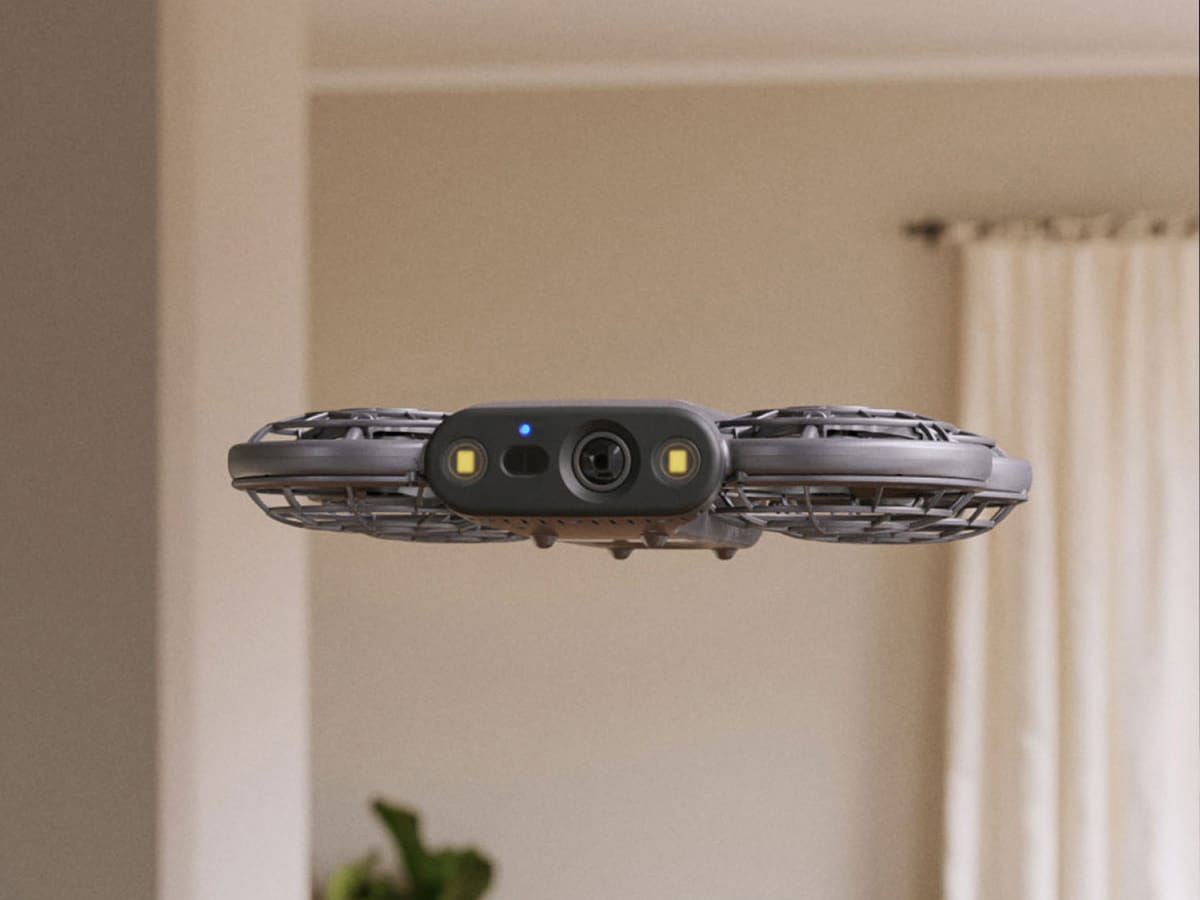
Having tested smart security setups in various living spaces over the years, watching a miniature 165-gram drone physically lift out of its dock to investigate an alert is certainly impressive. It might represent a departure from stationary doorbells and companion-like vacuums, but that doesn’t stop it from being any less creepy. The hardware carries a forward-facing 2K camera with twin illumination LEDs and a dedicated 1080p camera on its belly with a downward spotlight, casting beams across dark rooms that mimic a security guard carrying a torch. We’ve spent time with many micro-drones in the past, so it’s unsurprising to hear that the tiny propellers produce a sharp, audible buzz that signals its exact location, and that the battery life isn’t great. It delivers between eight and ten minutes of airtime before returning to its base, where an eight-minute top-up yields one minute of flight.
Priced at USD$249.99 (approx. AUD$385), the Ring Drone Cam delivers whole-home coverage at a fraction of the cost of hardwired multi-camera installations that easily climb past AUD$1,200. Meanwhile, the commercial-grade Ring Rover Cam sells for USD$999.99 (approx. AUD$1,540), bringing autonomous ground patrols to business premises with an adjustable 4K periscope camera and an active light tower. Lets take a closer look at the latest Ring smart home robotics releases!
Ring Drone Cam’s Decade Of Development
Ring founder Jamie Siminoff first initiated development on an autonomous flying camera concept in 2016, two years prior to Amazon’s acquisition of the brand. Early prototypes progressed through multiple testing cycles, including a fully packaged 2021 production run that the company shelved before distribution due to early flight issues.
Engineering teams faced serious hurdles during a 2025 development push that attempted to handle spatial awareness through local compute. The processors and sensor arrays required larger batteries, which increased the total aircraft mass and forced the motors to spin harder. You might remember that drone with the battery sticking out the bottom of it. Well, the compounding weight forced engineers to install heavier propeller shrouds, creating an engineering fix that threatened to drive the retail price past USD$5,000. It seems that they’ve finally figured out how to make it work, and it looks very similar to some of our favourite micro-drones on the market, including the DJI Neo 2 and Hoverair X1 PRO.
“For years, customers told us they wanted eyes in the places a fixed camera couldn’t reach, and peace of mind in the spots they’d never want one,” said Jamie Siminoff, founder and chief inventor of Ring. “The honest answer wasn’t more cameras; it meant reimagining what a security device could be. That kind of invention is hard, and it takes time. But we kept at it until we got it right, and that’s Ring Robotics. It’s not just a new category of security; it’s the beginning of a future where proactive, autonomous protection is something every home and every business can have.”
Beyond the shrouds and battery, Ring solved the weight problem by migrating navigation calculations to cloud computing. Using the custom AI Pilot system over home Wi-Fi, the drone offloads spatial processing to external servers, keeping the physical aircraft at 165 grams and holding the retail price at USD$249.99.
Autonomous Flight Paths And Night Patrol Optics
When you use the Ring Drone Cam around the house, it acts as an active physical sentry. Navigation connects directly with Amazon’s Alexa Home Map, which builds a 3D digital twin of your property. Users tap specific rooms on the interactive floor plan to dispatch the drone along automated flight paths to designated patrol coordinates. If you’ve ever used a robot vacuum, this will all be very familiar stuff.
The flight system integrates with external perimeter sensors placed throughout the house. When a door sensor trips or an environmental monitor registers a water leak, the Drone Cam lifts from its base station and flies directly to the alert coordinates. During nighttime sweep flights, the twin forward LEDs and illuminated downward spotlight cast focused beams across dark corridors, mirroring the sweep of a security torch. The downward 1080p camera monitors floor obstacles while the forward 2K wide lens captures wall-to-wall room context.
Hardware mechanics also keep household privacy top of mind. The high-speed rotors produce a steady, audible hum that clearly announces the drone’s physical presence in every room. When docked in its cradle, the camera powers down and physically angles away from the living area. Recorded footage uploads through Ring’s Throw Away the Key encryption architecture, which lock video files behind strict biometric access.
Ring’s Ground Rovers and Keyless Door Hardware
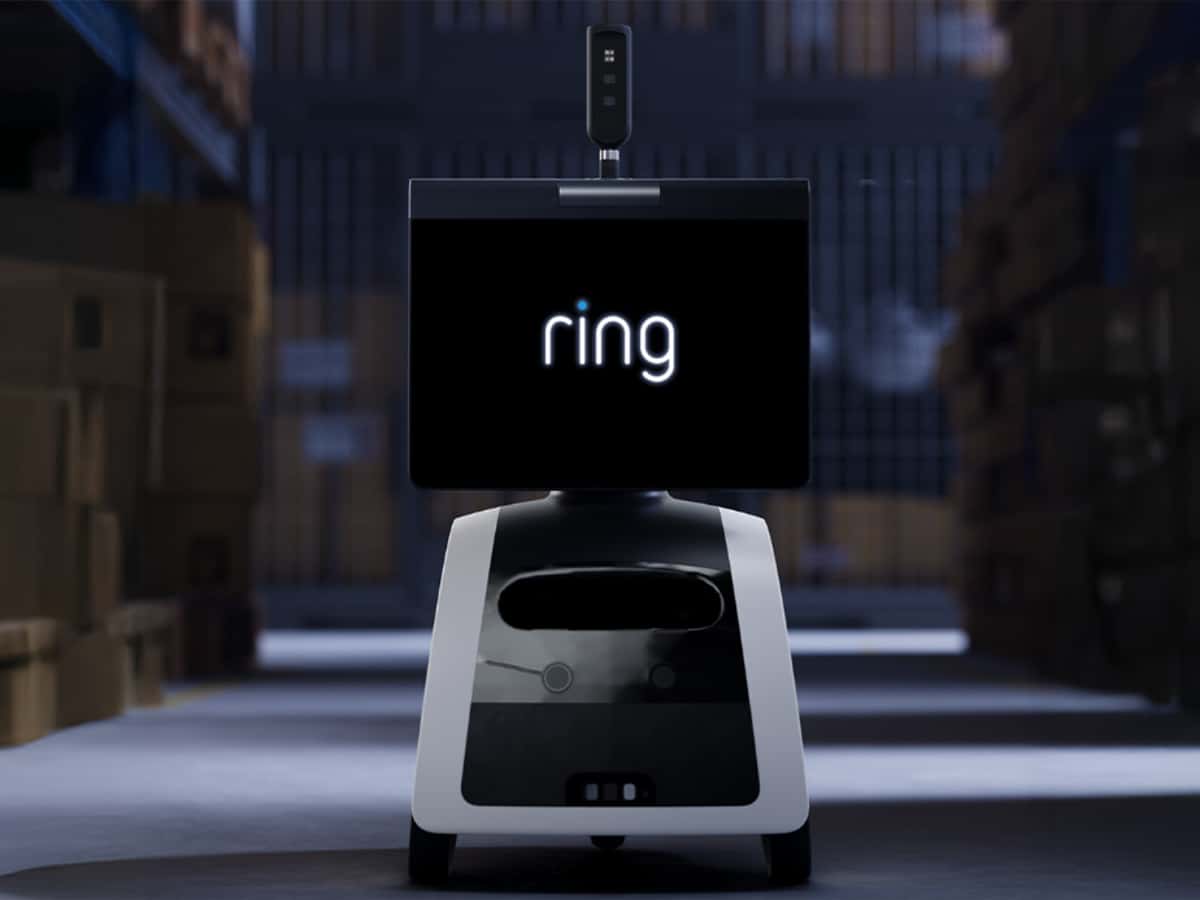
The Drone Cam wasn’t the only announcement, as Ring also launched a commercial-grade Ring Rover Cam that applies mobile robotics to warehouses, commercial showrooms, and retail floors. They engineered the machine as a dedicated enterprise security sentry, using the base of Amazon’s Astro robot to create an autonomous commercial patrolling platform priced at USD$999.99.
It features a motorised periscope mast that rises four feet to inspect high shelving and checkout counters. There’s also continuous 4K video streams available during sweeps, and it carries active deterrence hardware, including a high-decibel siren and a light tower that projects a blue tracking halo onto the ceiling during quiet patrols and flashes red during alarms. While resting at its charging base, the Ring Rover Cam maintains continuous person detection, recording immediate footage the moment movement crosses its field of view.
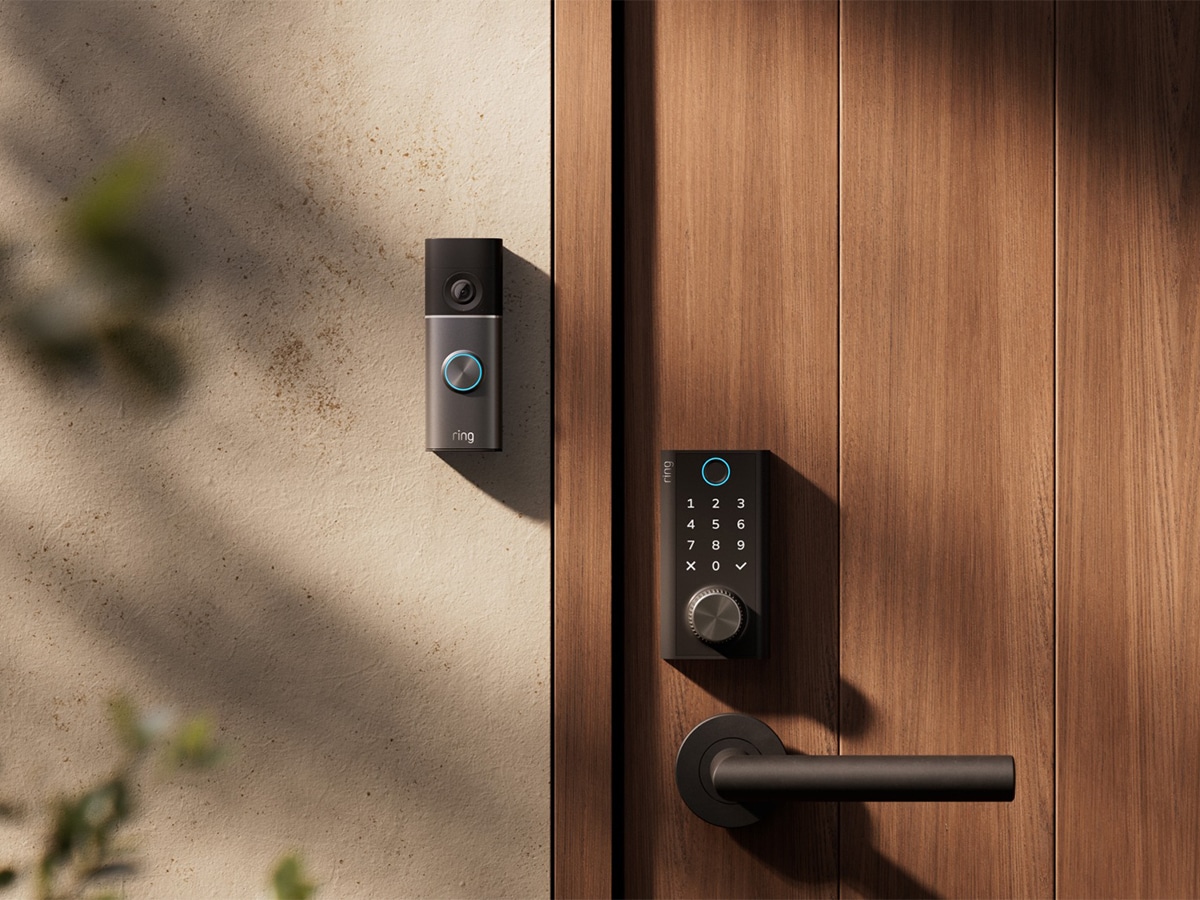
Last but not least, the brand also updated its physical perimeter lineup with its first smart lock featuring an integrated manual power dial. The mechanism allows homeowners to generate charge by hand to unlock the bolt during power failures. That lock joins four newly announced 4K perimeter cameras and an updated pan-tilt indoor camera.
This all sounds great, especially for homeowners with large single-level layouts, holiday properties, or open-plan living areas. While the Ring Drone Cam delivers everything that’s on the tin at a relatively affordable price point, the need for fast visual confirmation and active deterrence across an entire house from a single mobile device still begs to be questioned. That’s especially true for homeowners with low ceilings, tight stairwells, or indoor pets, who will find static security cameras far more suitable for daily life. It’s also hard to look past the fact that having a loud, flying drone in your house is as antisocial as it gets.



























Comments
We love hearing from you. or to leave a comment.