

Updated:
Readtime: 10 min
Every product is carefully selected by our editors and experts. If you buy from a link, we may earn a commission. Learn more. For more information on how we test products, click here.
- The six-watch collection spans two Prospex models, plus Astron, Presage, Seiko 5 Sports and the revived Rotocall digital design.
- Australian prices range from AUD$675 for the Seiko 5 Sports SKX to AUD$4,500 for the Astron GPS Solar Chronograph.
- All six arrive in Australia from October 2026, with editions limited to between 2,000 and 9,999 pieces.
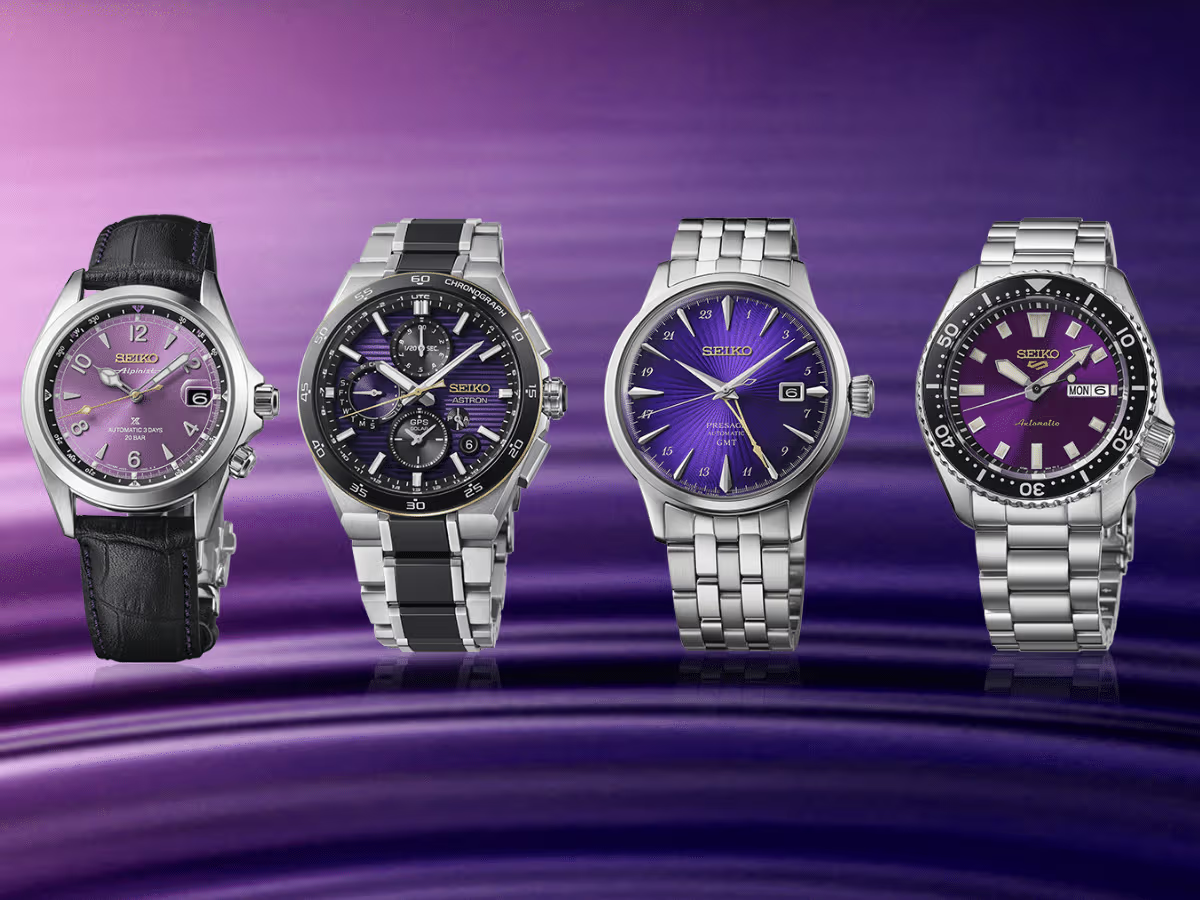
For the third series in its 145th-anniversary program, Seiko has unveiled six limited-edition watches built around “Edo purple”. The traditional colour emerged during Japan‘s Edo period and became closely associated with the former city of Edo, now modern Tokyo, where Seiko founder Kintaro Hattori opened his first watch shop in Ginza in 1881.
Purple is rarely a neutral design decision, particularly when it’s applied so generously to six models ranging from a classic mechanical sports watch to a satellite-connected chronograph, alongside a revived 1980s digital model that many could mistake for a G-Shock all juiced up on Ribena.
Beyond that shared history and the gold-coloured accents found on each timepiece, the watches don’t use a single uniform shade or application of purple. The treatments range from pale lavender and aubergine (we call them eggplants here) to deep violet and a selective purple accent ring.
What Is Edo Purple, And Why Did Seiko Choose It?
Seiko’s connection to Edo purple runs deeper than a shared link to Tokyo.
Historically, the colour was seen as a cooler, blue-leaning purple, visually distinct from the redder purple associated with Kyoto. Purple once carried strong imperial and aristocratic associations in Japan, but by the Edo period it had become available in a wider range of tones and was worn by samurai families and common folk alike. The people’s purple, if you will.
But Seiko’s approach to the historical connection is a bit looser than just calling everything “Edo purple”. Each watch uses the colour differently, inviting its wearer to contemplate just how much they really like purple.
 1/2
1/21. Seiko Prospex Alpinist HBC006
- Movement: Seiko 6R55 automatic with manual winding
- Power reserve: Approximately 72 hours
- Case: 39.5mm stainless steel with super-hard coating
- Crystal: Sapphire with date magnifier and inner anti-reflective coating
- Water resistance: 200 metres
- Price: AUD$1,400
- Limited edition: 7,000 pieces
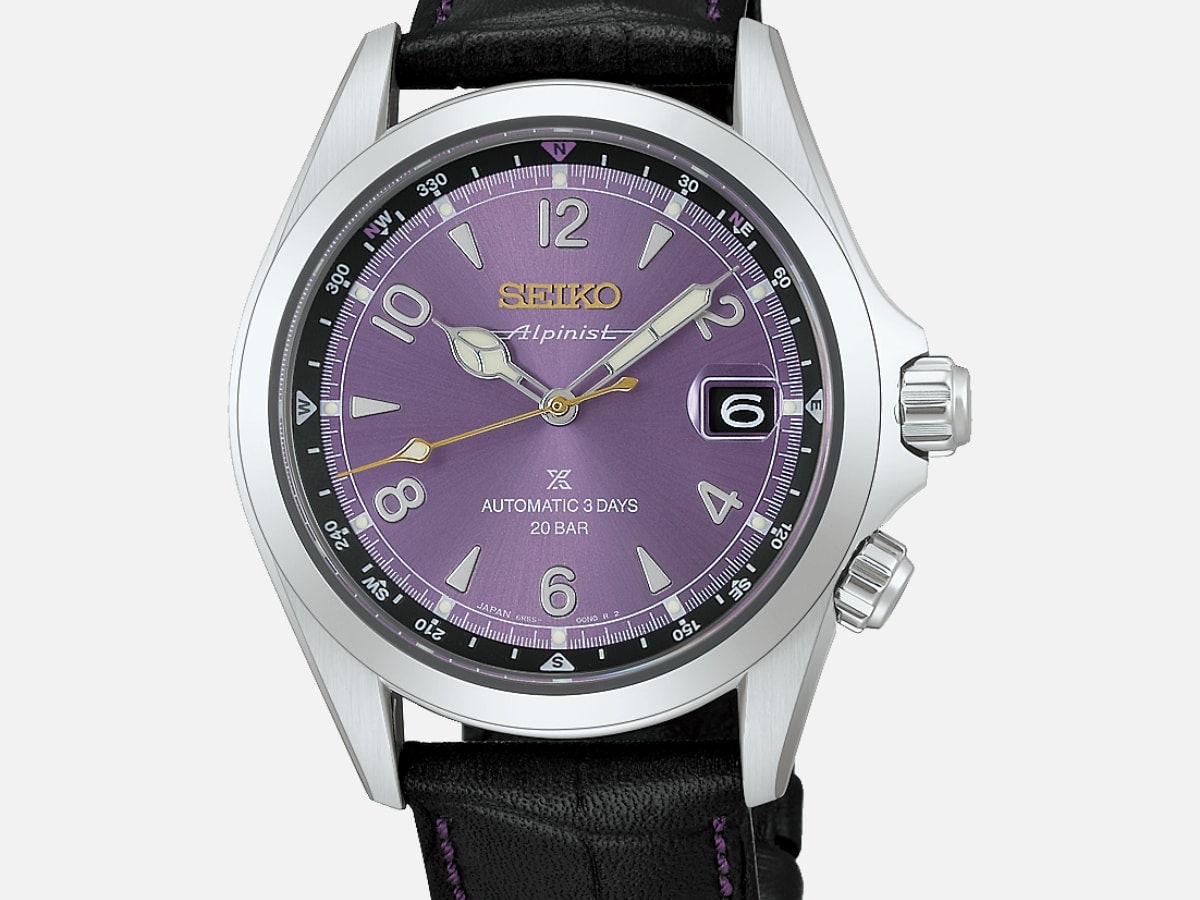
The Alpinist wears the lightest shade in the collection, with a soft lavender dial sitting inside its black rotating compass ring. Silver Arabic numerals, wedge-shaped markers and cathedral-style hands give the colour clear boundaries to work within, while the gold Seiko logo and seconds hand add smaller points of contrast.
It’s the only watch in the group paired with leather rather than a metal bracelet, with more purple in the stitching running along the black strap to carry the anniversary colour beyond the dial.
Beneath the Seiko logo, the “Alpinist” script recalls the original 1959 Laurel Alpinist, Seiko’s first sports watch and a model created for outdoor use. The modern HBC006 keeps the familiar twin-crown layout and internal compass ring, but the lighter purple gives the otherwise rugged design a softer edge.
 1/2
1/22. Seiko Prospex Speedtimer HBJ005
- Movement: Seiko V192 solar chronograph
- Power reserve: Approximately six months when fully charged
- Case: 41.4mm stainless steel
- Crystal: Curved sapphire with inner anti-reflective coating
- Water resistance: 100 metres
- Price: AUD$1,200
- Limited edition: 8,000 pieces
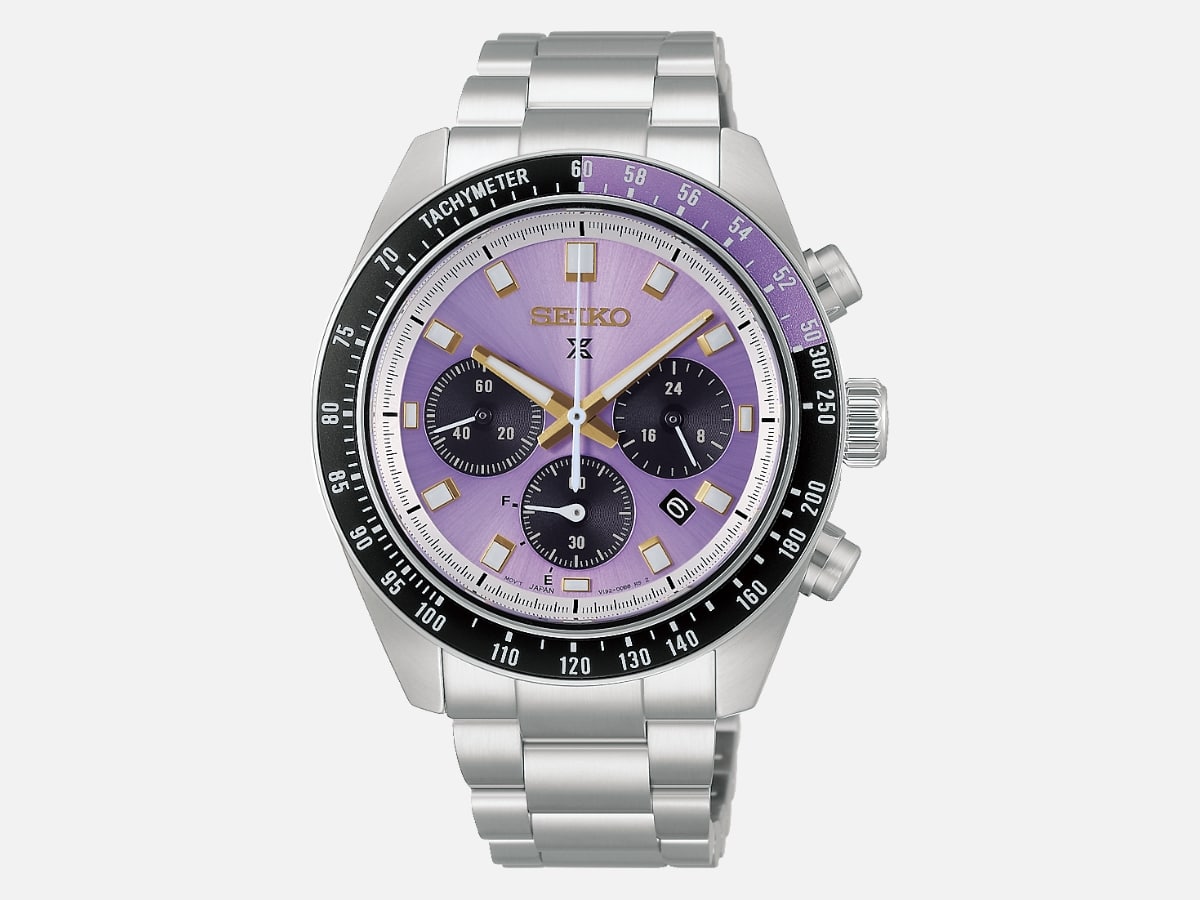
The Speedtimer wears its purple more cautiously than the Alpinist, breaking the pale lilac dial up with three black subdials and a mostly black tachymeter bezel. A purple segment between the 50 and 60 markings carries the anniversary colour beyond the dial, while gold-toned hands, markers and branding introduce another layer without overwhelming the chronograph layout.
It’s essentially Seiko’s take on a purple panda dial, with enough black, white and steel surrounding it to keep the various displays easy to read. The familiar three-register arrangement also gives each colour a defined position, helping organise the date window, power-reserve indicator and several timing scales around the dial.
Seiko traces the design to Speedtimer chronographs from the 1960s and 1970s, including a bi-colour tachymeter bezel from its vintage archives. Its V192 solar movement can run for around six months from a full charge.
Compared with the Alpinist, the anniversary treatment is busier, but the Speedtimer’s existing chronograph structure gives all that purple and gold somewhere useful to go.
 1/2
1/23. Seiko Astron HAB011
- Movement: Seiko 5X83 GPS Solar
- Power reserve: Approximately six months when fully charged, or two years in power-save mode
- Case: 43.3mm titanium with ceramic and titanium bezel
- Crystal: Dual-curved sapphire with super-clear coating
- Water resistance: 100 metres
- Price: AUD$4,500
- Limited edition: 2,000 pieces
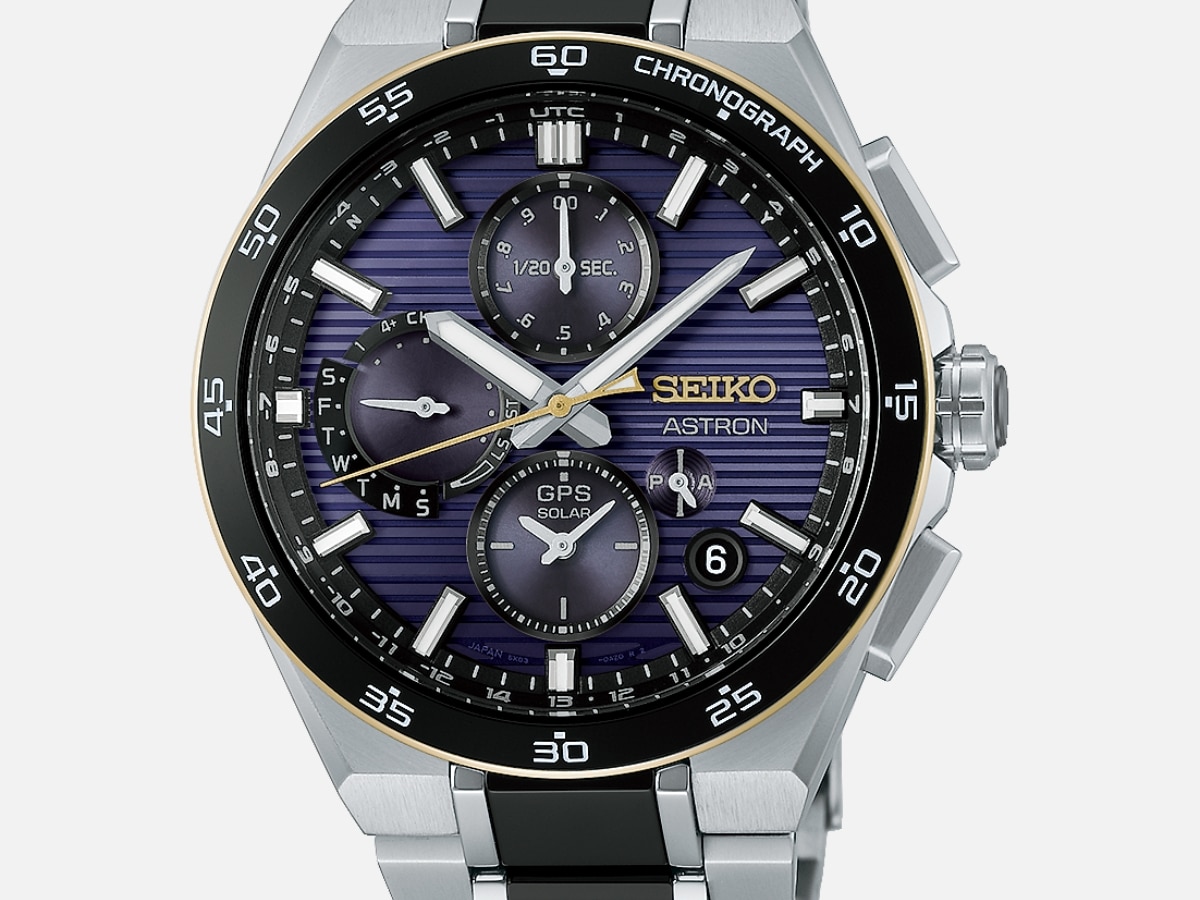
The Astron takes the deepest and most technical approach to Edo purple, using a dark violet dial with a vertical gradient and horizontal lines that vary in width from top to bottom. Its treatment is designed to capture the changing colours of the sky at dusk.
Even without the heavier shade of purple, there’s already plenty happening across the dial: three subdials, multiple scales, a date window and several indicators for its GPS, chronograph and dual-time functions. It’s a busy watch, and the purple does very little to simplify any of it. But I gotta say, the dark violet gives the technical display a stronger backdrop, while the black ceramic centre links and bezel carry that darker palette beyond the dial.
Seiko is a little more restrained with the gold, placing it selectively on the logo, seconds hand and bezel edge for a touch of warmth against a design dominated by titanium, black and violet.
It’s comfortably the largest by diameter, most expensive and most limited watch in the collection. Inside, you’ll find the 5X83 GPS Solar movement, which adjusts to 38 time zones, supports dual time and a 1/20-second chronograph, and keeps its perpetual calendar correct through February 2100. It can run for approximately six months from a full charge, stretching to around two years in power-save mode.
With a whole lot of purple and even more functionality, the Astron is the collection’s full-strength anniversary watch.
 1/2
1/24. Seiko Presage Cocktail Time HCB006
- Movement: 4R34 automatic GMT, 41-hour power reserve
- Case: 40.5mm stainless steel
- Crystal: Box-shaped Hardlex
- Water resistance: 50 metres
- Price: AUD$950
- Limited edition: 6,000 pieces
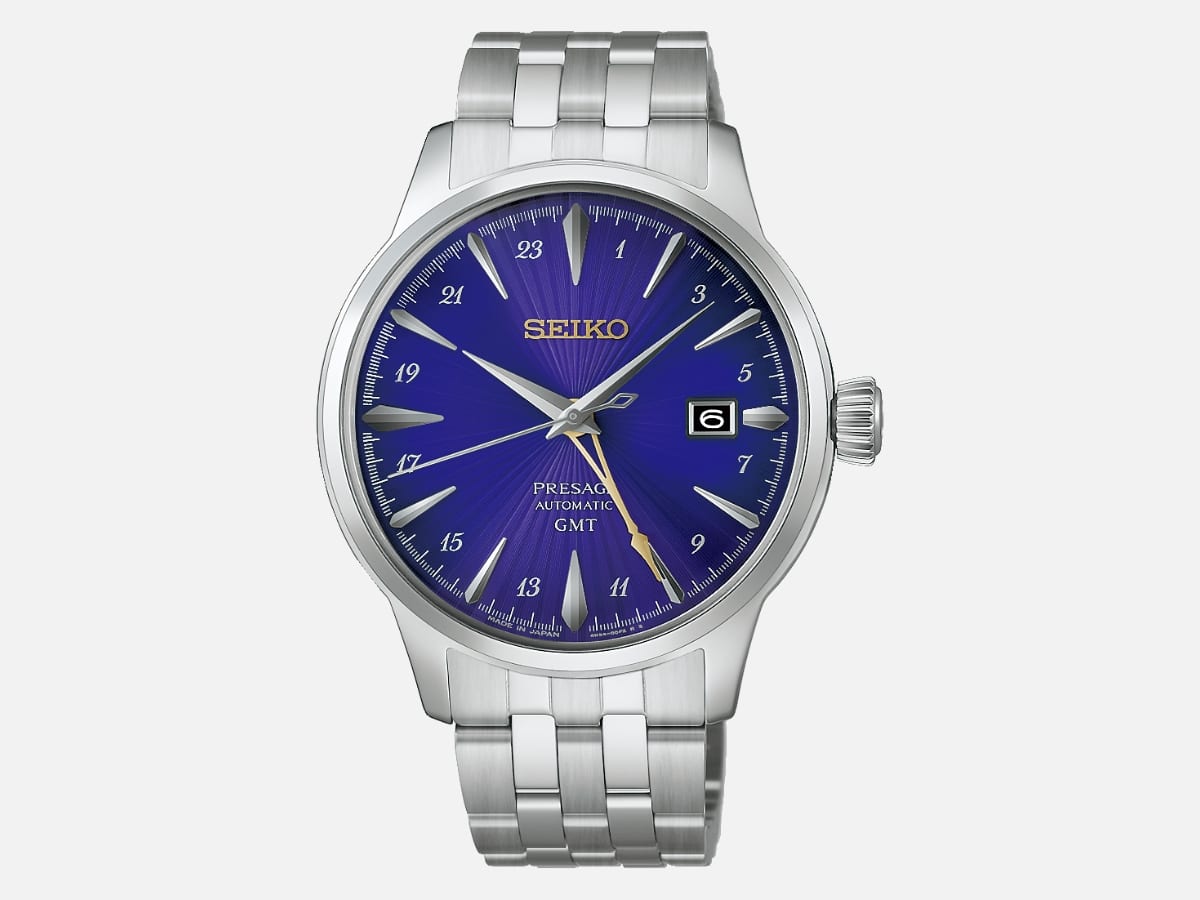
Of the six watches, Cocktail Time is clearly having the most fun with the colour purple. The Presage line already leans on the glossy, richly coloured dials inspired by drinks, so the HCB006 feels right at home behind the bar.
Its radial-patterned dial takes inspiration from the “Edo Murasaki” cocktail created by Hisashi Kishi, owner of STAR BAR in Tokyo’s Ginza district. The deep purple finish has a translucent quality, with light catching the radial texture and bringing out subtle highlights that Seiko compares with scattered gold flakes.
You’ll find more gold here than the Astron, most noticeably on the Seiko logo and the arrow-shaped GMT hand that sweeps around a 24-hour scale tucked between the hour markers.
The 4R34 automatic GMT movement adds manual winding, stop-seconds, a date display and a 24-hour hand for dual-time display, while the steel case is paired with a five-link bracelet and see-through screw caseback.
Out of all the watches in the collection, Cocktail Time is obviously waiting for happy hour for a few brightly coloured drinks.
 1/2
1/25. Seiko 5 Sports SKX HDB003
- Movement: Seiko 4R36 automatic with manual winding
- Power reserve: Approximately 41 hours
- Case: 42.5mm stainless steel
- Crystal: Curved Hardlex
- Water resistance: 100 metres
- Price: AUD$675
- Limited edition: 9,999 pieces
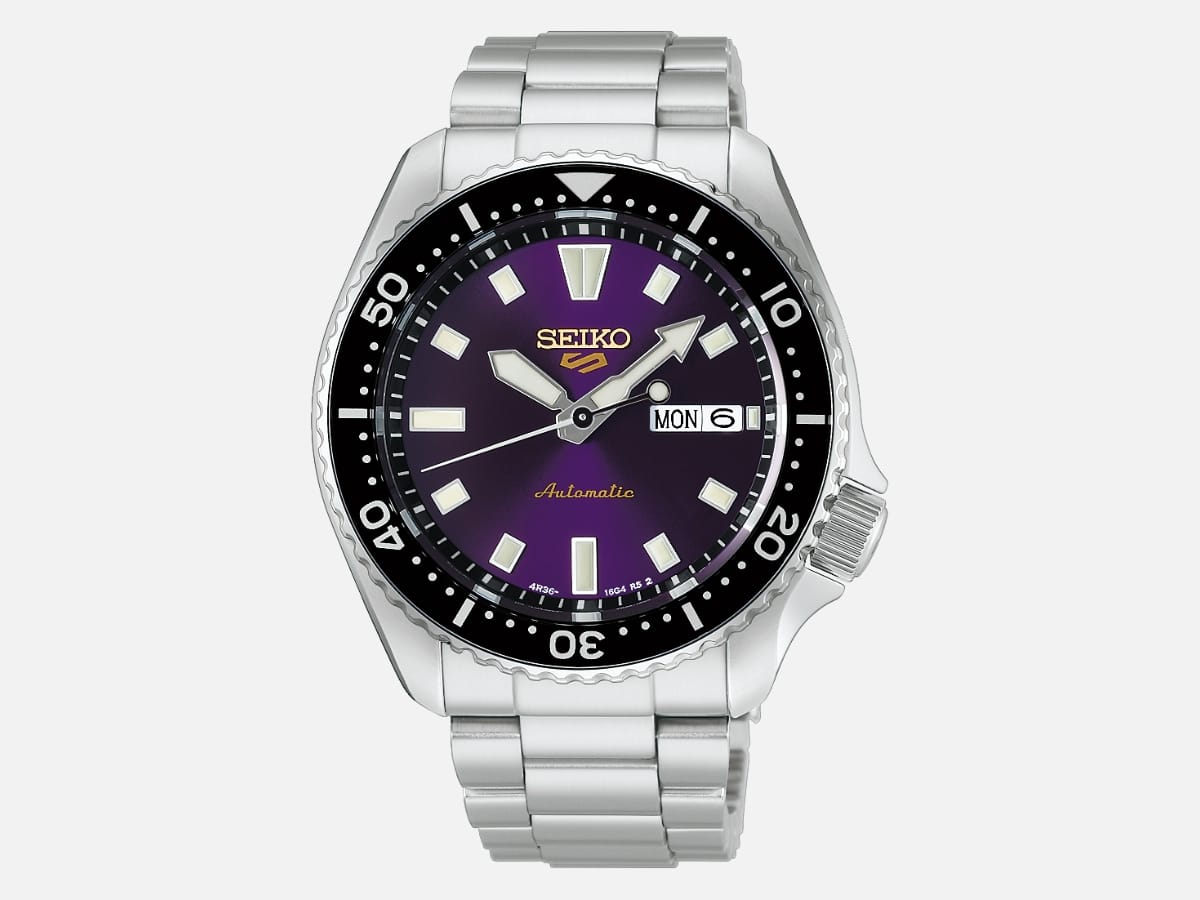
The Seiko 5 Sports takes a more straightforward route, pairing a deep aubergine (there’s that eggplant again) dial with the familiar black bezel, oversized luminous markers and broad hands of the SKX series. There’s plenty of purple, but the established sports-watch layout gives it a much simpler canvas than either the Astron or Speedtimer.
Gold is limited mostly to the Seiko 5 Sports logo and “Automatic” script, giving the dark dial a smaller point of contrast without pulling too much attention away from the large white markers. The glossy Hardlex bezel and vertically striated indexes add some texture, although the recognisable case shape and four o’clock crown day-date window are the reasons why people love it.
Seiko’s 4R36 automatic movement adds manual winding, stop-seconds and day-date functionality, while the 42.5mm case comes with a three-row bracelet, unidirectional rotating bezel and see-through screw caseback.
At AUD$675, it’s the most affordable watch in the anniversary collection. I’ve always been a fan of the SKX shape. But this edition is for anyone who has been waiting to see it have an anniversary moment in purple.
 1/3
1/36. Seiko HFL001 ‘Rotocall’ Digital
- Movement: Seiko A824 quartz
- Battery life: Approximately three years
- Case: 37mm stainless steel with black hard coating
- Crystal: Hardlex
- Water resistance: 100 metres
- Price: AUD$925
- Limited edition: 4,000 pieces
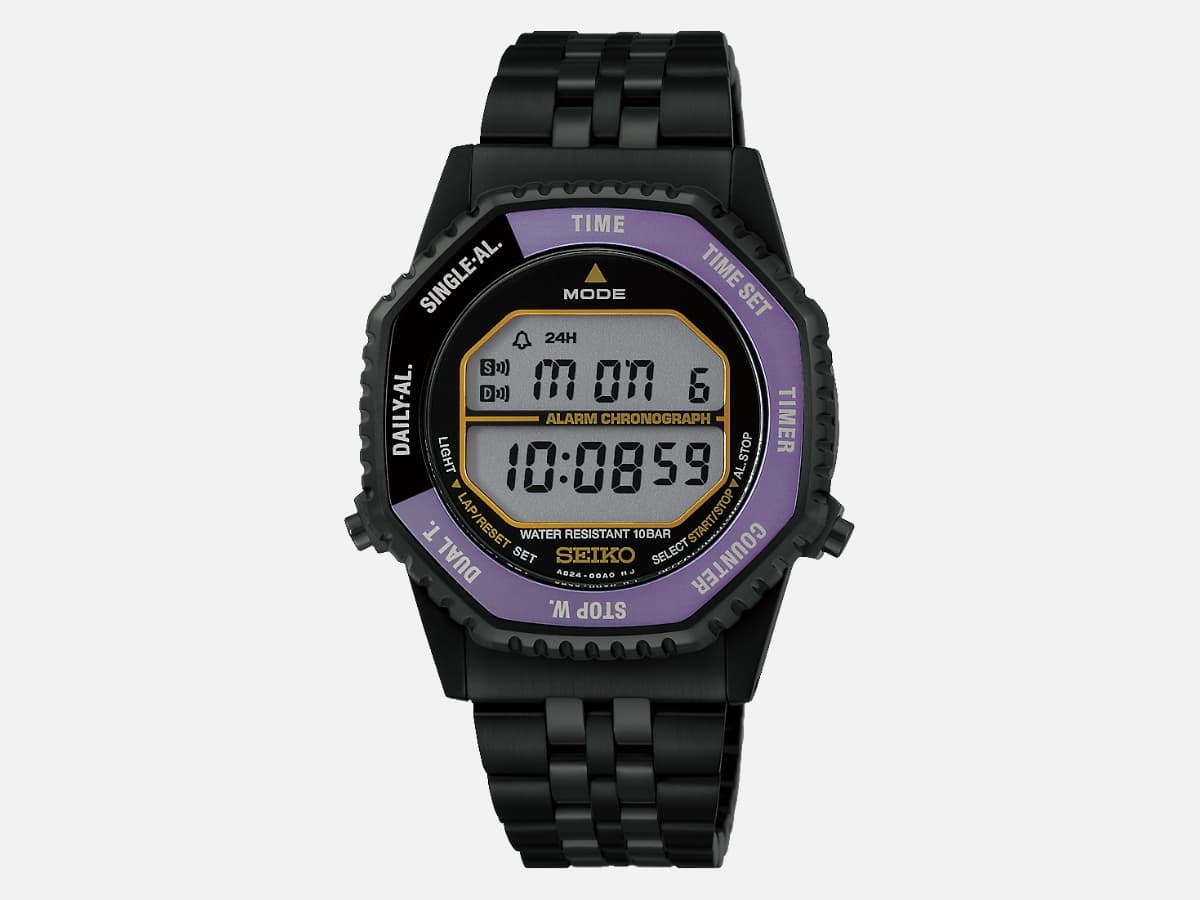
The Rotocall is easily the strangest watch in the collection, pairing a black-coated case, bracelet and digital display with anniversary purple concentrated around the aluminium rotary bezel rather than spread across the entire watch.
Gold appears around the display, Seiko logo and function labels, giving the purple ring a warmer point of contrast without getting in the way of the wonderfully busy control layout. The large text wrapped around the bezel tells you exactly where to turn for the timer, alarm, counter and dual-time modes, which gives the watch its distinctive retro-futuristic character.
For those unfamiliar with this design, the HFL001 is based on the Rotocall introduced in 1982 and revived by Seiko in 2025. Instead of cycling through functions with a series of button presses, its rotating bezel acts as a mode selector, moving between the alarm, countdown timer, chronograph, counter and dual-time display.
Seiko also points to the original Rotocall’s reported use among astronauts as one reason it gained recognition overseas.
Its A824 quartz movement includes a chronograph capable of running for up to 100 hours, a full calendar programmed through 2074 and internal LED illumination.
It may look like the collection’s most excessive design at first glance, but the Rotocall actually keeps Edo purple on a fairly tight leash.
Seiko’s 145th Anniversary in Edo Purple
Seiko has taken one historic colour and stretched it across six very different watches, from the comparatively restrained Alpinist to the wonderfully strange Rotocall. Some lean hard into the purple paint, while others keep it low-key, but each one gives Seiko’s 145th anniversary its own distinct flavour.
The only question left is how much “Edo purple” you’re willing to wear on your wrist?
Related reads


















Comments
We love hearing from you. or to leave a comment.