


Updated:
Readtime: 7 min
Every product is carefully selected by our editors and experts. If you buy from a link, we may earn a commission. Learn more. For more information on how we test products, click here.
- Seiko has created a one-of-a-kind mechanical watch for long-time ambassador and Los Angeles Dodgers star Shohei Ohtani.
- The Star Time can display accumulated time up to one million hours – or just over 114 years.
- Development began roughly three years ago after Ohtani reflected on how much longer he could keep playing baseball.
- The watch uses five rotating discs to track different hour scales and is not available for sale.
Japanese watchmaker Seiko has just created a one-of-a-kind mechanical wristwatch that can count to one million hours. Built for long-time ambassador and Los Angeles Dodgers star Shohei Ohtani, the Seiko Star Time uses five rotating discs to display more than 114 years of accumulated time on one dial.
The watch itself is a remarkable feat of engineering, but its creation came from a question Ohtani had been asking himself: “How much longer can I keep going as a baseball player?” Whether you’re a baseball fan or not, at some point in time, every elite athlete eventually has to reckon with some version of that question. Whereas Seiko found a more unusual answer.
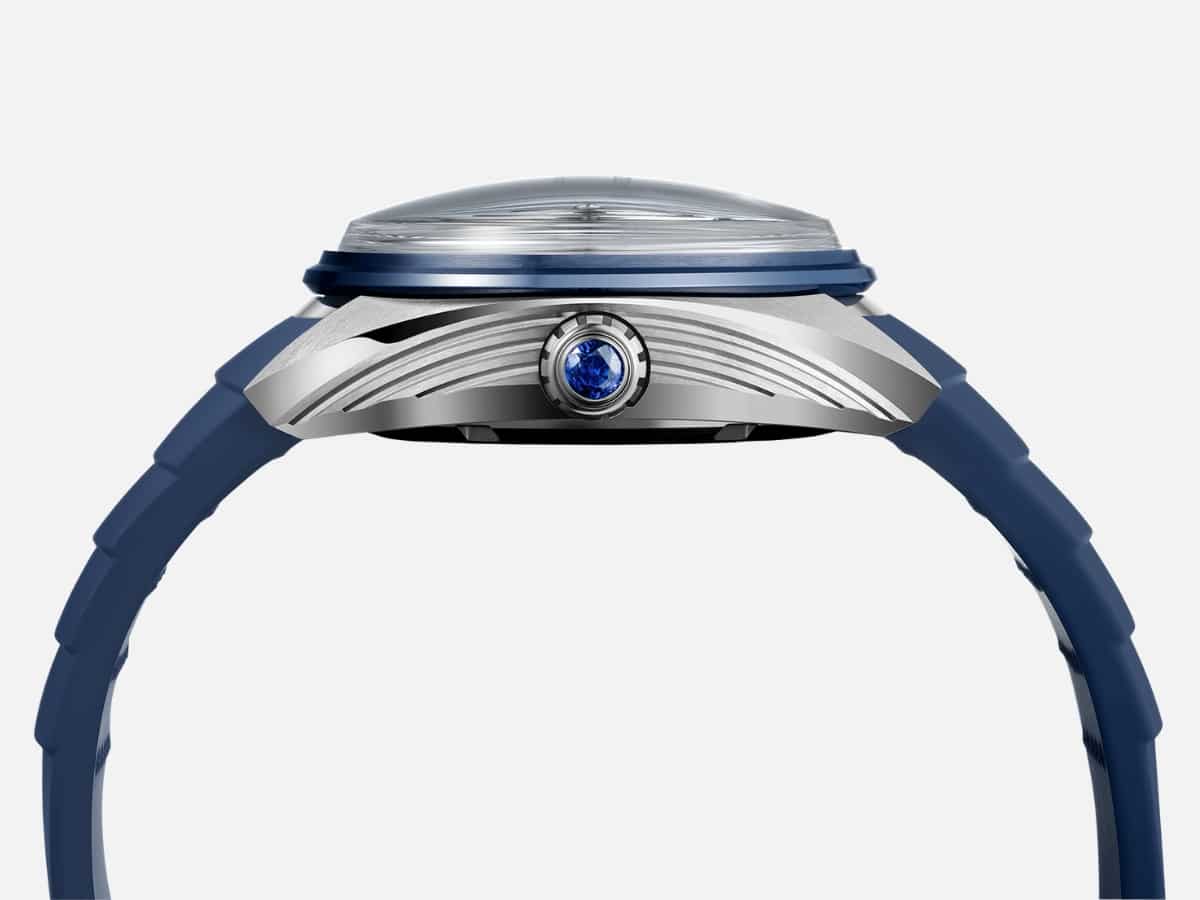
How Does the Seiko Star Time Track One Million Hours?
The trick is that the Star Time doesn’t actually work like a regular watch display. Instead of using conventional hands to show hours and minutes, Seiko has built the dial around five layered rotating discs, each responsible for a different scale of accumulated time.
Those discs count 24 hours, 1,000 hours, 10,000 hours, 100,000 hours and finally 1,000,000 hours. As the discs rotate, the numbers pass beneath a red line on the inner surface of the box-shaped sapphire crystal, giving the wearer a reading of accumulated time in hours. The central disc also pulls double duty, displaying the current time in a 24-hour format.
It’s essentially a mechanical odometer for time rather than your standard wristwatch. While one disc handles the daily cycle, the others move through increasingly larger blocks of hours, slowly building toward a number most of us would never naturally think about when telling the time.
Seiko says the discs move so gradually they are almost imperceptible to the naked eye, echoing the movement of stars across the night sky. Each disc is also set with a diamond to mark when it has completed a full rotation, while the diamond at the centre represents the North Star.
Why the Seiko Star Time Was So Hard to Build
Getting the Star Time onto Ohtani’s wrist required serious engineering, and not just because Seiko had to stack five rotating discs inside a mechanical watch. What they needed to figure out was whether a mechanical display could move that slowly over a one-million-hour timescale without causing problems.
The answer forced Seiko to rethink the structure underneath the dial. Each of the five disc hands carried enough weight to place real stress on the central axis, which risked stopping the watch or creating structural defects. Rather than leave all that weight sitting on one central pillar, Seiko changed the structure to four pillars, making the movement easier to support, access and disassemble.
It was a truly galactic challenge, dealing with the very small and the very large at the same time. The gears had to be made with micron-level precision, and Seiko also had to consider how the watch could be repaired in the future, because a one-million-hour display isn’t exactly something your average watch repair shop can handle between changing quartz batteries.
Ohtani also had a hand in the final shape of the Star Time. Repeated discussions were held between the player and the development team throughout the project, with the idea of setting a diamond on each rotating disc adopted along the way. And while you may have expected a fancier material wrapped around his wrist, the silicone strap was produced in a custom length tailored to Ohtani’s exact measurements.
In the documentary, Ohtani explains that because he travels constantly for away games, Japan trips and everything that comes with his baseball career, he wanted something he could actually wear every day.
The result, Seiko says, “combines a comfortable fit with excellent practicality.”
Has Seiko Tried Anything Like This Before?
Seiko has played with rotating-disc displays before, but not quite like this. The closest family resemblance is probably the Seiko Discus, better known among collectors as the “Discus Burger”, which used three rotating discs to display the hours, minutes and seconds through a mechanical movement. That earlier watch was already a strange way to tell the time, until you put the Star Time’s one million hours next to it.
Other watchmakers have also chased enormous timescales through serious complications, from secular perpetual calendars to moon-phase displays that claim accuracy over millions of years. It’s a world of technicality we won’t pretend to understand entirely, but take the IWC Portugieser Eternal Calendar, for example. This watch uses a 400-year gear to handle leap-year exceptions, with a claimed moon-phase accuracy of 45 million years.
Then there’s Franck Muller’s Aeternitas Mega, which follows a 1,000-year calendar cycle, for even more suitably ridiculous numbers.
Watchmaking, it turns out, has a long history of taking astronomical timekeeping problems very seriously, even when the numbers span several human lifetimes. With Star Time, Seiko is answering a stranger, more personal question by making a person’s accumulated time readable on the wrist.
And Seiko’s quite proud of its efforts too. As of July 2026, based on its own research, Seiko says no other wristwatch can measure and display up to one million hours using five disc indicators. It’s a very specific record to claim, but it still makes Star Time one of the stranger technical projects we’ve covered.
Key Specs: Seiko Star Time
- Model: Seiko Star Time
- Case: High-Intensity Titanium case and clasp
- Crystal: Box-shaped sapphire crystal with anti-reflective coating on the inner surface
- Display: Five rotating discs for accumulated time up to 1,000,000 hours
- Current time: Central 24-hour disc
- Diameter: 41.8mm
- Thickness: 17.4mm
- Water resistance: 10 bar
- Strap: Silicone strap, custom length for Shohei Ohtani
- Availability: One-of-a-kind model, not for sale
Three Years and One Million Hours To Go
After roughly three years of development, the finished watch was presented to Ohtani by Seiko Watch Corporation Chairman, CEO and CCO Shinji Hattori.
“I wanted to wear something that reflects the time I’ve put in so far and how much further I can go,” Ohtani said. “Seeing the watch in person, it’s exactly as I had imagined.”
Even if you only loosely follow baseball, Ohtani is one of those names that keeps breaking through. He was a first-overall pick in Japan, won a Japan Series, crossed to MLB, became Rookie of the Year, collected multiple MVP awards, joined the Dodgers, put together a 50-home-run, 50-stolen-base season and kept going from there.
The Seiko Star Time is a watch built around accumulation: years, hours, work, records and whatever comes next. For Seiko, it shows what watchmaking can do when an existential question becomes an even more difficult mechanical brief. For Ohtani, it won’t buy him more time in baseball, but it can mark the hours already spent and the ones still to play.

























Comments
We love hearing from you. or to leave a comment.