

Updated:
Readtime: 5 min
Every product is carefully selected by our editors and experts. If you buy from a link, we may earn a commission. Learn more. For more information on how we test products, click here.
- Land Rover revealed the road-legal Defender Dakar at Monterey Car Week.
- It transfers competition hardware directly from the Dakar Rally-winning D7X-R.
- Unrestricted 4.4-litre twin-turbo V8 produces 626 hp and 750 Nm of torque.
- Features long-travel Bilstein dampers and massive 35-inch all-terrain tyres.
- Intelligent ‘Flight Mode’ modulates mid-air torque to eliminate landing shock.
- Bodywork features lightweight carbon-fibre panels and riveted wheel arches.
- Reservations open early 2027, positioned above the AUD$291,542 Defender OCTA.
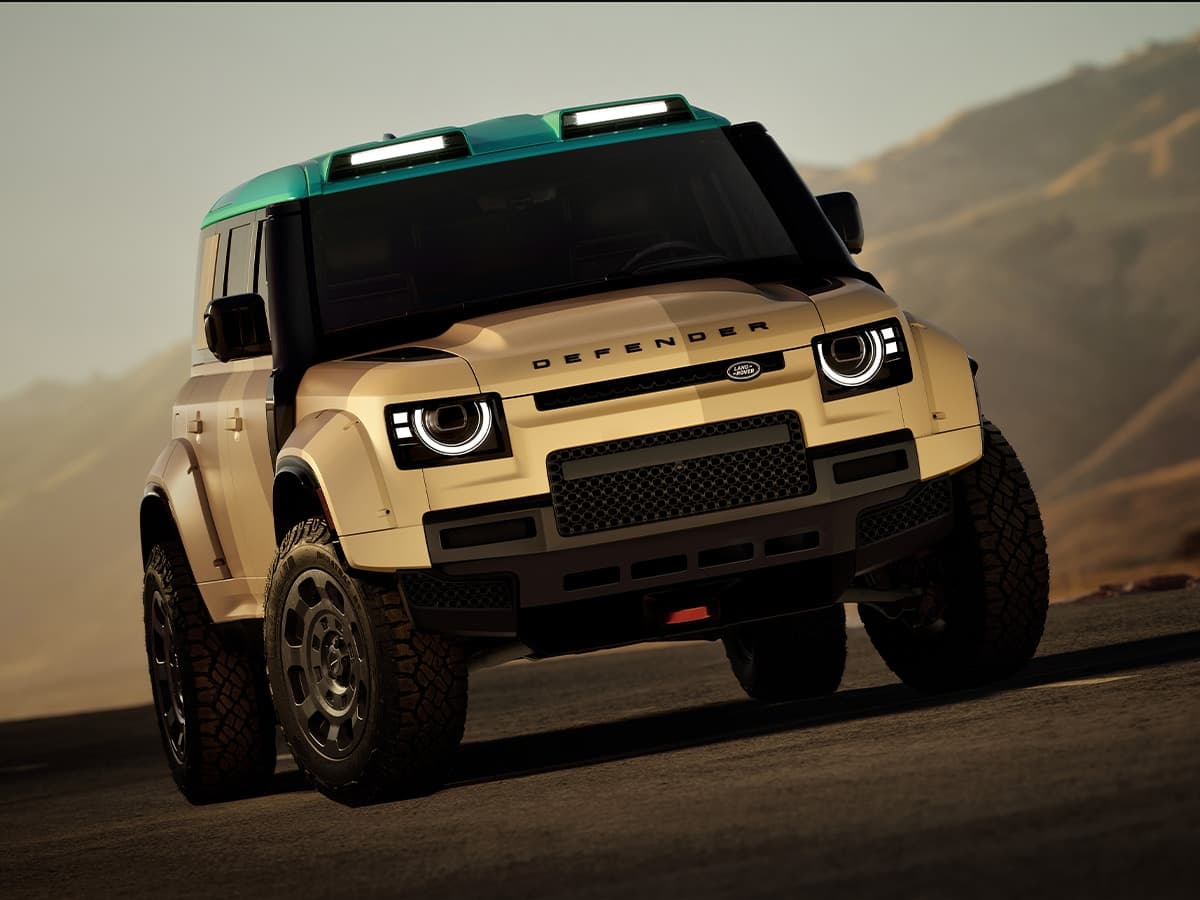
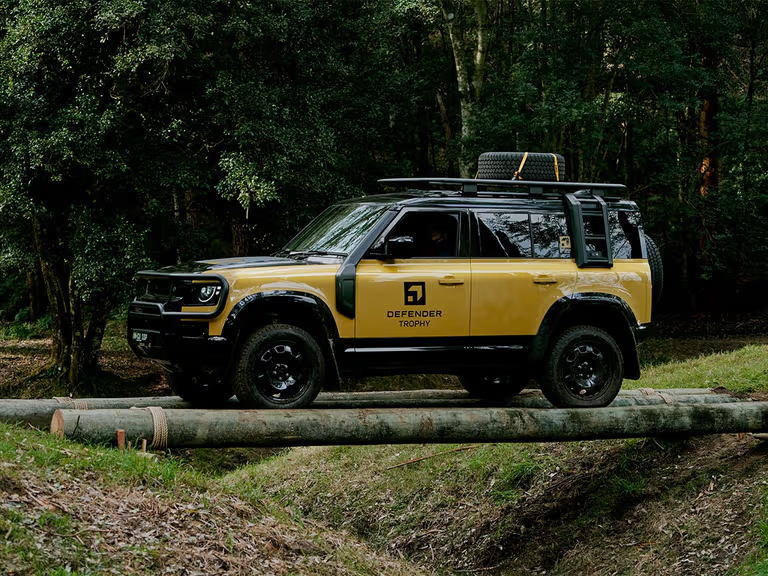
Think of the new Defender Dakar as the off-road equivalent of a Porsche 911 GT3 RS. It’s a road-legal evolution of a factory race car engineered to transfer competition hardware directly to the street. Unveiled as a Design Preview Model at The Quail during Monterey Car Week, the limited-run 4×4 is derived from the D7X-R competition truck that dominated the 2026 Dakar Rally on its debut, sweeping first, second, and fourth place in the Stock class while logging 24,000 km over 14 days of desert racing.
Positioned as the pinnacle of the lineup above the AUD$291,542 Defender OCTA, official vehicle reservations will open in early 2027. Having previously strapped into the navigator seat for a Defender Dakar D7X-R passenger ride-along during its testing phase, let me tell you from first-hand experience that seeing this competition machine receive a registration plate represents a rare homologation move from JLR and the industry at large. Managing Director Mark Cameron highlighted the development directive, stating that after proving the D7X-R in competition, “we asked: could we make the Dakar Rally-winning D7X-R road legal? The result is the Defender Dakar.”
Underneath the widened carbon-fibre bodywork, the road car retains the competition vehicle’s general architecture and 4.4-litre twin-turbocharged V8 engine. Unshackled from FIA rally air restrictors, the powertrain develops 626 hp (467 kW / 635 PS) and 750 Nm of torque, backed by a 35-inch tyre package (~890 mm tall), long-travel Bilstein dampers, and mid-air Flight Mode software.
Defender Dakar Key Performance Specifications
| Specification | |
| Engine Architecture | 4.4-Litre Twin-Turbocharged V8 |
| Total Power Output | 626 hp (467 kW / 635 PS) |
| Peak Torque Output | 750 Nm (553 lb-ft) |
| Transmission & Drivetrain | 8-Speed Automatic with Dual-Range All-Wheel Drive |
| Chassis Architecture | D7x Heavy-Duty Aluminium Monocoque |
| Suspension Hardware | Rally-Spec Coil Springs with Bilstein Advanced Dampers |
| Tyre & Wheel Package | 35-inch Advanced All-Terrain Tyres on Forged 20-inch Wheels |
| Off-Road Drive Modes | Dunes Mode, Gravel Mode, and Intelligent Flight Mode |
| Seating Layout | 2+2 Cabin Configuration with Front Race Bucket Seats |
| Reservation Timeline | Reservations Open Early 2027 (Specs at 2027 Dakar Rally) |
Race-Bred V8 Powertrain, Bilstein Dampers, and Flight Mode
Mechanically, the Defender Dakar retains the core driveline, transmission, and structural aluminium monocoque of the D7X-R race car, which is itself derived from the production OCTA. Power comes from the 4.4-litre twin-turbocharged V8 engine. Without the restrictive air intake plates mandated by FIA rally regulations, the engine delivers its full factory output of 626 hp (467 kW / 635 PS) and 750 Nm of torque alongside an upgraded thermal cooling package.
To manage rough terrain at speed, the complex 6D Dynamics air suspension from the standard OCTA is replaced with a rally-spec coil-spring setup featuring long-travel Bilstein Advanced Dampers. Power reaches the ground via 35-inch Advanced All-Terrain tyres wrapped around forged 20-inch alloy wheels.
Alongside newly calibrated Dunes and Gravel terrain modes, the Dakar inherits the intelligent ‘Flight Mode’ software developed for the rally truck. Using chassis sensors to detect when all four wheels leave the ground during high-speed cresting, the system automatically modulates torque delivery in mid-air to eliminate drivetrain shock upon landing.
Rally-Derived Carbon Bodywork, Cabin, and Availability
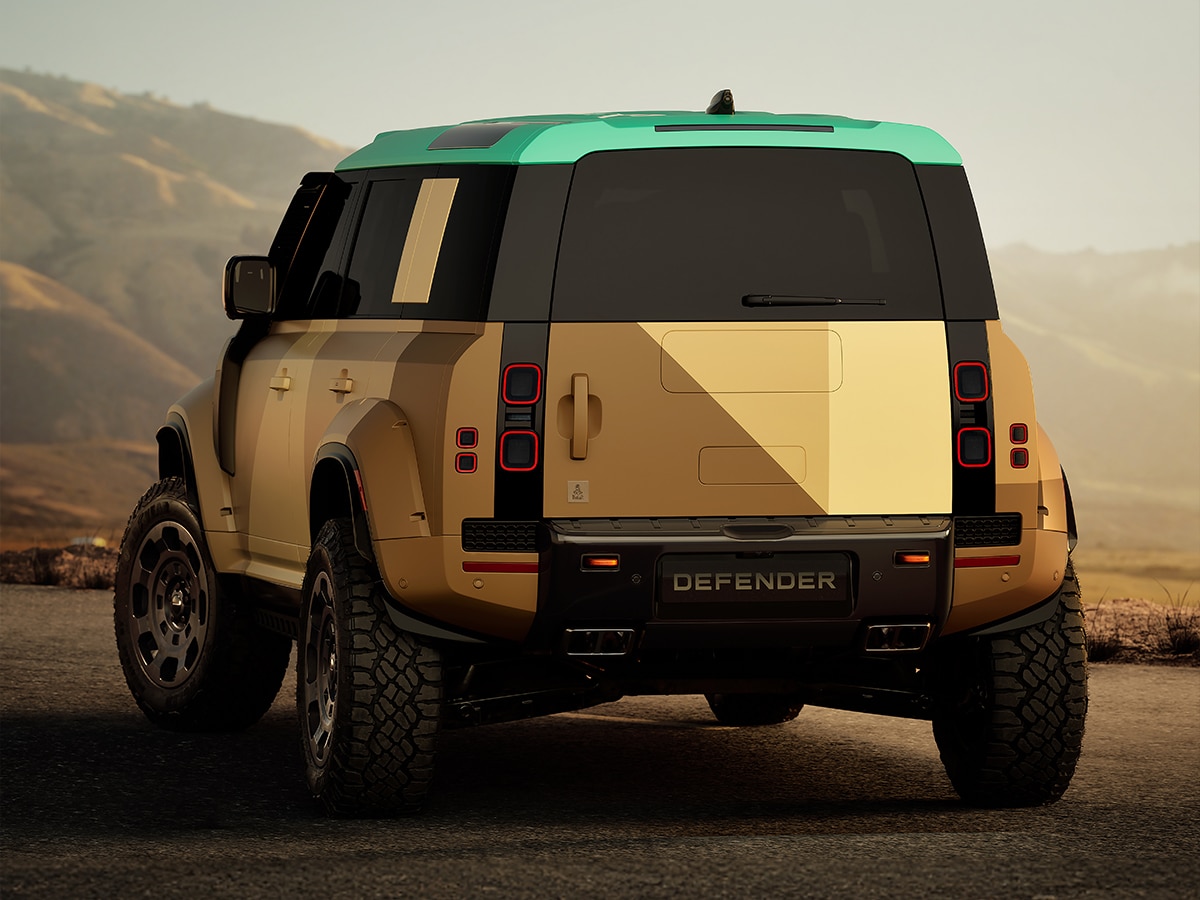
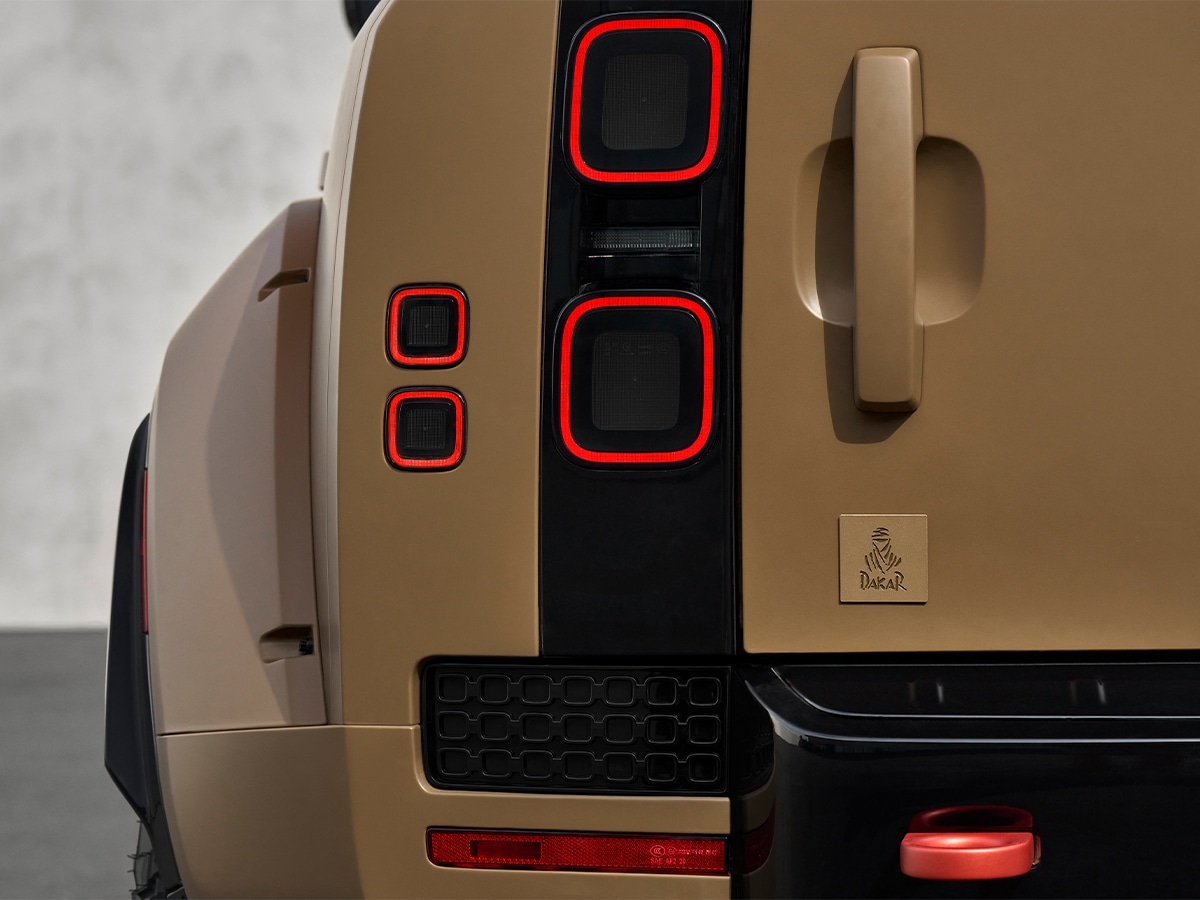
Visually, the road-going Defender Dakar incorporates functional competition body modifications. The exterior features carbon-fibre raised air intakes, a carbon-fibre bonnet, riveted wheel arch extensions, roof-mounted LED light pods, and a fixed metal roof replacing the standard glass panoramic sunroof. Heavy-duty underbody protection is provided by an enhanced metal front undershield, while the rear tailgate uses a blanking plate and signature mud flaps. Exterior paint options are headlined by a Dakar Sand body paired with a Yanbu Turquoise roof, mimicking the official race livery.
While official cabin imagery remains under wraps for now, Land Rover has confirmed the interior replaces standard seating with a 2+2 layout featuring single-row race bucket seats designed specifically for this model, with optional four-point racing harnesses. The rear cargo area is configured with dedicated stowage for race helmets, an integrated mounting bracket for a full-size spare wheel, and a built-in heavy-duty air compressor.
Registrations of interest are currently being collected by JLR, with formal vehicle reservations set to open in early 2027 ahead of full technical homologation disclosures at the 2027 Dakar Rally in Saudi Arabia. While official pricing will be finalised closer to launch, expect the Dakar special edition to command a significant premium over the standard Defender OCTA’s starting price of AUD$291,542.





















Comments
We love hearing from you. or to leave a comment.