

Updated:
Readtime: 15 min
Every product is carefully selected by our editors and experts. If you buy from a link, we may earn a commission. Learn more. For more information on how we test products, click here.
When it comes to cutting brisket, you can do everything right for twelve hours and undo it all in 60 seconds. The cut is what makes the other twelve hours count., because all that collagen you spent a morning breaking down still sits in muscle fibres, running in two different directions. Cutting the wrong way across them turns tender beef into rope.
The cook is the part everyone photographs. The slice is the part that decides whether anyone comes back next year.
The other problem is that almost every brisket guide you’ll find is American, written for an American butcher’s counter, in inches. Walk into an Australian butcher and ask for a packer brisket and all you’ll get is a funny a look. We buy this cut differently here, we call the two halves something else, and the guide you’re following hasn’t told you that. So before the knife comes out, it’s worth knowing exactly which piece of beef you have bought.
How to Slice a Brisket
The short version, for anyone standing over a resting brisket right now:
- Find the grain before you cook it. Nick a corner while the meat is raw and remember which way the fibres run.
- Rest it, properly. An hour minimum. Slicing early costs you the juice.
- Separate the two muscles. The point end and the navel end have grains running at roughly ninety degrees to each other. They can’t be sliced as one piece.
- Trim the fat cap back to a thin, even layer, and take off anything that has set hard.
- Slice the navel end across the grain, around 6mm thick, in one long pull rather than a sawing action.
- Turn the point end ninety degrees and slice it thicker, or cube it for burnt ends.
Each of those is worth doing properly. Here’s the detail, starting with the part the American guides leave out.
First, Work Out Which Brisket You Actually Bought
An American recipe will talk about the flat and the point, the two muscles that make up a whole packer brisket. Australian butchers cut and label the same animal differently. Here you’ll be offered point end brisket and navel end brisket, and most of the time they’re sold as separate pieces rather than as one whole.
Meat and Livestock Australia’s consumer arm notes there are two briskets per animal, accounting for around 7.2 per cent of the carcass, and lists both as cuts that need to be cooked low and slow. Australian processor Teys is more specific on the difference. The navel end, it says, “is larger and more evenly shaped than the point end”, and navel ends “are ideal for classic oven-baked brisket, slow cooker brisket with onions and smoked brisket”. The point end “is more marbled than the flat cut, and also has more connective tissue”, and is “perfect when you require slow-braised beef that can easily be shredded”.
In practice, for slicing:
- Navel end. The even, rectangular piece. This is the one that gives you those neat slices with a smoke ring around the edge. If you’re cooking brisket to slice and serve, this is what you want.
- Point end. Fattier, thicker, irregular, with more connective tissue running through it. It slices less tidily and shreds beautifully, which is why it becomes burnt ends or pulled beef.
- A whole brisket. Both still attached. Teys puts a whole one at up to 7kg. If you have bought this, you have two muscles with two different grain directions, and step three below isn’t optional.
On quantity, Teys suggests buying 230 grams of raw brisket per person and serving 150 grams cooked. Brisket loses a lot of weight over a long cook, and that gap between the two numbers is the single most common reason people under-buy.
What You Need to Cut a Brisket
Brisket asks different things of a knife than everyday cooking does, which is why Furi builds a set for it specifically. The cut is wide, so the blade needs to clear it in one pass; it’s soft when it’s ready, so the edge has to part it rather than push it; and it has a fat cap and connective tissue that need a different blade entirely.
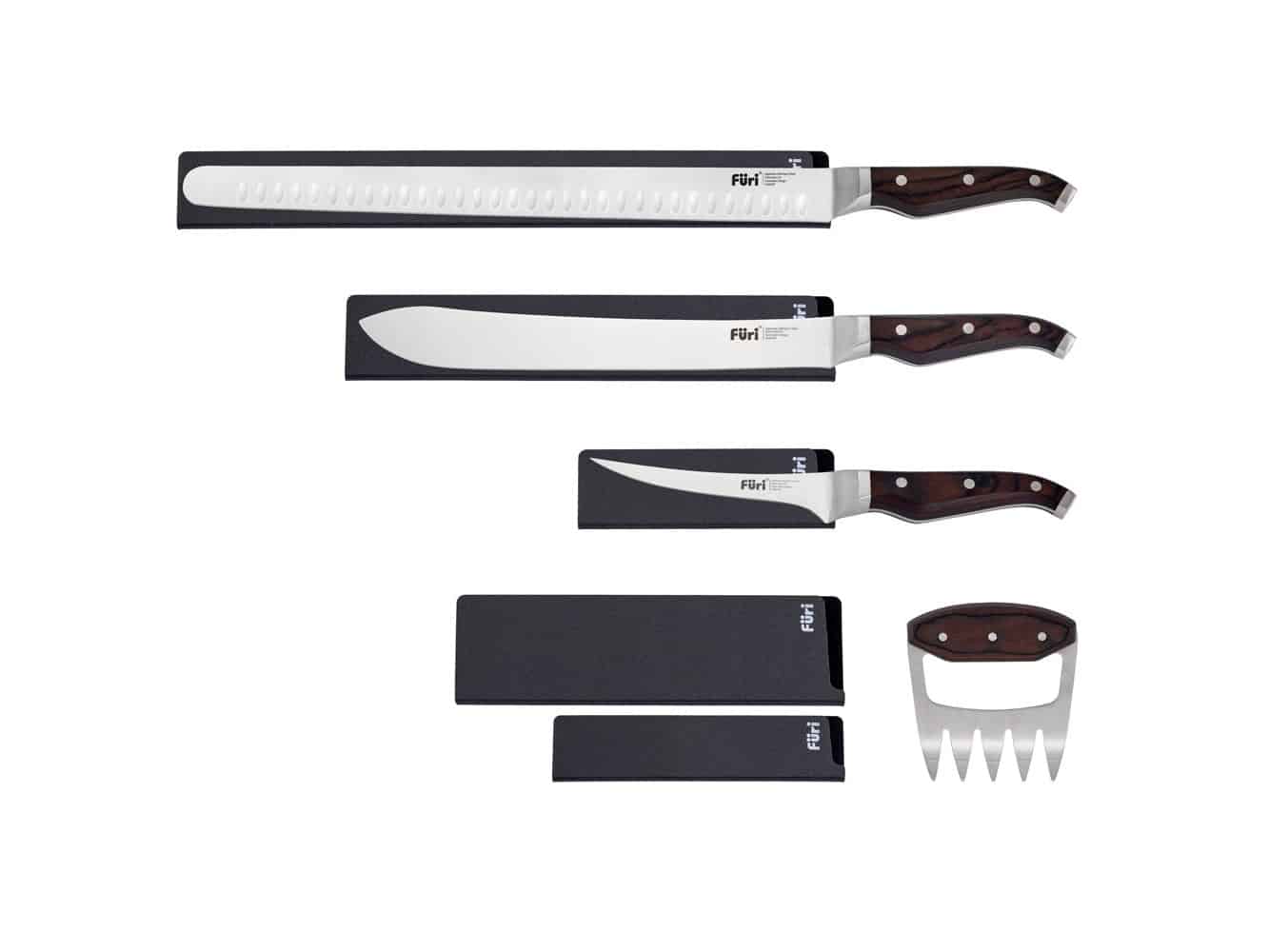
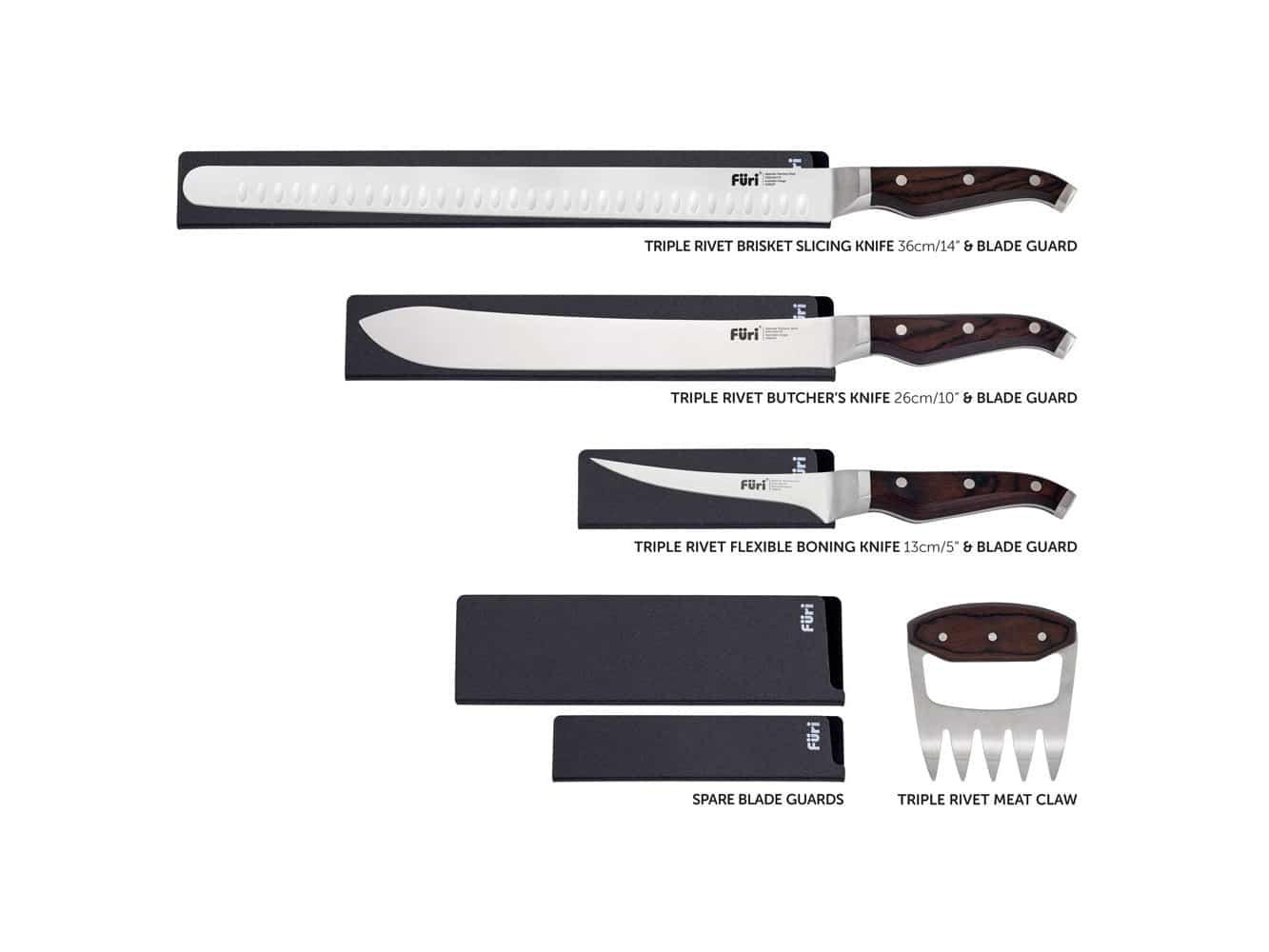
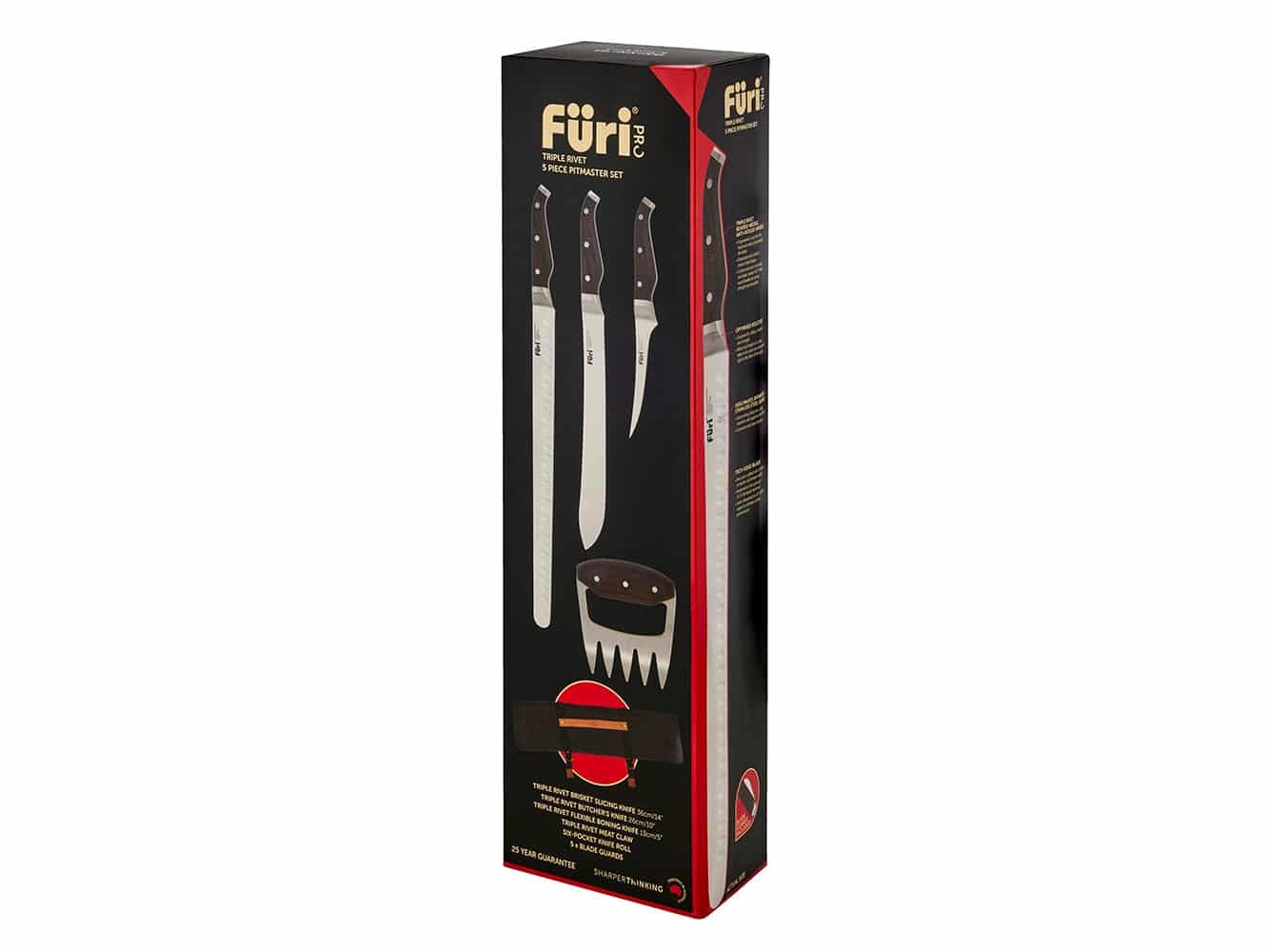
The Furi Pro Triple Rivet Pitmaster Roll Set is built around exactly that division of labour, which is why it’s the kit we have used through this guide. It’s a five piece set at $499:
- Brisket slicing knife, 36cm. The long blade is the point of it. Scalloped indentations along the edge reduce food cling, so a slice releases instead of sticking and tearing as you pull through.
- Butcher’s knife, 26cm. Curved, wide-tipped and long, for the trimming and the large cuts. This is the blade that separates the two muscles, and it is the Triple Rivet Butcher’s Knife 26cm.
- Flexible boning knife, 13cm. Tapered and curved, for fat, sinew and working in close.
- Meat claw. Holds the joint steady while you carve, and shreds the point end when you would rather pull it than slice it.
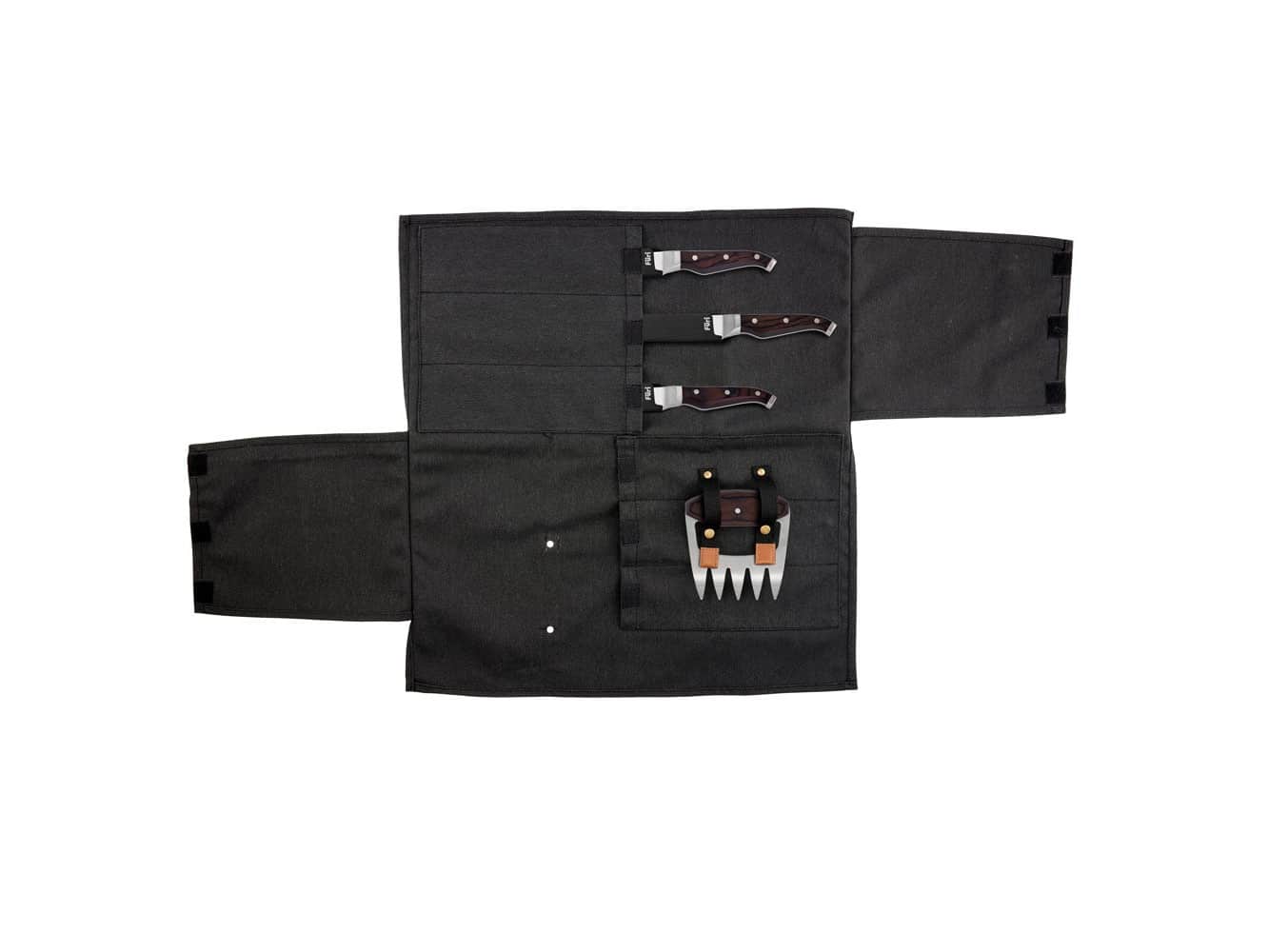
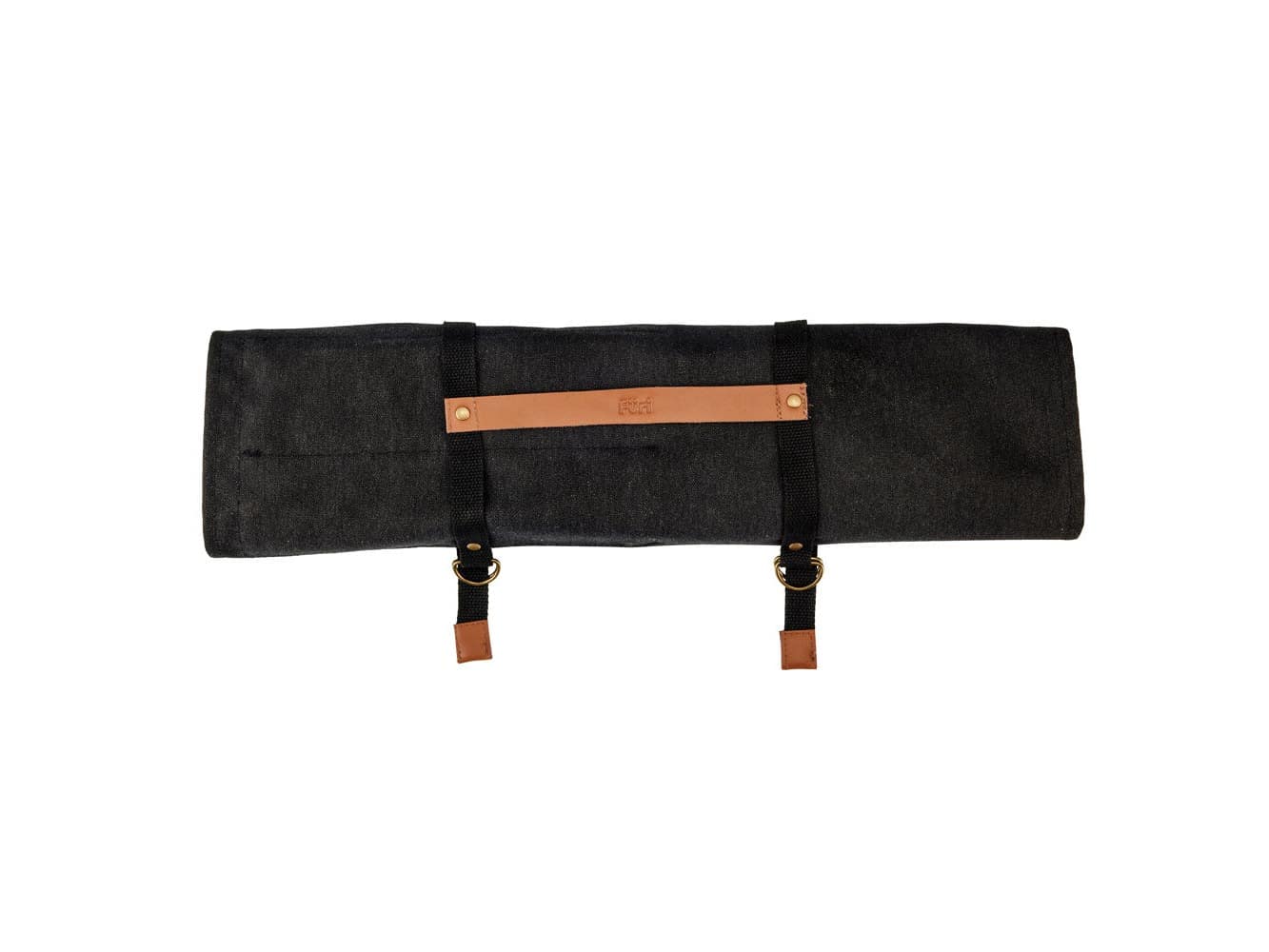
- Six-pocket knife roll. Cotton and polyester with a leather handle, plus five blade guards. Relevant if the brisket isn’t being cooked at your house, which it often isn’t.
Every blade in the five piece set is X50CrMoV15 Japanese stainless steel, hardened and tempered across fourteen steps to 55 to 57 on the Rockwell scale, then hand-sharpened to a 26 degree cutting angle. The handles are full tang, triple riveted, in FSC certified Pakka wood. Furi backs the knives with a 25 year guarantee. If you want the wider range rather than the barbecue-specific set, our guide to the best Furi knives and kitchen tools covers the everyday blades.
You’ll also want a board big enough to hold the whole cut with a juice channel around it, and somewhere to catch what runs off. A brisket gives up a surprising amount of liquid, and that liquid is worth keeping.
Step 1: Find the Grain Before You Cook
This is the trick that separates people who slice brisket well from people who guess. Once the cut is cooked, crusted with bark and dark all over, the fibres are genuinely hard to read. Before it goes anywhere near heat, take the boning knife and cut a small notch off one corner, square to the grain. When it comes off the heat hours later, that flat corner tells you instantly which way the fibres run, and you slice parallel to the cut you already made.
If you didn’t do this and the brisket is already cooked, look at the thin edge rather than the top. The bark hides the grain on the surface; the cut face at the end of the muscle usually shows it.
Step 2: Rest It, and Mean It
Slicing a brisket straight off the heat is the most common way to waste one. The muscle is still contracted and full of liquid under pressure, and every cut you make lets that liquid run onto the board instead of staying in the meat. An hour is the floor. Two is better, and a brisket held wrapped in an esky will sit happily for several.
Rest it unsliced. Slice only what you’re about to serve, because a sliced brisket dries out quickly and a whole one doesn’t.
Step 3: Separate the Point End from the Navel End
If you have cooked a whole brisket, this is the step that decides everything. The two muscles have grains running at roughly ninety degrees to each other, and there’s a seam of fat between them that shows you exactly where they part.
Find the fat seam running through the cut, get the butcher’s knife into it, and follow it. You’re not carving here so much as persuading the two muscles apart along a line that already exists. Use the meat claw in your other hand to hold the joint steady rather than your fingers, because a rested brisket is soft, slippery and heavier than it looks.
Once they’re apart, put the point end aside. It goes back on for burnt ends, or it gets sliced separately at the end.
Step 4: Trim the Fat Cap
Some of the fat cap will have rendered into something worth eating. Some of it’ll have set into a firm white layer that nobody wants on a plate. Take the flexible boning knife and pare back the hard fat, leaving a thin even layer over the meat.
Work with the blade almost flat to the surface and let the flex do the work. This is the one job in the whole process where a stiff blade fights you.
Step 5: Slice the Navel End Across the Grain
Now the long knife earns its length. Set the navel end so the grain runs left to right in front of you, and cut down through it at ninety degrees to those fibres.
Three things matter here:
- Thickness. Around 6mm, near enough to the thickness of a pencil, is the convention among barbecue cooks and it holds up. Too thin and a slice falls apart under its own weight; too thick and you’re back to chewing through fibre.
- One pull, not a saw. A 36cm blade is long enough to cross the whole muscle in a single stroke. Let the length of the knife do it. Sawing compresses the meat and tears the crust off the edge of every slice.
- No downward pressure. If you’re pushing, the edge isn’t sharp enough. A properly sharp brisket slicer falls through rested beef under its own weight.
Lay the slices back in order as you go. It keeps them from drying and it looks like you knew what you were doing.
Step 6: Turn the Point End and Slice It Separately
Take the point end back out. Its grain runs across the direction you were just cutting, so turn it roughly ninety degrees before you start. Check the fibres again rather than trusting the geometry; the point end is an irregular piece of meat and it doesn’t always behave.
Slice it thicker than the navel end with the 36cm brisket knife, because it’s fattier and it holds together better. Or do what most people do with it and cube it into rough chunks for burnt ends, which is the point end playing to its strengths: more marbling, more connective tissue, and a piece that shreds rather than slices neatly.
Five Mistakes That Ruin a Good Brisket
- Slicing the whole thing at once. Cut what you’re serving. Sliced brisket dries within the hour.
- Treating it as one muscle. If you slice a whole brisket in one direction, half of it’s going to be tough, and it’ll be the half you were most proud of.
- Cutting with the grain by accident. Easy to do once the bark is on. This is what step one prevents.
- Using a short knife. A 20cm chef’s knife means multiple passes across the same slice, and every extra pass shows.
- Working with a blunt edge. Brisket is soft. A dull knife doesn’t cut it, it squashes it, and the juice ends up on the board.
Why the Long Blade Matters
A brisket slicer is a specialist and it looks it. At 36cm the Triple Rivet Brisket Knife is longer than anything else in a normal kitchen, and the reason is simply geometry: a slice of navel end can be 25cm across, and you want to cross it in one movement. Every time you stop and restart mid-slice you leave a ridge, and you drag the crust.
The scalloped indentations along the edge break the suction between the blade and the cut face. On a wet, soft, fatty cut that’s the difference between a slice that falls away cleanly and one that folds over and sticks to the steel. It’s the same principle behind a granton edge on a salmon slicer, and if you want to see the equivalent job on fish, our guide to filleting a snapper covers a blade doing the opposite work.
The 26 degree cutting angle and 55 to 57 HRC hardness are what let that edge stay usable across a whole brisket rather than fading halfway through. Hardness is the part that matters over a long cook: a softer blade rolls its edge on the first pass through a fat cap and never quite recovers.
Keeping the Edge
A brisket slicer gets used a handful of times a year, which is exactly why it’s usually blunt when you reach for it. Store it in a guard or the six-pocket roll rather than loose in a drawer, where the edge meets other steel. Hone before you cook rather than the night before, and hand wash: warm soapy water, blade pointed away, dried thoroughly straight after. Furi‘s own care advice for the range says the same, and a dishwasher will take the edge off a $499 set faster than any amount of use.
Storing What Is Left
Leftover brisket keeps better unsliced. Wrap the remaining piece with some of the rendered fat and any juice you caught on the board, and it’ll hold for three or four days in the fridge. Reheat gently and wrapped rather than in a hot pan, which drives out the moisture you spent all day protecting.
If you froze it, do it in a single piece rather than in slices. Slices freeze with too much surface area and come back dry.
How We Put This Guide Together
Cut names, cooking suitability and portion guidance come from Australian sources rather than American ones: Meat and Livestock Australia’s consumer site for the carcase breakdown and cooking methods, and Teys Australia for the difference between the point end and navel end and the raw-to-cooked portion sizes. Blade specifications, steel, hardness, sharpening angle, contents and pricing come from Furi‘s own published product information. Where a technique is a convention among barbecue cooks rather than a measured fact, such as the 6mm slice, we have said so.
If you want the rest of the setup rather than just the knife work, our barbecue must-haves rounds out the kit, and our gifts for foodies guide is where this set tends to end up for anyone shopping for someone else. And if after all this you would rather someone else did the work, the best steak restaurants in Sydney are right there.
Slicing a Brisket FAQs
Across the grain, at ninety degrees to the direction the muscle fibres run. A whole brisket has two muscles whose grains run at roughly ninety degrees to each other, so they must be separated and sliced in different directions.
Australian butchers sell it as point end brisket and navel end brisket, usually as separate pieces. American guides refer to the same two muscles as the point and the flat.
The navel end. Teys Australia describes it as larger and more evenly shaped than the point end, and lists smoked brisket among its ideal uses. The point end is more marbled and carries more connective tissue, which suits shredding and burnt ends.
Around 6mm, roughly the thickness of a pencil, for the navel end. The point end is usually cut thicker or cubed.
At least an hour, and longer is better. Slicing it straight off the heat lets the juice run onto the board instead of staying in the meat.
Teys Australia suggests buying 230 grams of raw brisket per person and serving 150 grams cooked, which accounts for the weight lost over a long cook.
A long slicing knife, ideally around 36cm, so the blade crosses the whole cut in one pull. The Furi Pro Triple Rivet Pitmaster Roll Set pairs a 36cm brisket slicer with a 26cm butcher’s knife for separating the muscles and a 13cm flexible boning knife for trimming fat.
Sorting Your Kit
Brisket rewards preparation more than technique, and most of that preparation happens before the meat arrives. Know which end you’re buying, know which way the grain runs, and have a blade long enough to cross it. The Furi Pro Triple Rivet Pitmaster Roll Set covers the three blades the job actually needs, and the 25 year guarantee means it should still be doing it long after you have stopped counting how many briskets you have got through.

























Comments
We love hearing from you. or to leave a comment.