

Updated:
Readtime: 7 min
Every product is carefully selected by our editors and experts. If you buy from a link, we may earn a commission. Learn more. For more information on how we test products, click here.
TAG Heuer has spent more than a century and a half in pursuit of the ultimate timekeeping tool. Chasing down accuracy to hundredths, thousandths, even ten-thousandths of a second is embedded in the brand’s DNA, and from dashboard instruments to the wrist-borne chronographs, it has repeatedly redefined what precision means throughout its history.
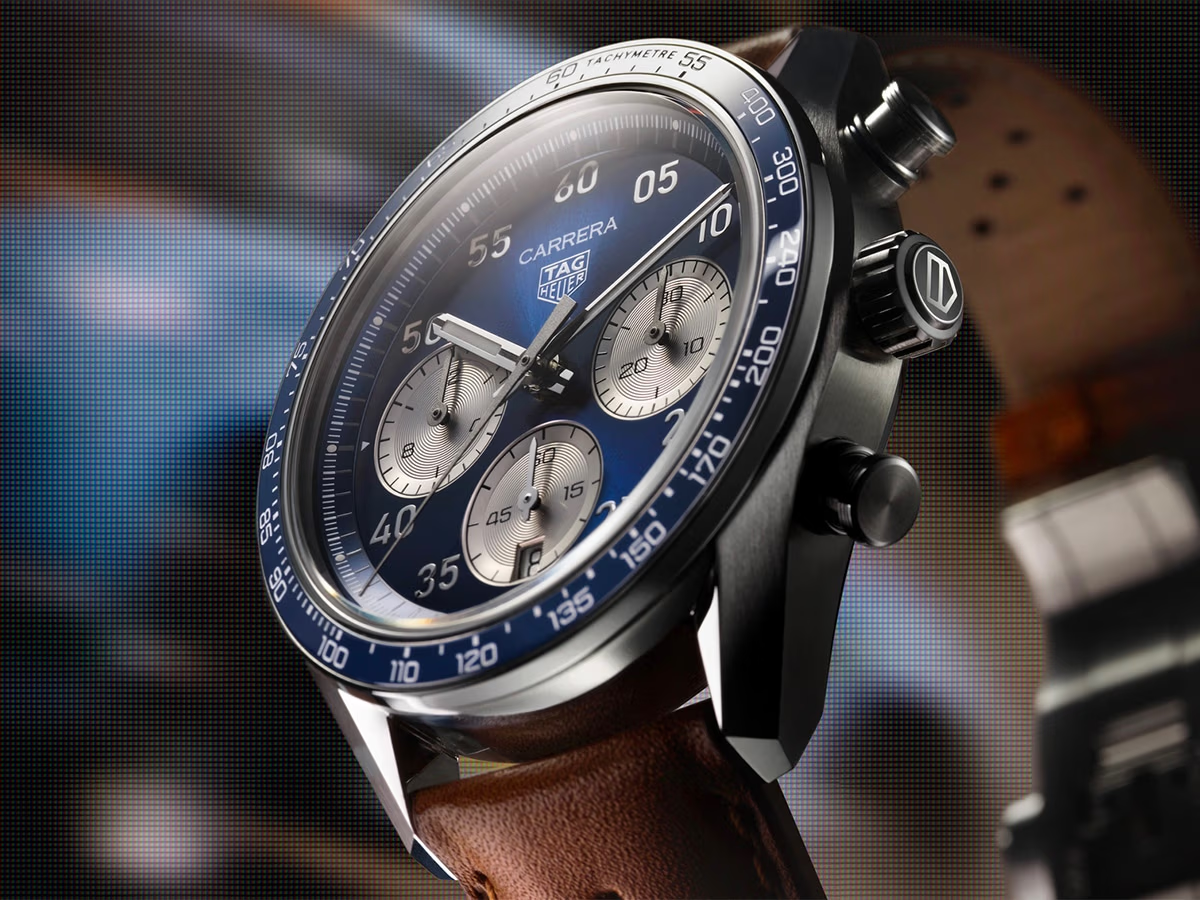
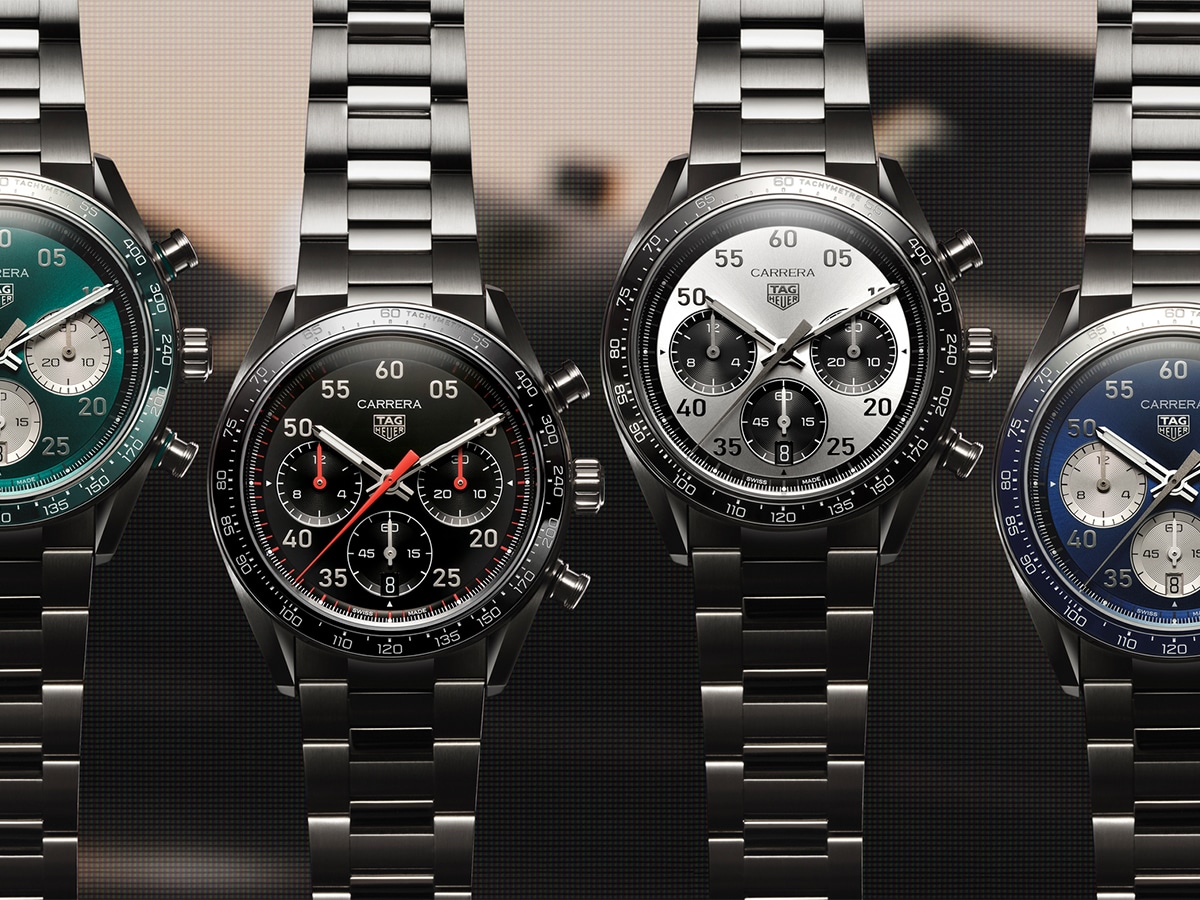
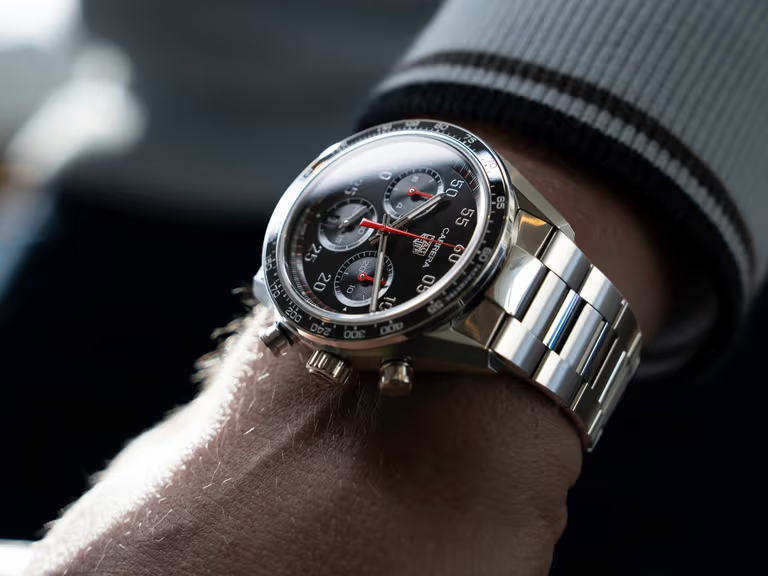
This journey of watchmaking prowess (and decades of unmatched passion for motorsport) came to a head recently with the new Carrera Chronograph Sport collection, perhaps the most significant milestone of the maison’s “Year of the Chronograph” celebration. Arriving hot on the heels of the Monza Flyback Chronograph, each of the collection’s five new references is a chronograph of the highest order; a superb racing tool that blends world-class engineering with an aesthetic that recalls the heart-pounding thrills of the world of motorsport.
But how did we get here? What makes TAG Heuer the chronograph maker of choice for discerning drivers, pit crews, and racing fans alike? Somewhat ironically, this pursuit of perfection is not a race, but rather a journey of countless innovations over the course of decades. So, read on to discover how the Official Timekeeper of Formula 1 came to craft these peerless tools for the track.
Founded on Innovation
From the moment Edouard Heuer founded his eponymous workshop in 1860, Heuer’s focus was to develop innovations that would allow it to craft more reliable, precise watches than its competitors. These watches were to be more capable than anything else out there, and it’s a mission that remains at TAG Heuer’s core 166 years later.
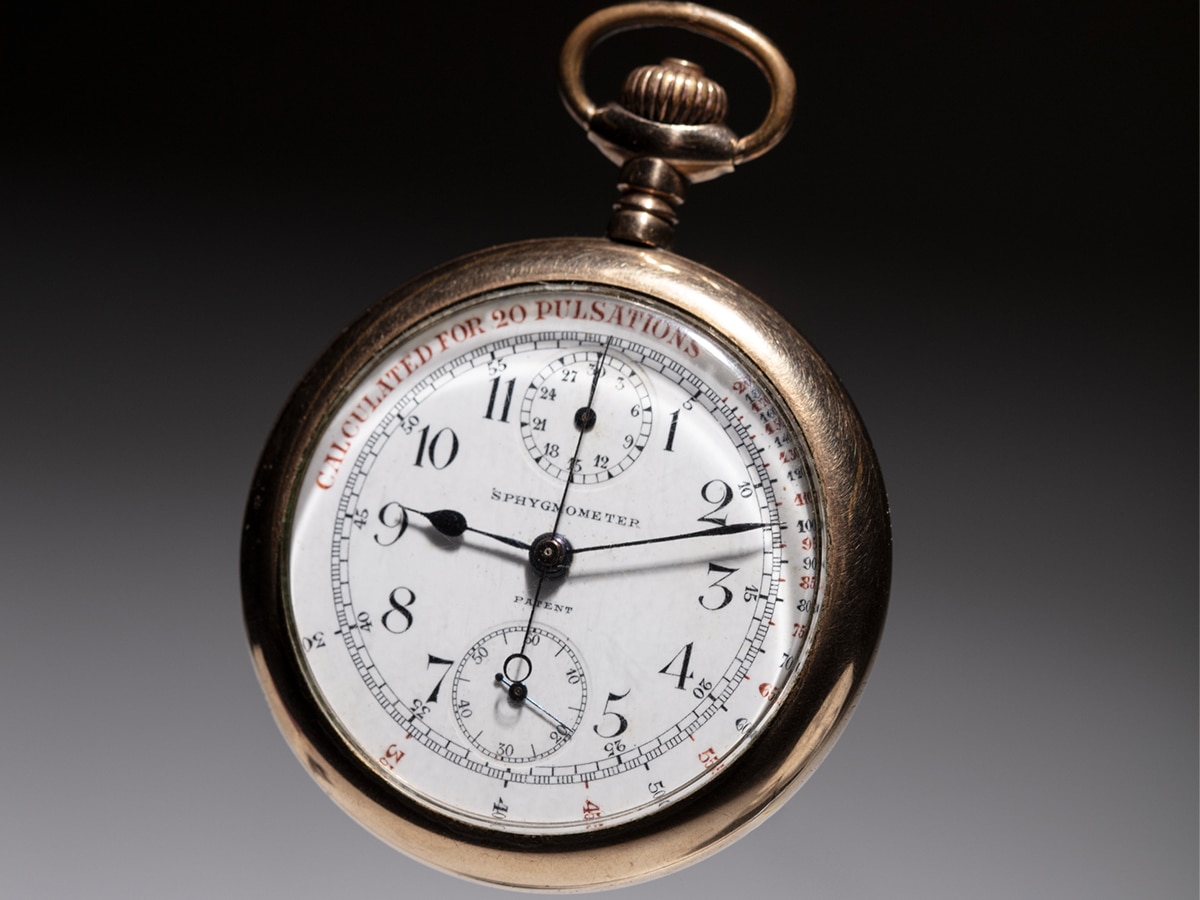
By 1880, Heuer was already filing patents that helped guide the trajectory of the watchmaking industry, while simultaneously laying the groundwork for its reputation as a chronograph specialist. That reputation only deepened when, in 1908, Heuer released the sphygmometer, a device that combined a moisture-proof case, a keyless winding mechanism, and an oscillating pinion into a single instrument that embodied Heuer’s devotion to functional design.
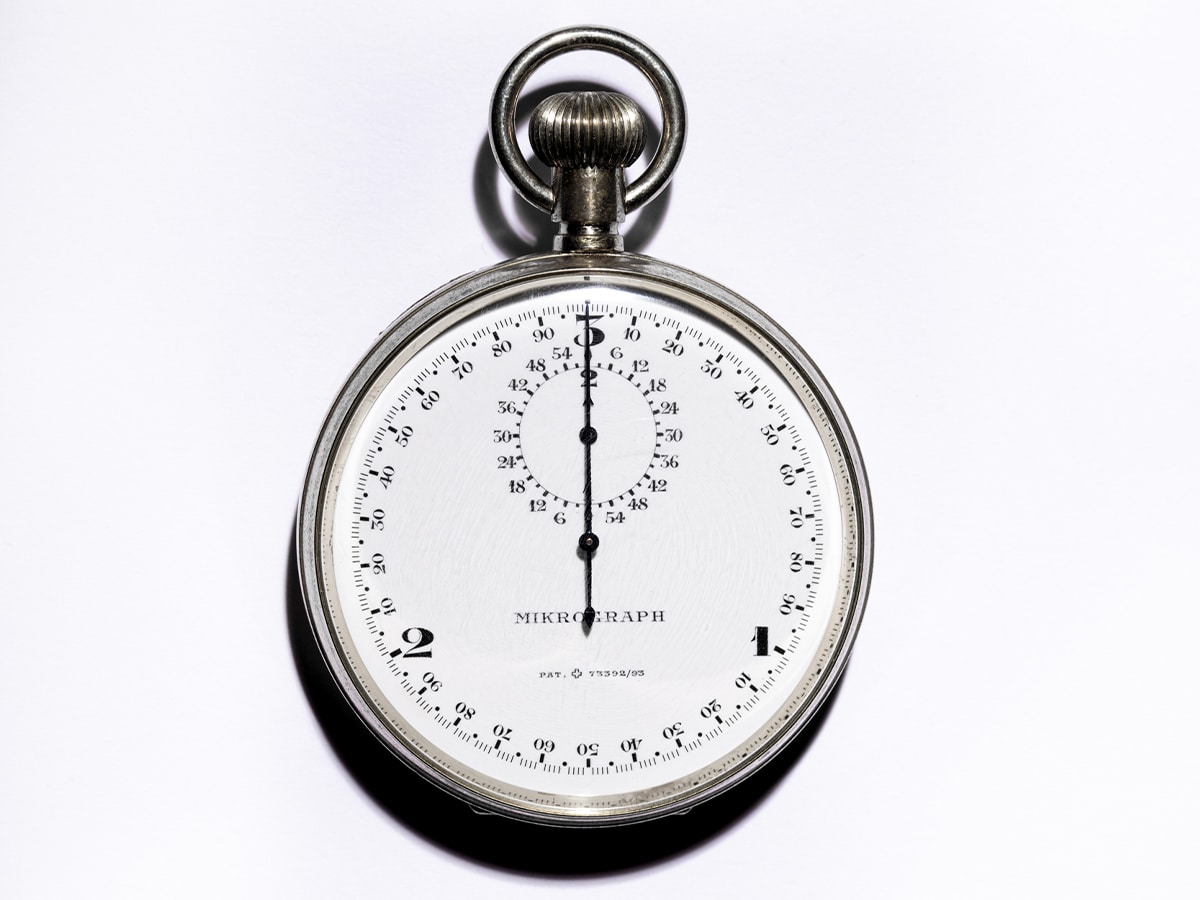
Providentially, this devotion collided with what would become an unceasing obsession with the automobile when, in 1911, Heuer unveiled the Time of Trip. This was a dashboard-mounted instrument that would time your journey, which was a genuinely novel idea for the era. Five years later, Heuer pushed this capacity for precision even further with the launch of the Mikrograph, the first stopwatch capable of measuring time down to 1/100th of a second. It was a leap that quickly became the benchmark for sports timing around the world.
From Dashboard to Wrist
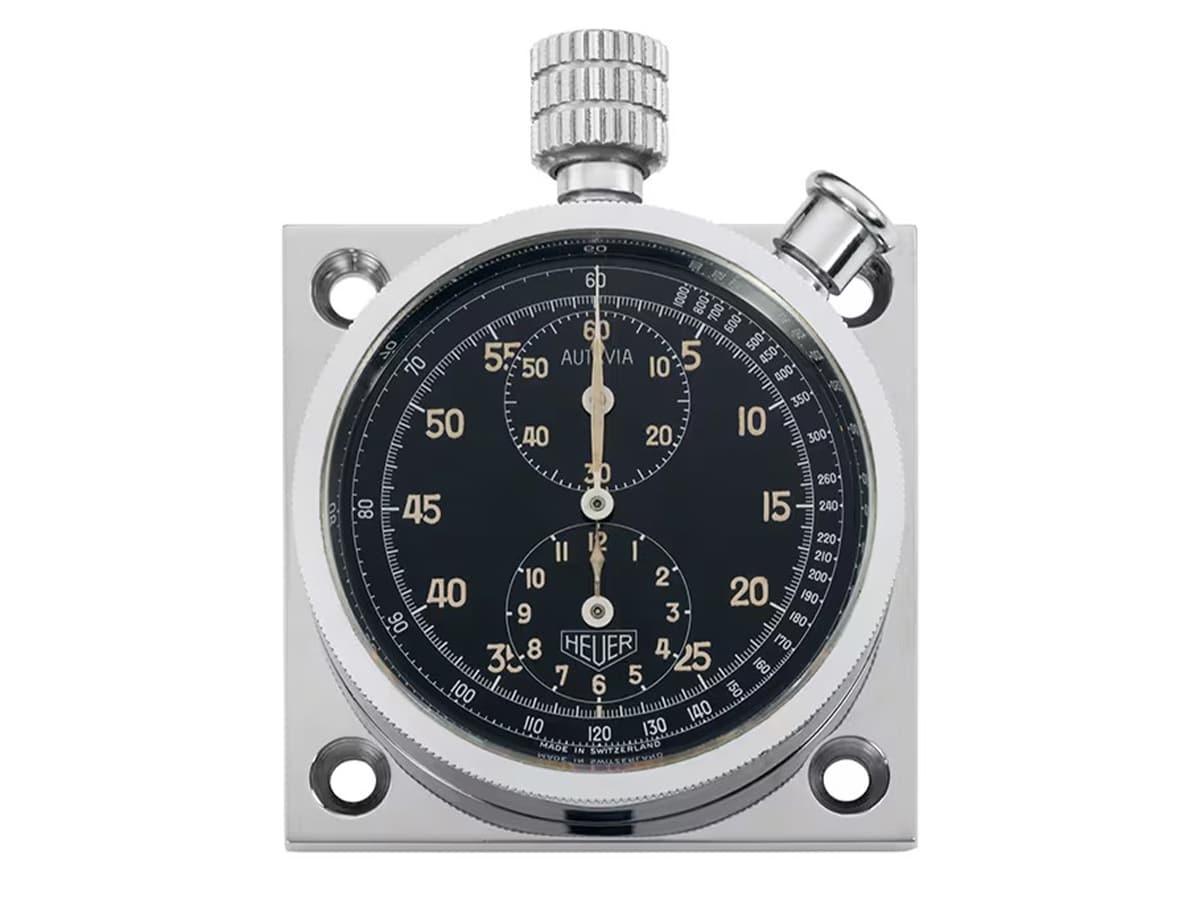
The brand’s motoring affiliation only grew with the 1933 release of a timekeeping device whose name would remain synonymous with motorsport for the remainder of the century. The Autavia, a 12-hour spotwatch whose name was derived from the fusion of “automobile” and “aviation”, embodied Heuer’s dual fascination with speed on the road and in the air. Paired with the brand’s Hervue eight-day clock, it became an indispensable piece of equipment for both aircraft and automobiles.
The ‘40s brought with it a subtle but no less essential chapter of Heuer’s story, establishing the foundations of the modern sports chronograph in the process. Over that decade, the brand developed larger cases, luminous dials, and bigger crowns and pushers that prioritised legibility and usability. This helped to define many of the design codes we still recognise to this day.
In the following decade, Heuer made a decisive bet, cementing authority over its own unique position within the watch landscape: it stopped making time-only timepieces to make way for a sharpened focus on chronographs. The move introduced a new, entirely modern design language and technical mastery upon which the brand’s future would be built.
An Era of Icons and Accuracy
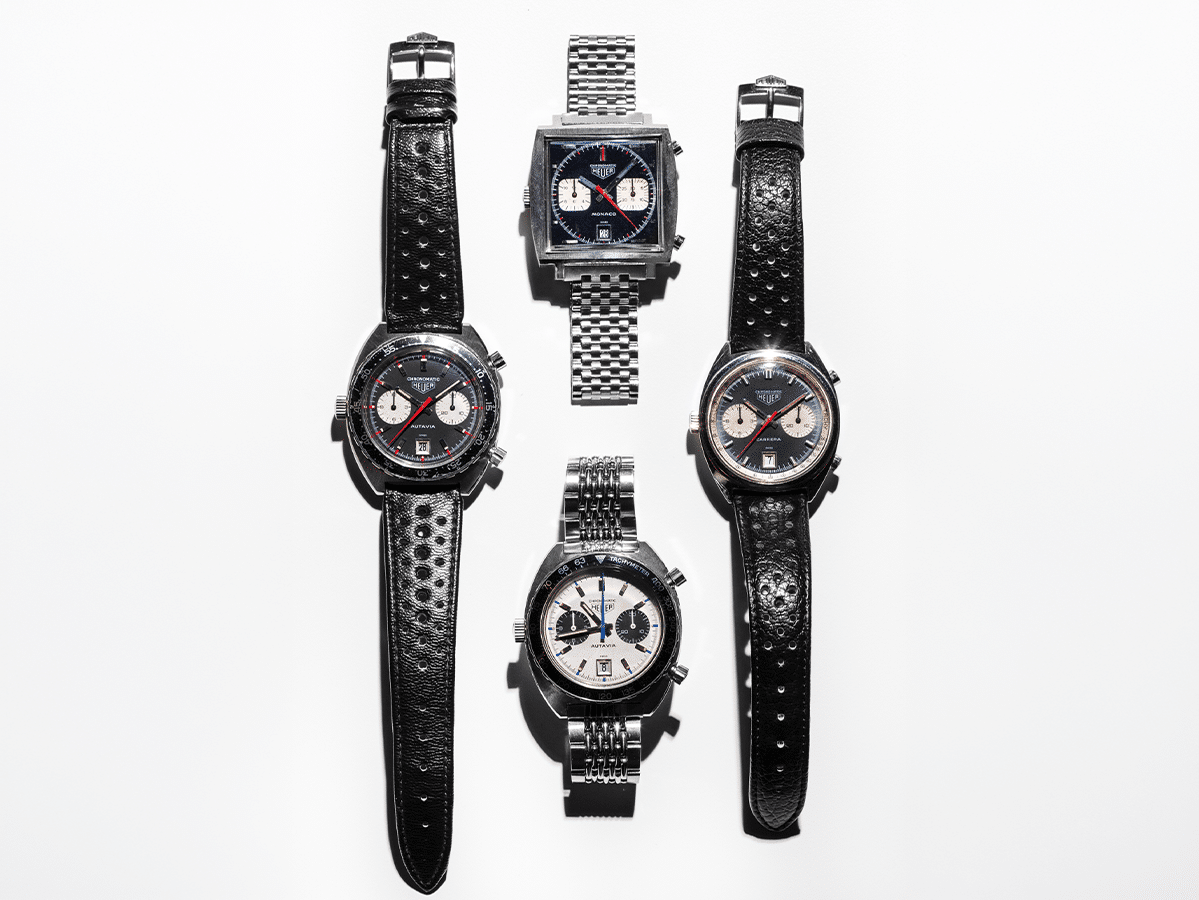
Under the stewardship of Jack Heuer (Edouard Heuer’s great-grandson), the 1960s became a golden decade for the watchmaker. In quick succession, three wristwatches were developed that would go on to become horological legends: the Autavia (not to be confused with the aforementioned stopwatch), the Carrera, and the Monaco. Each of these blended an acute technical rigour with a strong visual identity in a way that proved beyond a shadow of a doubt that precision instruments could also be considered objects of desire.
Then, in 1966, Heuer’s obsession with fractions of a second reached new heights with the Microtimer. The first fully electronic timer capable of reading out time to the thousandth of a second.
Three years later, that same relentlessness produced a genuine watchmaking milestone: the Calibre 11 “Chronomatic” movement. It was among the world’s first commercially available automatic chronograph movements. Installed in the aforementioned Monaco, it proved a turning point not just for Heuer but for the whole watchmaking industry.
Taking to the Racetrack
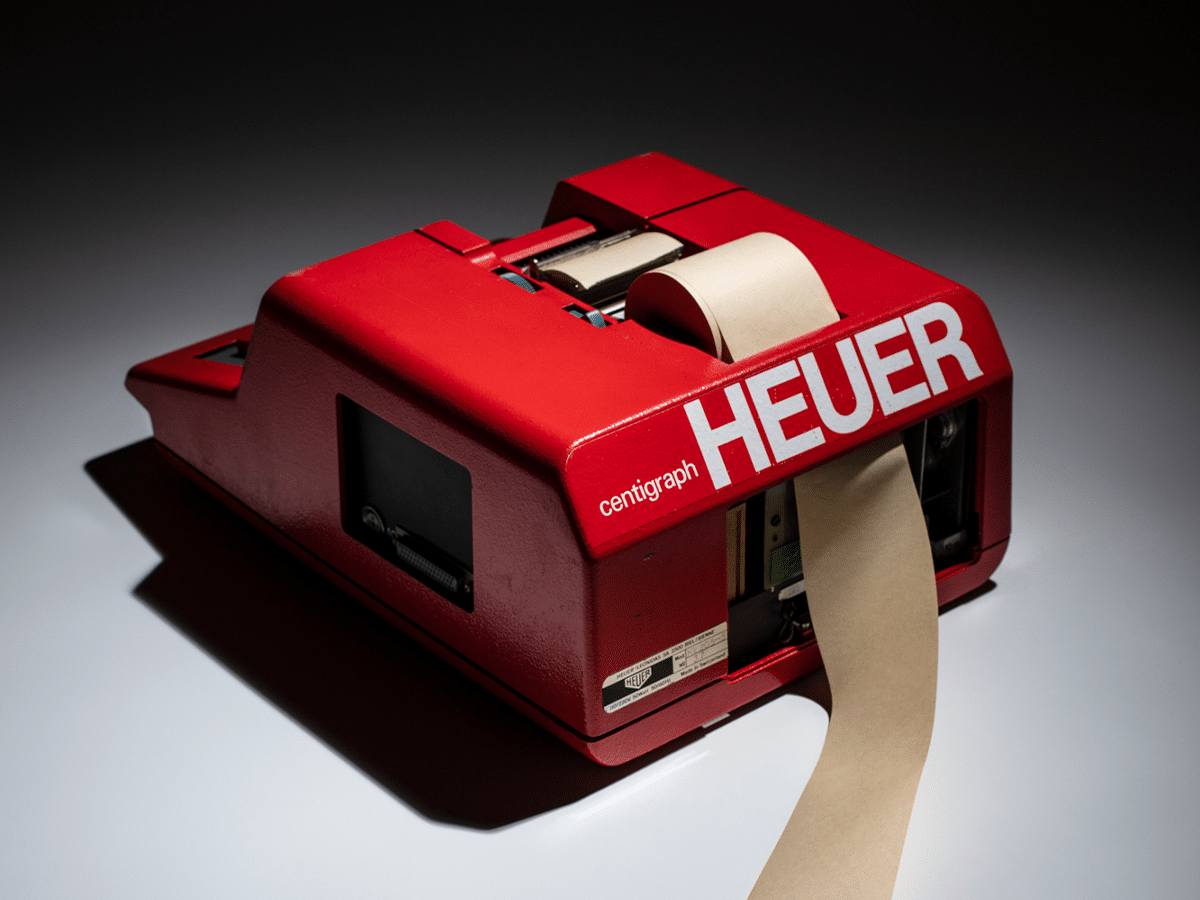
Heuer’s affinity for motorsport, evident since the Time of Trip, was first formalised in 1971 when the maison partnered with Scuderia Ferrari in order to outfit the team’s test track with the era’s most cutting-edge timing technology. Included was Heuer’s groundbreaking 1/1,000th second Le Mans Centigraph, which became an essential tool for the team and accompanied them worldwide.
This extreme expertise was again demonstrated in 1975, when the brand’s newly created Heuer Mikrotechnic division delivered its first quartz-powered wristwatch, the Chronosplit. The first wristwatch chronograph accurate to 1/100th of a second, it was a feat of extraordinary minaturisation that saw technology journey from desktop units through to neck-worn stopwatches and ultimately the Chronosplit wristwatch.
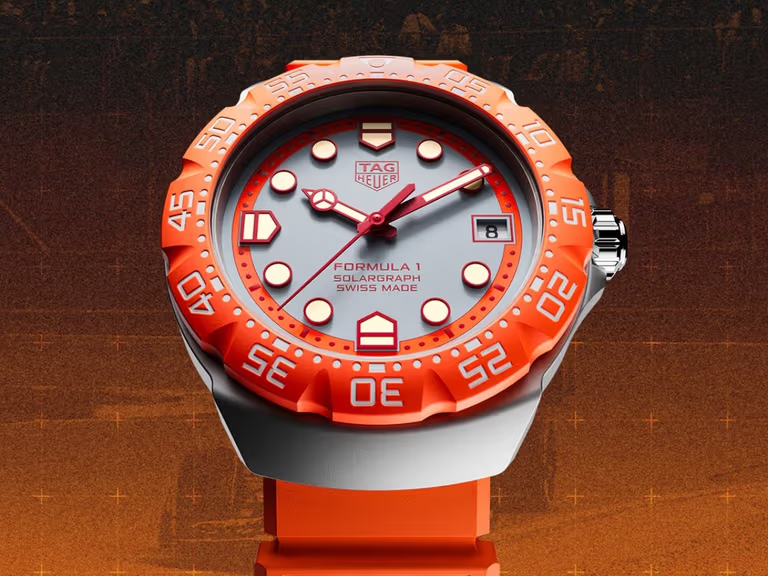
This motorporting spirit continued as the company entered a new chapter altogether when TAG—Techniques d’Avant Garde—acquired the brand, and Heuer became TAG Heuer. Wasting no time, the newly monickered watchmaker launched the Formula 1 collection in 1986 and expanded the line two years later with a chronograph version powered by an advanced Mechaquartz movement. Offered in black, blue, and red, it became a cultural touchstone, not least of which due to it going on to be worn by the McLaren Formula 1 team and, unforgettably, iconic Brazilian driver Ayrton Senna.
The Racer’s Watchmaker
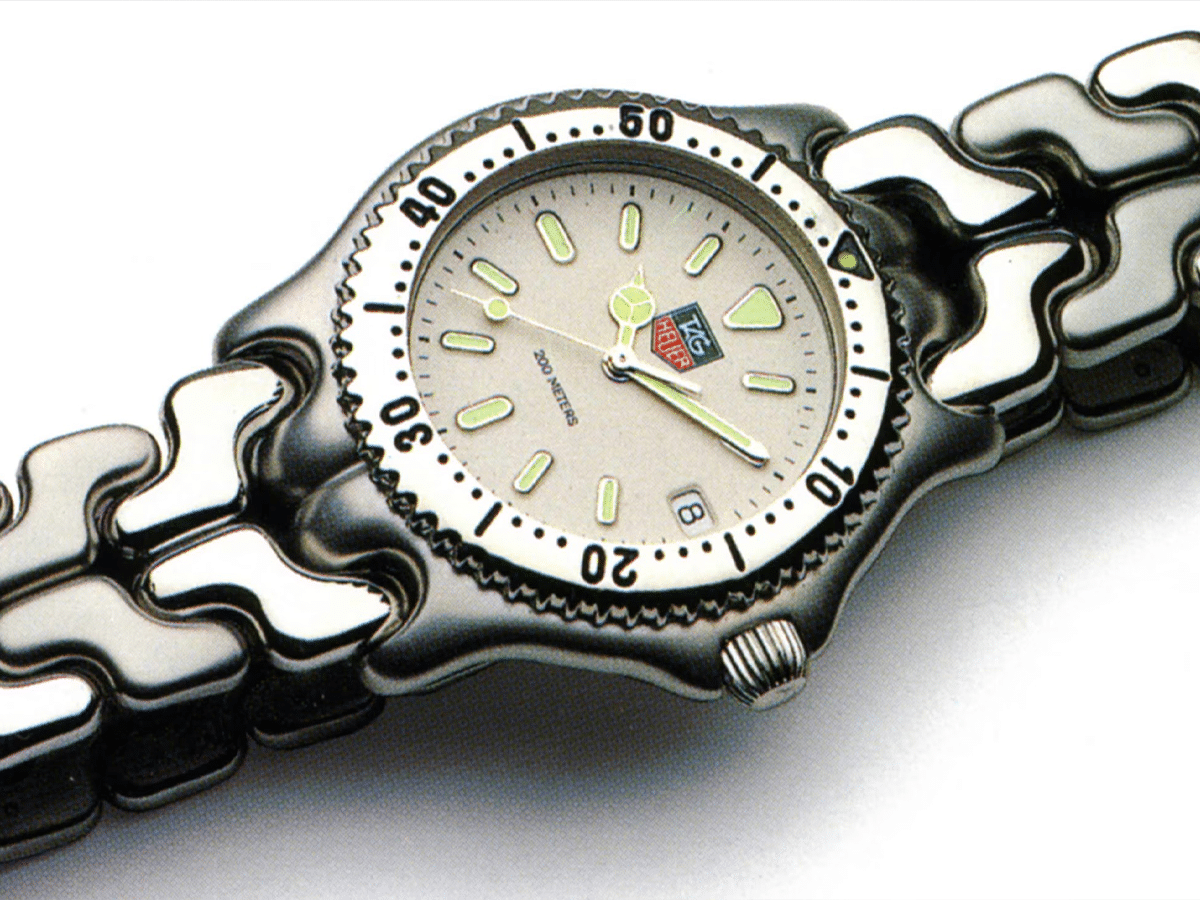
Senna’s watch of choice was actually the S/EL, short for Sport/Elegant, which TAG Heuer launched in 1987. When he signed with McLaren in 1988, he adopted the two-tone, split-seconds S/EL chronograph as his personal signature. So iconic was this pairing of driver and watch that the two are still linked in the public imagination decades later.
A similarly iconic pairing came in 1992, when TAG Heuer was named the Official Timekeeper of Formula 1. Built on more than a century of horological innovation, it’s a role the brand would hold for 11 years and then triumphantly reclaim in 2025.
In that intervening period, TAG Heuer would continue to develop extraordinary innovations, including the first chronograph designed to be fully functional underwater, the first timing system capable of recording 1/10,000th of a second, and the first mechanical wristwatch able to record 5/10,000th of a second.
The Year of the Chronograph
That brings us to 2026, a year in which TAG Heuer’s appetite for innovation shows no signs of abating as the maison has released one exceptional chronograph after another.
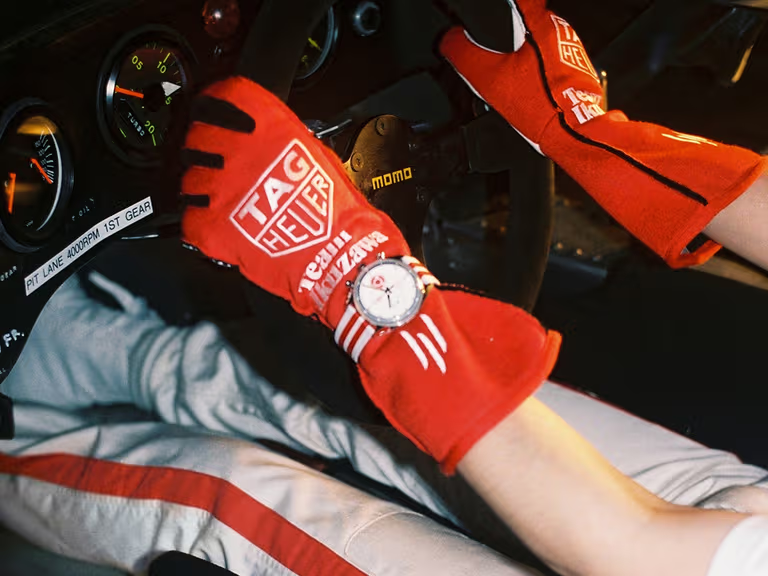
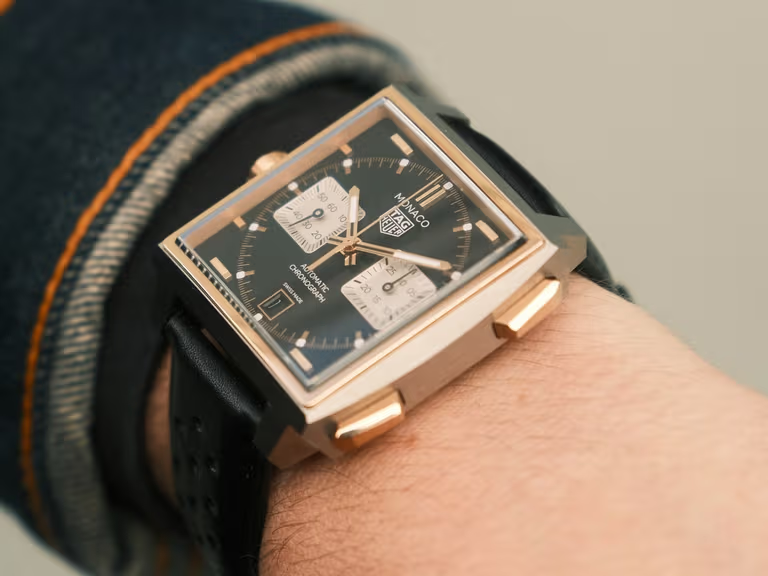
Their number includes, but is not limited to, the new Monaco Chronographs, powered by one of the brand’s most significant chronograph movements, the new Calibre TH-80; the Carrera Chronograph x Team Ikuzawa, which is a strong contender for the most stylish collaboration of the year; and, of course, those stunning Carrera Chronograph Sport releases we mentioned at the outset.
The last of these feels like we’ve arrived at motorsport’s perfect timepiece, as perhaps it should after 166 years of innovation and refinement. However, while the Carrera Chronograph Sport is undoubtedly a historic release, there’s no doubt TAG Heuer believes there’s still work to be done. Because, despite how immaculately engineered these timepieces are, when it comes to the chronograph, TAG Heuer can always improve on perfection.
















Comments
We love hearing from you. or to leave a comment.