


Updated:
Readtime: 15 min
Every product is carefully selected by our editors and experts. If you buy from a link, we may earn a commission. Learn more. For more information on how we test products, click here.
When Porsche rolled out the electric Macan, it was hard not to feel short-changed. It felt like a halfway house in the eye of strict emissions regulations, as if the brand had phoned in the assignment to satisfy regulators and not their diehards. What was delivered was a competent crossover, but one that lacked the mechanical soul that defines the badge on the steering wheel. The Macan GTS improved on the original significantly, but taking a safe, compromised approach with the Cayenne was never going to work.
It’s well documented that the Cayenne has paid the bills in Zuffenhausen since 2002, and high-water marks like the Porsche Cayenne Turbo GT proved just how great a full-size family SUV can be when a bunch of engineers are given the time and resources.
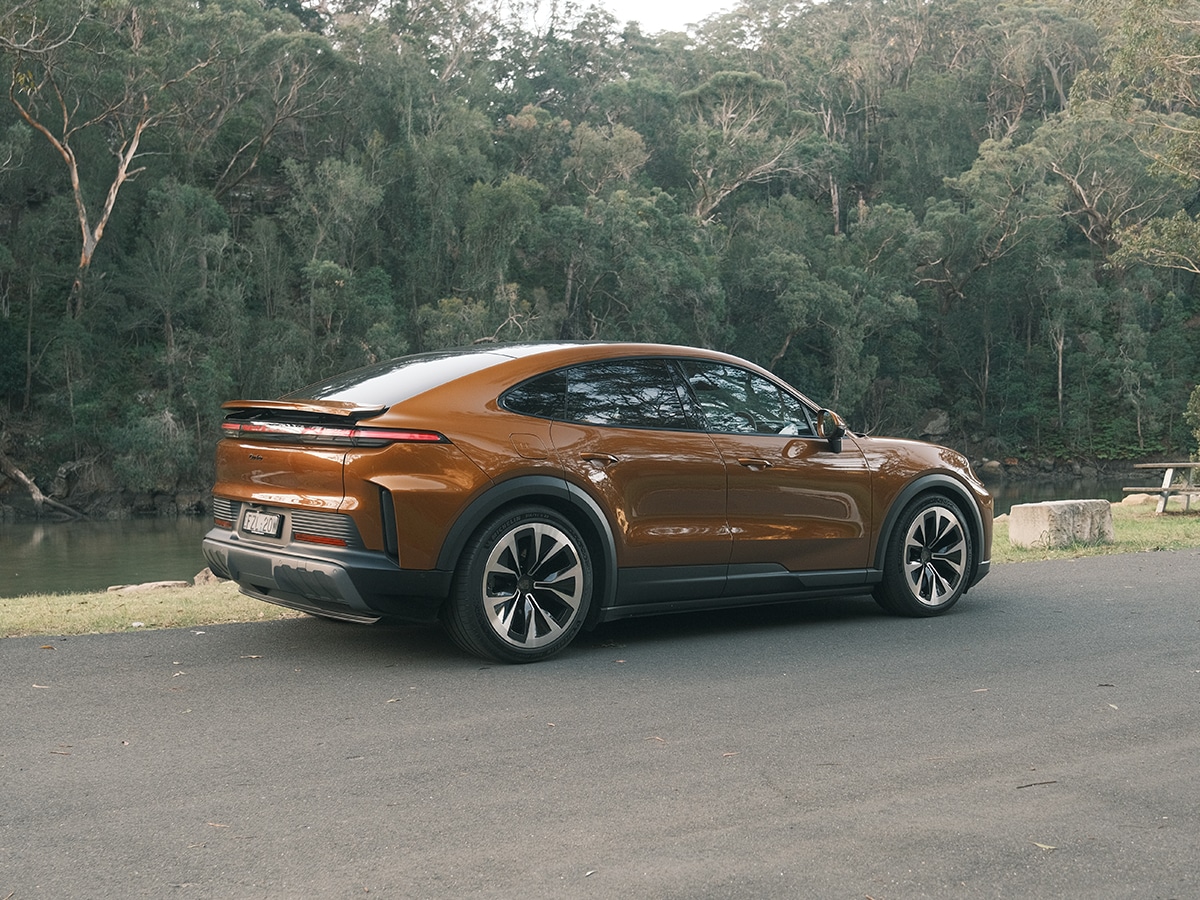
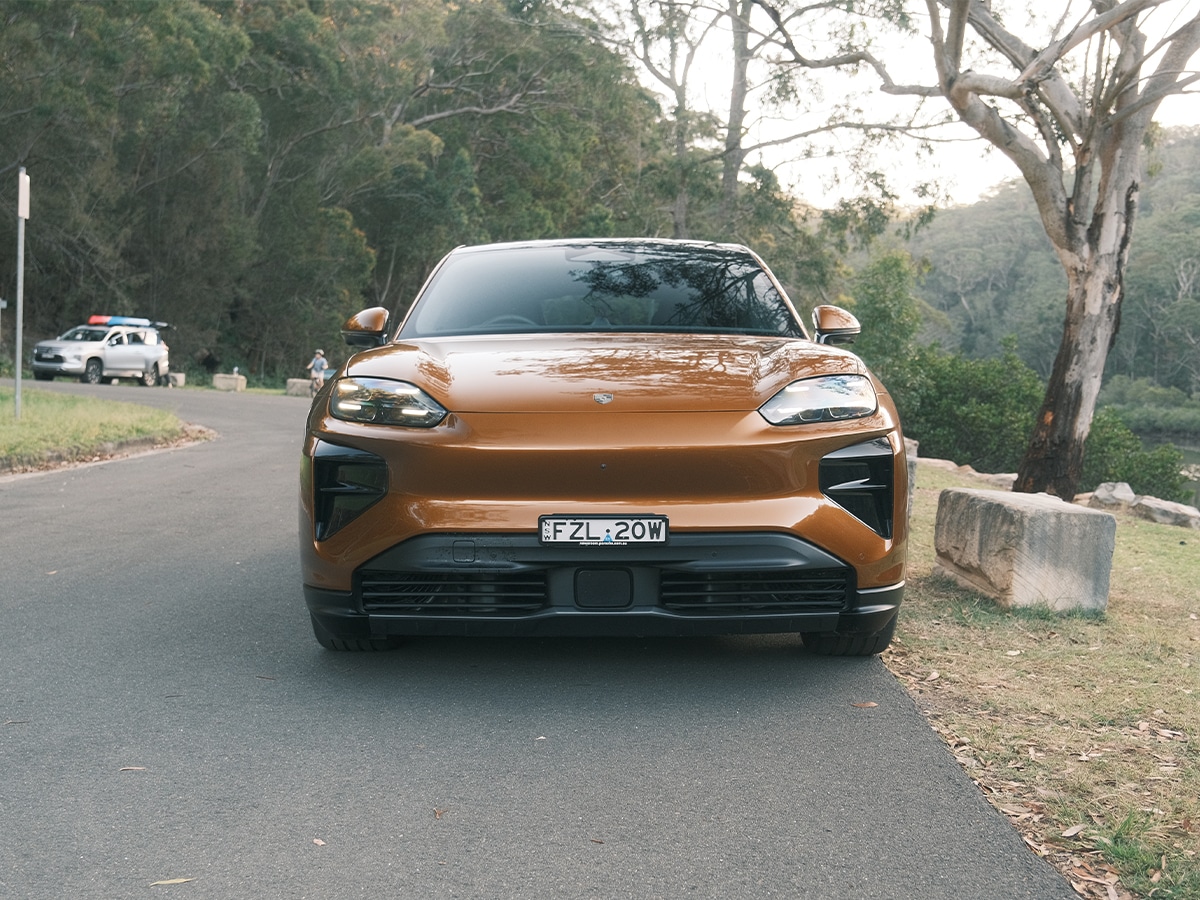
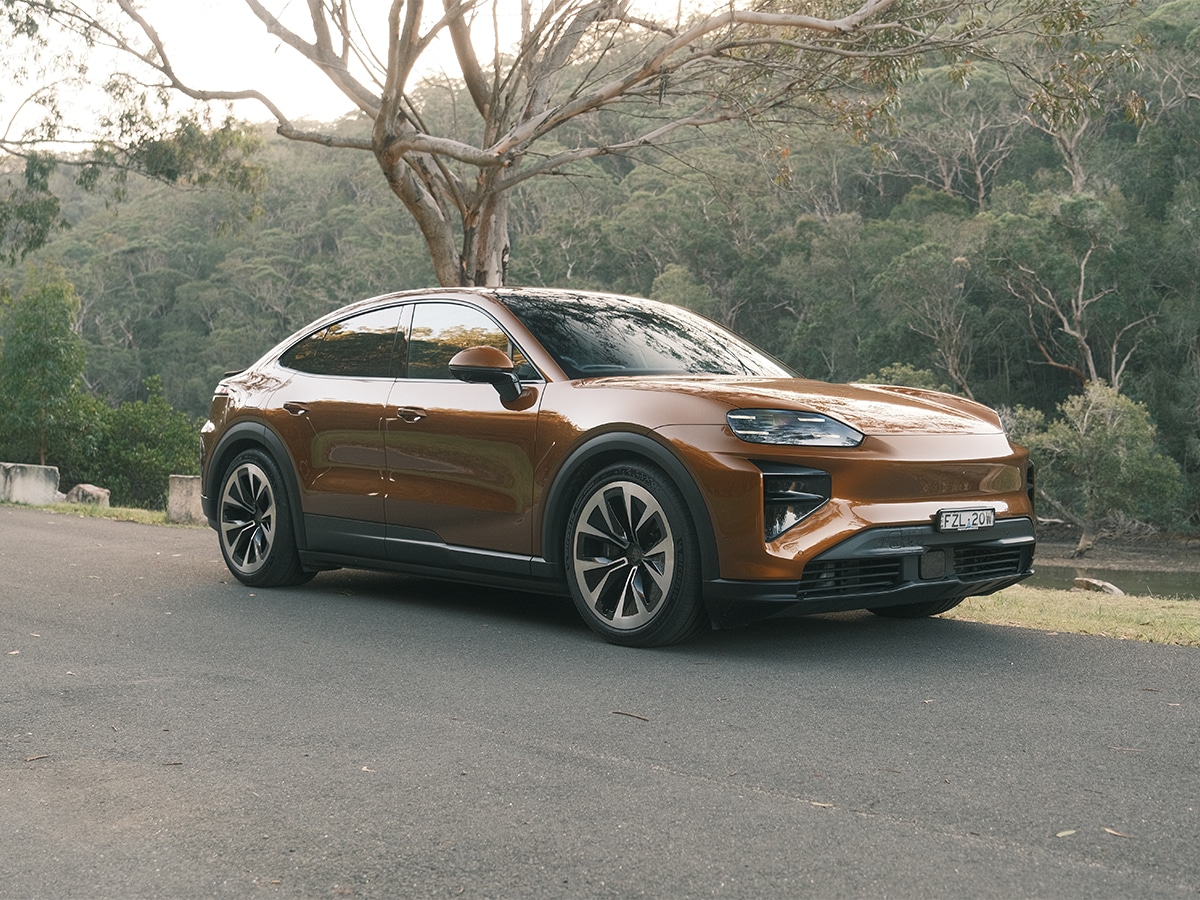
Here with the 2026 Porsche Cayenne Turbo Coupé Electric, it feels like management has done the same again. It’s as if they put their best mechanical and software engineers in a room, threw away the key, and refused to let them out until they built something that isn’t just another “best in the segment” but a leader in the automotive industry at large. Look past the repulsive Madeira Gold Metallic of this Cayenne Turbo Coupé Electric (from AUD$272,000 before on-road costs) and the AUD$101,180 worth of factory options stuck to it, and you find the benchmark for which all modern cars will be measured.
Porsche threw every mechanical, software, and computational trick in its arsenal at this car. It starts with the eye-watering peak output of 1,156 HP (850 kW) but extends to suspension technology that outright defies the laws of physics in Porsche Active Ride. On paper, building an electric four-door coupe that tips the scales at a hefty 2,645 kg unladen sounds like a textbook recipe for a sterile, blunt straight-line weapon. But after putting it through its paces across coarse-chip Aussie B-roads, twisty mountain climbs, and daily commutes, I came to the rather blunt conclusion that Porsche has built the new gold standard for electric vehicles.
| What We Loved | Room for Improvement |
|---|---|
| The 2026 Cayenne Turbo Coupé Electric delivers physics-defying performance. Its 1,156 HP dual-motor powertrain offers hypercar acceleration, while the Porsche Active Ride suspension completely masks its 2.6-tonne kerb weight. It retains daily practicality, ultra-fast 16-minute charging capability, and a genuine 3,500 kg towing capacity for true SUV versatility. | The entry price is steep, but the options list is exorbitant. Essential dynamic hardware like Active Ride and carbon ceramic brakes quickly inflate the bill well beyond expectations. Additionally, the heavy unladen weight slightly compromises ultimate cargo space, and the coupé roofline marginally reduces rear headroom compared to the wagon. |
Price, Availability, and Options
Priced from AUD$272,000 before on-road costs, the Cayenne Turbo Coupé Electric is more affordable than a Porsche 911 Carrera (from AUD$296,700) but more expensive than a Cayenne GTS (from AUD$209,600). It sits in this sweet spot quite well, by offering the performance of a 911 Turbo S (from AUD$577,300) and more luxury and technology than a Panamera (from AUD$246,700).
No Porsche stays standard, but our local models are highly specified from the factory. The Turbo Coupé arrives with adaptive 18-way electric sports seats, HD-Matrix LED headlights, 21-inch alloy wheels, and four-zone climate control. However, our test vehicle was heavily customised to showcase the Stuttgart options book with $101,180 in fitted extras. The total price as tested is a whopping AUD$373,180 before on-roads.
Here’s the full list of options as fitted to our test car:
- Porsche Ceramic Composite Brakes (PCCB) with high-gloss Black calipers: AUD$21,240
- Porsche Active Ride hydraulic suspension system: AUD$17,480
- Burmester 3D High-End Surround Sound System: AUD$9,630
- Decorative interior contrast stitching in Orange: AUD$7,250
- Augmented Reality Head-Up Display: AUD$5,020
- Inner door sill guards trimmed in leather with contrast stitching: AUD$4,970
- Passenger-side dashboard infotainment display: AUD$4,100
- Offroad Package: AUD$4,010
- Interior package in Turbonite leather: AUD$3,750
- Rear-axle steering: AUD$3,570
- Centre console side panels in leather with contrast stitching: AUD$2,370
- Extended grab handles in Turbonite leather with orange stitching: AUD$1,990
- Roof lining grab handles in Race-Tex with orange stitching: AUD$1,750
- Heated GT sports steering wheel with carbon matt inlay: AUD$1,300
- Illuminated brushed aluminium door sill guards: AUD$1,250
- Bespoke illuminated Turbo seat badges: AUD$1,250
- High-gloss Black painted rear model designation: AUD$1,170
- Porsche crests embossed on front headrests: AUD$1,000
- Tinted HD-Matrix LED headlights: AUD$990
- Surface heating package covering front and rear seats: AUD$970
- Air Quality cabin filtration system: AUD$890
- Illuminated seat belt buckles: AUD$750
- High-gloss Black side window trim surrounds: AUD$720
- Model logo embossed on centre console armrest: AUD$670
- Mood Modes ambient lighting package: AUD$500
- Preparation for Porsche Wireless Smartphone Charging: AUD$470
Buyers in Australia must keep local taxes front of mind. Depending on which state you register the car in, stamp duty adds anywhere between $30,000 and $38,000, which pushes the final drive-away price for a vehicle configured like this one well past AUD$410,000.
RELATED: 2024 Porsche Cayenne Is Still the Benchmark for SUVs.
Cabin Design, Ergonomics, and Practicality
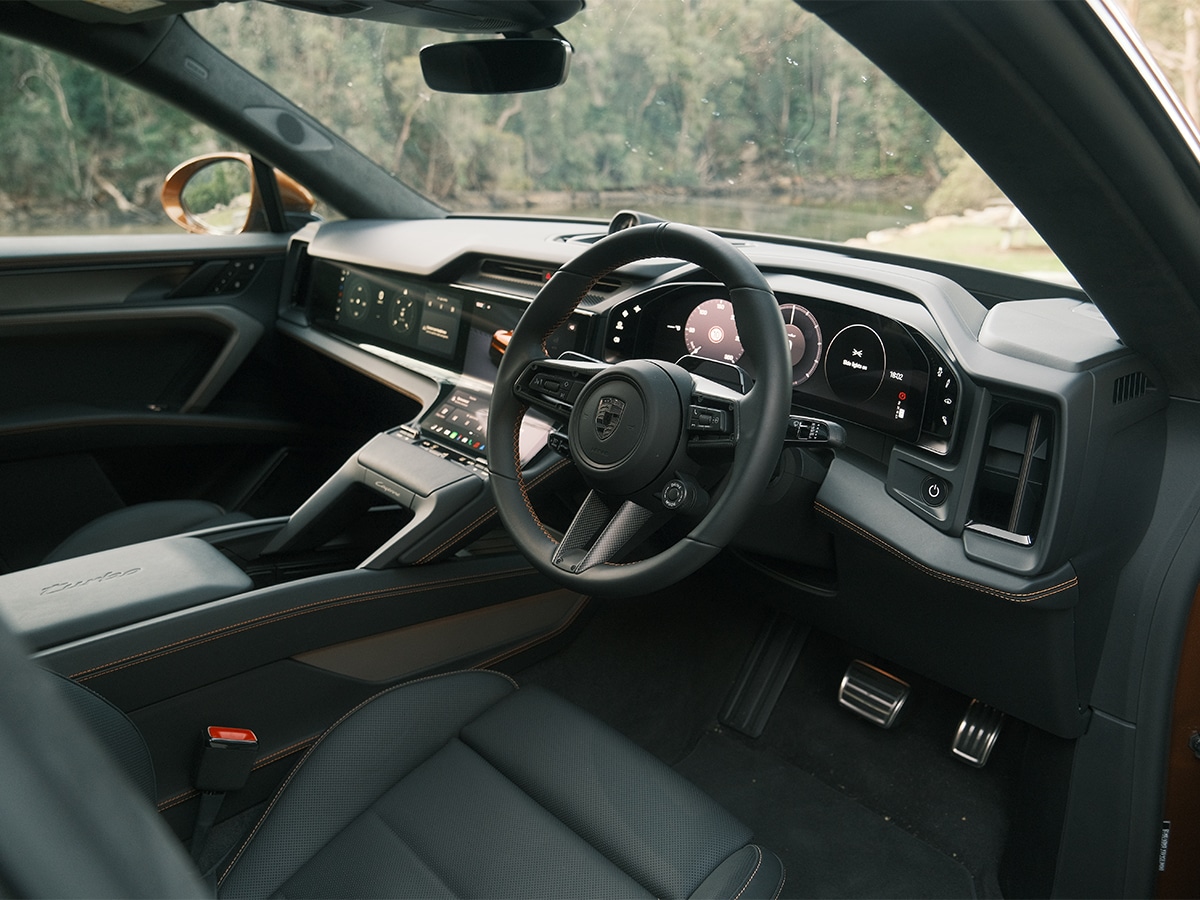
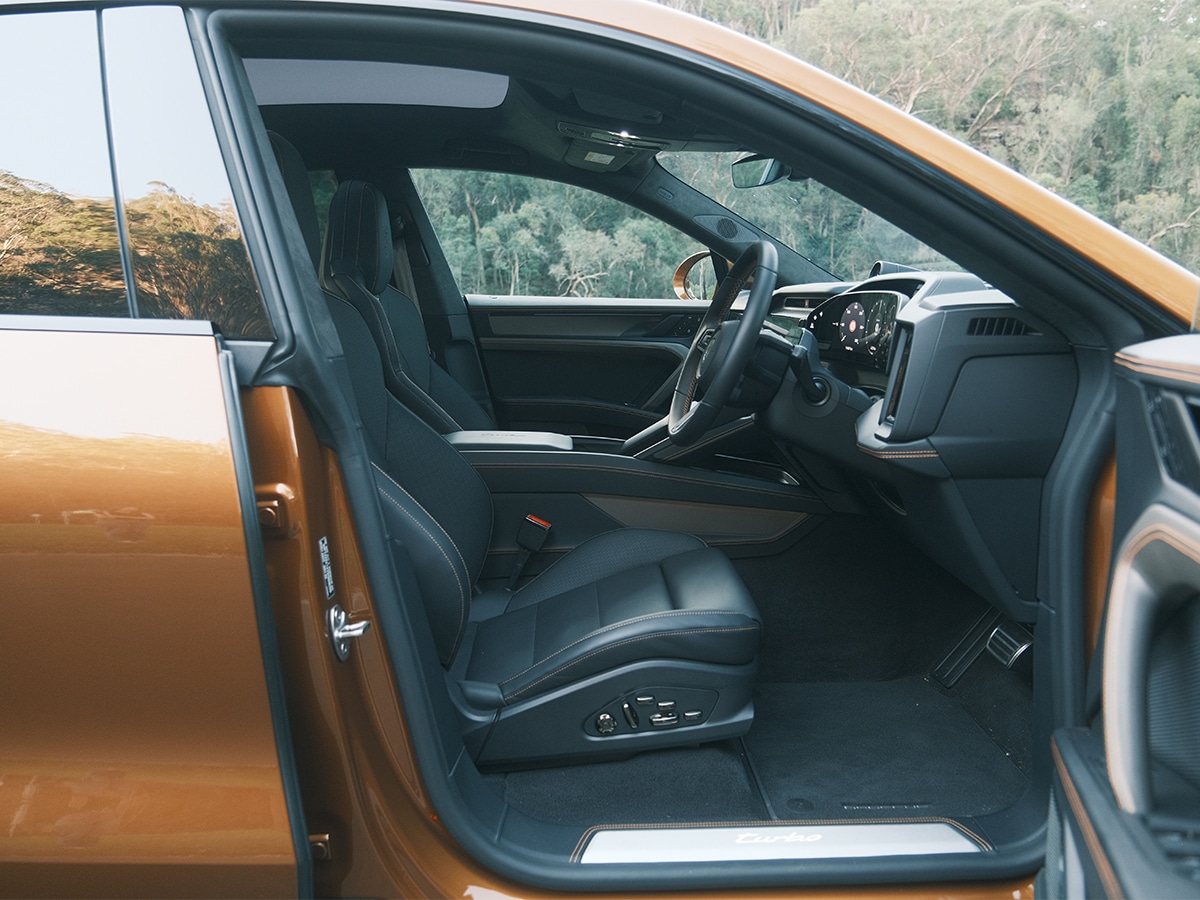
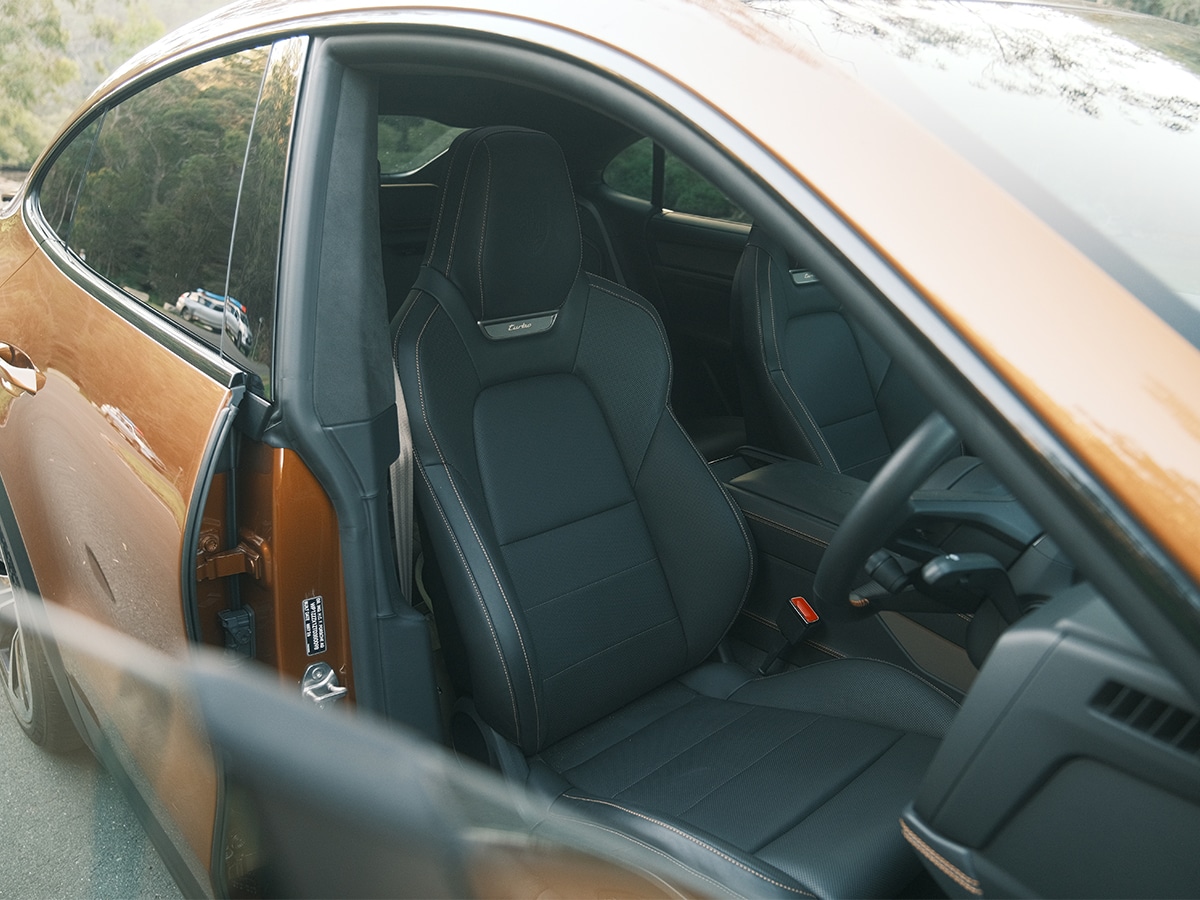
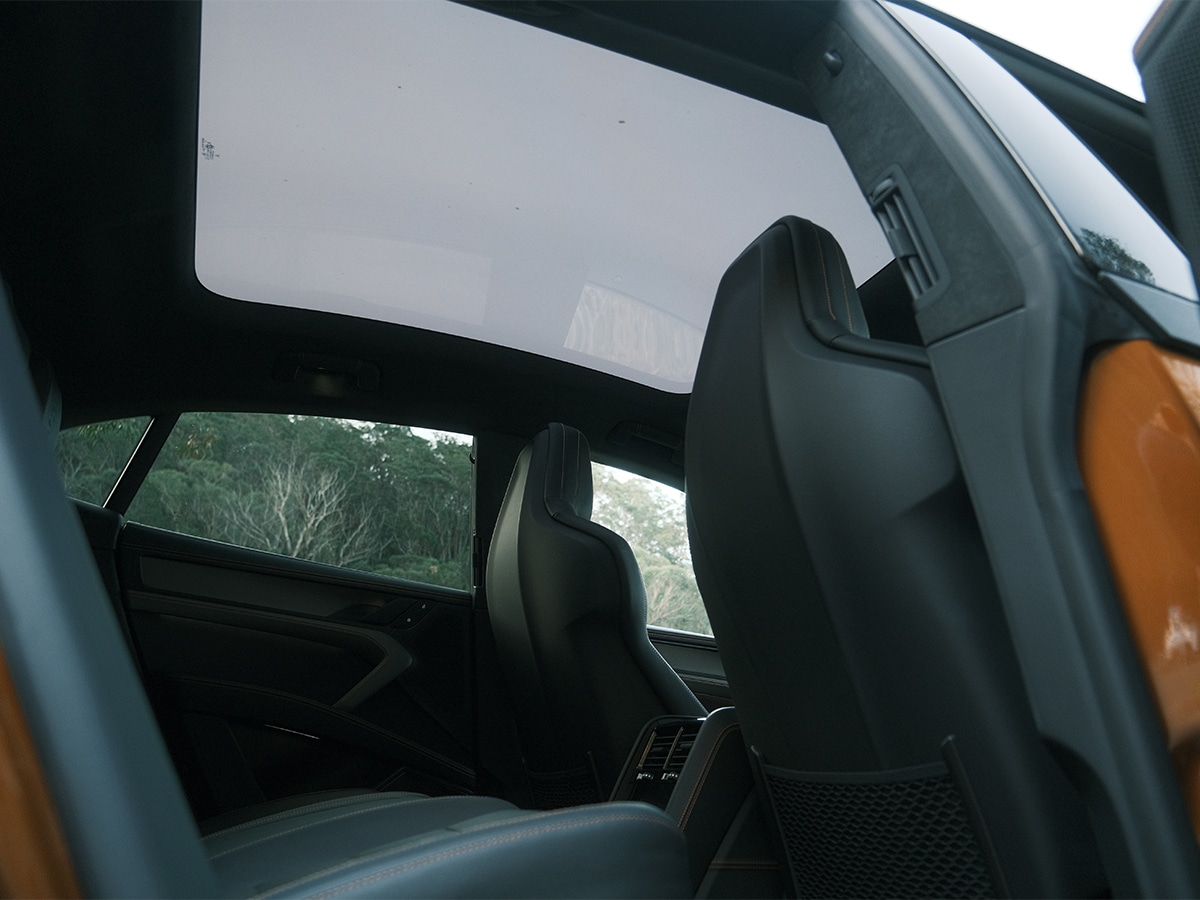
Hop inside the cabin, and the driver environment immediately feels as focused and purposeful as a Porsche should. You drop down into the exceptional 18-way electrically adjustable adaptive sports seats trimmed in smooth-finish black leather, and you notice how well the hip point is noticeably lower than that of conventional tall SUVs. The deep-seat bolsters grip your torso through hard cornering without pinching on longer highway stints. Even with an above-average 186 cm test frame, headroom is generous beneath the fixed panoramic glass roof.
The curved 14.2-inch OLED digital instrument cluster sits upright on the steering column, displaying high-resolution, anti-reflective dials that stay visible even in bright afternoon sun.
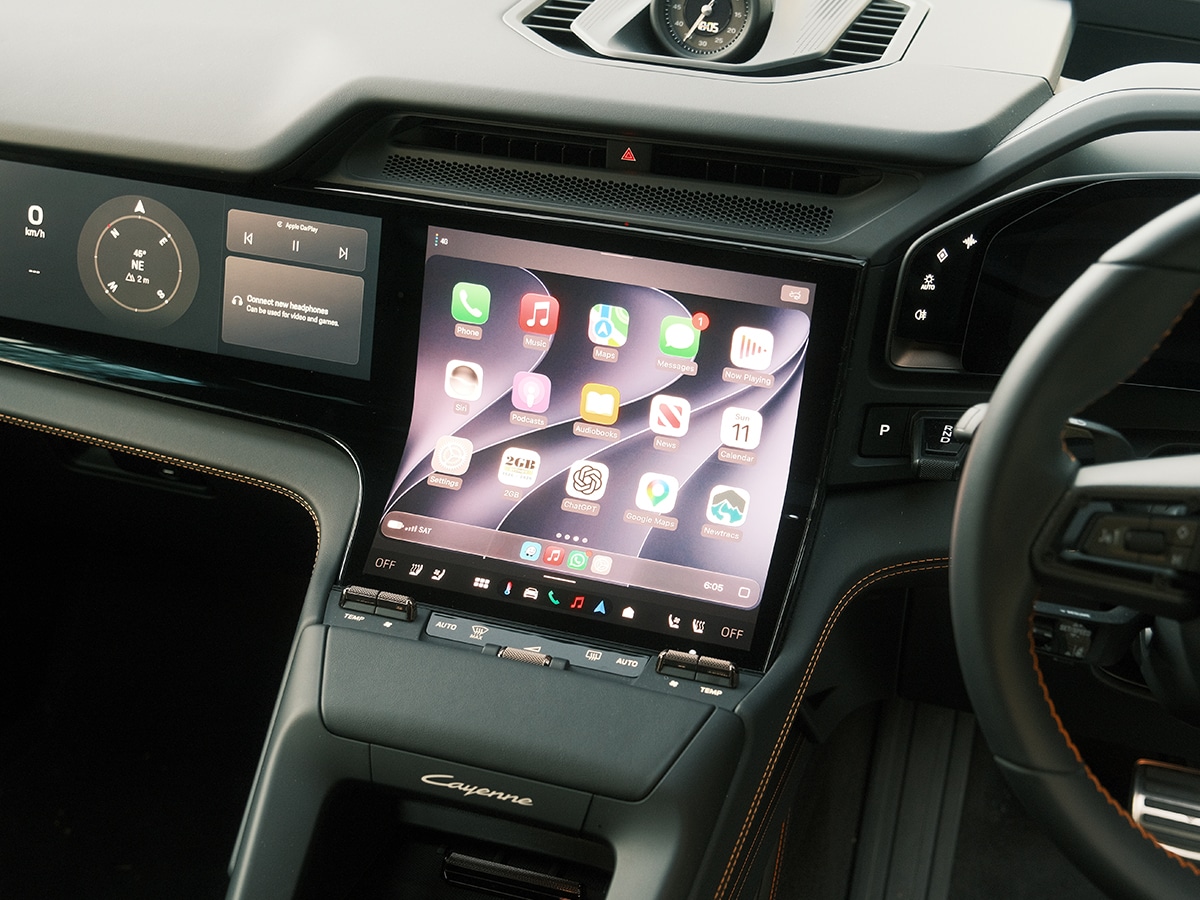
Centred on the dashboard is the curved 12.25-inch OLED Porsche Communication Management (PCM) touchscreen, which is exclusive to the Cayenne Electric. Porsche has included a supportive leather-padded wrist rest just beneath it, which makes all the difference when navigating menus while driving. Climate controls haven’t been buried in digital menus, and I quickly came to appreciate the solid, physical toggles on the console that directly control fan speed and temperature.
It’s hardly essential, but at AUD$4,100 the passenger screen lets your co-pilot manage media, input route waypoints, or view vehicle telemetry through a privacy filter that prevents driver distraction.
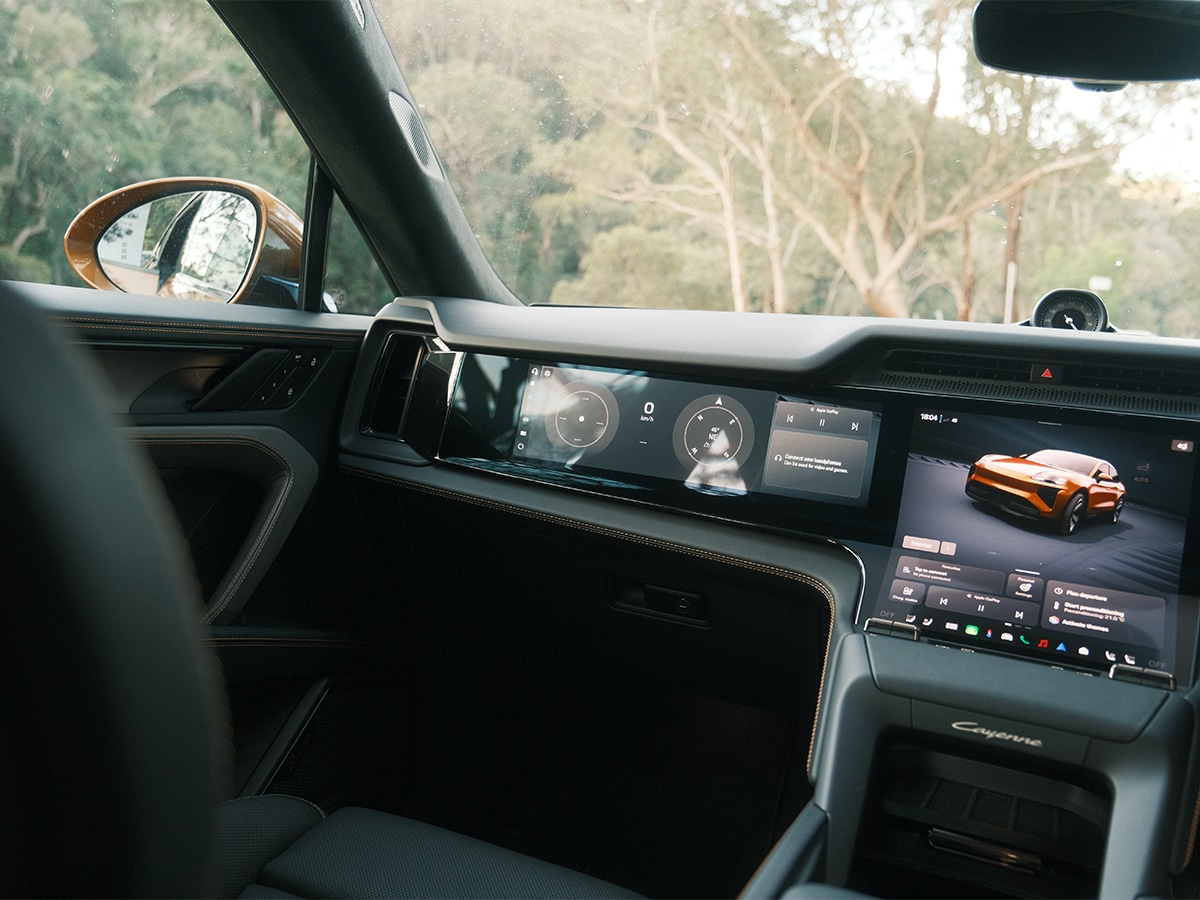
The test car brought plenty of visual drama inside with Turbonite seatbelts, illuminated Turbo seat emblems, and sharp orange stitching across the leather dashboard, door cards, and grab handles.
Material execution is rock-solid throughout, free from cabin squeaks or hollow-feeling plastics. The second row adopts a 2+1 seating configuration with electrically adjustable backrest rake and longitudinal sliding adjustments. Legroom is also plentiful, allowing tall passengers to sit behind a six-foot driver with room to spare. While the tapering roofline trims a little vertical room compared to the wagon-bodied variant, adults can sit comfortably without their heads brushing the headliner.
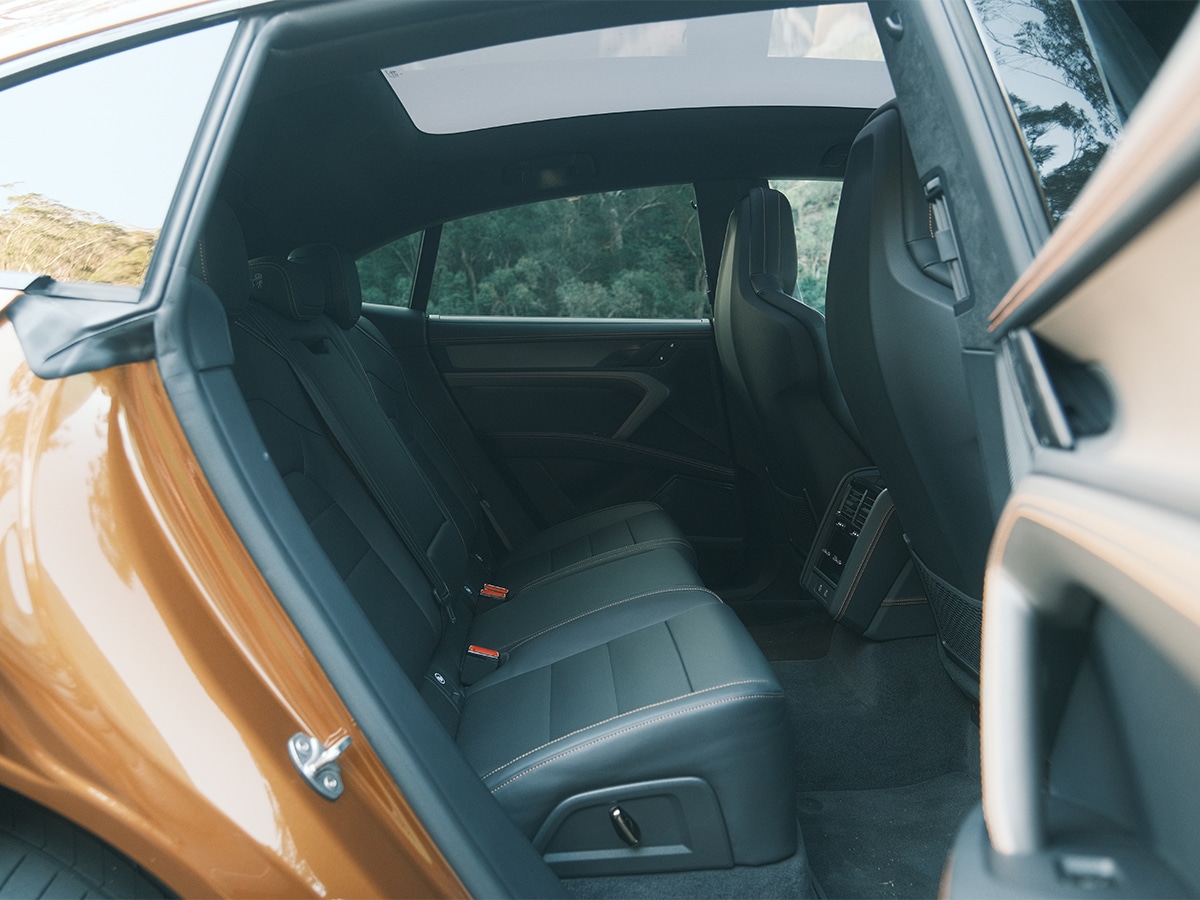
Cargo practicality also holds up well. The rear boot has 500 litres of luggage space, which is marginally down from the 534 litres in the base car.
Remote release switches in the cargo area fold the 40:20:40 rear seats flat in seconds. Up front, the 90-litre frunk provides plenty of additional space for charging cables, tyre repair kits, and a pair of soft weekend bags. Overall, it’s a really well-thought-out cabin experience.
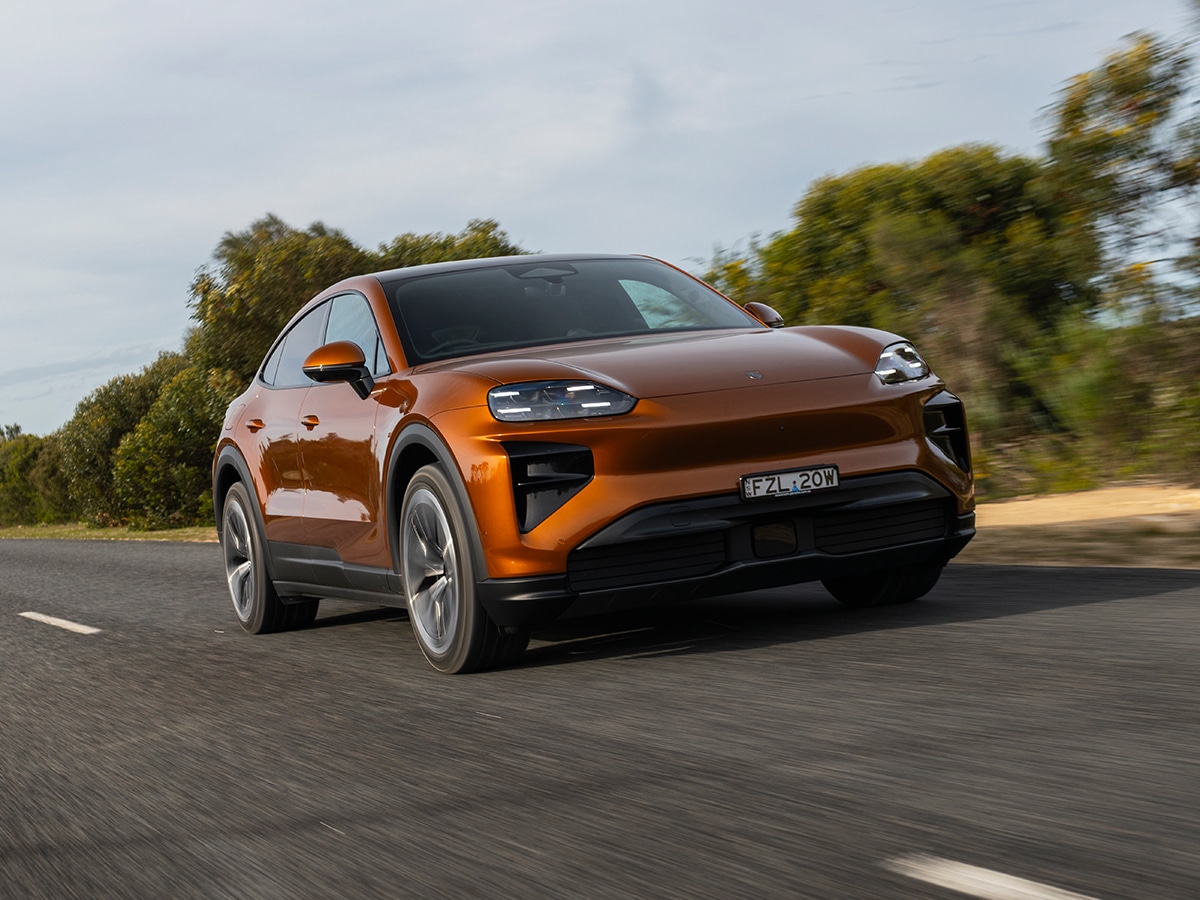
Cayenne Turbo Electric 1,156 HP Dual-Motor Powertrain
The electric heart of the Cayenne Turbo Coupé Electric is an in-house-engineered dual-motor setup. Both axles run high-output Permanent Magnet Synchronous Motors (PMSM) managed by an electronically controlled Porsche Traction Management (PTM) system. Under normal driving conditions, the system delivers 857 HP (630 kW), but if you dial the steering wheel mode switch over to Launch Control, the electronics unleash an overboosted output of 1,156 HP (850 kW) and 1,500 Nm of torque.
Stomp on the brake and throttle together, release, and the acceleration hits with gut-wrenching force. The 0-100 km/h sprint is a Porsche claimed 2.5 seconds flat, but independent tests have got it down to 2.2 seconds when traction is ideal. There’s no tyre slip or hesitation in power delivery either thanks to the clever torque vectoring that directs output between the four wheels far quicker than any mechanical differential could hope to achieve.
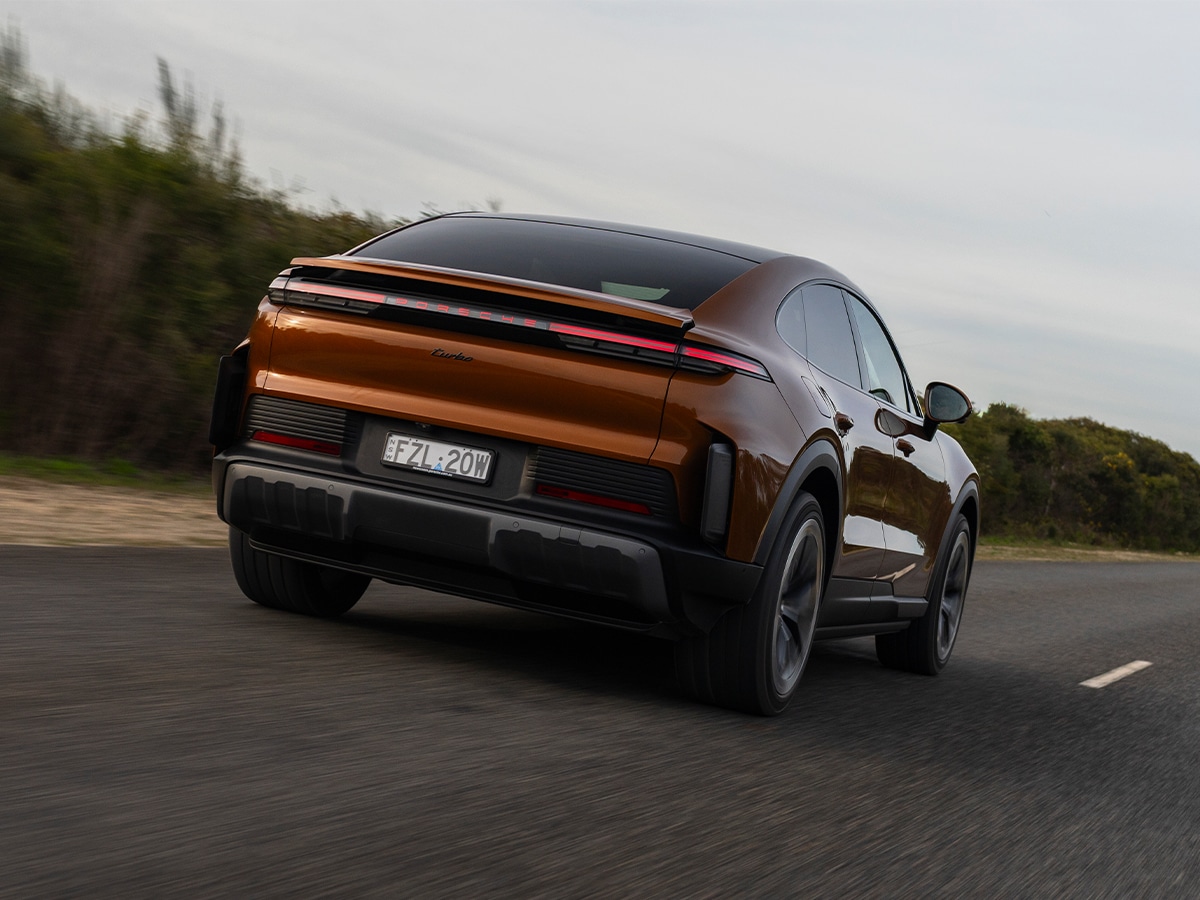
More impressive is how the electric Cayenne pull past 100 km/h and into the deep triple digits. Porsche claims 0-200 km/h in 7.4 seconds, accelerating until the electronic governor steps in at 260 km/h.
Power is supplied by a 113.2 kWh gross high-voltage lithium-ion battery pack mounted low within the chassis floor. Official combined electricity consumption is a V8-like 23.2 kWh/100km on the WLTP cycle, resulting in a claimed driving range of 637 km. During our test cycle on rural roads and rapid mountain sections, energy consumption averaged between 25.4 kWh and 28.1 kWh/100km, which equates to a practical touring range of roughly 410 to 450 km.
When it comes time to plug in, Porsche’s 800-volt charging architecture proves its worth. Hooked up to an ultra-fast DC charger operating at full capacity, the Cayenne Turbo Coupé Electric charges from 10 to 80 per cent in just 16 minutes. If you plug into a more common 160 kW DC unit, that same 10 to 80 per cent window takes 26 minutes. The standard 11 kW AC on-board charger completes a zero to 100 per cent replenish in 11 hours at home.
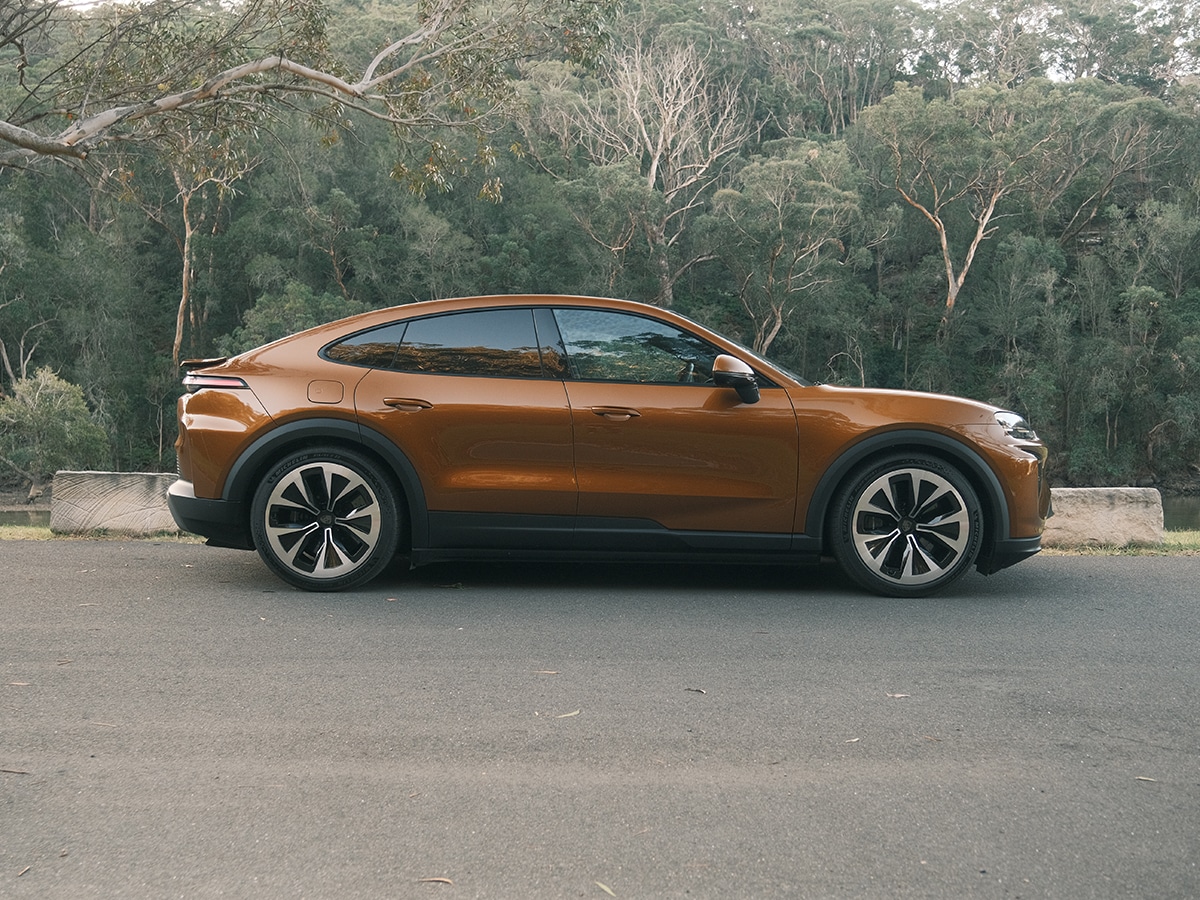
The Cayenne features charge ports on both rear quarter panels with motorised slide-open covers, making garage plug-in straightforward regardless of which side your wallbox sits on. However, if we were speccing a Cayenne Turbo Coupé Electric for our own garage, we would look closely at the AUD$470 Preparation for Porsche Wireless Charging fitted to our tester. The Cayenne Electric is one of the first production EVs in the world to offer 11 kW contactless inductive charging. By parking on a compatible floor pad in your garage, the car aligns itself over the magnetic coil and matches the charging speed of a conventional 11 kW wallbox, eliminating the need to haul heavy cables out of the boot.
RELATED: 2025 Porsche Macan Review: All-Electric, Better?
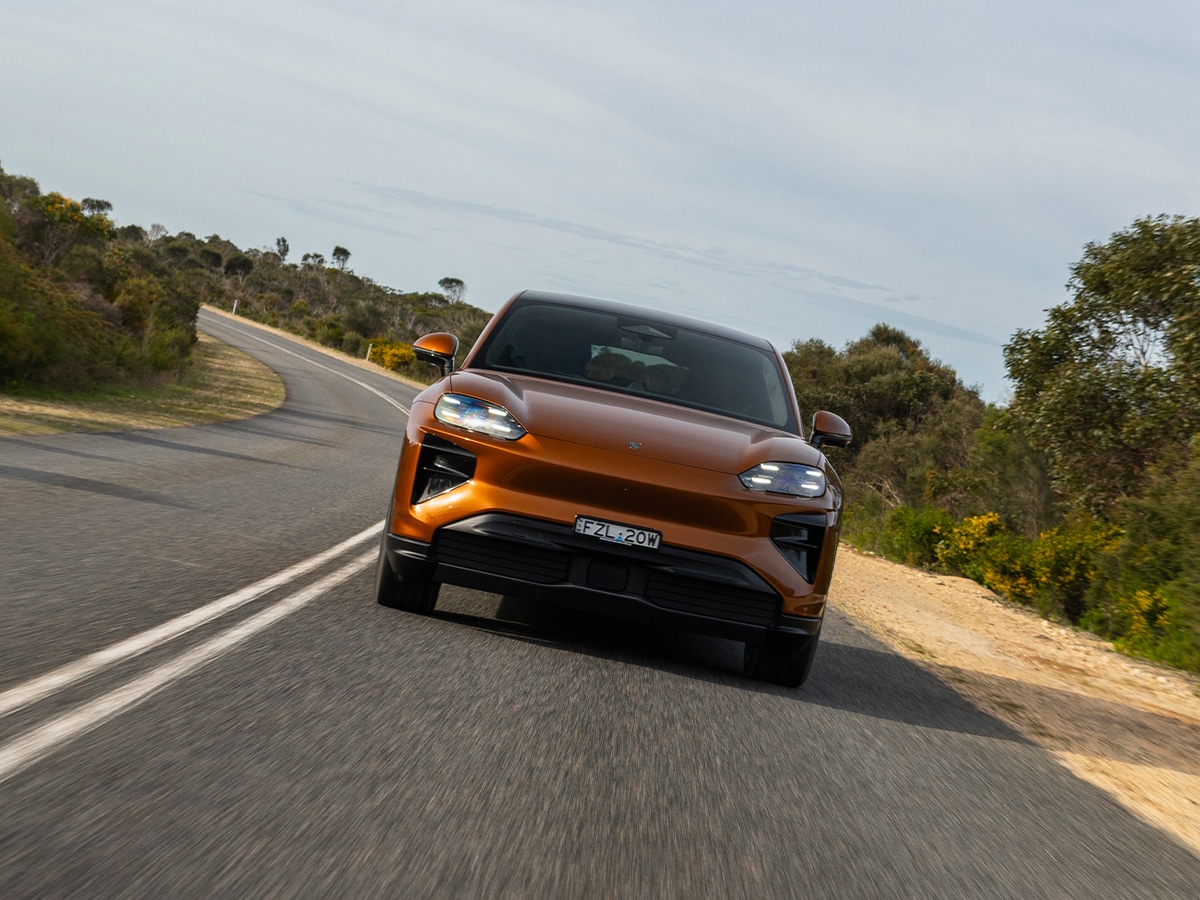
Driving Dynamics, Porsche Active Ride, and Braking Performance
Making a 2,645 kg vehicle handle like a performance car requires serious mechanical triumphs. Porsche has fitted aluminium multi-link setups front and rear, reinforced by Porsche Torque Vectoring Plus (PTV Plus) and Power Steering Plus.
While entry versions get adaptive two-chamber air springs, our test machine came optioned with the AUD$17,480 Porsche Active Ride system, which is worth every penny. Porsche Active Ride deletes conventional anti-roll bars entirely, replacing them with four active electro-hydraulic motor-pump units plumbed directly into the dampers. The system adjusts hydraulic pressures at each wheel individually within milliseconds, virtually eliminating nose-dive under hard braking and preventing rear squat under full acceleration. Tip the car into a fast sweeper, and it can actively lean into the apex like a motorcycle, keeping the tyre contact patches flat and stuck to the tarmac. The result on twisty B-roads is nothing short of uncanny. The chassis remains dead level through tight transitions, letting you place its broad 1,980 mm body with total confidence.
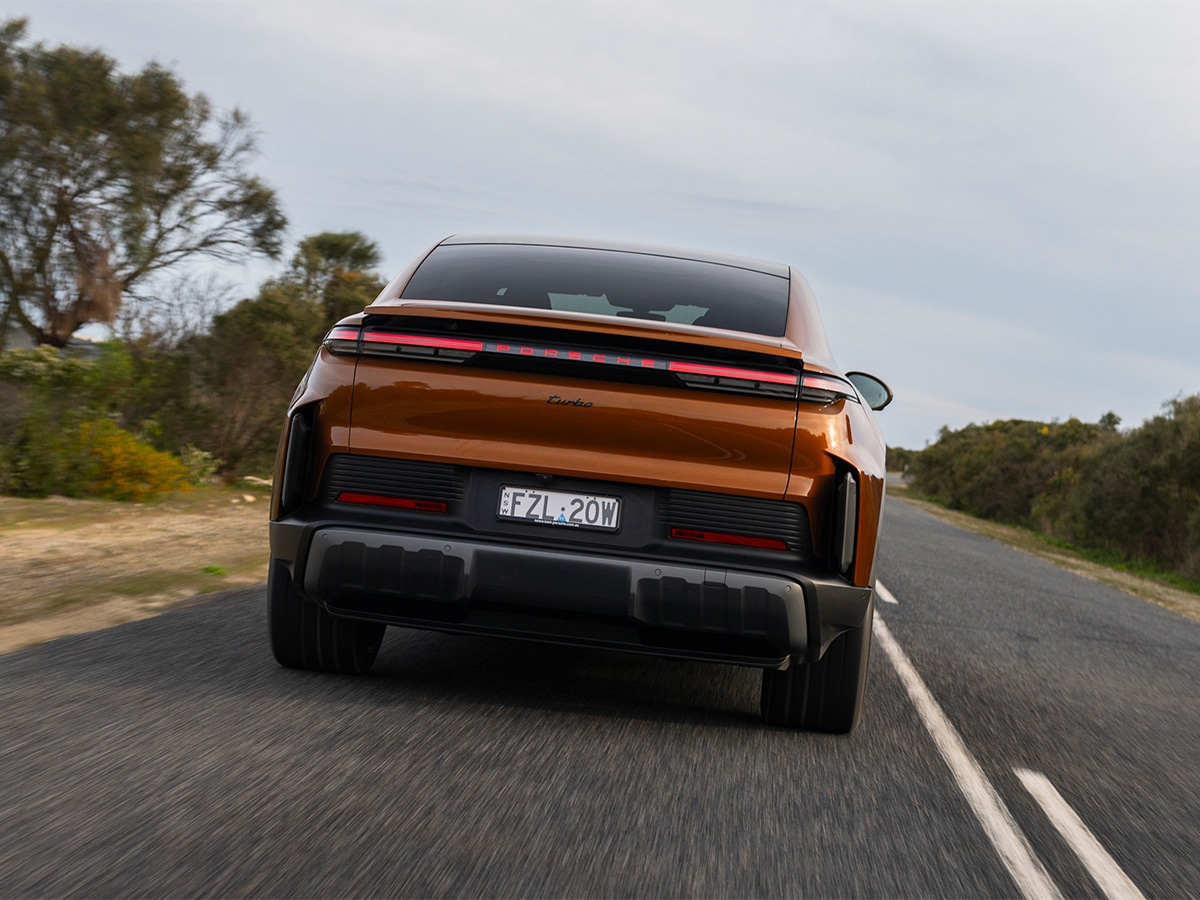
The fitted AUD$3,570 rear-axle steering turns the rear wheels up to 2.8 degrees opposite the fronts at low speeds, tucking the car into tight parking spots and hairpins with ease. When you’re travelling at highway speed, the rear wheels turn in the same direction as the fronts, giving the car rock-solid stability during high-speed corners. Steering feedback through the thick GT rim is fast, natural, and isolated from torque steer. The front end turns in with surprising urgency for a 2.6-tonne SUV, refusing to wash wide or stumble over mid-corner corrugations.
Scrubbing off speed falls to the AUD$21,240 Porsche Ceramic Composite Brake (PCCB) package. Massive 10-piston fixed front aluminium calipers bite into 420 mm carbon ceramic discs, working with 4-piston calipers and 370 mm discs at the rear. Pedal feel is firm and direct, and the transition between regenerative electric braking and physical friction pads is completely seamless. Even after repeated maximum-effort stops coming down steep descents, the brakes showed zero fade.
Ownership, Servicing Costs, and Warranty
Porsche Cars Australia covers the 2026 Cayenne Turbo Coupé Electric with a three-year, unlimited-kilometre vehicle warranty, three years of roadside assistance, and a 12-year anti-corrosion guarantee. The high-voltage lithium-ion battery has its own dedicated coverage for eight years or 160,000 kilometres, guaranteeing that at least 70 per cent of the capacity is retained.
Scheduled servicing intervals are spaced at two years or 30,000 kilometres. This extended schedule reduces the need for owners to frequently attend to the service department compared to performance rivals that require inspections every six to twelve months.
Man of Many’s Verdict on the Porsche Cayenne Turbo Electric
The 2026 Porsche Cayenne Turbo Coupé Electric shows that immense battery mass doesn’t have to ruin a sports car chassis. By pairing a savage 1,156 HP (850 kW) dual-motor powertrain with the physics-defying body control of Porsche Active Ride, Stuttgart has produced a family SUV that out-drags their fastest sports cars while maintaining great long-distance capabilities.
Priced at AUD$272,000 before on-road costs and options, the standard car represents potent performance per dollar. But we’re not sure any Porsche has left the factory without an option, and ticking boxes quickly inflates the bill. The non-negotiable AUD$17,480 Active Ride suspension and AUD$21,240 PCCB brakes are essential to unlocking its full dynamic ability, lifting our tester to an eye-watering AUD$373,180 once it’s all said and done.
If the budget permits, it’s the best and most capable performance SUV on the road, and arguably the most impressive car that I’ve had the chance to drive this year. Yes, I’ve driven a Turbo S.
FAQs
The Cayenne Turbo Coupé Electric starts at AUD$272,000 before on-road costs. Our evaluation test vehicle was fitted with $101,180 in factory options, resulting in a total tested price of AUD$373,180 before statutory taxes.
With Launch Control active, the twin motors pump out 1,156 HP (850 kW) and 1,500 Nm of torque, firing the SUV from 0 to 100 km/h in 2.5 seconds. It hits 200 km/h in 7.4 seconds on the way to an electronically limited 260 km/h top speed.
Equipped with a 113.2 kWh battery, the official combined WLTP range is 637 km. In mixed Australian road conditions, expect around 410 to 450 km of real-world range. On an ultra-fast DC charger, the 800V architecture takes the battery from 10 to 80 per cent in 16 minutes.
Yes. For drivers who want razor-sharp body control and composed touring comfort, Porsche Active Ride is the single most transformative option you can tick. It eliminates roll, pitch, and dive via active hydraulic pumps, completely hiding the car’s 2,645 kg kerb weight.
Yes. While many electric crossovers are saddled with poor tow limits, the Cayenne Turbo Coupé Electric retains a full 3,500 kg braked towing capacity, matching its combustion siblings.























Comments
We love hearing from you. or to leave a comment.