


Updated:
Readtime: 11 min
Every product is carefully selected by our editors and experts. If you buy from a link, we may earn a commission. Learn more. For more information on how we test products, click here.
Australia's highest-paid chief executives for FY2025 have been revealed, and one thing is clear: if you were running a mining company this year, you probably made a fortune. Thanks to surging gold prices and booming demand for critical minerals, a handful of small and mid-tier miners turned into heavyweight success stories, delivering multimillion-dollar paydays and huge option windfalls. Leading the pack is Develop Global boss Bill Beament, who walked away with roughly AUD$60 million, most of it from a jump in the value of shares he bought years ago as gold rallied. It is one of the biggest CEO windfalls ever recorded in Australia. The ranking is based on the AFR BOSS annual CEO pay survey for the year ended 30 June 2025, and it makes for a resources-heavy read, with mining, gold and exploration executives taking six of the top 10 spots.
Highest-Paid CEOs in Australia at a Glance
- Highest earner: Bill Beament (AUD$60 million)
- Healthcare pay leader: Michael (Mick) Farrell (AUD$46 million)
- Most prominent female CEO: Shemara Wikramanayake (AUD$24 million)
- Longest-serving founder: Greg Goodman (AUD$20 million)
- Big miner benchmark: Michael (Mike) Henry (AUD$14 million)
The 10 Highest-Paid CEOs in Australia
1. Bill Beament: AUD$60 million
Bill Beament sits at the top of the table as the face of Develop Global, a mining business he has led since 2021. In Australian resources circles, he is known as an operator with deep sector credibility rather than a career custodian parachuted into the role. That matters in mining, where investors tend to pay for executives who can read assets, cycles and capital markets with conviction. His position reflects both the rewards available in the sector and the premium attached to leadership with a proven resources pedigree.
- Company: Develop Global
- Sector: Mining
- Appointed CEO: 2021
- Tenure: since 2021
- Salary source: Boss Hunting
2. Michael (Mick) Farrell: AUD$46 million
Michael Farrell has been chief executive of ResMed since 2013, giving him one of the more established tenures near the top of the list. ResMed is a global medical devices company best known for sleep and respiratory care, a field where technology, regulation and healthcare demand intersect. Farrell’s pay reflects the market value attached to a leader running an Australian-founded business with serious international reach. In a ranking dominated by miners, his presence underscores the earning power of specialised healthcare technology.
- Company: ResMed
- Sector: Medical devices
- Appointed CEO: 2013
- Tenure: since 2013
- Salary source: Boss Hunting
3. Vikesh Ramsunder: AUD$27 million
Vikesh Ramsunder represents the pharmacy side of healthcare through Sigma Healthcare, where he has served as CEO since 2022. The role sits in a complex part of the market, spanning distribution, retail pharmacy relationships and the pressure points of Australia’s healthcare supply chain. His place near the front of the list points to the strategic value of pharmacy infrastructure at scale. It also shows how quickly executive pay can rise when a company is operating in a sector with both defensive demand and corporate activity.
- Company: Sigma Healthcare
- Sector: Healthcare (pharmacy)
- Appointed CEO: 2022
- Tenure: since 2022
- Salary source: Boss Hunting
4. Shemara Wikramanayake: AUD$24 million
Shemara Wikramanayake remains one of the defining figures in Australian financial services, leading Macquarie Group since 2018. She is best known for steering a global financial platform with deep exposure to infrastructure, markets and asset management. Macquarie’s model rewards executives who can balance risk discipline with an appetite for complex, international opportunities. Her position on the list reflects both personal standing and the earning capacity of one of Australia’s most globally recognised financial institutions.
- Company: Macquarie Group
- Sector: Financial services
- Appointed CEO: 2018
- Tenure: since 2018
- Salary source: Boss Hunting
5. Paul Savich: AUD$21 million
Paul Savich brings the exploration end of the resources market into the top five through WA1 Resources, where he has been CEO since 2021. Mining exploration is not the same game as running a diversified major, with valuation often tied to geology, investor confidence and the credibility of management. Savich’s ranking captures that high-stakes dynamic, where leadership is judged on how effectively a company can progress opportunity into market belief. It is a reminder that exploration success can put smaller resources names into the same pay conversation as far larger companies.
- Company: WA1 Resources
- Sector: Mining exploration
- Appointed CEO: 2021
- Tenure: since 2021
- Salary source: Boss Hunting
6. Greg Goodman: AUD$20 million
Greg Goodman is the outlier by tenure, having led Goodman Group since 1989 as its founder. The business sits in logistics real estate, a sector reshaped by e-commerce, supply chain strategy and demand for modern industrial property. Founder-led companies often pay for continuity as much as annual performance, particularly when the executive is closely tied to strategy, culture and investor trust. Goodman’s ranking reflects the value markets can place on a long-serving operator who built and still leads the platform.
- Company: Goodman Group
- Sector: Real estate (logistics)
- Appointed CEO: 1989
- Tenure: since 1989 (founder)
- Salary source: Boss Hunting
7. Anastasios Arima: AUD$18 million
Anastasios Arima leads IperionX, a titanium technology business he has run since 2021. His inclusion gives the list a more specialised industrial edge, away from traditional bulk commodities and into advanced materials. Titanium technology sits at the intersection of manufacturing, defence, aerospace and supply chain security, which gives capable leadership a different kind of strategic value. Arima’s pay points to the premium investors can attach to executives operating in technically complex, future-facing materials markets.
- Company: IperionX
- Sector: Titanium technology
- Appointed CEO: 2021
- Tenure: since 2021
- Salary source: Boss Hunting
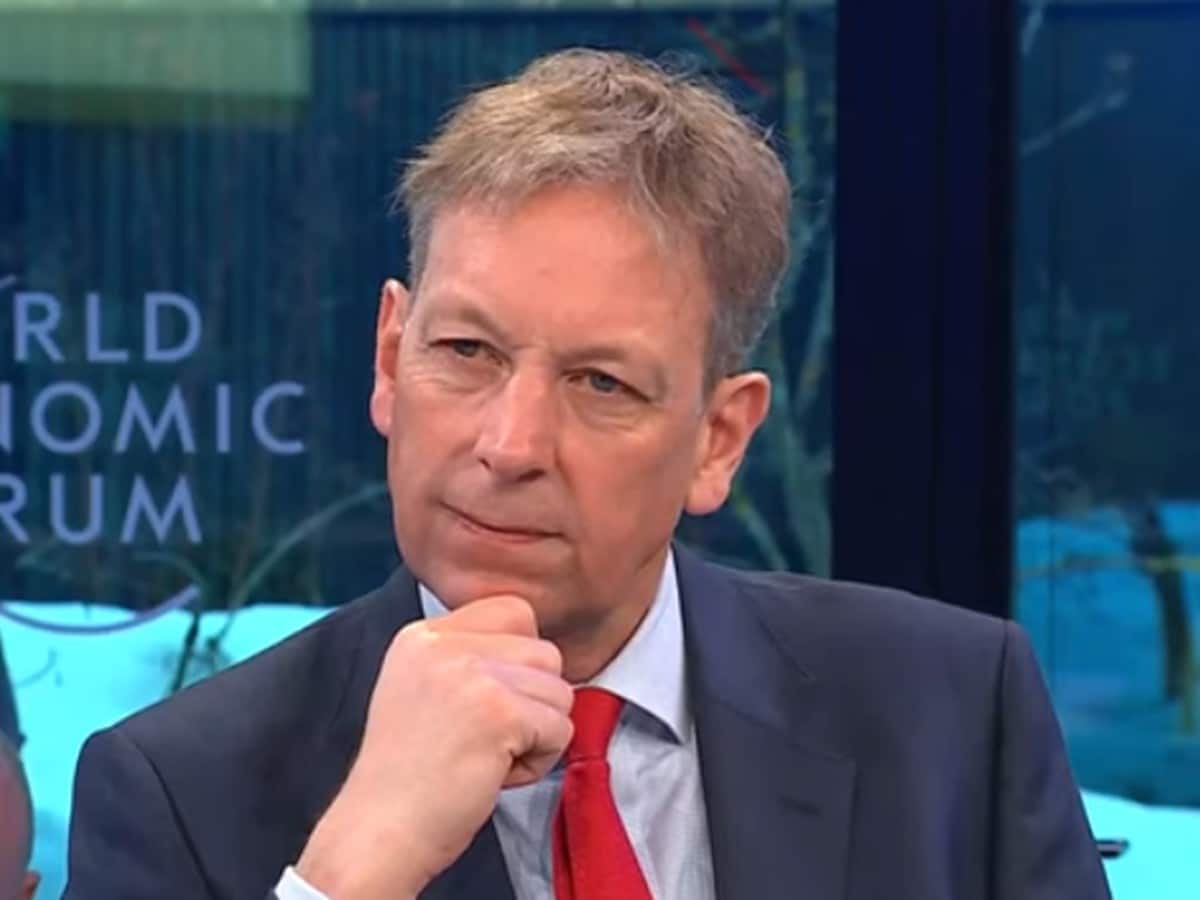
8. Jakob Stausholm: AUD$16 million
Jakob Stausholm’s Rio Tinto tenure ran from 2021 to 2025, placing him among the most visible mining leaders in the world during that period. Running Rio Tinto means managing iron ore, copper, aluminium and the political realities that come with assets across multiple jurisdictions. His standing on this list reflects the scale and scrutiny attached to a global resources major, not just the Australian market. Even after stepping down, his FY2025 realised pay keeps him firmly inside the top 10.
- Company: Rio Tinto
- Sector: Mining
- Appointed CEO: 2021
- Tenure: 2021 to 2025 (stepped down)
- Salary source: Boss Hunting
9. Raleigh Finlayson: AUD$15 million
Raleigh Finlayson is a well-known name in Australian gold, and his Genesis Minerals role placed him back near the centre of the sector’s corporate conversation. He was appointed CEO in 2022 and moved to executive chair in 2026, according to the supplied tenure data. Gold mining leadership commands attention because investor confidence is tied to operations, capital allocation and the commodity cycle. Finlayson’s ranking reflects the market’s willingness to reward executives with strong standing in a specialist resources niche.
- Company: Genesis Minerals
- Sector: Gold mining
- Appointed CEO: 2022
- Tenure: 2022 to 2026 (now Exec Chair)
- Salary source: Boss Hunting
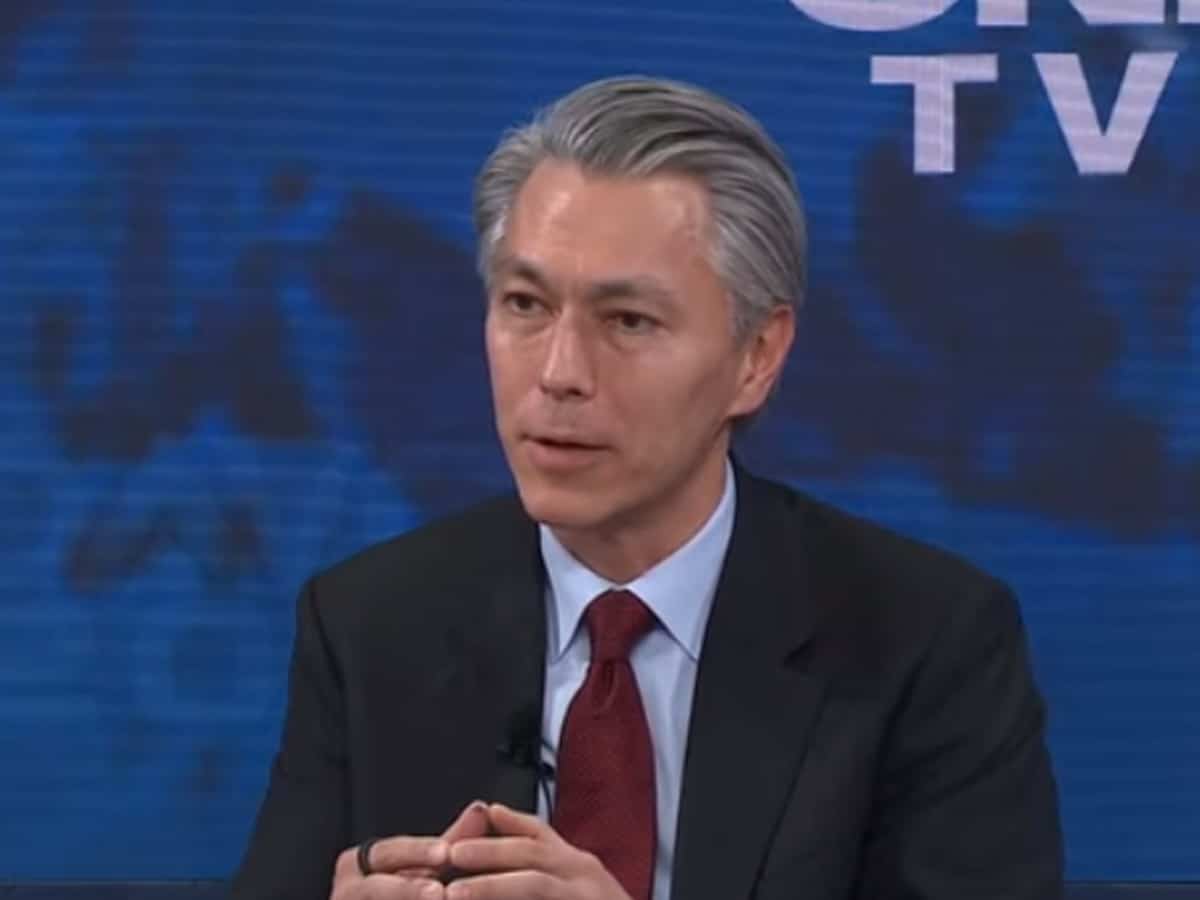
10. Michael (Mike) Henry: AUD$14 million
Mike Henry closes the top 10 as the former chief executive of BHP, a company that remains one of the central pillars of the Australian sharemarket. He led the mining giant from 2020 to 2026, a period defined by portfolio focus, decarbonisation pressure and the continuing importance of commodities to global growth. The role demands more than operational discipline, with geopolitical, environmental and investor expectations all part of the job. His place on the list reflects the scale of BHP and the market rate for running a miner of that standing.
- Company: BHP
- Sector: Mining
- Appointed CEO: 2020
- Tenure: 2020 to 2026 (stepped down)
- Salary source: Man of Many
The History of CEO Pay in Australia
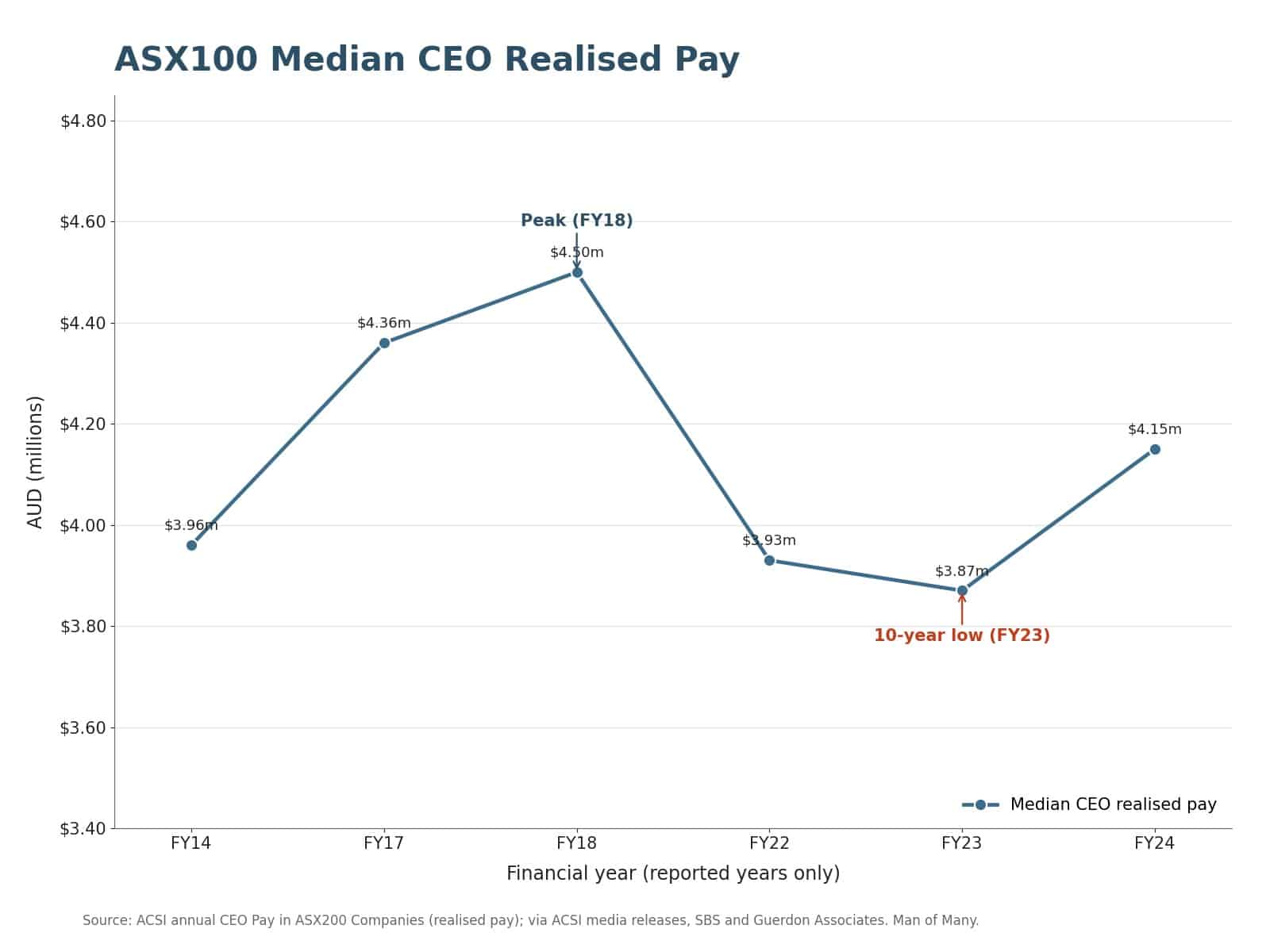
For all the headlines, pay at the very top of corporate Australia has been remarkably flat. The median realised pay for an ASX100 chief executive was AUD$4.15 million in FY24, barely ahead of the AUD$3.96 million recorded a decade earlier. Realised pay counts what a CEO actually banked once cash bonuses and vested shares are tallied, which is why it is the number governance groups watch.
The series peaked at AUD$4.50 million in FY18 and slid to a ten-year low of AUD$3.87 million in FY23 before ticking back up. COVID left the clearest mark: in FY20 median bonus outcomes collapsed to 31 per cent of the maximum from 60 per cent the year before, then rebounded above 76 per cent by FY21.
The biggest individual pay days are dominated by executives at globally listed companies. Recent ACSI reviews put ResMed’s Mick Farrell at AUD$47.58 million in FY23 and News Corp’s Robert Thomson at about AUD$42 million in FY24, figures driven almost entirely by shares vesting rather than salary.
This Year’s Highest-Paid CEOs, Compared
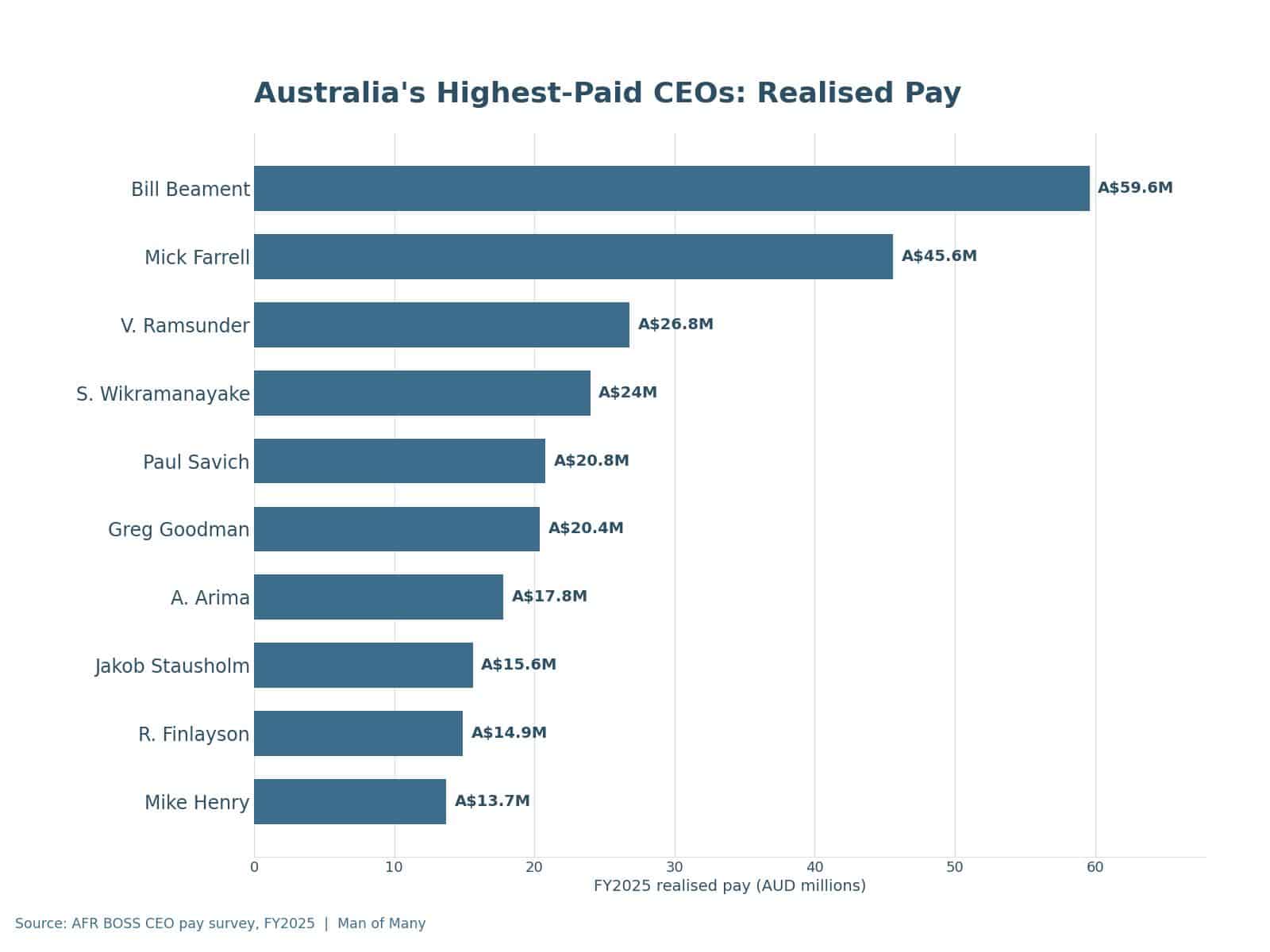
How the FY2025 realised-pay packets on this list stack up against one another.
CEO Pay Controversies in Australia
Australia gives shareholders a sharper tool than most markets: the two-strikes rule, in force since 1 July 2011. If 25 per cent or more of votes go against a company’s remuneration report at two consecutive annual meetings, a resolution to spill the board follows. Spills rarely pass, but a strike is a public rebuke boards work hard to avoid.
The landmark revolt was Qantas in 2023, where roughly 83 per cent of votes rejected the pay report amid the airline’s illegal-outsourcing ruling and the outcry over Alan Joyce’s exit. Rio Tinto had drawn a first strike of more than 61 per cent at its 2021 meeting, over executive terms following the Juukan Gorge destruction. Joyce’s package became the defining golden-parachute case: after a governance review, the Qantas board clawed back AUD$9.26 million, and ACSI has since reported termination payouts trending down across the market.
The gap between the corner office and the shop floor remains the most cited grievance. Australian listed-company CEOs earned about 55 times the average worker in FY24, down from 71 times a decade earlier, and modest beside the United States, where the ratio sits around 290 to 1. Pay taken while cutting jobs also stings: Ownership Matters found at least 25 ASX300 firms that received JobKeeper still paid executive bonuses worth AUD$24.3 million.
How Australian CEOs Get Paid
A large-cap Australian pay packet has four parts. Fixed base salary (plus superannuation) is the guaranteed cash. A short-term incentive, usually a cash bonus, rewards one-year targets. A long-term incentive, typically equity or performance rights, vests over three to four years against measures such as relative shareholder return. Termination benefits sit on top, the contractual notice and severance that golden-parachute debates turn on.
This structure is why two very different pay figures circulate. Statutory reported pay expenses the estimated grant-date value of equity whether or not it ever vests; realised pay counts only what the executive actually received. ACSI reports realised pay because it reflects money genuinely banked, and for most large-cap CEOs the majority of the potential package is at risk rather than fixed. Figures throughout are drawn from the ACSI annual review of ASX200 CEO pay.
Highest-Paid CEOs in Australia Compared
| Rank | Name | Company | FY2025 realised pay |
| 1 | Bill Beament | Develop Global | AUD$60 million |
| 2 | Michael (Mick) Farrell | ResMed | AUD$46 million |
| 3 | Vikesh Ramsunder | Sigma Healthcare | AUD$27 million |
| 4 | Shemara Wikramanayake | Macquarie Group | AUD$24 million |
| 5 | Paul Savich | WA1 Resources | AUD$21 million |
| 6 | Greg Goodman | Goodman Group | AUD$20 million |
| 7 | Anastasios Arima | IperionX | AUD$18 million |
| 8 | Jakob Stausholm | Rio Tinto | AUD$16 million |
| 9 | Raleigh Finlayson | Genesis Minerals | AUD$15 million |
| 10 | Michael (Mike) Henry | BHP | AUD$14 million |
How This List Was Compiled
The ranking uses realised pay from the AFR BOSS annual CEO pay survey, compiled by OpenDirector and Odgers for FY2025, the year ended 30 June 2025. Realised pay is not simply base salary, it captures the value received by executives during the year, including incentive outcomes and equity that has vested or otherwise become available under the survey methodology.
Related Reading
- Afr Boss Annual Ceo Pay Survey (Realised Pay), Compiled By Opendirector And Odgers, Covering Fy2025 (Year Ended 30 June 2025). Published Late November / December 2025.
- Average Salary in Australia by Age, State, and Industry (2026)
Highest-Paid CEOs in Australia FAQs
Bill Beament of Develop Global topped the AFR BOSS realised pay survey for FY2025 with AUD$60 million. The result put the mining executive ahead of ResMed chief executive Michael Farrell and Sigma Healthcare chief executive Vikesh Ramsunder in the annual ranking compiled by OpenDirector and Odgers.
Realised pay measures what an executive actually received during the financial year, rather than only their fixed salary. In this survey, that can include salary, short-term incentives and the value of equity-based rewards that vested or became available in FY2025 under the reported methodology.
Mining and resources dominate the top 10 because executive rewards in the sector are often closely tied to equity, market value and asset performance. Develop Global, WA1 Resources, Rio Tinto, Genesis Minerals and BHP all appear, showing how strongly capital markets can reward resources leadership.
No. The AFR BOSS table is based on realised pay, so it is broader than base salary. A CEO may rank highly because of vested equity, bonuses or incentive outcomes connected to company performance and sharemarket value during FY2025, not because their fixed annual salary alone was that large.





















Comments
We love hearing from you. or to leave a comment.