


Updated:
Readtime: 15 min
Every product is carefully selected by our editors and experts. If you buy from a link, we may earn a commission. Learn more. For more information on how we test products, click here.
The era of hybrid supercars started more than a decade ago with the Ferrari LaFerrari, Porsche 918 Spyder, and McLaren P1. Nicknamed the ‘Holy Trinity’, it was a revolutionary sneak peek into the future we currently live in. I was barely old enough to drink when they went to battle in the hands of Chris Harris, Tiff Needell, and Marino Franchitti, but it was then and there that I decided I would not leave this planet without driving a supercar. It was the Lamborghini Huracan STO that popped my cherry, but a few years later, and every major brand covered, I’ve realised there’s a major issue boiling under the surface.
Cars that I once dreamed of are being neutered by European emissions regulations, and the more time I spend behind the wheel of modern hybrid supercars like the McLaren Artura, Ferrari 296 GTB, and even the new-generation Porsche 911 Turbo S, the more I realise that the market has developed a frustrating identity crisis.
Brands are tossing four-figure horsepower numbers around and 2-second 0-100 km/h acceleration times, but half of these hyper-complex exotics feel more like digital-appliance simulations than smile-inducing driving machines. You get mind-bending straight-line speed, active torque-vectoring with electric motors that respond faster than you can think. Worst of all? No sound out of the exhaust. They lack emotion, but these issues are bubbling to the surface, and Ferrari has realised they have the chance to provide the solution.
To do so, Maranello decided to bring back one of the most revered names in automotive history. The 2026 Ferrari 849 Testarossa (from AUD$932,648 before on-road costs) does more than simply adopt the mid-rear plug-in hybrid architecture and turn the performance up to absolute maximum. With a revised twin-turbo V8 and three electric motors churning out a combined 1,050 CV, it’s both the most powerful road-going production Ferrari ever built and a champion of the new era of supercar performance. Arriving as the direct replacement for the SF90 Stradale, this is proof that hypercar-level performance doesn’t have to mean an emotionless driving experience. Let me explain.
| Technical specification | |
| Powertrain | 4.0-litre twin-turbo V8 + three electric motors (PHEV) |
| ICE Output | 830 CV (610 kW) @ 7,500 rpm |
| Electric Output | 220 CV (162 kW) via three motors |
| Total Power | 1,050 CV (772 kW) |
| Maximum Torque | 842 Nm @ 6,500 rpm |
| Transmission | 8-Speed Dual-Clutch F1 Automatic |
| 0-100 km/h | Under 2.3 seconds |
| 0-200 km/h | 6.35 seconds |
| Top Speed | Over 330 km/h |
| Dry Weight | 1,570 kg |
Price
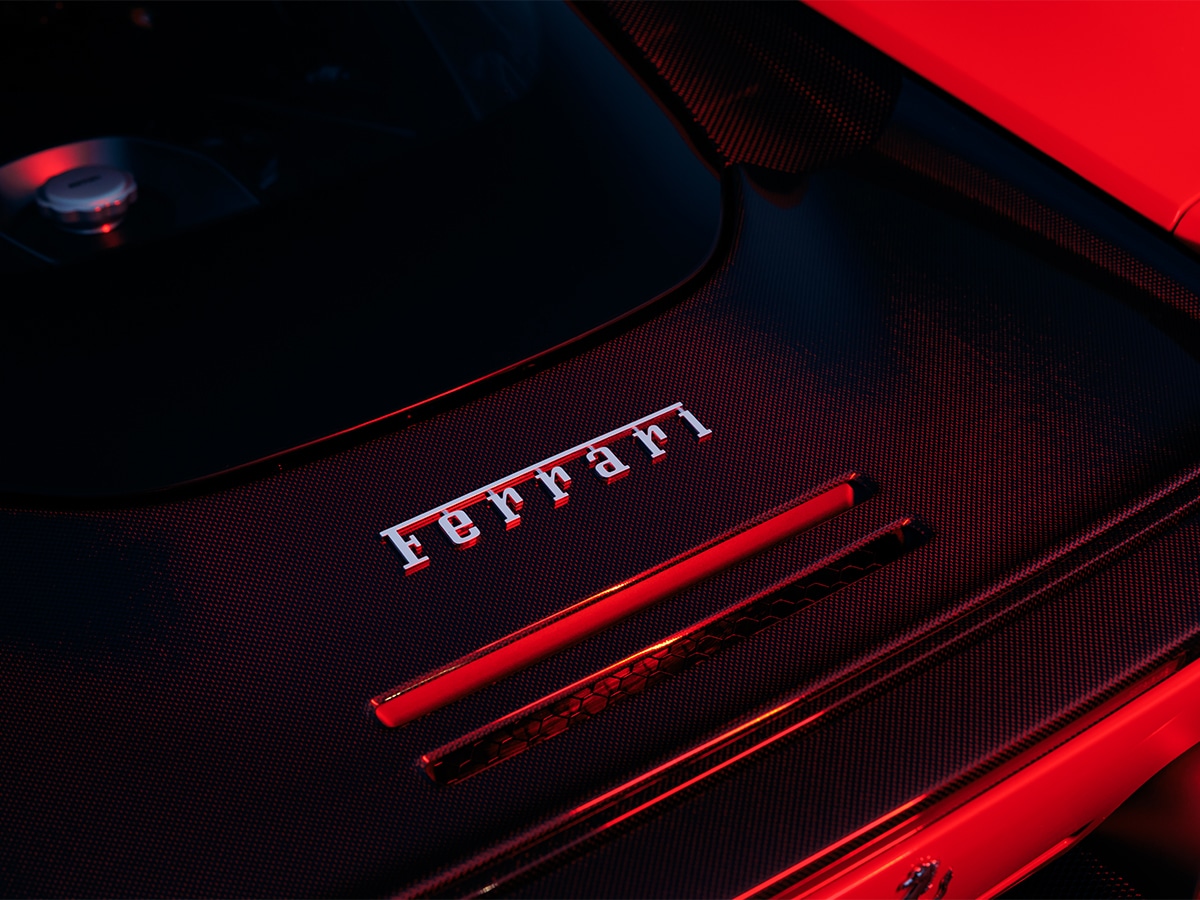
It matters little to the customer who’s been offered an allocation, but the Ferrari 849 Testarossa commands a list price starting at AUD$932,648 before on-road costs and options for the Coupe. Meanwhile, the 849 Testarossa Spider is priced from a rather healthy $1,015,589 before on-roads.
Those who are lucky to secure an allocation will need to be patient, as the first Australian arrivals are expected in the first half of next year.
To put the price into context, the outgoing SF90 Stradale sat around the $846,888 mark before on-roads. However, the 849 Testarossa demands its premium for extensive mechanical, aerodynamic, and electronic upgrades. It puts itself in direct competition with the Lamborghini Revuelto (from AUD$987,000 before on-road costs).
While there will eventually be a more hardcore version (such is the nature of the game) Ferrari also offers the Assetto Fiorano package for those who can’t wait. That optional spec shaves 30kg off the 1,570kg dry mass by introducing 20-inch carbon fibre wheels that reduce unsprung mass, titanium springs, and lightweight tubular Alcantara seats that save 18kg on their own. It replaces the active rear spoiler with twin fixed rear wings that triple vertical downforce, and installs stiffer, single-rate Multimatic shock absorbers. Crucially, for the first time on an Assetto Fiorano model, buyers can opt to keep the semi-active Magneride suspension to retain the front axle lifter.
 1/4
1/4Styling
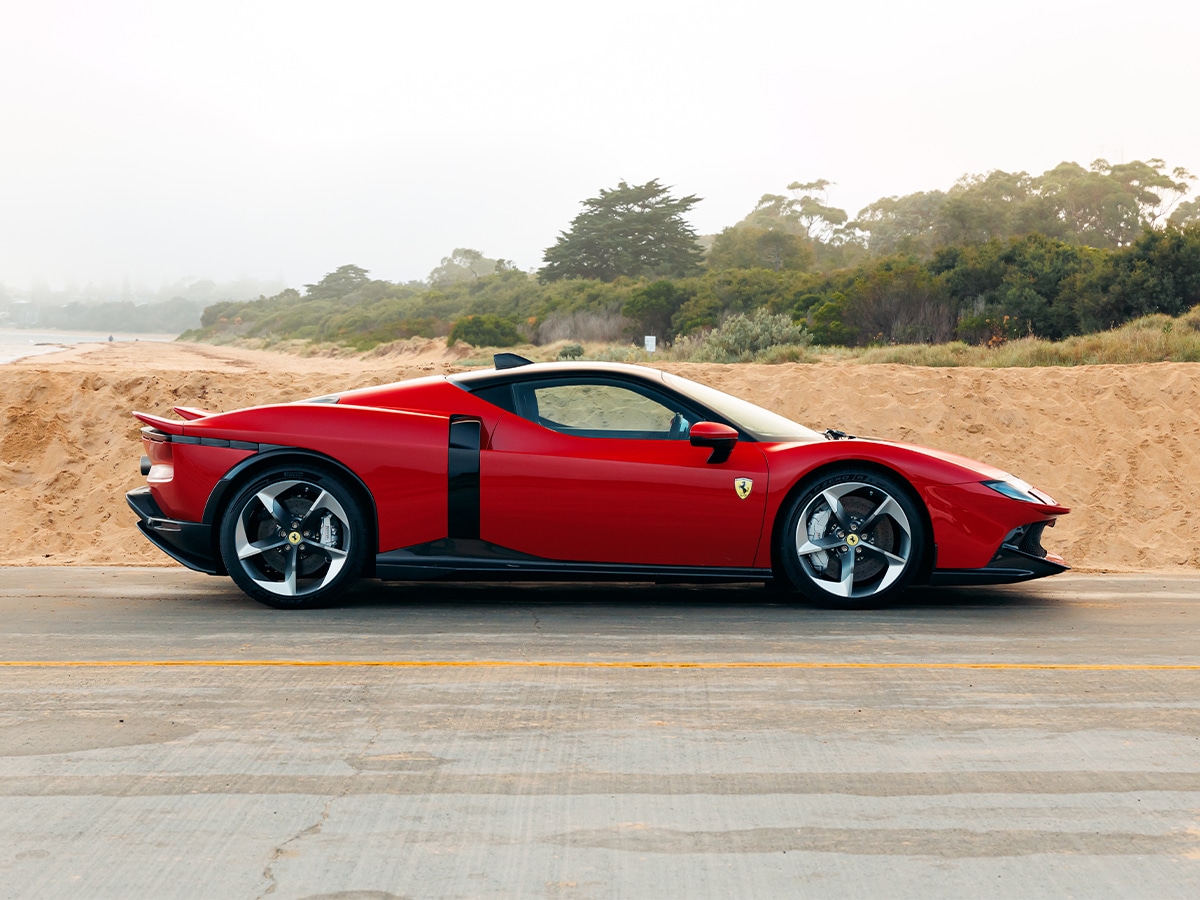
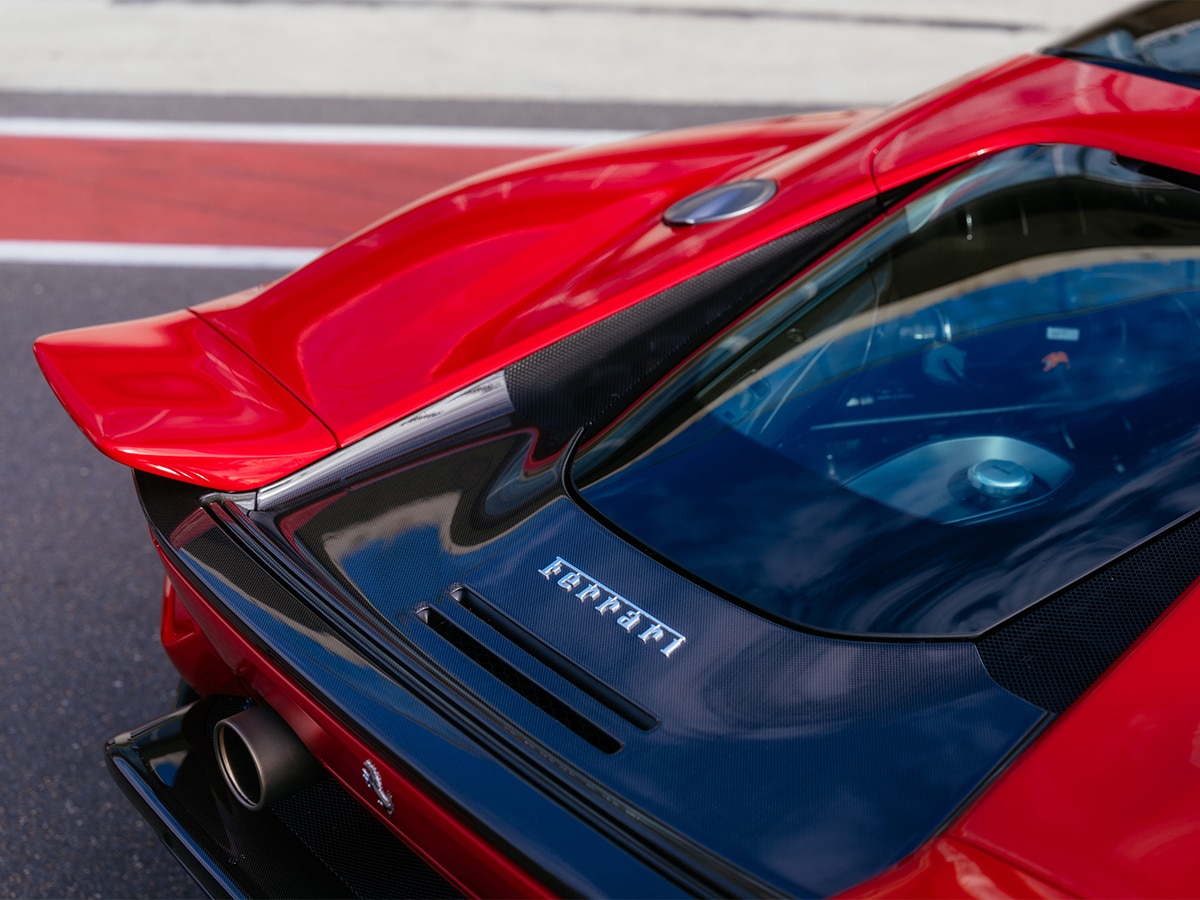
It surprised me to learn that the design direction for the 849 Testarossa was established before the design team knew the finished car would bear the Testarossa badge. It’s why the car looks like a 1970s Sports Prototype that has been dragged into a futuristic wind tunnel, as Flavio Manzoni and the Ferrari Styling Centre drew direct inspiration from icons like the 512 S and 512 M.
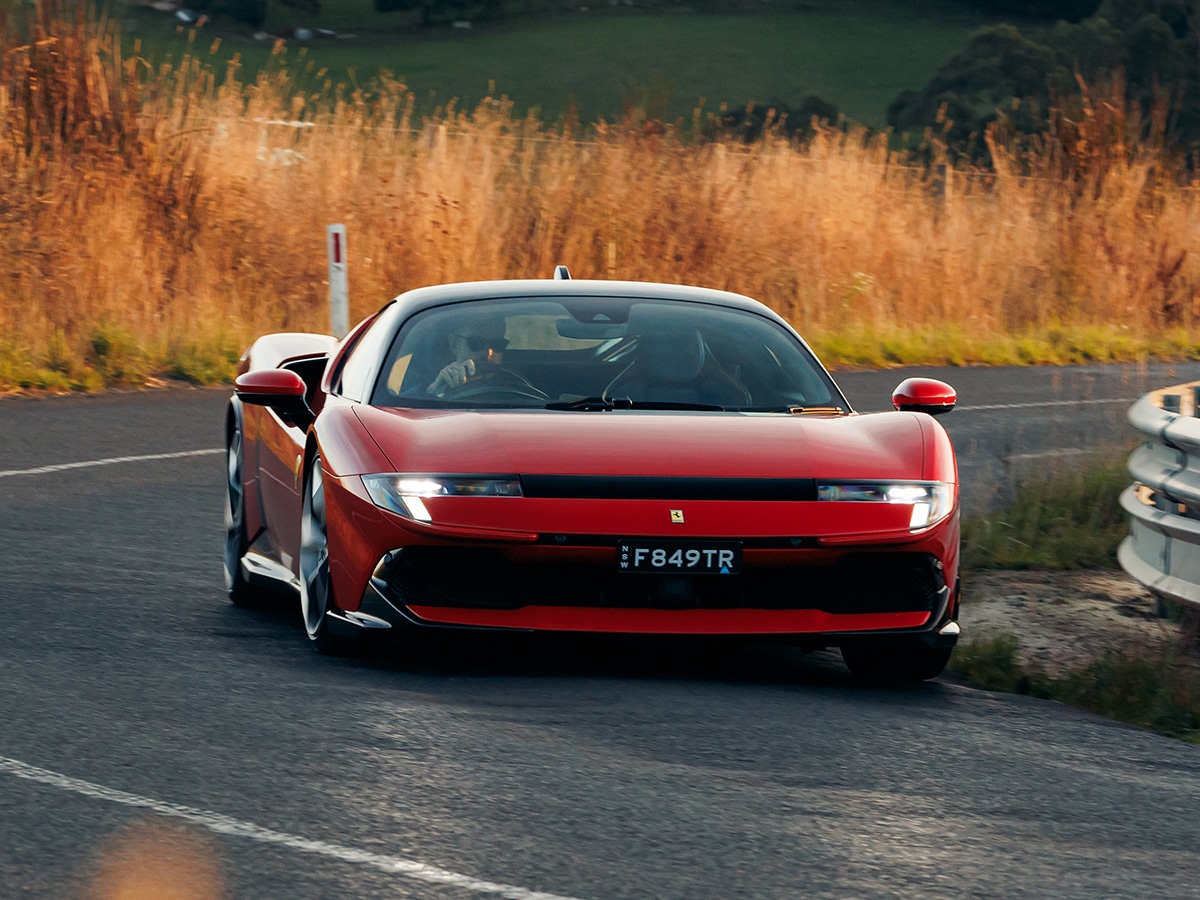
The result is a compact, cab-forward silhouette measuring 4,718mm long, 2,304mm wide, and 1,225mm tall. The stance has been completely transformed. Look down the flank, and you will see door panels deeply sculpted from a single aluminium moulding to create a three-dimensional aerodynamic duct. This channels air directly into the side intercoolers, boosting intercooler airflow by 30 per cent while capturing boundary-layer airflow along the sill. Up front, a squarer bumper with a larger splitter and flicks inspired by the SF90 XX Stradale generates 10 per cent of the front downforce, supported by a completely redesigned underfloor featuring three pairs of cascading vortex generators that deliver 35 per cent of the car’s total load.
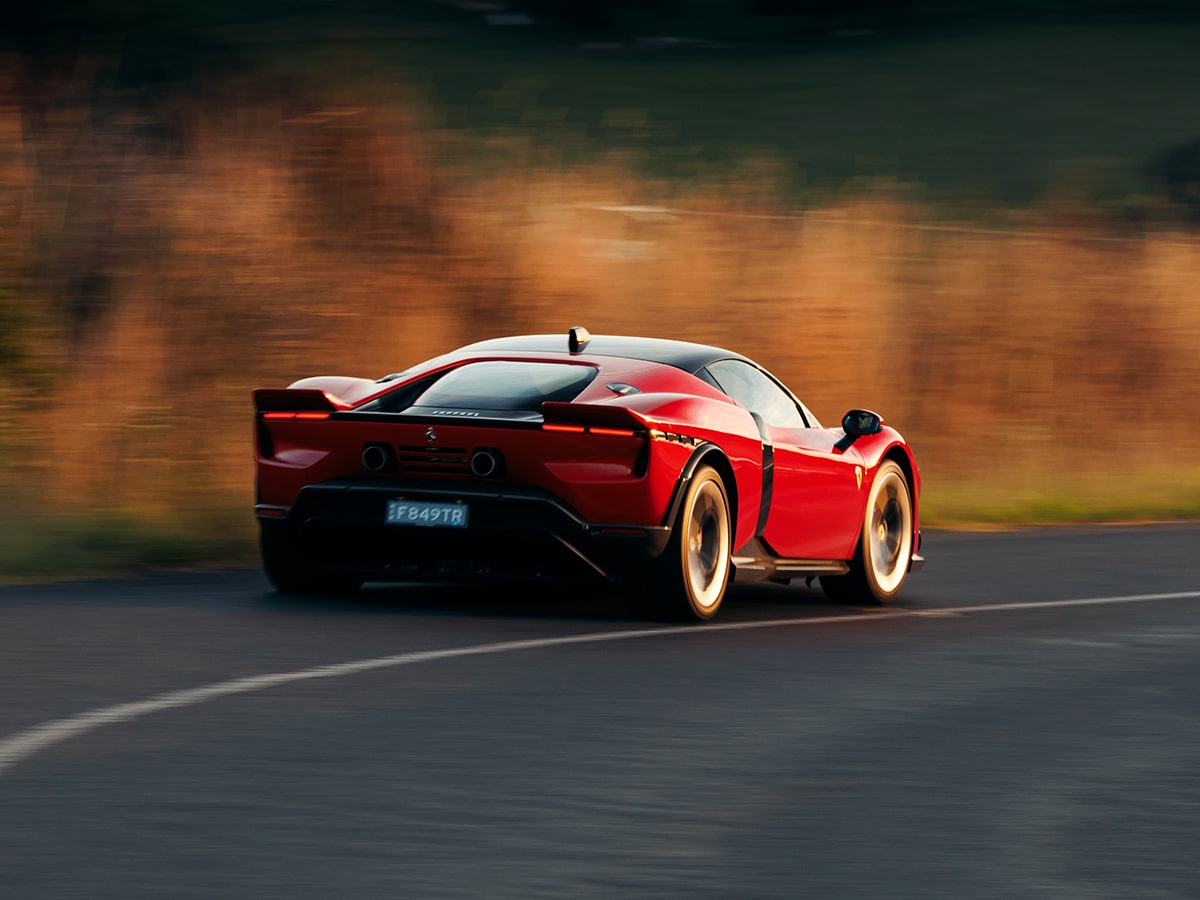
When you look at the back of the car, the twin-tail architecture houses an active rear spoiler that can switch between Low Drag and High Downforce configurations in less than a second. Put the car in High Downforce mode, and it generates 100kg of load at 250 km/h, contributing to a total downforce figure of 415kg that glues the rear axle to the tarmac.
Interior
I’ve spoken at length about supercar interiors and how frustrating the industry’s shift toward touch-capacitive screens has become.
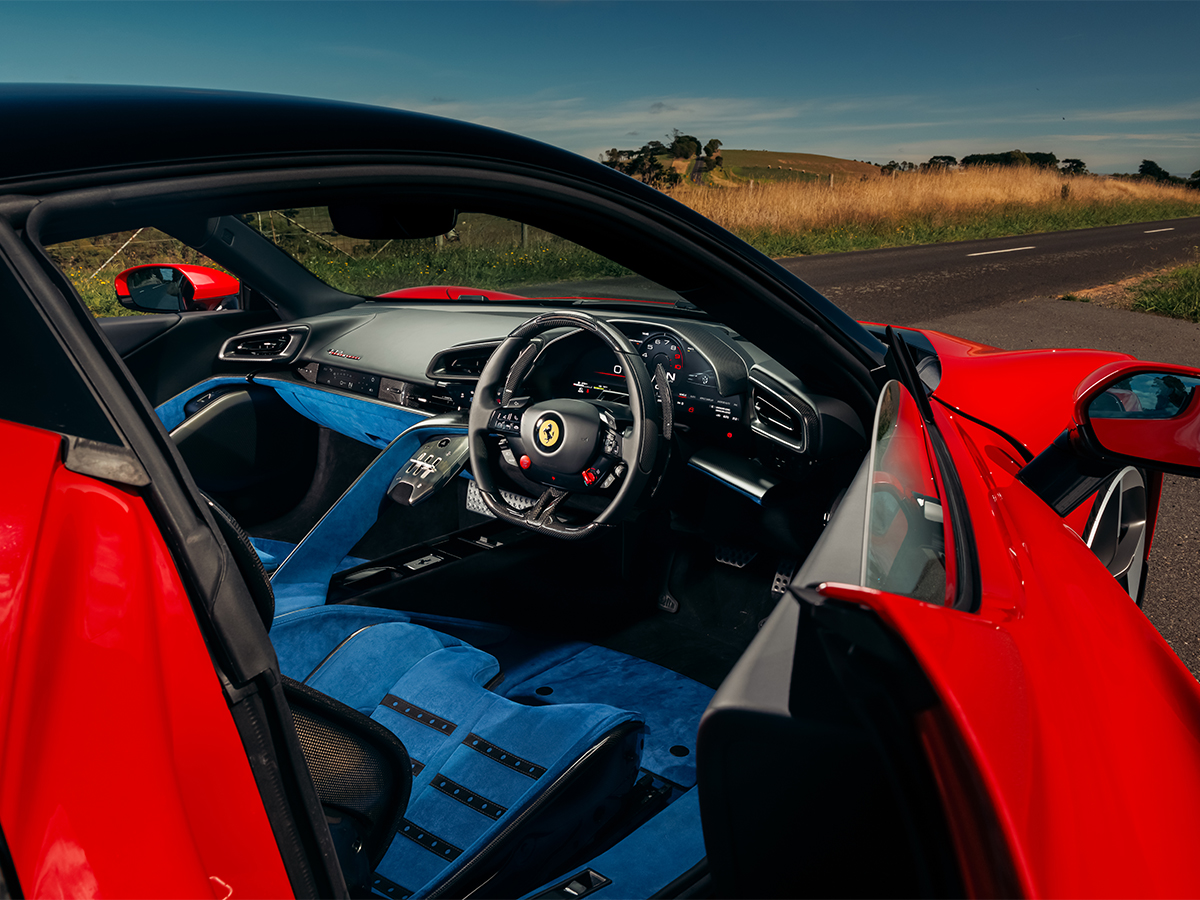
Here, Ferrari does its best to avoid this mistake by listening to driver feedback and bringing back physical, tactile switchgear on the steering wheel. I was relieved to find real mechanical buttons for key controls, including the iconic red Engine Start button on the steering wheel that clicks with a heavy, satisfying action.
The steering wheel combines these physical switches with the digital eManettino selector, allowing you to cycle through four distinct hybrid management programs: eDrive (up to 25 km of pure EV driving), Hybrid (the default balance of petrol and electric power), Performance (keeps the V8 running to maintain battery charge), and Qualify (unlocks the full 1,050 CV output).
 1/4
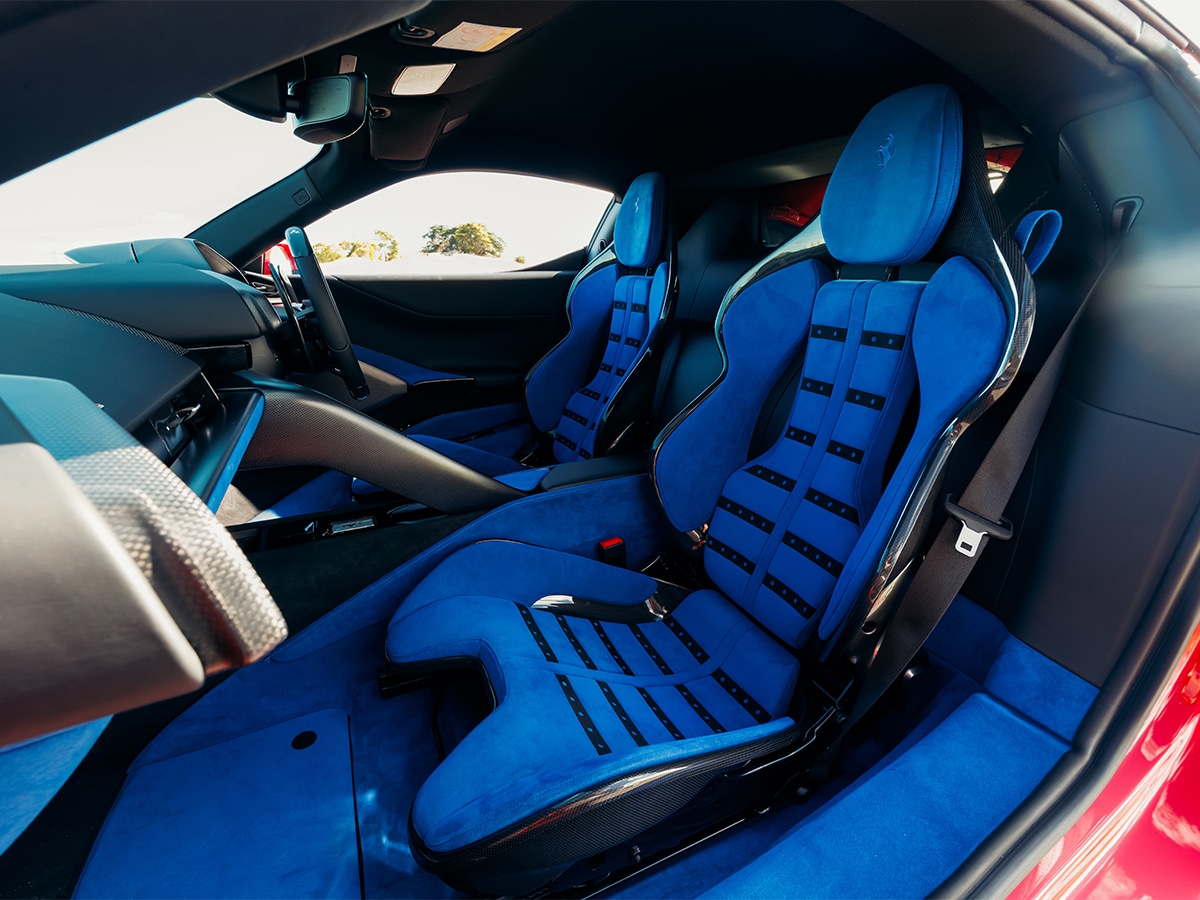
1/4Probably my favourite feature of the interior is the dashboard and cockpit architecture, with a floating upper section featuring C-shaped aluminium air vents. It’s anchored by a contrasting horizontal band that houses the main control interface and an integrated passenger display screen. Below, the central tunnel borrows design cues from the flagship F80, featuring a floating sail motif that houses the metal gear-change gate, wireless smartphone charging, and secondary controls.
The central sail theme carries over to the door cards, which house a woofer with an aluminium grille alongside the door pull. These interior materials are all very high-quality and feel dense, carbon-heavy, and driver-focused. Buyers can choose between three seat options, including Comfort seats and Carbon-Fibre Racing seats featuring aggressive side bolsters for lateral support under high cornering loads. Opting for the Assetto Fiorano package replaces both with lightweight tubular Alcantara racing seats that save 18 kg on their own, significantly reducing unsprung and interior mass.
To keep your hands on the wheel, key driving metrics are displayed on the digital instrument cluster, supported by wireless Apple CarPlay, Android Auto, MyFerrari Connect integration, and a wireless charging pad built directly into the central tunnel.
Cargo capacity sits at a compact 74 litres in the front frunk, in case you were wondering.
Powertrain
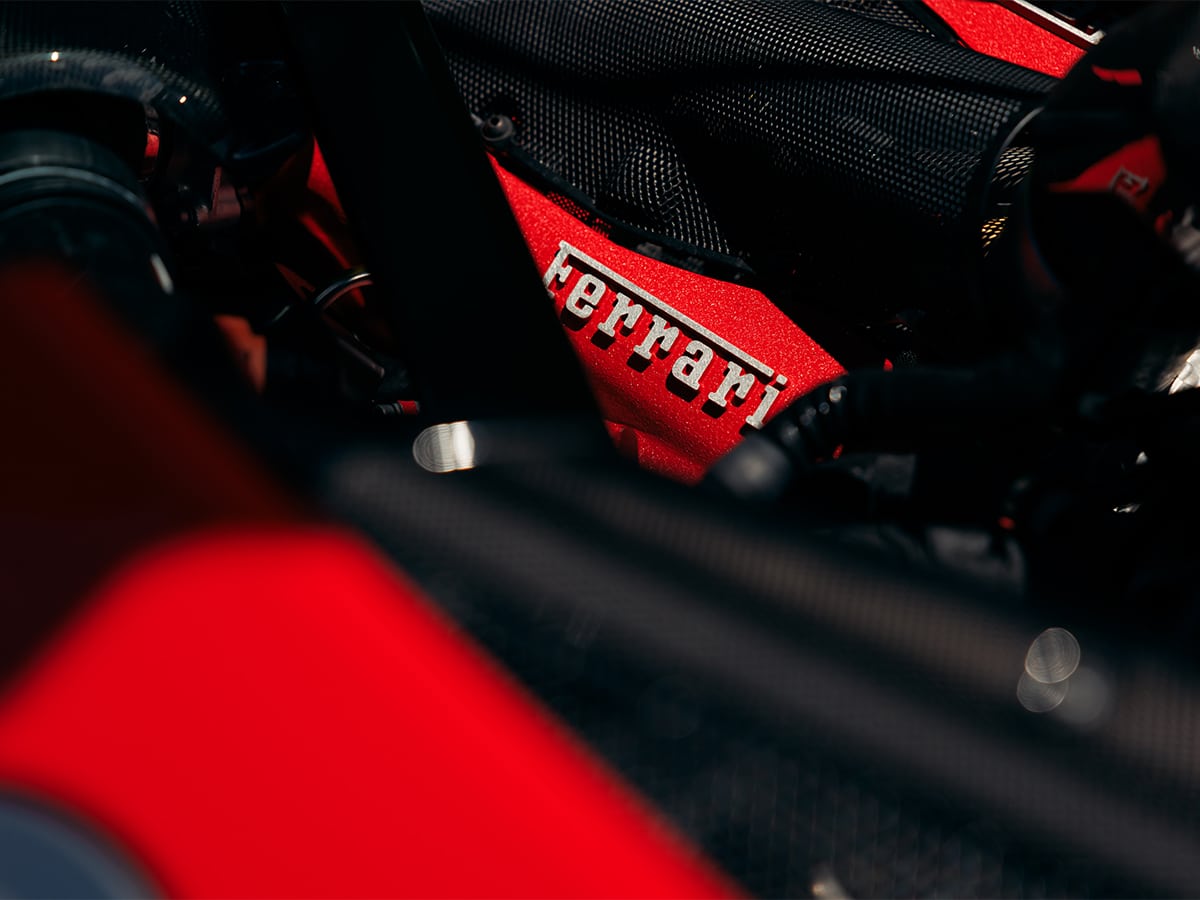
Now for the fun technical bits. The internal combustion engine at the heart of the 849 Testarossa is the F154FC 4.0-litre twin-turbo V8, now producing 830 CV at 7,500 rpm and 842 Nm of torque at 6,500 rpm before you add any hybrid trickery. That represents a specific output of 208 CV per litre.
To achieve all that, Ferrari engineers fitted larger turbochargers featuring F80-derived low-friction bearings, a 296 GT3-inspired turbine heat shield, an F80-derived intercooler with a 19 per cent larger surface area, lightweight titanium fasteners, and recycled aluminium secondary alloy castings that cut engine production emissions by 80 per cent. To address the muffled sound problem caused by modern emissions laws, the Inconel exhaust manifold has its duct diameter increased by 20 per cent and its length extended by 10 per cent.
Combined with a new overrun gearshift strategy inherited from the SF90 XX Stradale, it produces an explosive racing-shift pop when lifting off under load. However, the overall exhaust sound is still limited by emissions laws, and if I owned one, I’d go straight to the aftermarket.
Working in tandem with the dry-sump V8 are three electric motors delivering an additional 220 CV. Two sit on the front axle to handle RAC-e torque vectoring, while the third is an F1-derived MGU-K motor positioned at the rear. Energy is stored in a 7.45 kWh lithium-ion battery, allowing up to 25 km of silent electric driving in eDrive mode. Once you get through all of this engine trickery, power is sent through an eight-speed dual-clutch F1 transmission to an intelligent four-wheel-drive system. When Qualify mode is active, the combined punch is a staggering 1,050 CV, sending the berlinetta from 0-100 km/h in 2.3 seconds and 0-200 km/h in 6.35 seconds.
Driving
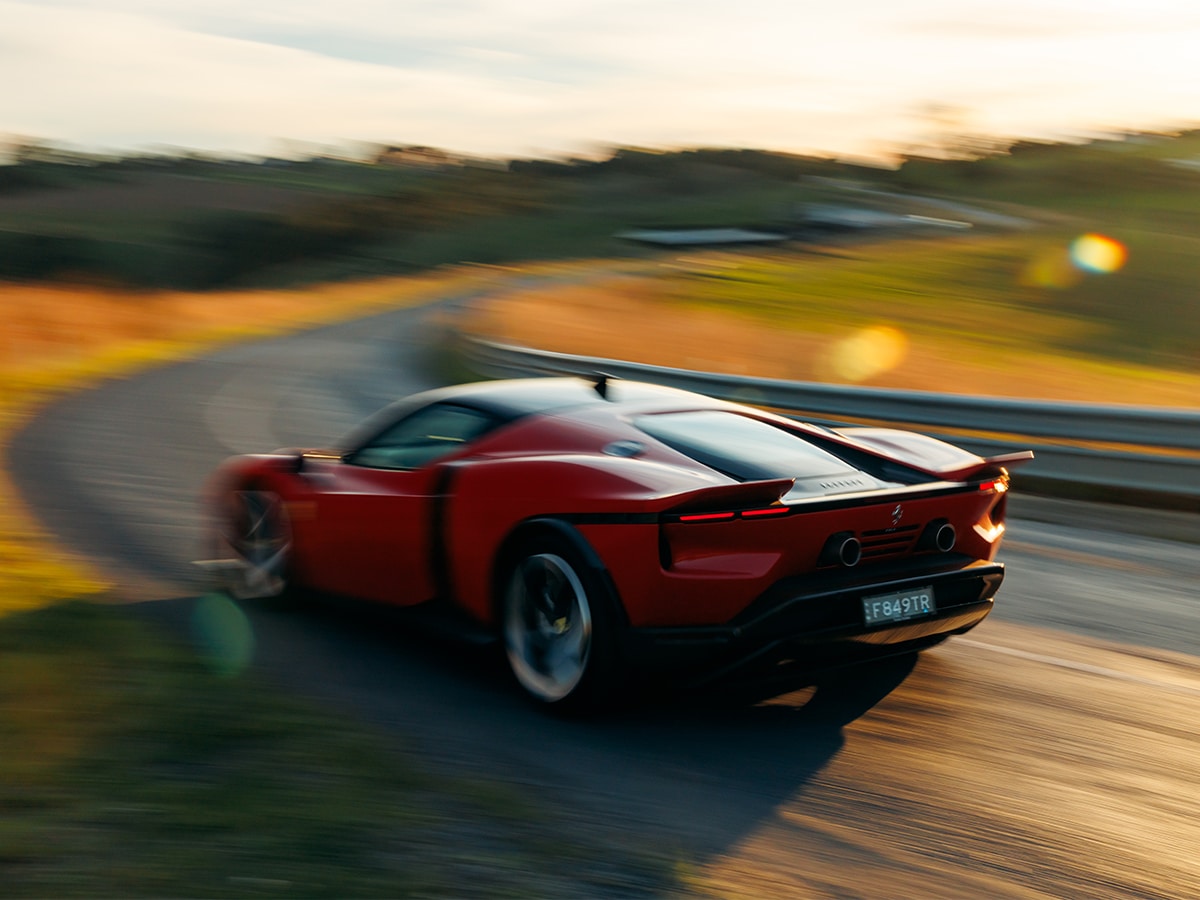
My time with the 849 Testarossa started in the dry, night-hazed desert surrounding Tailem Bend. Cruising on open public roads in Hybrid mode, the car behaves in unexpected ways. The front electric motors handle low-speed urban duties silently, while the revised suspension absorbs choppy rural asphalt with genuine compliance.
When you set off in eDrive mode, the twin-turbo V8 remains completely asleep, leaving the twin RAC-e electric motors on the front axle to draw from the 7.45 kWh lithium-ion battery.
Delivering up to 163 CV of silent electric push, it gives you 25 km of pure EV range, making sneaking out of a hotel driveway at dawn effortless. However, the moment you tip further into the accelerator or switch the eManettino selector into default Hybrid mode, the 4.0-litre V8 ignites. On early hybrid exotics, this transition often felt clunky, accompanied by an awkward shudder through the drivetrain. Ferrari solved this by introducing an active damping function directly into the hybrid control architecture.
The system uses the rear MGU-K motor to regularise engine idle speeds and cushion the physical handover between electrical and thermal power phases, making the engine ignition imperceptible through the seat.
The other major revelation on public roads is the brake pedal calibration. Previous brake-by-wire systems suffered from a wooden, unpredictable pedal feel as the car struggled to balance regenerative battery harvesting with physical caliper pressure. Ferrari completely revised the energy regeneration strategy with this new car, and the system smoothly coordinates regenerative braking from the front RAC-e motors and rear MGU-K with the 410mm front and 372mm rear brake discs.
What you end up with is a natural, highly progressive pedal travel that feels like a conventional hydraulic setup, whether you are gently slowing down for a country roundabout or scrubbing speed on an open highway.
Pushing out into the Mallee scrub, the revised suspension architecture reveals how different it is compared to the previous-generation vehicle. The road springs are 35 per cent lighter than those fitted to the SF90, and the overall roll gradient has been reduced by 10 per cent. On paper, a 10 per cent reduction in body roll sounds like a recipe for harshness, but in practice, shock absorber damping was bang-on across low-frequency motions and high-frequency impacts.
While there was a little tramlining along ruts and crashing over harsh mid-corner expansion joints out in the desert, the chassis glides over most uneven country asphalt with poise, keeping the contact patch of the 265/35 R20 front and 325/30 R20 rear tyres completely planted.
Working quietly in the background is the new FIVE system, short for Ferrari Integrated Vehicle Estimator. It acts as a digital twin of the car.
FIVE uses 6D chassis sensors to estimate real-time vehicle speed with an error margin of less than 1 km/h and yaw angle with an error of less than 1 degree. Even in standard road conditions, this data feeds directly into the eDiff, traction control, and RAC-e front-axle torque vectoring. It’s not something that you’re inherently aware of while driving, but if you encounter a patch of loose gravel or a diesel spill on a country road, FIVE adjusts power distribution across all four wheels before you even register the loss of grip through the steering wheel.
When you find an open stretch of desert highway and squeeze the throttle in third gear, the mechanical character of the overhauled V8 takes over.
Longitudinal acceleration from 5,500 rpm upwards is noticeably sharper than before, driven by the lighter camshafts, titanium fasteners, and larger turbochargers. Crucially, it no longer sounds like a muted, vacuum-assisted motor at highway speeds. You’re treated to a deep, resonant combustion timbre at partial throttle, providing a nice preview of what happens when you finally get the car onto a closed circuit. More on that in a minute.
Track Test
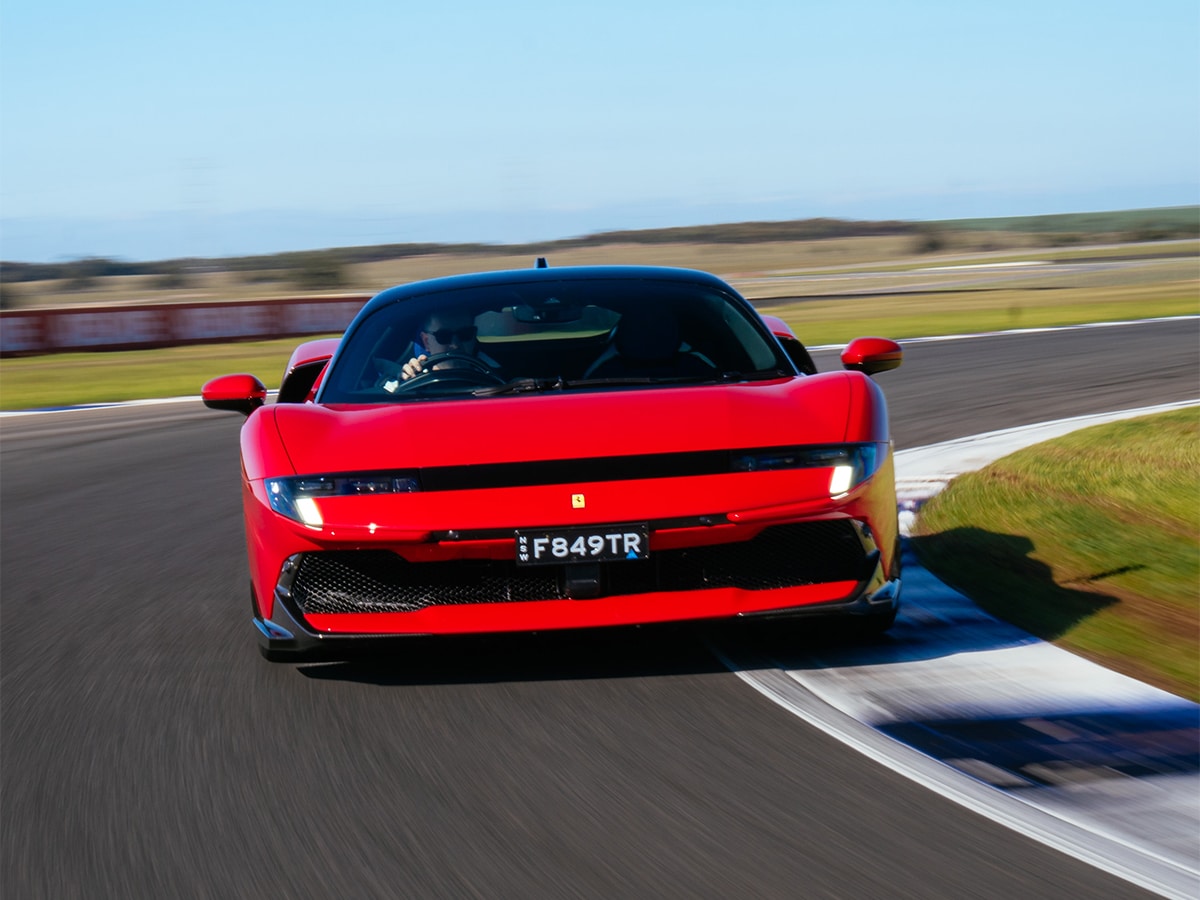
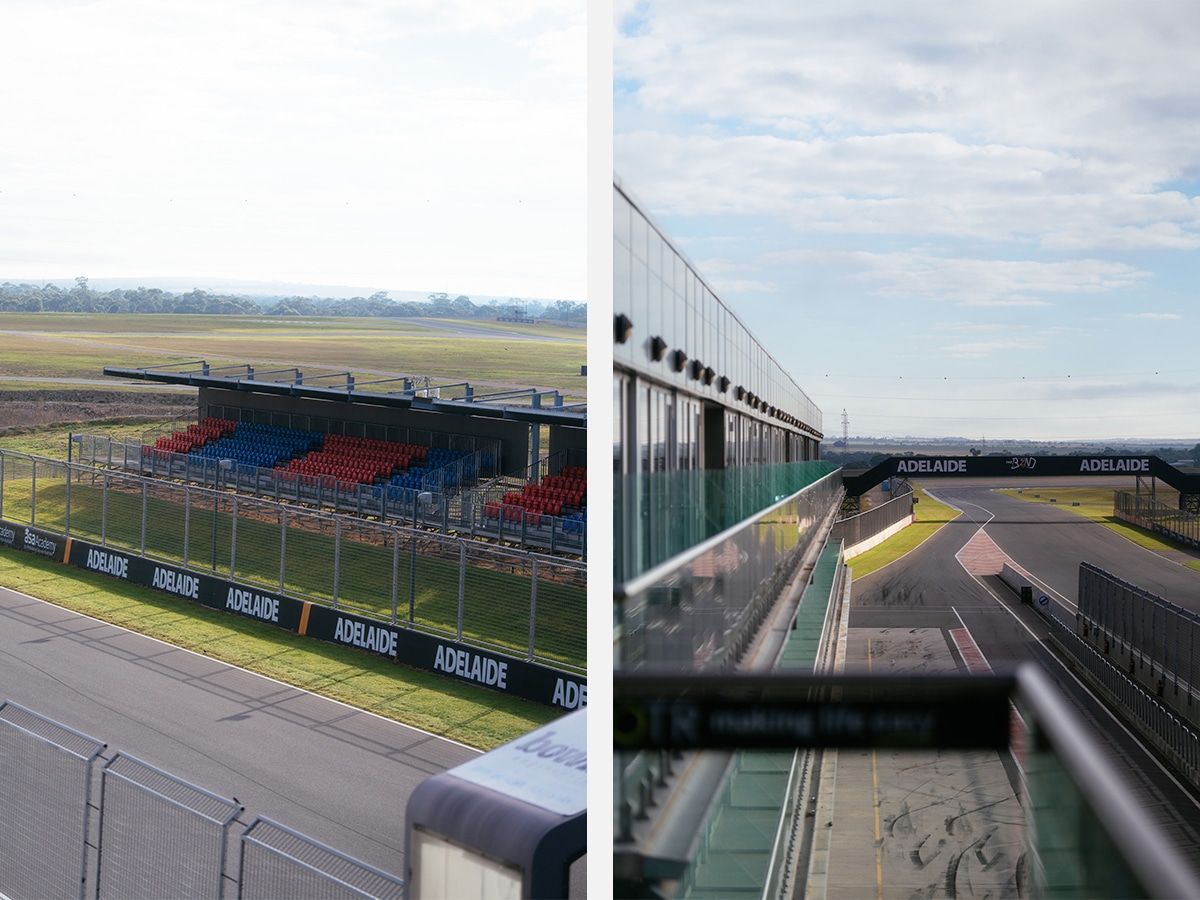
The real revelation happened when I pulled off the desert highway and rolled through the gates at The Bend Motorsport Park. Leaving public speed limits behind is the only way to safely explore what happens when 1,050 CV is completely uncorked.
Switching the eManettino selector to Qualify mode bypasses energy conservation, waking the front RAC-e motors and the rear MGU-K for maximum power.
Up until this point, the Lamborghini Revuelto was the quickest car I’d driven on track, but the 849 Testarossa has entered the fold. When I flatten the accelerator down the main pit straight, it delivers a brutal physical sensation. The combined torque launches the car from 0 to 100 km/h in under 2.3 seconds, and the digital readout sweeps past 200 km/h in just 6.35 seconds, with no pause in momentum.
The indicated speed on the dashboard before Turn 1 starts with a three. Turn in, and instead of the understeer you might expect from a heavy, all-wheel-drive hybrid, the active rear spoiler instantly drops into its High Downforce configuration. With 100kg of additional load clamping the rear axle and the front electric motors vectoring torque directly to the inside wheel, the nose turns into the apex with mind-bending precision.
It’s the standout feature of the 849 Testarossa, and it makes itself known down the short chute toward Turn 6, a tight hairpin testing high-load deceleration, you stomp on the pedal at over 240 km/h. The ABS Evo controller works alongside the FIVE system to calculate target wheel slip across all four tyres in real time. The car sheds speed from 100 to 0 km/h in just 28.5 metres with zero pedal chatter or tail-wagging, allowing you to trail-brake deep into the corner before leaning on the torque vectoring.
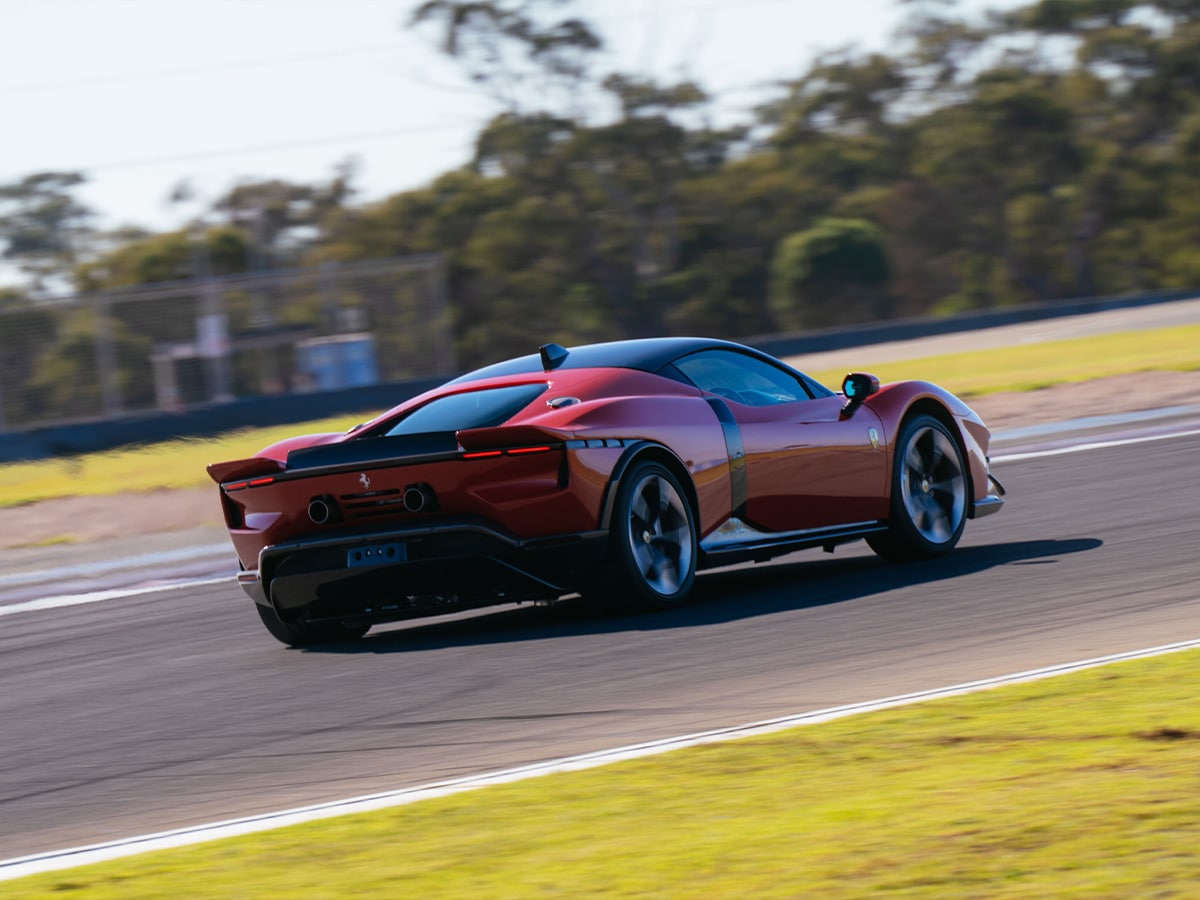
Through the technical, flowing S-bends of Turns 14 and 15, the reduced body roll keeps the chassis completely flat, letting you lean heavily on the mechanical grip of the tyres. Punching the throttle on exit, the SF90 XX Stradale-derived gearshift calibration delivers a violent, explosive pop from the Inconel exhaust on upshifts, echoing off the pit wall as the V8 screams to its 8,300 rpm redline.
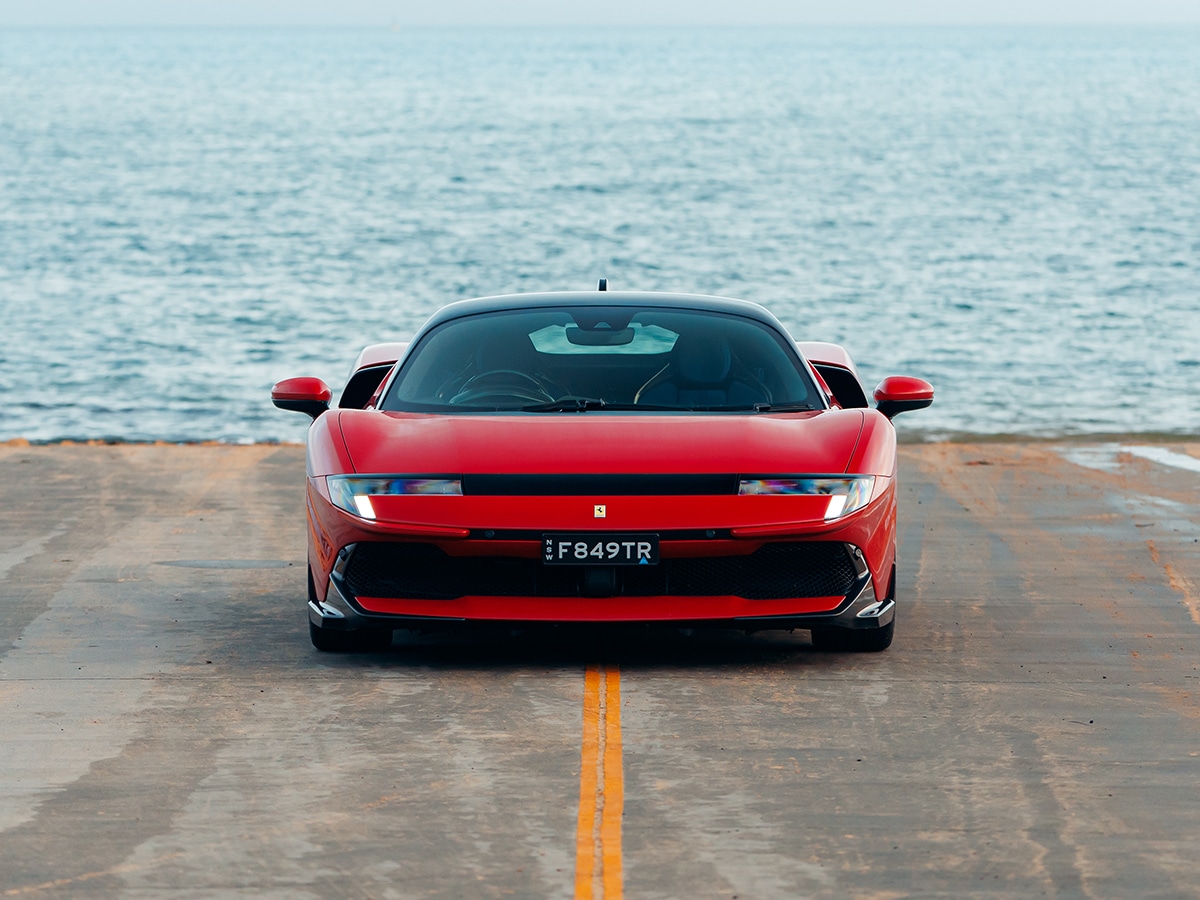
Unlike so many modern hybrid supercars, the 849 Testarossa turns a technical circuit into an addictive high-speed playground, and even better, a huge smile. It finally delivers the exact emotional thrill I feared modern hybrid supercars had lost.
Verdict
Priced at well over a million dollars by the time it lands in your driveway, the Ferrari 849 Testarossa represents a monumental investment, and the benchmark is very high. Yet, it serves as the definitive answer to the identity crisis currently troubling the supercar world. It proves that electrification and strict emissions mandates do not have to result in a sterile, silent digital appliance.
By bringing back physical mechanical buttons to the steering wheel, extending the Inconel exhaust to deliver a legitimate V8 soundtrack, and using the FIVE digital twin system to make 1,050 CV genuinely fun (and very usable at the limit), Ferrari has built something extraordinary. It glides over country asphalt with surprising compliance in Hybrid mode, then turns into an absolute weapon the second you engage Qualify mode on a circuit like The Bend.
With local deliveries arriving shortly, the wait is entirely justified for those fortunate enough to hold an allocation. The 849 Testarossa is a triumphant statement that hypercar-level performance can still deliver raw, unadulterated smiles.
Related reads




















Comments
We love hearing from you. or to leave a comment.