


Updated:
Readtime: 5 min
Every product is carefully selected by our editors and experts. If you buy from a link, we may earn a commission. Learn more. For more information on how we test products, click here.
- Olli’s Garage entered a 280 HP Dacia Logan at the Nürburgring.
- The fan-funded privateer car utilised a Renault Megane RS engine swap.
- The team battled chronic misfires and a series of strict penalties.
- They hit the wall with just three hours left to race.
- Mechanics repaired the destroyed suspension to finish 107th overall.
Max Verstappen’s debut as a team owner at the Nürburgring 24 Hours was the main story heading into the race weekend. However, when the #3 Verstappen Racing Mercedes-AMG GT3 retired with a broken driveshaft on Sunday morning, relinquishing the race lead, the Formula 1 champion’s race ended abruptly, and the attention turned to an unlikely fan favourite.
The #81 BMW M3 Touring 24H won its class, and HWA’s EVO.R reimagined the iconic Mercedes 190E DTM racer, but the most impressive effort in the paddock was happening at the opposite end of the grid. Olli’s Garage Racing, a privateer team from Münster, was attempting to survive the race in a 280 HP Dacia Logan. It takes a specific kind of nerve to muscle a commuter car around the Nordschleife in the dark, and even more when a train of factory-backed GT3 cars is bearing down on your rear bumper (including Max Verstappen). But for the crew at the #300 Ollis Garage Racing Dacia Logan, surviving that closing speed is just part of the job, with a few failed attempts at the Green Hell 24 Hours.
Their entry had paid the price for it before, suffering heavy, car-destroying shunts in both 2023 and 2025 when top-tier traffic misjudged the gap. Rather than scrap the project, the team used fan donations to build a new car from a bare shell, dropping in a Renault Megane RS engine to give them a fighting chance on the straights.

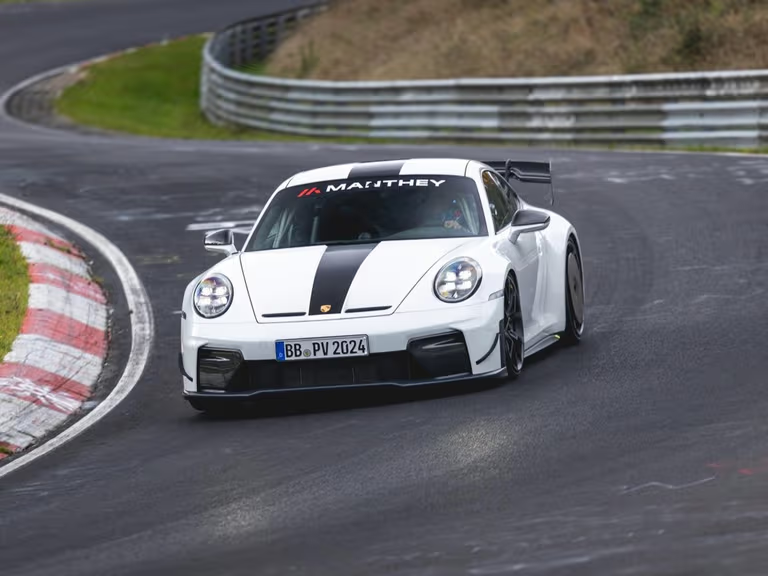
Placed into the same garage as a Ferrari 296 GT3 and the famous Manthey ‘Grello’ Porsche 911, the Dacia crew fought a relentless battle just to keep the engine running. While the factory teams tweaked aerodynamics and monitored telemetry, Olli’s Garage was dealing with a chronic misfire above 4,500 RPM, forcing them to swap out a cam sensor at every pit stop.
Despite the mechanical gremlins, the Logan was genuinely racing. Utilising a six-speed sequential gearbox, the car clocked an 11:03.438 in qualifying, outpacing several BMW 325i entries (11:41.597) and an Audi RS3 LMS DSG by a significant margin (11:16.229). Then, during the race, drivers Oliver Kriese, Alexander Becker, Christian Geilfus, and Robert Neumann were recorded hitting 178 km/h down the Döttinger Höhe, squeezing every ounce of performance out of a chassis originally designed for the grocery run.
But sheer pace and mechanical attrition weren’t the things that nearly derailed the #300’s weekend. It was a brutal string of penalties and a highly contentious trackside recovery.

Things started on the wrong foot before the race even began when the team was slapped with a five-place grid penalty for performing an unauthorised U-turn on the track (see picture above). Then, once the green flag dropped, the disciplinary issues continued. During Neumann’s stint, he was clocked doing 104 km/h in a Code 60 zone. Race control handed down a 74-second stop-and-go penalty and two DMSB penalty points, sinking them further down the order.
Then came the crash. With just three hours remaining in the 24-hour endurance test, the Dacia hit the barriers, violently ripping off its left-front wheel.
The recovery itself turned into a heated dispute as the team instructed the marshals not to tow the car, fearing the extraction would bend the frame or damage the suspension mounts beyond repair. The recovery vehicle hooked it up and towed it anyway, then dumped it back in the paddock with secondary damage from the tow. The team was left with a mangled front end and the clock ticking down. Under Nürburgring 24 Hour regulations, a car is only classified as a finisher if it crosses the line within 15 minutes of the overall winner.

This is where the contrast between the front and the back of the grid was finalised. When Dani Juncadella brought Verstappen’s race-leading Mercedes into the pits with a broken driveshaft hours earlier, the team assessed the damage and formally retired the car. But down the pit lane, Olli’s Garage picked up their tools and started cutting away the destroyed bodywork, desperately rebuilding the front left suspension to finish the race.
With the odds against them, the mechanics got the commuter car repaired, approved, and back out onto the tarmac. Car #300 crossed the finish line to take the checkered flag within the classification window, officially finishing the Nürburgring 24 Hours and finishing in 107th place.
Verstappen’s exit generated the headlines, but watching a privateer team thrash to resurrect a fan-funded Dacia and cross the finish line is what defined the ADAC RAVENOL 24h Nürburgring.










Comments
We love hearing from you. or to leave a comment.