

Garmin Forerunner 170 Music Review: The Watch That Paced Me to 1:18 at My First HYROX

Updated:
Readtime: 14 min
Every product is carefully selected by our editors and experts. If you buy from a link, we may earn a commission. Learn more. For more information on how we test products, click here.
On 5 July, I crossed the finish line at my first HYROX race in 1:18:02. Eight workout stations, eight 1km running segments, and 78 minutes of sustained effort. That’s the kind of event where your gear either works for you or against you, and I wasn’t willing to leave pacing, heart rate data, or race-day logistics to chance. When Garmin Australia offered me the new Forerunner 170 Music to test through my prep block, I said yes immediately. I wore it for every F45 session, every long run around Coogee, every Hyrox simulation workout, and the race itself. Here’s what I found.
Garmin Forerunner 170 Music Review: The TL;DR
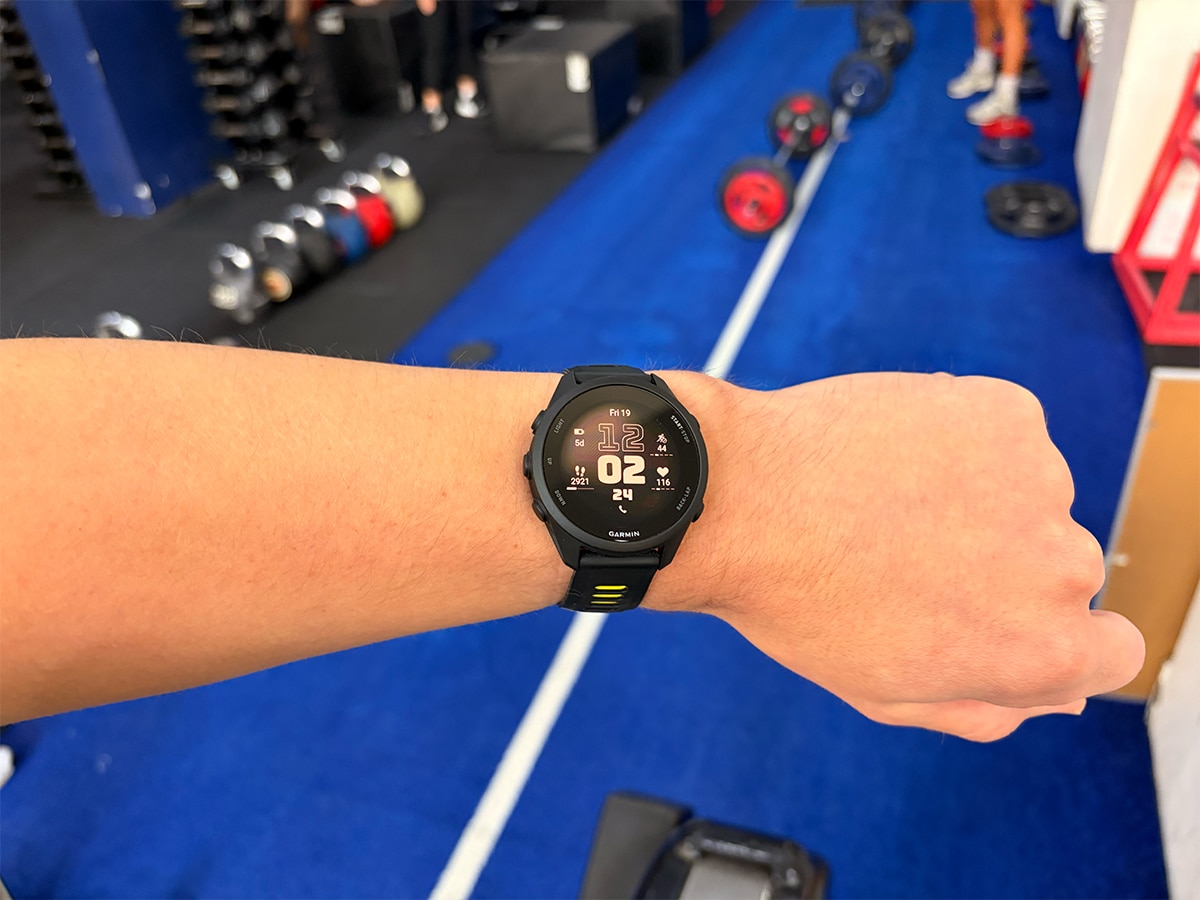
The Forerunner 170 Music ($549 AUD / $349.99 USD) is Garmin’s new mid-range GPS running watch with a 1.2-inch AMOLED display, offline Spotify support, and a training metrics suite that used to be reserved for watches costing $200 more. It weighs 41 grams, lasts up to 10 days in smartwatch mode (20 hours with GPS), and packs every sensor you need for serious run training. For a first-time HYROX competitor who wanted deep training data without the $900+ price tag of a Fenix or Enduro, it’s been the right pick.
The Forerunner 170 Music is also stocked at Rebel Sport and specialty running retailers.
Why I Went Garmin for HYROX (vs Apple Watch and Other Smartwatches)
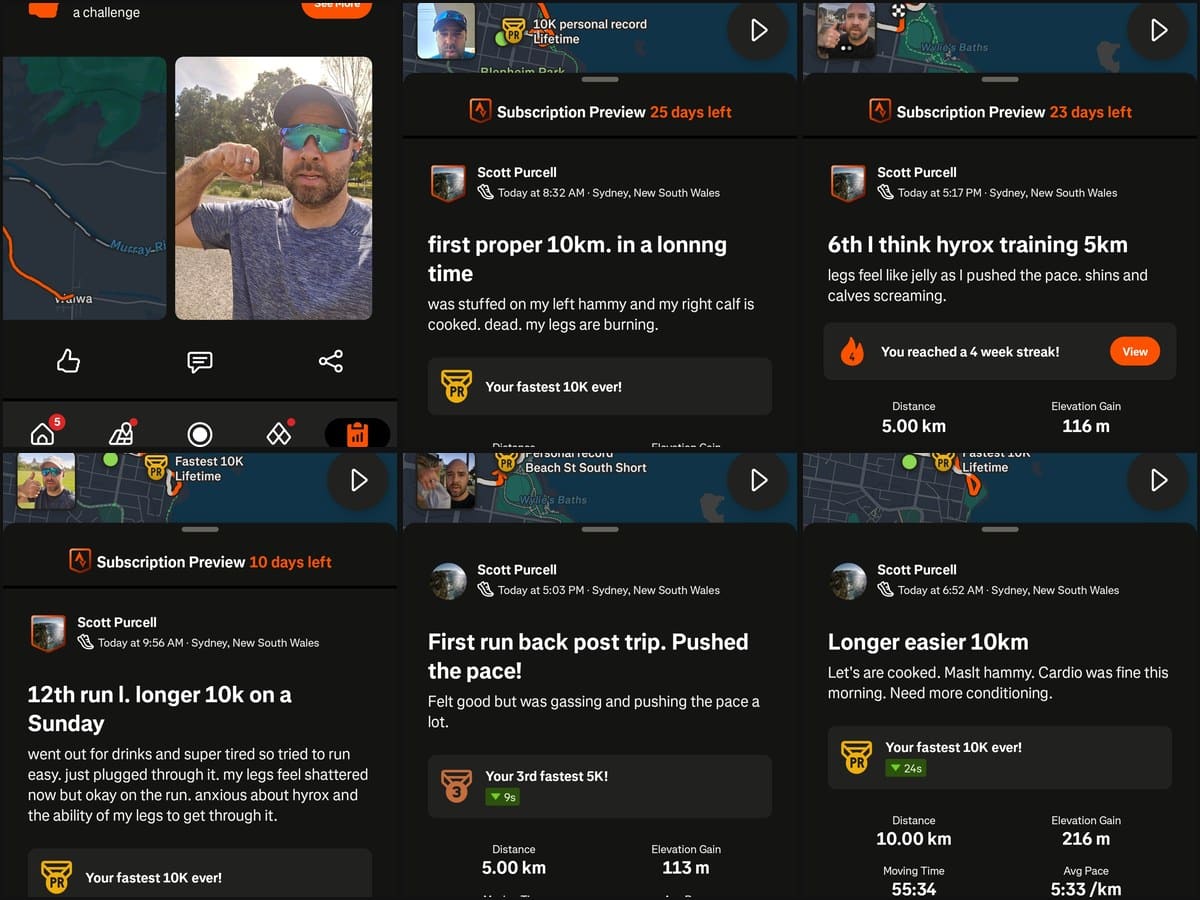
I’ll be honest: I wore an Apple Watch Series 9 for two years before this. It’s a brilliant smartwatch. Notifications, Apple Pay, iMessage on my wrist. But when I committed to HYROX training in March, I started noticing the gaps. The Apple Watch tracks heart rate fine, but its workout app doesn’t give you Training Status, Training Readiness, or load management across a full training block. It doesn’t tell you whether yesterday’s intervals actually pushed your aerobic capacity or just fatigued you.
That distinction, smartwatch versus sports watch, matters more than most people realise. A smartwatch is built around your phone. A sports watch is built around your training. The Forerunner 170 still handles notifications and Garmin Pay, but it’s designed from the ground up for people who care about pace targets, recovery windows, and weekly training load.
Samsung’s Galaxy Watch Ultra and the Apple Watch Ultra 2 ($1,336 AUD) have closed the gap on hardware with dual-frequency GPS and solid heart rate sensors. But neither offers Garmin’s training ecosystem: VO2 Max estimates, Training Readiness scores, HRV Status, and adaptive race predictions. For a race that demands you know your body’s state before, during, and after, Garmin’s software is what sold me.
HYROX and F45 Tracking: Pacing, Heart Rate Zones, and Interval Timing
HYROX is a strange beast. You’re alternating between 1km runs and functional fitness stations (ski erg, sled push, sled pull, burpee broad jumps, rowing, farmers carry, sandbag lunges, and wall balls). That means your watch needs to handle both running metrics and general exercise tracking without you fumbling with buttons mid-race.
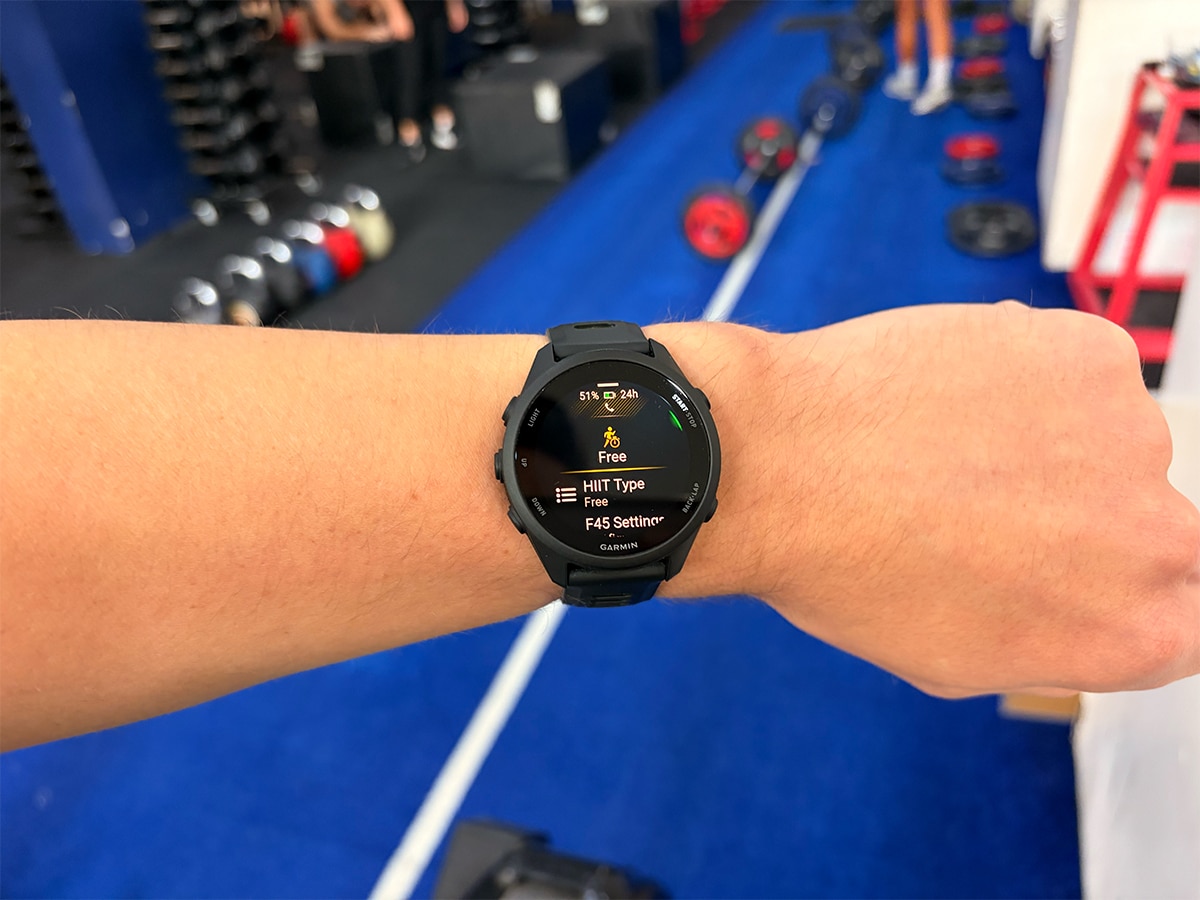
The Forerunner 170 doesn’t have a native HYROX activity profile out of the box the way the Fenix 8 or Forerunner 965 do, since it lacks multisport/triathlon mode. The workaround is straightforward: I’ve been using a custom interval workout that mirrors the HYROX format, with 1km run segments followed by timed station efforts. Setting this up took about ten minutes in Garmin Connect, and it syncs to the watch over Wi-Fi. During sim sessions at F45 Darlinghurst, I tap the lap button at each transition and get clean splits for every segment.
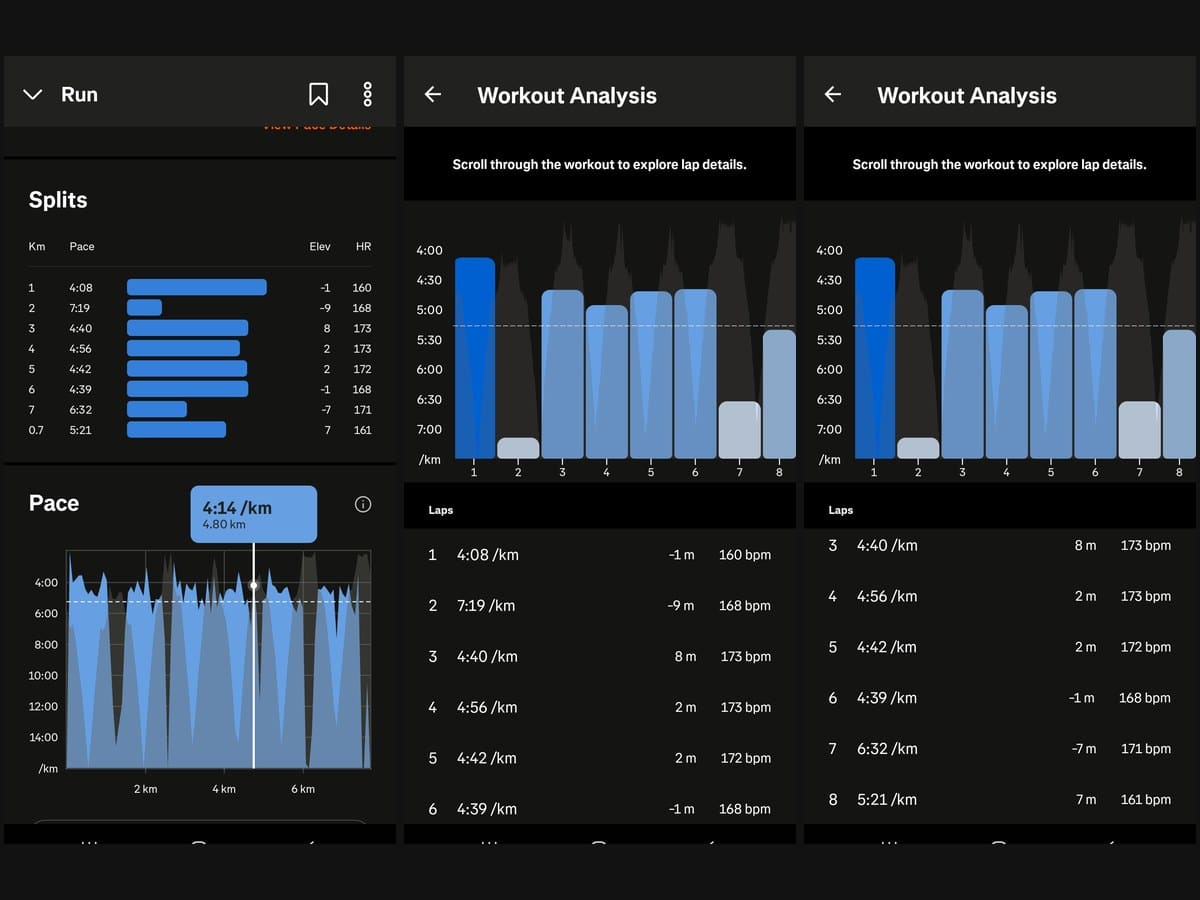
The heart rate zone data has been genuinely useful. During my first full sim in April, I was redlining into Zone 5 by the third station because I started too hot. The watch showed me exactly where I blew up: my first two 1km runs were at 4:15/km pace when my target should have been 4:40. That data in Garmin Connect let me recalibrate. Now I hold back on the early runs and have enough left for the sled push and farmers carry, where most first-timers fall apart.
For HIIT workouts at F45, I use the Cardio activity profile. It picks up heart rate continuously and gives me calorie burn, time in each zone, and Training Effect scores (aerobic and anaerobic) afterwards. The Elevate Gen 4 optical sensor has been consistent during high-intensity work, and I’ve compared it against my Oura Ring’s resting heart rate data overnight. The two are within 1-2 BPM.

Race Day: Pacing (and Ignoring) My Watch at HYROX Sydney
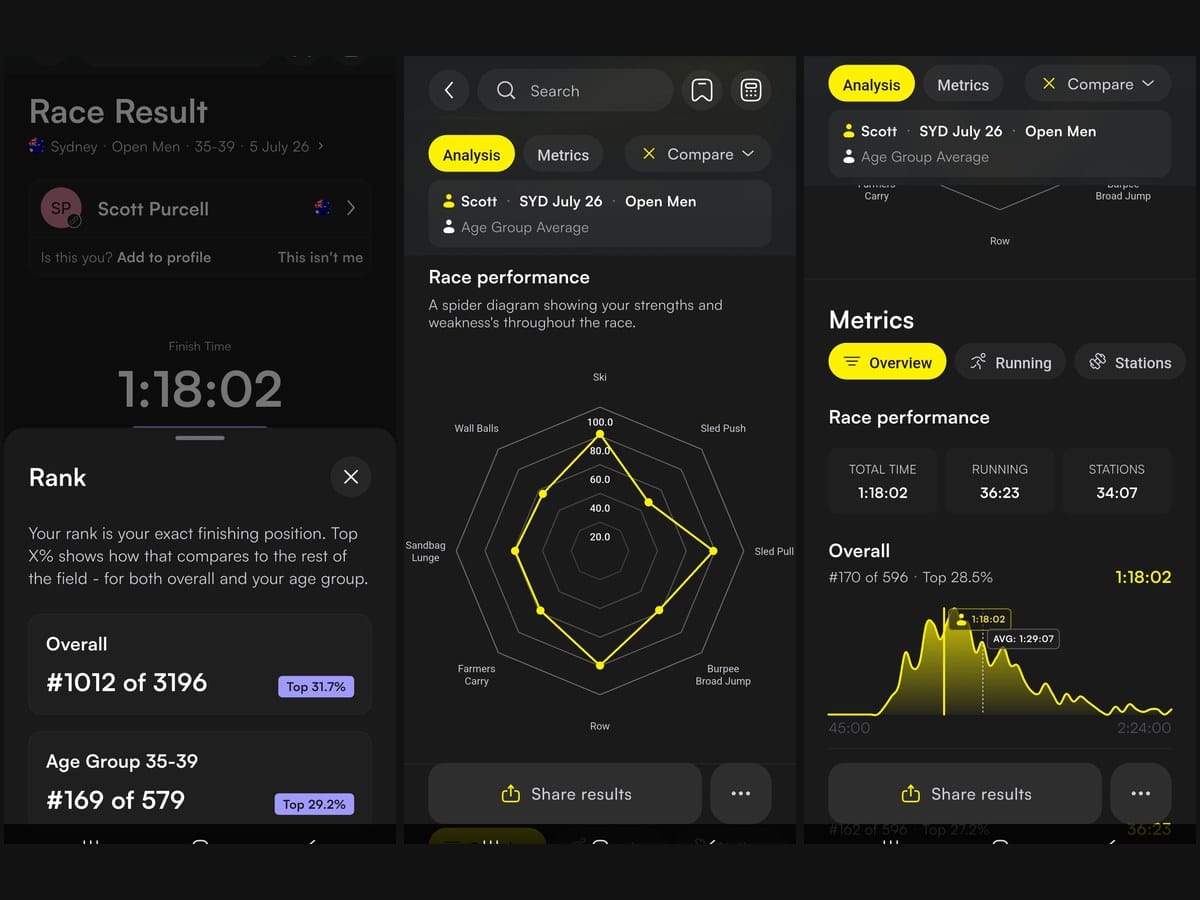
The race itself was the final exam, and the data it produced is the most honest review of my training block I could ask for. I finished the 4:30pm Men’s Open wave in 1:18:02: 1,012th of 3,196 overall and 169th of 579 in my age group, against a target of going under 1:20. The official breakdown had me at 36:23 across the eight runs and 34:07 on the stations, with the balance lost in the Roxzone between them.
Here is the embarrassing part. Everything I wrote above about learning to hold back on the early runs went out the window the moment the crowd started roaring. My opening kilometre flashed up at 3:38 when the plan said 4:40, and I watched it happen in real time on my own wrist and kept going anyway. A faster mate from F45 had spent all week warning our group not to go out hot. The watch did its job; the human ignored it. The lap data afterwards shows exactly what that cost me through the middle stations.
Where the Forerunner earned its keep was everything else. The custom interval workout I had rehearsed in the sims meant one tap of the lap button at each transition, so I now have a clean split for every run and every station without ever fumbling mid-race. (The PUMA x HYROX shoes I raced in got their own review, and their own share of the blame for that opening kilometre.) Three weeks earlier, my full simulation had come in at 1:19, and the comparison between the two files in Garmin Connect shows the difference was almost entirely pacing discipline through runs three to six, which is precisely the kind of insight I bought a sports watch for.
“I’m quite worried with how I’ll go. I don’t feel amazing at all but fingers crossed I get through it,” I messaged Jem on race morning. The watch said Zone 2; the nerves disagreed.
Music and Spotify Offline: Running Without a Phone
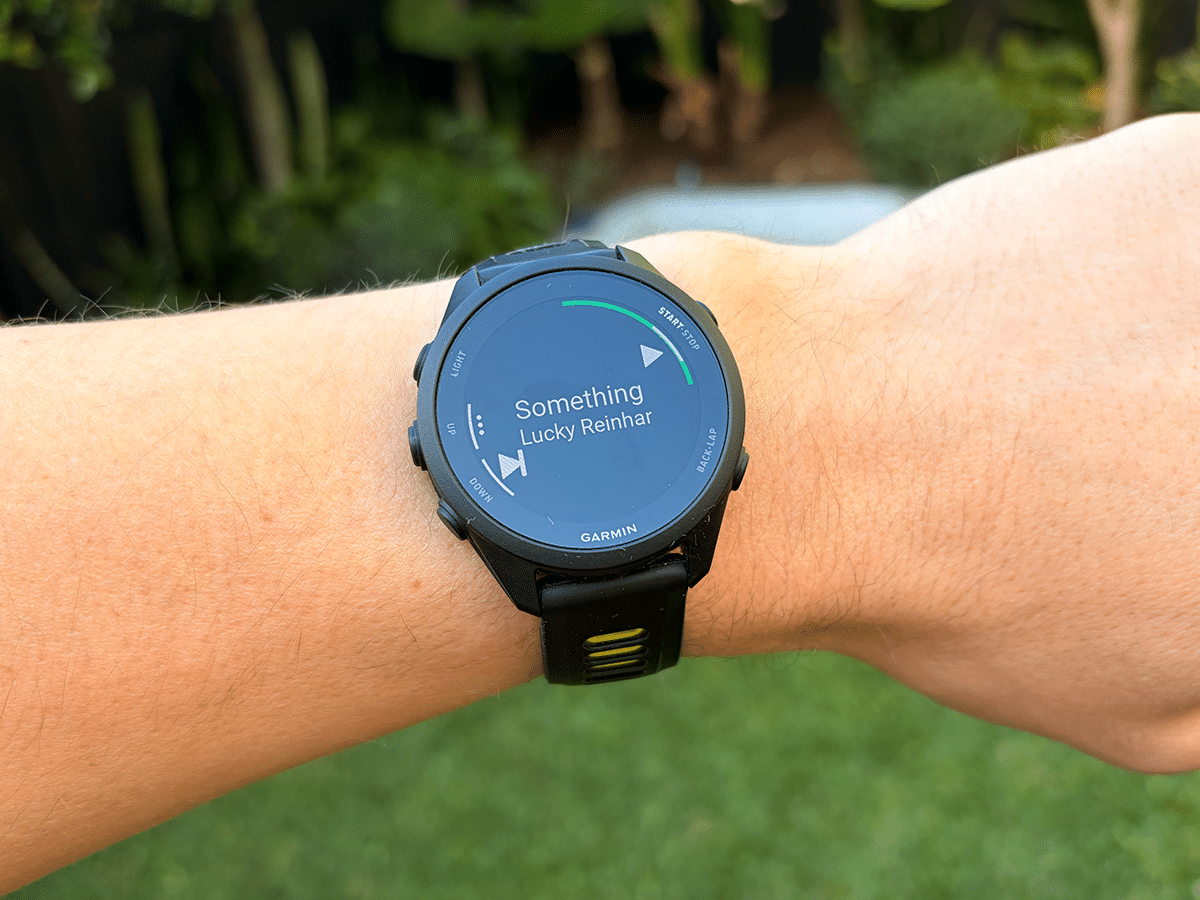
This was the single biggest reason I chose the Music variant over the standard Forerunner 170. The Music version costs $50 AUD more ($549 vs $499 AUD) and adds 4 GB of onboard storage, roughly enough for 500 songs. It supports Spotify, Amazon Music, and Deezer for offline downloads.
Setting up Spotify was painless but slow. You connect the watch to Wi-Fi, open the Spotify app on the watch, authenticate via your phone, and select playlists to sync. The initial download of a 60-song playlist took about 12 minutes. After that, you pair Bluetooth headphones (I’m using Jaybird Vista 2s) and you’re running without a phone.
Running phoneless around Coogee has been genuinely freeing. No vibrating notifications breaking my rhythm, no fumbling with an armband. Just the watch on my wrist, headphones in, and my running playlist locked in. For race day, I plan to load a specific 90-minute playlist with tracks that match the effort profile of each segment: steady BPM for the runs, higher energy for the stations.
The catch: Spotify requires a Premium subscription for offline sync, and the watch doesn’t support Apple Music. If you’re deep in the Apple ecosystem and refuse to pay for Spotify, this won’t work for you.
GPS Accuracy and Daily Wear
The Forerunner 170 uses single-frequency GPS with GLONASS, Galileo, BeiDou, and QZSS satellite support. It doesn’t have the multi-band (L1+L5) GPS found in the Forerunner 265 or Fenix series, which means it’s theoretically less accurate in dense urban environments or heavy tree cover.
In practice, running my regular loops around Coogee, Bronte, and Bondi, I haven’t noticed meaningful accuracy issues. Routes track cleanly in Garmin Connect, recorded distances have been within 1-2% of the Strava segments I use as benchmarks, and the watch locks onto satellites in about 8-12 seconds outdoors. DC Rainmaker’s independent testing reached the same conclusion, rating the 170’s GPS accuracy as excellent with only minor optical heart rate wobbles during intervals, which mirrors what I saw against a chest strap at F45.
For daily wear, the 43mm case sits low on my wrist and the 41-gram weight makes it easy to forget it’s there. The AMOLED display is bright in direct sunlight, and the always-on mode is clear enough to check pace mid-run without flicking your wrist. I’ve been wearing it alongside my Oura Ring 4 without any interference, getting a full picture of training load (Garmin) and recovery/sleep quality (Oura). The Eight Sleep Pod 4 I reviewed earlier this year handles the sleep environment side, but for wearable tracking, the Oura remains my pick.
Battery Life and Charging
Garmin rates the Forerunner 170 Music at up to 10 days in smartwatch mode and 20 hours in GPS mode. In my experience, with always-on display disabled and four to five GPS-tracked workouts per week (30-minute F45 sessions to 90-minute long runs), I’m charging every six days. That’s with music playback on about half those sessions, which drains the battery faster than GPS alone.
For a full HYROX race, battery isn’t a concern. Even a slow first-timer will finish in under two hours, and the watch holds GPS plus music playback for well over five hours on a single charge. Charging uses Garmin’s proprietary clip-on cable, not USB-C, which is annoying in 2026. A full charge from empty takes about 90 minutes.
Garmin Forerunner 170 Music Limitations
No watch is perfect, and the Forerunner 170 has a few shortcomings worth knowing about.
No multi-band GPS. The single-frequency chipset is fine for suburban and coastal runs, but if you’re trail running through narrow gorges or dense bushland, the Forerunner 265 with multi-band GPS will give you better accuracy.
No multisport/triathlon mode. The biggest functional gap compared to the Forerunner 265. If you plan to do triathlons or any race where you need automatic transitions between swim, bike, and run, this watch can’t do it. For HYROX, the custom interval workaround is fine.
No maps or turn-by-turn navigation. You get breadcrumb navigation (a track line showing where you’ve been) but not downloadable topographic maps. For my purposes, running known routes around Sydney’s eastern suburbs, this hasn’t mattered. If you want maps, you’re looking at the Forerunner 265 or above.
4 GB music storage fills up fast. With the OS taking a portion, you get roughly 3.5 GB for music, about 500 songs. You’ll need to be selective about which playlists you sync.
Proprietary charger. Garmin’s clip-on charging cable feels dated in a USB-C world. It works, but it’s one more cable to pack when travelling.
Garmin Forerunner 170 vs Forerunner 265 vs Apple Watch Ultra 2: Compared
| Feature | Forerunner 170 Music | Forerunner 265 | Apple Watch Ultra 2 |
|---|---|---|---|
| Price (AUD) | $549 | $649 | $1,336 |
| Display | 1.2″ AMOLED, 390×390 | 1.3″ AMOLED, 416×416 | 1.93″ OLED, 502×410 |
| Weight | 41g | 47g | 61.4g |
| GPS | Single-frequency multi-GNSS | Multi-band (L1+L5) | Dual-frequency (L1+L5) |
| Battery (smartwatch) | Up to 10 days | Up to 13 days | Up to 36 hours |
| Battery (GPS) | Up to 20 hours | Up to 20 hours | Up to 12 hours |
| Music storage | 4 GB (~500 songs) | 8 GB (~1,000 songs) | 64 GB |
| Offline Spotify | Yes | Yes | Yes (Apple Music native) |
| Water resistance | 5 ATM (50m) | 5 ATM (50m) | WR100 (100m) |
| Training Readiness | Yes | Yes | No |
| VO2 Max | Yes | Yes | Yes (cardio fitness) |
| HRV Status | Yes | Yes | Yes |
| Multisport/triathlon | No | Yes | Yes |
| Maps | No (breadcrumb only) | Yes (downloadable) | Yes (Apple Maps) |
The short version: if you’re training for running-focused events like HYROX, parkrun, or marathon prep, the Forerunner 170 Music gives you 90% of the Forerunner 265’s training features at $100 less. You lose multi-band GPS, maps, triathlon mode, and half the music storage. If those matter, step up to the 265. If you want a premium smartwatch that happens to do sports, the Apple Watch Ultra 2 is excellent, but you’re paying $787 more with a third of the battery life.
Who Should Buy the Garmin Forerunner 170 Music
Buy it if: You’re a runner, HYROX competitor, or gym regular who wants real training data without paying Fenix prices. You want to run without your phone and stream Spotify from your wrist. You’re stepping up from a fitness band or basic smartwatch and want your first proper Garmin running watch.
Skip it if: You’re a triathlete (no multisport mode). You need maps for trail running or ultramarathons. You’re already wearing a Forerunner 265 and happy with it. You want your watch to replace your phone (Apple Watch does that better).
Garmin Forerunner 170 Music: Tech Specs
| Specification | Detail |
|---|---|
| Model | Garmin Forerunner 170 Music |
| Price | $549 AUD / $349.99 USD |
| Case size | 43mm |
| Weight | 41g |
| Display | 1.2″ AMOLED, 390 x 390 pixels |
| Lens material | Chemically strengthened glass |
| Case material | Fibre-reinforced polymer |
| Water resistance | 5 ATM (50 metres) |
| Battery (smartwatch) | Up to 10 days |
| Battery (GPS) | Up to 20 hours |
| GPS | Single-frequency (GPS, GLONASS, Galileo, BeiDou, QZSS) |
| Heart rate sensor | Garmin Elevate Gen 4 (optical, wrist-based) |
| Additional sensors | Barometric altimeter, compass, gyroscope, thermometer, ambient light sensor, pulse oximeter, accelerometer |
| Music storage | 4 GB (~500 songs) |
| Music services | Spotify, Amazon Music, Deezer |
| Connectivity | Bluetooth, Wi-Fi, ANT+ |
| Payments | Garmin Pay |
| Controls | 5-button + touchscreen |
| Colour tested | Black with Black/Amp Yellow band |
| Training features | VO2 Max, Training Readiness, Training Status, HRV Status, Training Load, Running Power (wrist), PacePro, Race Predictor, Garmin Coach |
Garmin Forerunner 170 Music Verdict
The Garmin Forerunner 170 Music has become the watch I reach for every morning, and it was the one on my wrist when I crossed the HYROX Sydney finish line in 1:18:02 on 5 July. It does the things that matter for structured training: accurate heart rate tracking, detailed workout analysis, genuine pacing tools, and enough battery life that I never think about charging before a session. Spotify offline has changed how I run, letting me leave my phone at home and just go.
At $549 AUD, it sits in a sweet spot. Significantly cheaper than the Forerunner 265 ($649) and a fraction of the Apple Watch Ultra 2 ($1,336), yet it delivers the full Garmin training stack: Training Readiness, VO2 Max, HRV Status, and adaptive coaching. You give up multi-band GPS and triathlon mode, neither of which I need for HYROX or gym training in Sydney.
If you’re prepping for your first HYROX or just want a proper running watch that doesn’t cost a fortune, the Forerunner 170 Music is the one I’d point you toward. It’s not trying to replace your phone. It’s trying to make you a better runner. In my experience, it’s doing exactly that.
Garmin Australia provided the Forerunner 170 Music for this review. Scott was not paid and Garmin had no editorial input.
Garmin Forerunner 170 Music FAQs
Yes. The Forerunner 170 Music supports offline Spotify downloads, along with Amazon Music and Deezer. You need a Spotify Premium subscription to download playlists for phone-free listening. The watch stores approximately 500 songs on its 4 GB internal storage.
The Forerunner 170 doesn’t have a built-in HYROX activity profile, but you can create custom interval workouts in Garmin Connect that mirror the HYROX race format. Heart rate zone tracking, lap splits, and post-workout analysis in Garmin Connect give you detailed segment-by-segment data for training and race day.
The Forerunner 265 adds multi-band GPS for better accuracy in challenging environments, multisport/triathlon mode, downloadable maps, a slightly larger 1.3-inch display, 8 GB of music storage (vs 4 GB), and 13 days of battery life (vs 10 days). The Forerunner 170 costs $100 AUD less and shares most of the same training metrics, including Training Readiness, VO2 Max, and HRV Status.
If your priority is structured run training with detailed metrics like Training Readiness, Training Status, and adaptive coaching, the Forerunner 170 Music is the better choice. It also offers significantly longer battery life (10 days vs 36 hours on the Apple Watch Ultra 2). If you want a smartwatch that handles calls, messages, apps, and fitness tracking as a secondary function, the Apple Watch is more versatile. For dedicated runners and HYROX competitors, Garmin’s training ecosystem is hard to match.
























Comments
We love hearing from you. or to leave a comment.