


Updated:
Readtime: 18 min
Every product is carefully selected by our editors and experts. If you buy from a link, we may earn a commission. Learn more. For more information on how we test products, click here.
HYROX is a standardised fitness race: eight 1 kilometre runs paired with eight functional strength stations, run in the same fixed order at every event in the world. Founded in Germany in 2017 by Christian Toetzke and three-time Olympic medallist and hockey world champion Moritz Fuerste, it has spread to more than 30 countries on a single promise, that every race is identical, so a time set in Sydney means exactly what it means in Berlin or Chicago. That standardisation, plus a format that rewards everyday fitness rather than elite specialism, has turned it into one of the fastest-growing events in the sport. This guide is how to actually do it: what the race demands, what it does to your body, and the technique, weights and pacing for every station, drawn from the official HYROX rulebook, the equipment makers, elite competitors and HYROX’s own sport science research.
The 8 HYROX Stations in Order
- SkiErg (1,000m)
- Sled Push (50m)
- Sled Pull (50m)
- Burpee Broad Jumps (80m)
- Rowing (1,000m)
- Farmers Carry (200m)
- Sandbag Lunges (100m)
- Wall Balls (100 reps)
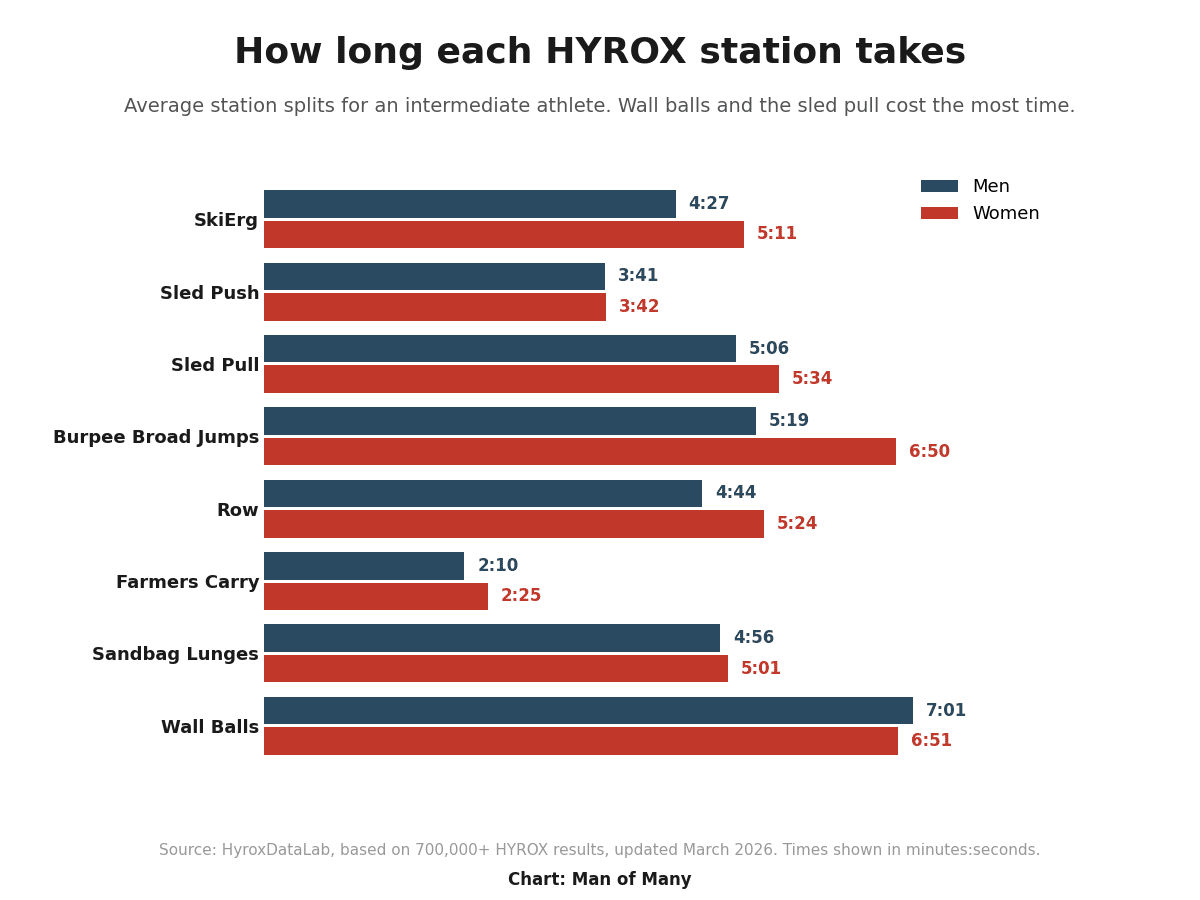
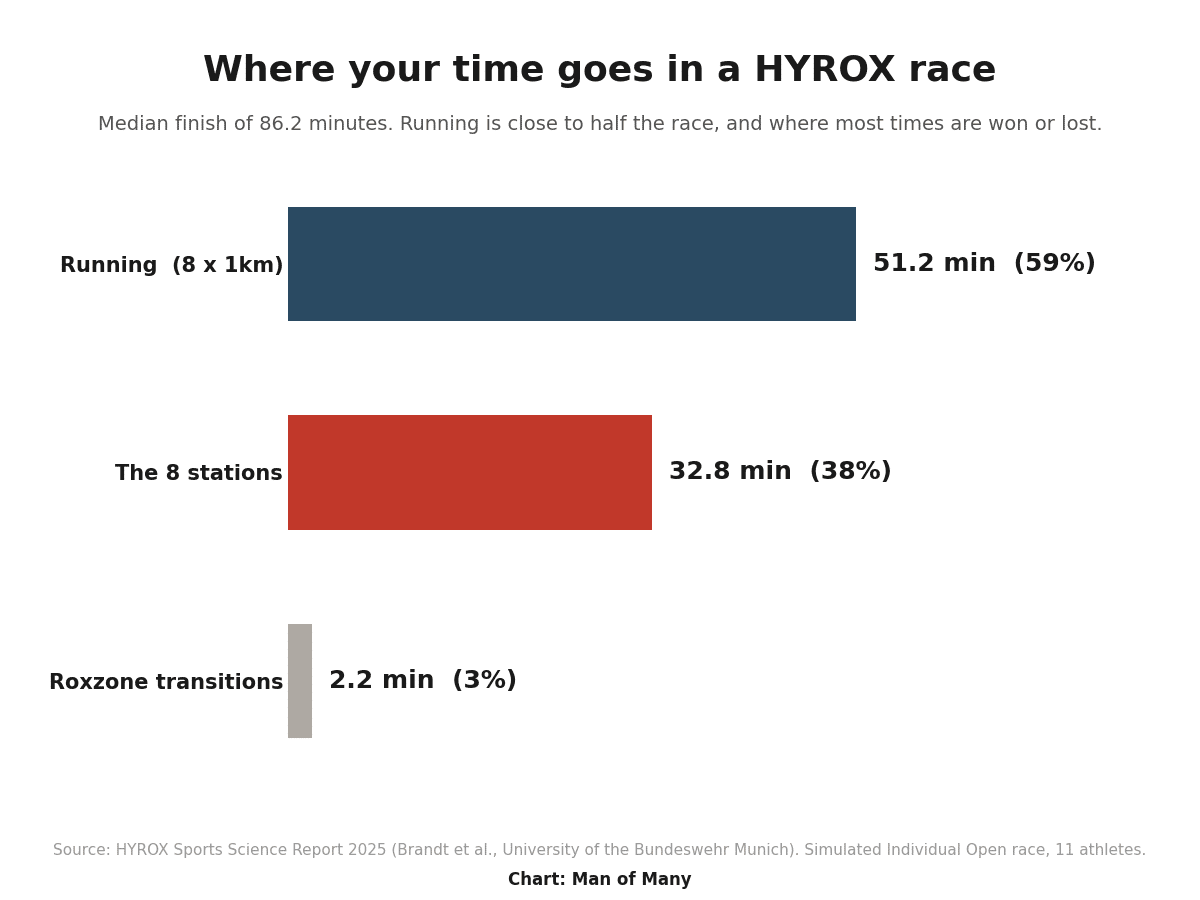
Every station is preceded by its own 1 kilometre run, so a HYROX race is eight runs and eight stations, roughly 8 kilometres of running in total. That running is close to half your finishing time, which is why pacing, not raw strength, is what usually decides your result.
HYROX Weights and Distances Compared
| Station | Distance / Reps | Women’s Open | Men’s Open | Men’s Pro | #1 mistake to avoid |
| SkiErg | 1,000m | Bodyweight | Bodyweight | Bodyweight | Pulling with the arms, not the hips |
| Sled Push | 50m (4 x 12.5m) | 102kg | 152kg | 202kg | Skipping pauses and wrecking the next run |
| Sled Pull | 50m (4 x 12.5m) | 78kg | 103kg | 153kg | Letting the rope pile at your feet |
| Burpee Broad Jumps | 80m | Bodyweight | Bodyweight | Bodyweight | Sprinting early and blowing up |
| Rowing | 1,000m | Bodyweight | Bodyweight | Bodyweight | Rowing with the arms, not the legs |
| Farmers Carry | 200m | 2 x 16kg | 2 x 24kg | 2 x 32kg | Breaking too early and losing grip |
| Sandbag Lunges | 100m | 10kg | 20kg | 30kg | Not standing tall between reps (penalty) |
| Wall Balls | 100 reps | 4kg / 2.70m | 6kg / 3.00m | 9kg / 3.00m | Shallow squats and missed targets (no reps) |
Sled weights are inclusive of the sled itself. All figures are from the current HYROX Singles Rulebook (2026/27 season).
The eight stations stay the same, but the weights and format shift by division, which is a big part of why Day rates HYROX’s accessibility so highly. “What sets HYROX apart is its accessibility,” he told Man of Many. “Unlike many competitive events that are exclusive to professional or advanced athletes, HYROX welcomes participants of all abilities, whether you’re a seasoned athlete or a fitness novice, there’s a race category available for you. The variety of exercises involved means it plays to different strengths, offering something for everyone.” It is also, Day notes, as much a social event as a fitness one: “As HYROX continues to roll out across the country, it’s becoming a social activity as much as it is a fitness event. It’s a fantastic way for people to connect while working out together.”
- Open: The standard and most popular division, raced solo at the Open weights above.
- Pro: The same solo race at heavier loads, for more experienced athletes.
- Doubles: A pair shares the load. Both partners run every kilometre, but the station work is split between them.
- Relay: Four athletes split the whole race evenly, the most accessible entry point for newcomers.
What HYROX Does to Your Body (and the Risks)
HYROX is built to bridge endurance and strength, and it hits nearly every marker of fitness at once, from power and speed to aerobic conditioning. Australian HYROX World Competitor and Lifespan Fitness expert Peter Day, who has finished inside Australia’s top 10 at a HYROX World Championships, told Man of Many the benefits go beyond the obvious gains in physique and cardio.
“There are numerous health benefits associated with HYROX. It builds strength, power, and endurance through a combination of functional exercises and running, which elevates the heart rate while also enhancing muscle growth,” Day said. “The workouts associated with HYROX move beyond traditional cardio or weight training and embody the shift perfectly. This type of training not only improves physical performance but can also be beneficial in everyday activities requiring manual effort. Intense, interval-based training can also help boost metabolism and promote fat loss when paired with proper nutrition and recovery.”
The flip side is that HYROX is genuinely demanding, and Day is blunt about the risks for anyone who turns up underprepared. “HYROX can be particularly demanding, especially for beginners. Without proper preparation, such as warming up adequately or ensuring you’ve fuelled your body with the right nutrition, you could be more susceptible to burnout, fatigue, or injury,” he said. “Exercises like running, burpees, and lunges can place strain on the joints, particularly for participants unaccustomed to the volume of training required. It’s essential to listen to your body and be mindful of any existing physical conditions.”
HYROX Station Technique: Tips From the Pros
Here is how to attack each station, in race order, and fold it into your wider workouts routine. Every block covers what it tests, the load you will face and the technique cues elite athletes and the equipment makers themselves swear by.
1. SkiErg (1,000m)
Distance: 1,000m · Load: Bodyweight (all divisions).
The opening station after run one. It looks like an arms exercise. It is not.
- Hip hinge, not a squat. Concept2 says to drive the handles down by hinging at the hips with your core and lats first, and let your arms follow.
- Think “hat to pockets”: finish with your hands beside your thighs, wrists straight, arms not fully extended.
- Set the damper to 3 to 5 (the race preset is 6, and you can change it) and hold a stroke rate of 40 to 60 per minute.
- Ease in. Both feet must stay on the base, though you can use a jumping motion as long as you land back on it.
“With 7 kilometers and 7 stations to go, easing into your race on the SkiErg will be better than trying to go all out on station 1,” advises Concept2’s HYROX guide.
2. Sled Push (50m)
Distance: 50m (4 x 12.5m) · Load (incl. sled): 152kg men’s Open / 102kg women’s Open / 202kg Pro.
Four 12.5 metre lengths of the heaviest load in the race. Pacing catches out more athletes than technique does.
- Get low, arms extended, hips down, and drive through your legs rather than rounding your back.
- Take short, powerful steps, and take short deliberate pauses to protect the run that follows.
- Do not judge the race sled by your gym sled. The surface, the humidity and the sled itself all change how it moves.
“A mistake I personally made in my first race was not taking enough short pauses during the push,” HYROX coach and commentator Greg Williams writes for Red Bull. “Even though my time on the station itself was reasonably quick, I really struggled to run afterwards.”
3. Sled Pull (50m)
Distance: 50m (4 x 12.5m) · Load (incl. sled): 103kg men’s Open / 78kg women’s Open / 153kg Pro.
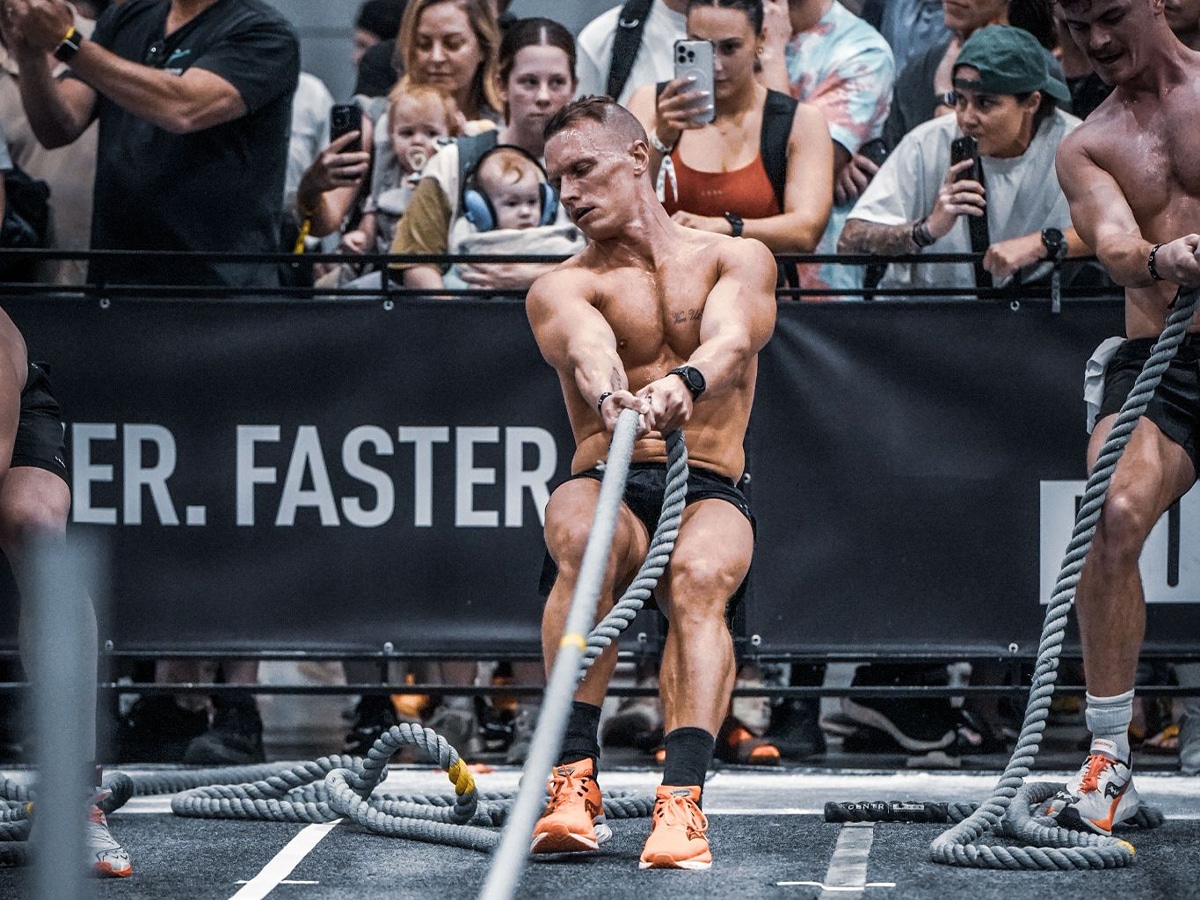
Drag the sled back to you with a rope from within a small box at the end of the lane. A posterior chain station: back, glutes and hamstrings.
- Stand at the front of the box and use your bodyweight, heaving the rope hand over hand as you step back.
- Manage the rope. The further you pull, the more it piles around your feet, and it becomes easy to trip over.
- Stay standing throughout. Pulling from a seated or kneeling position is not allowed, and chalk is permitted here.
As Williams notes for Red Bull, the box means “rather than the sled pull being purely an upper-body exercise, you do have a small amount of space you can step back into to help move the sled.”
4. Burpee Broad Jumps (80m)
Distance: 80m · Load: Bodyweight (all divisions).
A burpee into a standing broad jump, over and over for 80 metres. The station elite athletes say gets underestimated.
- Chest to the floor every rep, with your hands no more than 30cm ahead of your toes on the next one.
- Both feet take off and land together, with no more than a 5cm stagger and no shuffle steps.
- The length of each jump is up to you. Smaller, controlled jumps are often more efficient than max effort.
- Settle into a steady, repeatable rhythm rather than blowing up in the first 40 metres, the same rule as any high-rep bodyweight session.
HYROX World Champion Jake Dearden told Red Bull: “These are incredibly hard and people underestimate the skill it takes to get the technique right.”
5. Rowing (1,000m)
Distance: 1,000m · Load: Bodyweight (all divisions).
The one place you sit down, and the one where the most time gets thrown away with bad technique.
- Drive in the order legs, body, arms, then reverse it on the recovery: arms, body, legs.
- It is a legs exercise, not an arms one. Use a damper of 3 to 5, a cadence of 24 to 32, and a drive-to-recovery ratio around 1:2.
- Breathe on the recovery, and get in and out of the foot straps quickly.
- Do not over-row. Finishing 10 seconds faster can cost far more in fatigue than it is worth.
Five-time CrossFit Games champion Mat Fraser, who worked with Concept2 on its HYROX guide, puts the sequence bluntly: the RowErg is all “legs, legs, legs.”
6. Farmers Carry (200m)
Distance: 200m · Load: 2 x 24kg men’s Open / 2 x 16kg women’s Open / 2 x 32kg Pro.
A kettlebell in each hand for 200 metres. One of the fastest stations, so an unbroken carry banks real time.
- Carry both bells with your arms extended by your sides. Grip is the limiter, so train it.
- Go unbroken if you can. You may set the bells down to rest, as long as you do not move them forward.
- Chalk is allowed here, and it helps once your hands are wrecked from the sled pull.
“If you can complete the whole thing unbroken, it will likely mean you save time,” Williams writes for Red Bull. “It is a station that tests grip strength, shoulder stability, and core endurance.”
7. Sandbag Lunges (100m)
Distance: 100m · Load: 20kg men’s Open / 10kg women’s Open / 30kg Pro.
100 metres of walking lunges with a sandbag across your shoulders, on legs that are already gone.
- Keep the bag high and fully supported. Resting it on the ground, a barricade or your feet draws a 15-second penalty each time.
- The trailing knee must clearly touch the ground, and you must stand fully tall, hips and knees extended, between reps.
- Alternate legs, with no shuffle steps in between.
Dearden flags this as a rule people miss, telling Red Bull: “Walking lunges must be completed by standing up fully between lunges as opposed to keeping time under tension and not coming up fully.”
8. Wall Balls (100 reps)
Reps: 100 · Load / target: 6kg to a 3.00m target men’s Open / 4kg to 2.70m women’s Open / 9kg to 3.00m Pro.
The final station, and statistically the one where races unravel. 100 throws to a target on shattered legs.
- Drop into a full squat with your hips below your knees, then stand fully tall before every throw.
- Hit the centre of the target. A shallow squat or a miss is a no rep, which adds time and fatigue.
- Break the 100 into manageable sets from the very first rep instead of going to failure.
- It is as mental as physical. Composure here is worth more than fresh legs you no longer have.
The data backs this up. Analysis of more than 14,000 races for the HYROX Sports Science Report found wall balls have the highest completion-time variability of any station, a 2.02-minute standard deviation, because compound fatigue hits technique hardest exactly where the race demands it most.
HYROX Race Strategy: How to Pace It
Technique wins stations. Pacing wins races. The sport science is unusually clear on where the time actually goes.
- Respect the runs. Running is close to half your total time, and the Sports Science Report found the mid-race running splits (kilometres 5 to 8) correlate more strongly with your finish than anything else. Miss your pace there and you miss your goal.
- Build into the race. The heaviest stations, the sled push and pull, come early, so redlining the SkiErg or first sled just torches the runs that decide your time.
- Train compromised running. Every run from run two is on fatigued legs, and no amount of fresh-legs treadmill work prepares you for it.
- Rehearse the Roxzone. The transition area adds real distance on top of the 8 kilometres, and Dearden runs the full course “every two or three weeks just to get my body used to transitioning between exercises,” he told Red Bull.
- Do not go out too hard. It is the most common first-timer mistake, and it is unrecoverable once the wall balls arrive.
Research from HYROX’s own sport science report shows running decides most races: it eats around 59 per cent of a typical finish, with the eight stations taking about 38 per cent and Roxzone transitions the rest. So the runs, not the stations, are where you should budget most of your time. The guide below shows the average run pace you need to hold for a range of target finishes.
| Goal finish time | Average run pace (per 1km) | Time budget for the 8 stations |
|---|---|---|
| 1:10:00 | 5:10 min/km | ~27 minutes |
| 1:20:00 | 5:54 min/km | ~30 minutes |
| 1:30:00 | 6:38 min/km | ~34 minutes |
| 1:40:00 | 7:22 min/km | ~38 minutes |
| 1:50:00 | 8:07 min/km | ~42 minutes |
This is a planning guide built on the median HYROX split, running about 59 per cent of your time and the stations about 38 per cent, so the run pace is the number to protect. Elite racers run faster and spend proportionally less time on the stations, and the figures exclude Roxzone transitions. To model your exact splits station by station, the free HYROX simulator at hyresult.com lets you plug in target times and see your projected finish.
How to Train for a HYROX Workout
Give yourself 8 to 12 weeks. Build around three pillars and you will arrive ready.
- Running first. It is half the race, so a base of easy zone two volume plus some interval work does the most for your time. A structured running plan is a good backbone.
- Functional strength. Sleds, lunges, carries and wall balls, trained heavy enough to make race weights feel manageable.
- Race simulation. Practise the actual movements under fatigue, straight off a run, so nothing on race day is a surprise.
Australian HYROX World Competitor and Lifespan Fitness expert Peter Day, who finished inside the country’s top 10 at a HYROX World Championships, is emphatic that this is where first-timers win or lose their race. “My biggest advice for anyone looking to try the HYROX race is that preparation is crucial. No matter your fitness level, don’t go into the race blindly. Spend adequate time training and preparing yourself to tackle various strength and endurance types of workouts,” Day said. He keeps the priority simple: “Running makes up 50 per cent of the HYROX race so make sure that you build up your cardio and try to mimic the workout stations during your training.” Below is a session that does exactly that, using Open division weights from the official rulebook.
| Segment | Exercise | Detail |
|---|---|---|
| Warm-up | Light jog + dynamic stretches | 5 minutes, raise the heart rate |
| Run 1 | 1 kilometre | Moderate, controlled pace |
| Station 1 | SkiErg | 1,000 metres |
| Run 2 | 1 kilometre | Moderate pace |
| Station 2 | Sled Push | 50m (152kg incl. sled / 102kg women) |
| Run 3 | 1 kilometre | Moderate pace |
| Station 3 | Sled Pull | 50m (103kg incl. sled / 78kg women) |
| Run 4 | 1 kilometre | Moderate pace |
| Station 4 | Burpee Broad Jumps | 80 metres |
| Run 5 | 1 kilometre | Moderate pace |
| Station 5 | Rowing | 1,000 metres |
| Run 6 | 1 kilometre | Moderate pace |
| Station 6 | Farmers Carry | 200m (2 x 24kg / 2 x 16kg women) |
| Run 7 | 1 kilometre | Moderate pace |
| Station 7 | Sandbag Lunges | 100m (20kg / 10kg women) |
| Run 8 | 1 kilometre | Hold pace if you can |
| Station 8 | Wall Balls | 100 reps (6kg to 3.00m / 4kg to 2.70m women) |
| Cool-down | Walk + static stretches | 10 minutes |
HYROX World Records and Average Times
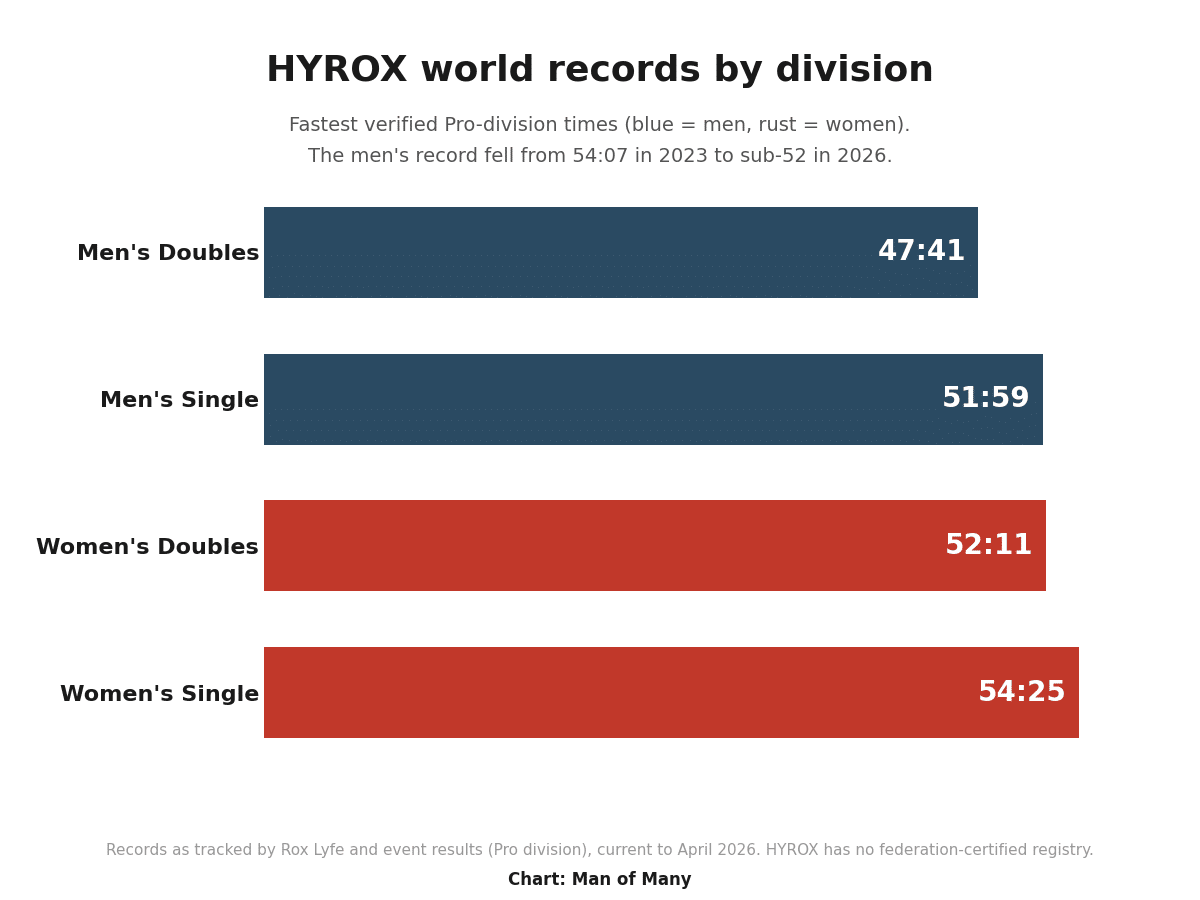
The elite end of HYROX is getting quicker fast. The men’s Pro world record has fallen from Hunter McIntyre’s 54:07 in 2023 to Alexander Roncevic’s 51:59 in April 2026, the first man under 52 minutes, per records tracked by Rox Lyfe and event results. The current Pro marks sit at 51:59 (men’s singles), 54:25 (women’s singles, Joanna Wietrzyk), 47:41 (men’s doubles) and 52:11 (women’s doubles). HYROX keeps no federation-certified register, so treat these as the community-tracked best.
For the rest of us the numbers look very different. Across more than 700,000 race results logged by HyroxDataLab, the average man finishes in about 1 hour 40 and the average woman in about 1 hour 54. As a rough guide for men, under 1:15 is elite, 1:15 to 1:25 is advanced, 1:25 to 1:40 is intermediate and 1:40 to 1:54 is beginner. Knowing your band is the fastest way to set a realistic first-race target.

What I Learned Racing My First HYROX
Man of Many co-founder Scott Purcell raced HYROX Sydney 2026 with a Man of Many team out of F45 Darlinghurst. This is his hands-on account, station by station. Additional reporting and interview by Nick Hall.
Everything above is the research. This is the lived version. I raced my first HYROX at HYROX Sydney on 5 July 2026 in the Open Men division and finished in 1:18:02, which put me 1,012th of 3,196 overall and 169th of 579 in the 35 to 39 age group, inside the top 30 per cent on debut. “I was hoping for sub 1:20,” I messaged the team afterwards, “so I was pretty happy.”
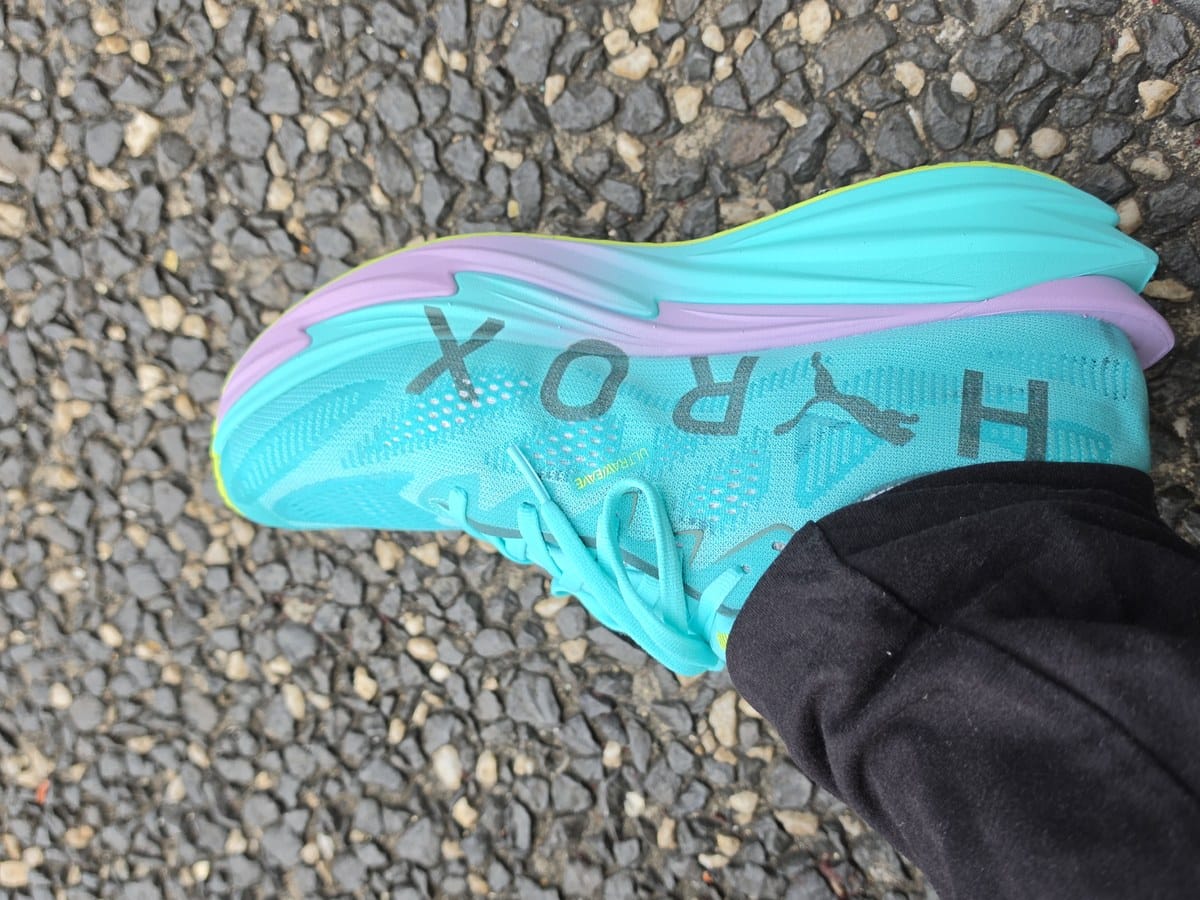
I wore the PUMA Deviate NITRO Elite, the brand’s dedicated HYROX shoe, and I used a Garmin Forerunner 170 Music to track every split in real time. It told the story I did not want to hear: I went out far too hard, a 3:38 first kilometre against a 4:40 plan, the exact mistake every guide warns against. We tested more sensible pacing in weekly HYROX simulations at F45, and I still ignored it on the day. The training had humbled me long before that. After one brutal wall-ball session I told the F45 group that HYROX had “ruined me,” and I got the reps done, in my own words, just “to make the pain go away.” But race day lined up almost exactly with the data. My running split of 36:23 and the machine stations, the SkiErg, the row and both sleds, were my strongest. My weakest were the ones that come late and punish grip and legs under fatigue: the farmers carry, the sandbag lunges and, worst of all, the wall balls.
In my experience, that is exactly what the sport science predicts: the back-half stations are where technique and composure decide your time. My two takeaways for anyone lining up for their first: respect the runs, because that is where the race is won or lost, and do not save your wall-ball practice for fresh legs, because that is not how you will meet them on race day.
HYROX Workout FAQs
The eight HYROX stations, in fixed order, are the SkiErg, sled push, sled pull, burpee broad jumps, rowing, farmers carry, sandbag lunges and wall balls. Each one follows its own 1 kilometre run, so a full race is eight runs and eight stations, around 8 kilometres of running in total.
In the Men's Open division the sled push is 152kg and the sled pull 103kg (both including the sled), the farmers carry is 2 x 24kg, the sandbag lunge 20kg and the wall ball 6kg. Women's Open uses 102kg, 78kg, 2 x 16kg, 10kg and 4kg. The SkiErg, row and burpees are bodyweight only.
Most beginners give themselves 8 to 12 weeks, and HYROX's own sport science research recommends a structured block of at least six weeks. Prioritise running, since it is roughly half the race, then build functional strength and practise the actual stations under fatigue.
Running makes up the largest share of race time, and the mid-race splits between kilometres 5 and 8 correlate most strongly with your finish. Build into the race rather than sprinting the SkiErg or sleds, and rehearse the Roxzone transitions so you do not lose free time between stations.




























Comments
We love hearing from you. or to leave a comment.