


Updated:
Readtime: 7 min
Every product is carefully selected by our editors and experts. If you buy from a link, we may earn a commission. Learn more. For more information on how we test products, click here.
- Stade Hassan II is projected to hold 115,000 spectators, making it the world’s largest purpose-built football stadium if completed as planned.
- Populous and Oualalou + Choi have shaped the venue around the Moroccan moussem, with a vast tented canopy covering gardens, concourses and public space.
- Populous says the stadium is due in 2028 and is being designed with the ability to host the 2030 World Cup final, although FIFA has not confirmed where the final will be played.
Long before 115,000 football supporters find their seats inside Stade Hassan II, the stadium is designed to make each of them feel as though they’ve arrived somewhere significant.
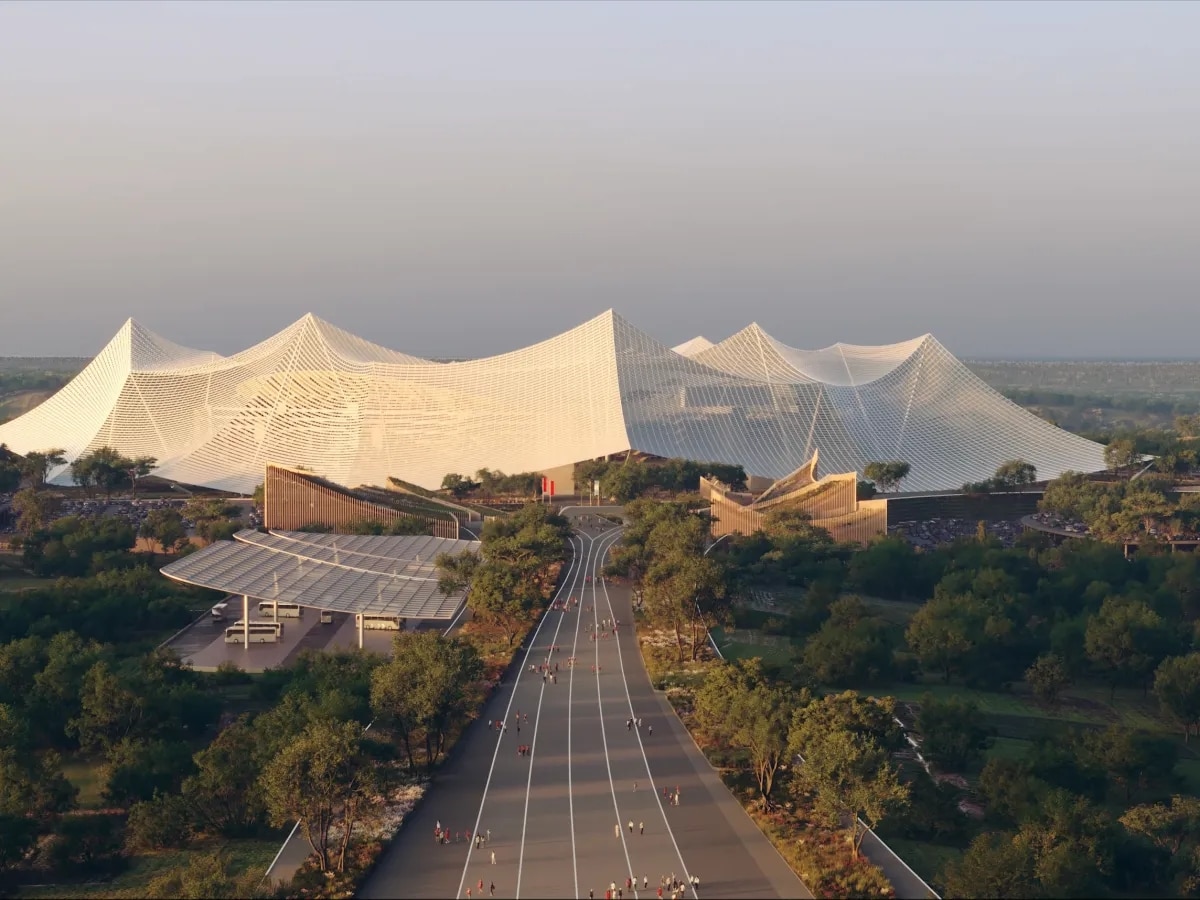
Rising from a forested landscape in El Mansouria, around 38km north of Casablanca, its vast aluminium canopy appears in the renders like a pale tented settlement reaching above the treeline. The stadium bowl, hidden beneath the canopy, turns what is essentially a monument to the beautiful game into a gathering place for its global fans.
Designed by Populous in collaboration with Oualalou + Choi, Stade Hassan II is projected to become the world’s largest purpose-built football stadium. Yet its defining idea goes far beyond the pursuit of a capacity record, drawing inspiration from the Moroccan moussem, a traditional gathering associated with ceremony, celebration, welcome and collective experience.
A Moussem Built for 115,000 People
Oualalou + Choi describe Stade Hassan II as a “landscape-building”, using the tent as its architectural starting point. The Casablanca-based studio says the design engages “in dialogue with the millennia-old culture of Morocco”, turning the stadium into “a major festive gathering place” built around a “primordial figure of architecture”.
But despite the awe-inspiring language and the monumental scale of the stadium’s design, it’s all meant to feel deeply personal, with 115,000 separate journeys ending beneath the same roof.
For Oualalou + Choi, the tent is the starting point for “a powerful and unique architectural presence”, with Stade Hassan II conceived as “open, generous and sustainable”.
You can think of it almost like a pilgrimage for the beautiful game, a destination built for football at its grandest. Spectators won’t just turn up, scan their tickets and disappear into another concrete bowl. The images present it as somewhere that rises gradually from the landscape, first as a landmark, then as a shelter and finally as a place where the crowd gathers around the pitch.
Oualalou + Choi says the stadium “embodies the tradition of welcome and hospitality that is so distinctive to us”.
It’s a big stadium, but that connection to the moussem gives it a greater purpose.
 1/4
1/4The Roof Turns Arrival Into Part of the Stadium
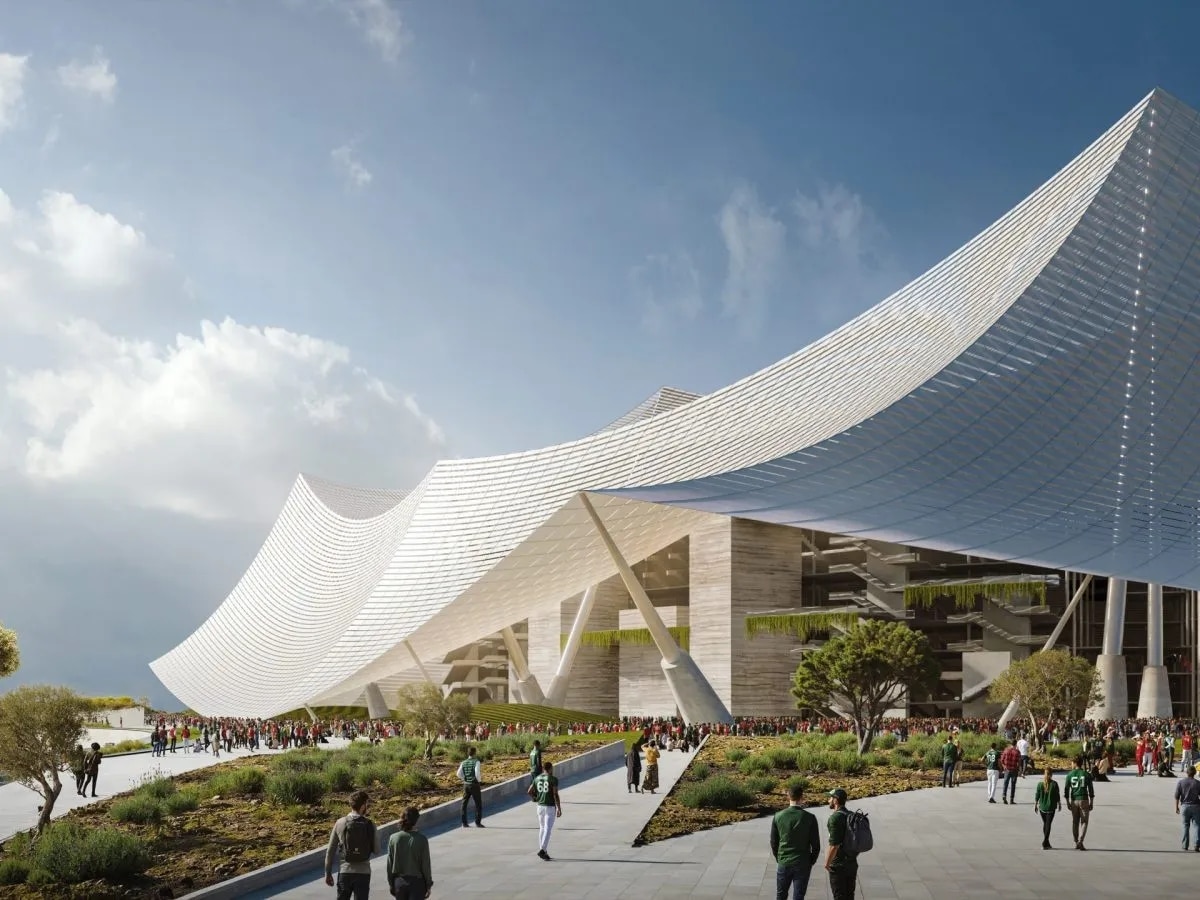
Stadium roofs typically keep out the elements. Stade Hassan II goes beyond cover, gathering gardens, walkways, concourses, activity spaces and crowds beneath a single continuous form.
Oualalou + Choi says the lightweight canopy will be formed by a network of cables supporting aluminium sunshades, a gargantuan structure stretching across the entire stadium and its surroundings. A ring of 32 stair towers will hold the structure up, creating what’s called monumental porticoes around the venue that support its grand concourse.
And I thought Wembley’s 133-metre arch was impressive.
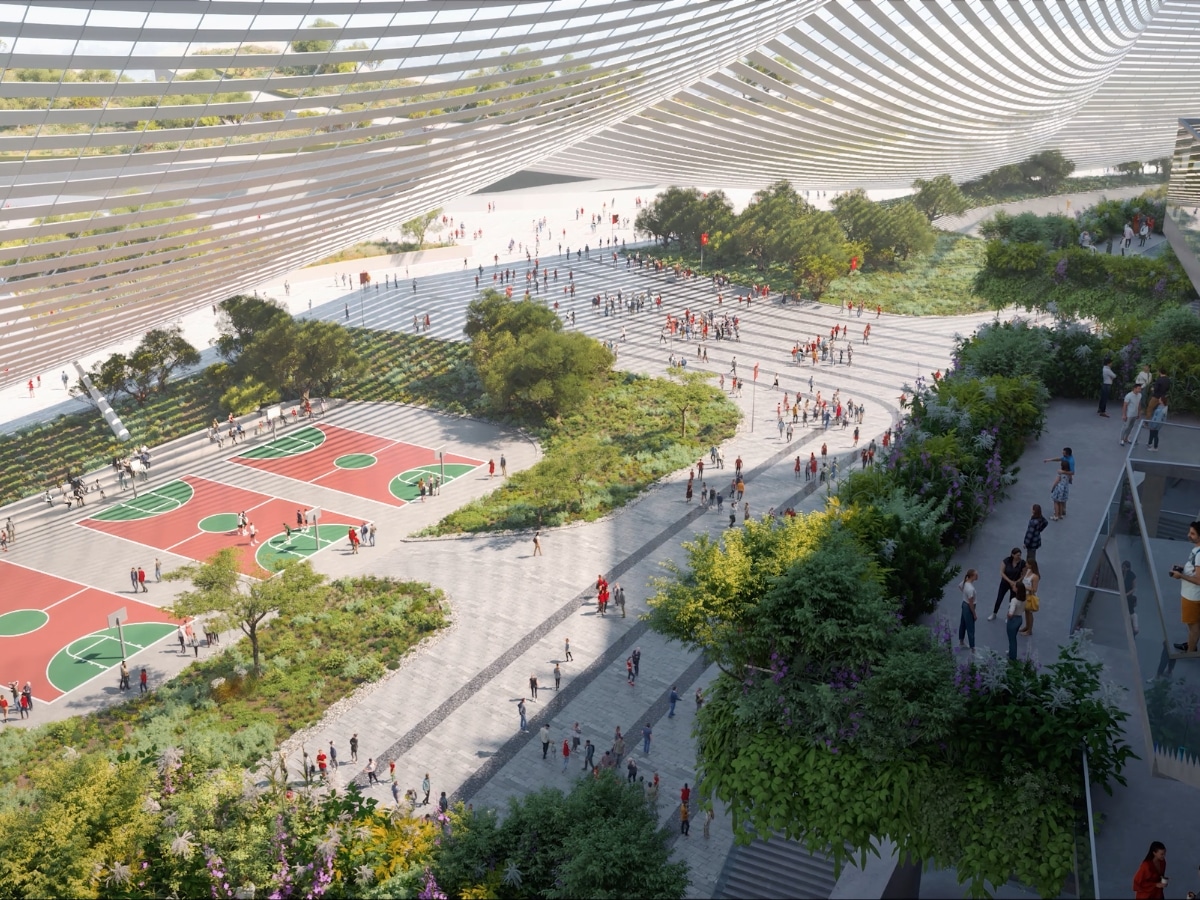
Populous plans to place lush gardens on platforms 28 metres above ground, with even more botanical gardens beneath the canopy’s outer edges. Together, they will create what the firm calls “an oasis of greenery under the translucent roof canopy” and “an extraordinary spatial experience”.
From the outside, the stadium’s peaks resemble tent poles pulling fabric upwards. Beneath them, spectators will move through shaded gardens and enormous gateways before reaching the bowl.
Unlike the acres of car parks surrounding some of the major stadiums, arrival is not treated like a tarmac dash to the turnstiles. It’s part of the architecture and the broader Stade Hassan II experience.
How Do You Fit 115,000 People Inside?
Of course, scale alone can’t guarantee atmosphere, particularly when a stadium is large enough for supporters to feel detached from the pitch. We’re looking at you, NFL at the MCG.
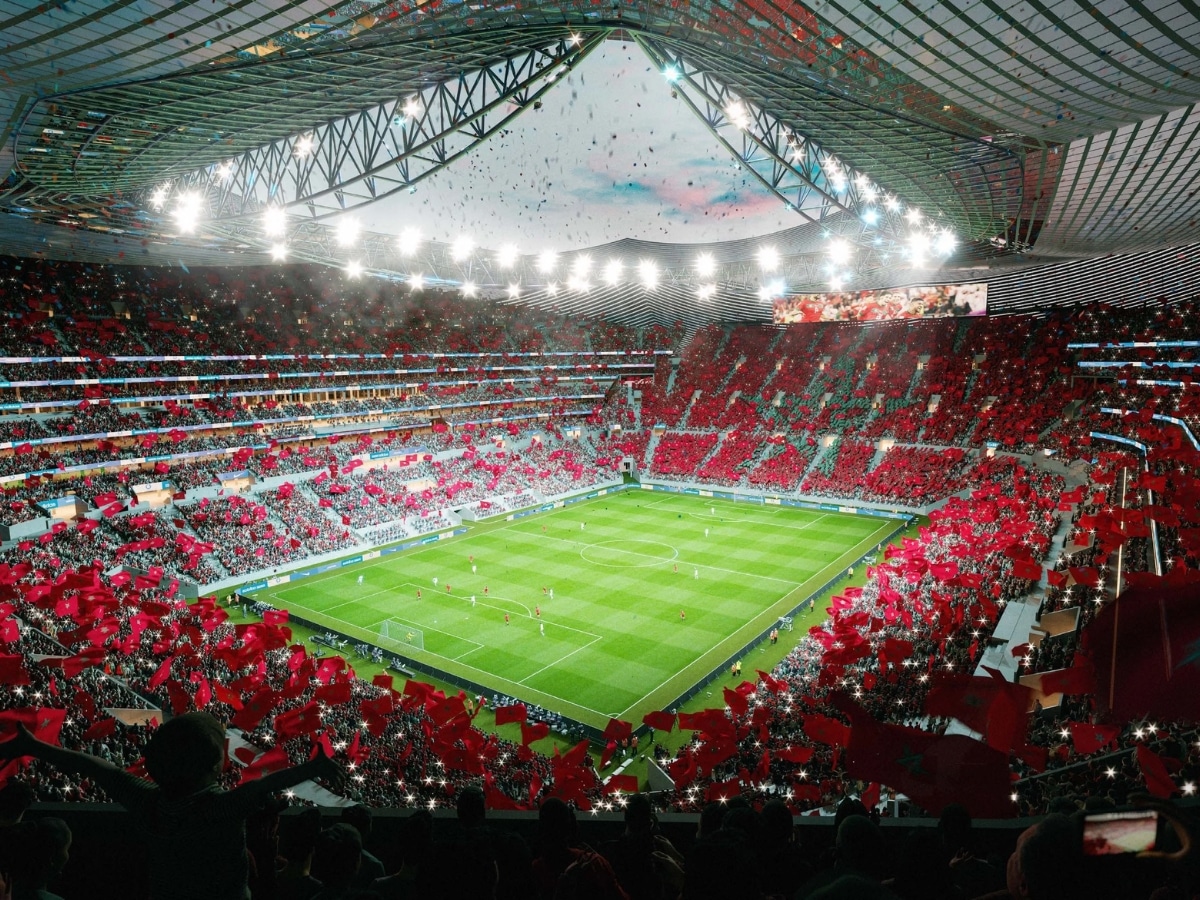
To concentrate the crowd, both ends of Stade Hassan II will contain three steep, compact tiers, with 29,500 general-admission spectators positioned behind each goal. Along the main stands, five hospitality levels will accommodate 12,000 VVIP, VIP, hospitality and box users, in addition to the Royal box. They also have a king.
With close to 30,000 people at either end, each side is a stadium in its own right, with enough capacity to rival many of the venues we have here in Australia. However, ours don’t usually cater to The Crown.
Sydney’s entire 42,500-seat Allianz Stadium holds only around 13,000 more people than a single end of Stade Hassan II. Even a packed-out Stadium Australia would still leave you 31,500 spectators short.
Not even the US can match the scale. Michigan Stadium, the country’s largest college-owned football venue, holds 107,601. As for New York New Jersey Stadium, which hosted the 2026 World Cup final? FIFA listed its tournament capacity at just 80,663, despite the venue ordinarily holding 82,500. And I thought everything was bigger in the US…
The gap is just as striking across Africa. Stade Hassan II would comfortably surpass Johannesburg’s FNB Stadium (94,736 capacity), which hosted the 2010 World Cup final, as well as Egypt’s Misr Stadium (93,940 capacity) and Borg El Arab Stadium (86,000 capacity).
Once complete, Stade Hassan II will push African football infrastructure beyond the 100,000-seat mark, becoming the continent’s largest stadium and one of the biggest stadiums in the world by capacity.
Comparisons aside, the stadium is being designed with the ability to host a World Cup final. That means enough room for international football, sponsors, officials and the layered access expected inside a modern tournament venue. It’s gotta be big.
A World Cup Dream Decades in the Making
Morocco’s plan for a major Casablanca stadium stretches far back to its bid for the 2010 World Cup, which proposed a new 95,000-seat Grand Stade before South Africa won the vote.
A 93,000-seat Casablanca venue returned as the proposed opening and final ground in Morocco’s 14-stadium bid for 2026, but the joint Canadian, Mexican and US bid prevailed.
The project finally gathered momentum in October 2023, when Morocco allocated around five billion dirhams (AUD$770 million) for the new stadium.
 1/3
1/3The Stadium Is Only Part of the 100-Hectare Site
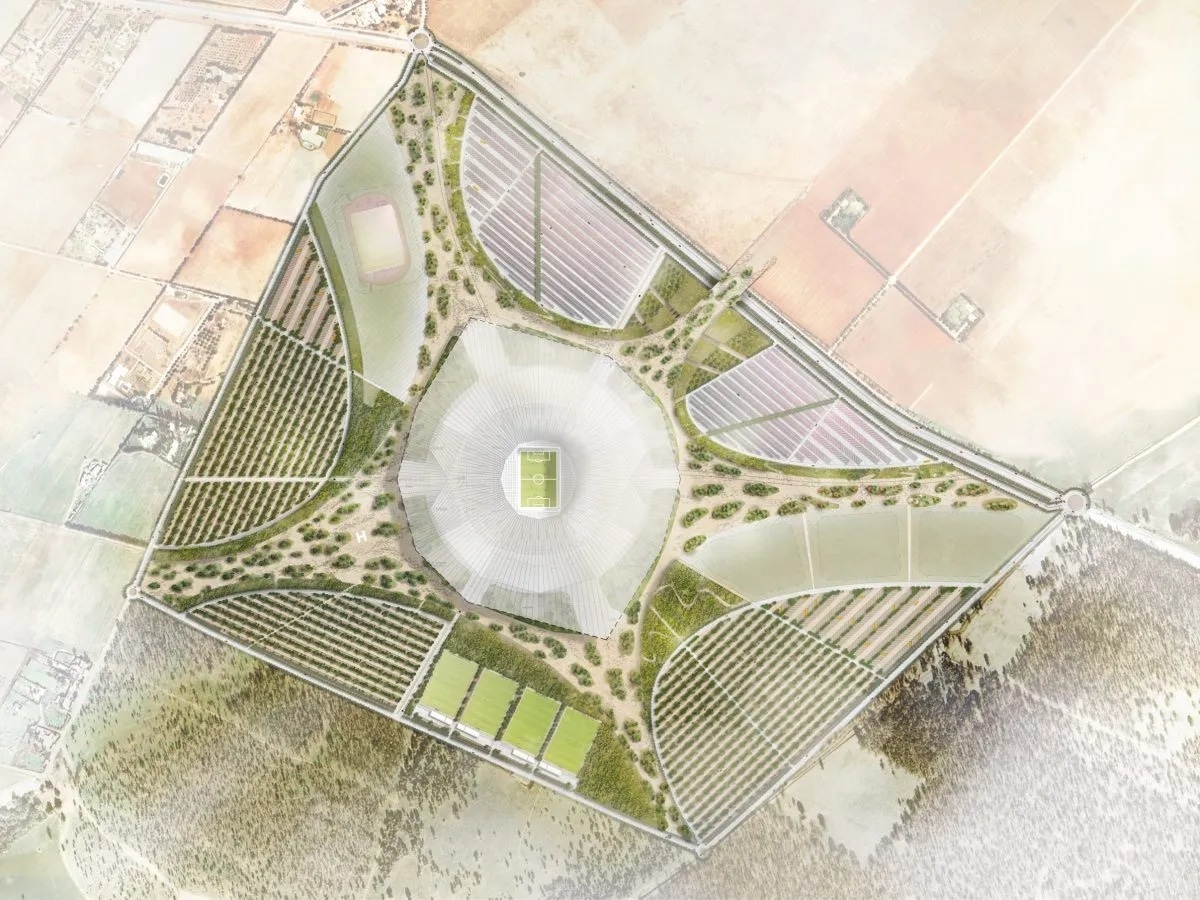
Stade Hassan II sits at the centre of a 100-hectare site, a figure that covers the wider precinct rather than the physical bowl on its own.
Beyond the oasis of gardens, the canopy is surrounded by extensive landscaping, parking, auxiliary pitches and other sporting facilities.
Populous says Stade Hassan II is due for completion in 2028, although its dedicated project page still lists the date as TBC. While the stadium has its sights set on hosting the 2030 World Cup final, FIFA has confirmed Morocco, Portugal and Spain as the tournament’s primary hosts. The location of the final remains unconfirmed.
“Seven countries have won their World Cup today. Congratulations to Uruguay, Argentina, Paraguay, Morocco, Portugal, Spain and Saudi Arabia,” FIFA President Gianni Infantino said following the appointments. “This is your day. So you should celebrate and we, we celebrate, of course, with you.” Saudi Arabia will host the separate 2034 tournament, while Argentina, Paraguay and Uruguay will each stage a centenary match in 2030.
After the tournament, when it’s all said and done and a new world champion is crowned, Populous says the stadium is intended to become the home of Raja Club Athletic, Wydad Athletic Club and the Moroccan national team.
Whether it ultimately hosts the final or not, Stade Hassan II is being designed as somewhere worthy of the journey. Its 115,000 seats may secure the record, but the lasting image is the canopy above them: one enormous Moroccan tent gathering the football world beneath its roof.





























Comments
We love hearing from you. or to leave a comment.