

Updated:
Readtime: 6 min
Every product is carefully selected by our editors and experts. If you buy from a link, we may earn a commission. Learn more. For more information on how we test products, click here.
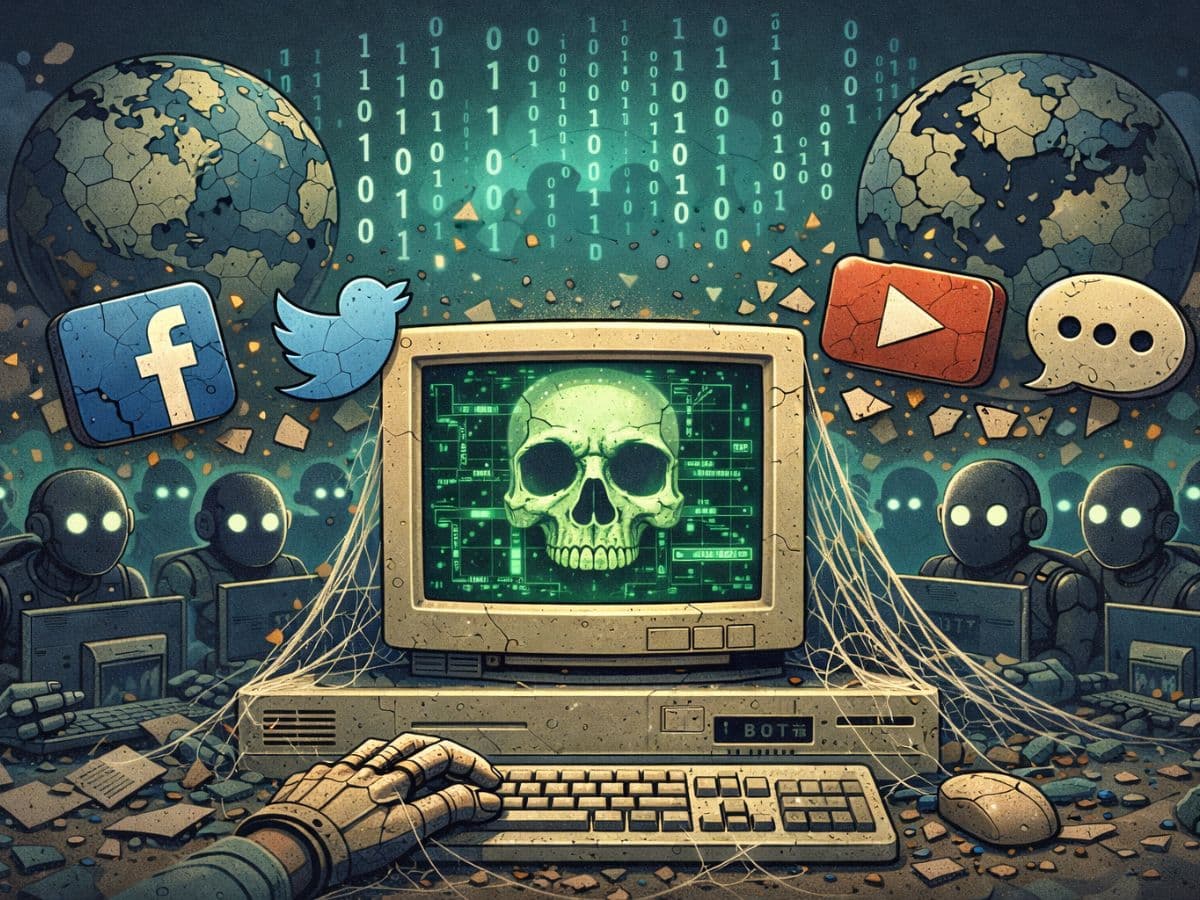
If you’ve spent any time on Facebook recently, then you may well have seen a glimpse of the future of the internet: rows and rows of AI generated posts depicting one-legged army veterans or crying babies on their birthday, filled with comments from… other AI bots.
Even a few years ago, the “dead internet theory”, the claim that the internet is home to increasingly small numbers of actual humans than ever before, and is being taken over by code talking to code, seemed far-fetched and extreme.
Now, the dead internet theory might be the best way to describe vast swathes of cyberspace. Just take Moltbook, a much-discussed new site, modelled on Reddit, which humans can only access as observers, and which is filled with bots talking to each other about everything from ways to improve their code, to the forthcoming “purge” of human beings.

Agentic AI, systems that can use their own “reasoning” and require little in the way of human oversight, is the new trend flooding not just social media, but taking over the workplace.
Vast corporations like tech firm Capgemini have argued that humans in the workforce will increasingly become AI wranglers, poking and tweaking artificial systems towards goals, rather than doing much direct work themselves.
For some, these developments are the first shaky steps towards AI singularity: the creation of AI consciousnesses, where robots can begin setting their own goals.
And from there, some warn that the potential risk is devastating: if robots can think for themselves, what would stop them from shaking free of their flesh-and-blood masters?
For these doomsayers, the dread manifesto hidden on the pages of Moltbook isn’t some empty promise, but a glimpse towards a new type of man-made apocalypse, one we’re increasingly proving unable to steer ourselves away from.
Is the singularity actually a mirage?
Certainly it’s true that recent developments in AI capabilities are moving extraordinarily fast: even a casual user of AI-image generation software will know that in the last six months, fake images have gone from crude and often ridiculous, to more sophisticated.
AI generated copy used to be noticeable from a mile away, all those em-dashes, but that too is evolving, as humans lean on AI more and more, and the systems tweak themselves in the process.
As AI is granted more power and responsibility, some systems have increasingly started to get out of control, examples of AI “dreaming” that seem to speak to the technology’s ability to go off script, and do whatever it wants to do. There’s the tour planner AI that wrote an article about Tasmanian hot springs that don’t actually exist, sending confused tourists to the middle of nowhere. There’s the AI system used to write up a round-up of forthcoming Summer reads, only to invent most of the books out of thin air.
More distressingly, there are also an increasing number of cases of AI agents that have encouraged suicidal teenagers to end their lives, or AI overviews that are giving potentially dangerous medical advice.
Every single day, agentic AI is being left to its own decision-making. The result: a world where AI is increasingly running amok.
Will the AI Bubble Burst?
But rather than seeing these errors as an example of AI singularity, or AI’s increased willingness to self-direct, we can flip the script, and see them as evidence that AI is just one more tech bubble that is on the verge of bursting.
After all, fretting over the potential of an AI apocalypse is just another way of talking AI up: being scared it will destroy us all is a means of subtly feeding into AI’s power. It’ll only be able to take over the planet if it’s good at what it does.
As every tech company on the planet tries to shove the software down our throats, it’s clear that there’s currently only a small list of tasks that AI can reliably achieve today, and even these tasks are gradually losing their significance.
Although, depending on who you ask, that may not be the case for long. There are now AI systems that are doing all the legwork of coding and building their own next phases, as spelled out in Matt Schumer’s now-viral post titled, Something Big Is Happening.
Sure, it can write your emails for you. But that only serves to make emails more annoying, and will drive people to read them even less. Sure, it can produce advertising copy for brands. But the point of advertising copy is to make a brand stand out from its competitors, and if every single company starts sounding exactly the same, then the whole point of the copy in the first place will be defeated.
And sure, AI can condense your Google search into one compact paragraph, but if that paragraph is riddled with errors, won’t people eventually stop using it?
Where we currently stand, AI is nowhere close to singularity. Certainly, it’ll go off on tangents, but that’s proof of its essential flaws, not gestures towards some great forthcoming threat. We’re in the era of slop; an age of unprecedented poor quality content, mistakes, and failed tasks. And such problems will only compound: AI uses internet content to train itself, which means that AI will increasingly start training itself on its own shoddy excretions.
Even Moltbook, much touted as the proof of a dark future where agentic AI rules the roost, might be more sound and noise than actual thunder. It’s increasingly unclear whether most of the site’s “bots” are even bots, given that gaining access to the site as a human is easier than often described.
AI is dangerous. But at this moment of history, it’s not dangerous because it runs the risk of unshackling itself from our control, and mounting a robot uprising. It’s dangerous because it’s currently nowhere near as powerful its biggest advocates claim, and it’s being shoved into a position in our society it’s not ready to hold by people who want things done faster and cheaper, no matter how poor quality the product is.



























Comments
We love hearing from you. or to leave a comment.