

Updated:
Readtime: 5 min
Every product is carefully selected by our editors and experts. If you buy from a link, we may earn a commission. Learn more. For more information on how we test products, click here.
- Five global spirits giants are sitting on a record $22 billion “lake” of unsold, ageing spirits.
- A perfect storm of high inflation, trade tariffs, and the rise of health trends like Ozempic has caused premium sales to plummet.
- To clear warehouses, producers are mothballing distilleries and slashing prices
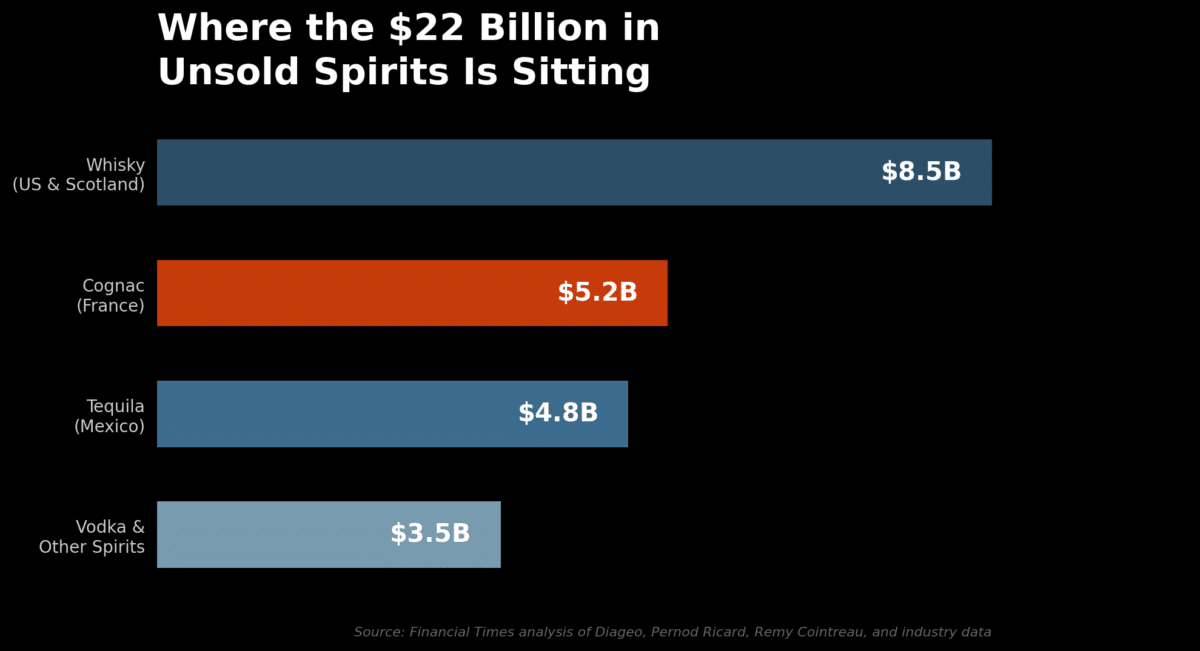
There’s a $22 billion problem building inside the global alcohol industry. It’s sitting in warehouses, where barrels of whisky, cognac and tequila are stacking up faster than they’re being sold. The world’s biggest drinks companies, including Diageo, Pernod Ricard and Rémy Cointreau, are now sitting on roughly USD $22 billion worth of ageing inventory, the highest level in more than a decade.
For years, it was always about getting a better bottle than the one you had before. Spend more. Drink better. And thanks to the pandemic, lockdowns created the conditions where a $100 bottle of tequila, vodka, or whatever you fancy actually made sense. Stuck at home, drinks over FaceTime, nowhere else to spend money. Yeah, I’d buy that (I did buy that).
The industry saw the surge and scaled for it. Production ramped up. Prices followed, all on the assumption we’d keep behaving like premium drinkers.
We didn’t. That version of the drinker didn’t stick around. And now, the hangover is showing up in price tags.
What Actually Went Wrong
Part of the issue comes down to timing. Spirits aren’t made for next quarter. Production forecasts are made for five, ten, sometimes twenty years down the line. And in 2021 and 2022, those predictions skewed heavily in one direction.
As Bernstein analyst Trevor Stirling told the Financial Times, the industry “lost the run of themselves” assuming demand would keep climbing at the same pace.
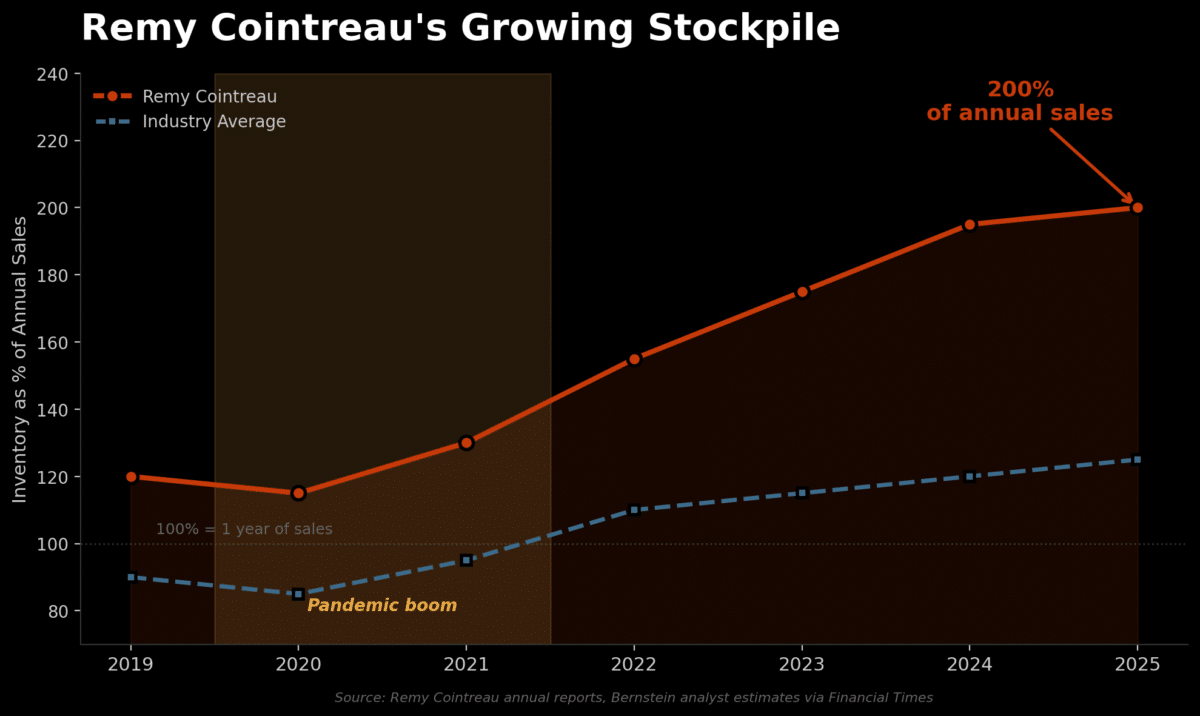
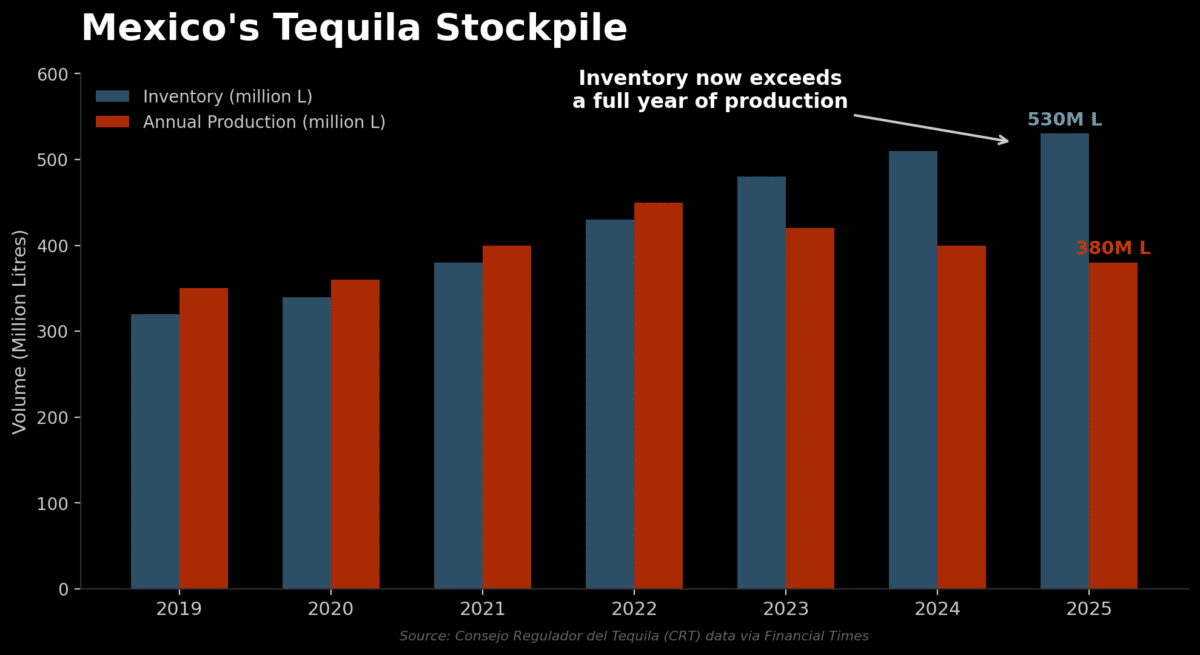
You can see how that played out. Rémy Cointreau’s inventory is now worth roughly double its annual sales, meaning it could stop production for up to two years and still meet demand. Over in Mexico, producers are sitting on more than half a billion litres of tequila. Or roughly a whole year’s worth of production.
If we look at the entire $22 billion stockpile, it’s roughly 2,000 Olympic-sized swimming pools of liquor.
But stock levels aren’t rising because everyone stopped drinking. They just stopped buying premium.
Once lockdowns ended, those $100 bottles had to compete with everything else again. Rent, fuel, groceries, nights out. And in our cost-of-living crisis. They’re not exactly winning. Suntory has closed its main Jim Beam distillery in Kentucky, Diageo has paused whiskey production in Texas and Tennessee, and Brown-Forman has cut jobs and scaled back operations as the category slows.
There’s also a broader shift happening. More people are drinking less, or at least thinking about it. “Sober-curious” habits are becoming normal, and the rise of GLP-1 medications like Ozempic is only accelerating that trend. At the same time, ready-to-drink options and non-alcoholic alternatives are taking a larger share of the occasion.
Even celebrity endorsements aren’t enough to get us to cough up at the bottle’o, no matter how much mana they have.
Then there’s the external pressure. Cognac, one of the industry’s most premium categories, has been hit particularly hard by trade tensions between the EU and China, with tariffs cutting off a key market and leaving producers with fewer places to send it.
Stack it all together and you get an industry sitting on too much expensive liquid, with fewer people willing to pay what they’re charging for.
By The Numbers: Where the $22 Billion Is Sitting
A billion-dollar figure is one thing. Break it down, and the scale becomes much harder to ignore.
| Category | What’s Sitting Unsold | What It Actually Means |
|---|---|---|
| Total Industry Inventory | ~$22 billion worth of ageing spirits | The highest level in over a decade, built on pandemic-era demand assumptions |
| Rémy Cointreau (Cognac) | Inventory ≈ 200% of annual sales | Enough stock to stop production for up to two years and still meet demand |
| Tequila (Mexico) | ~500+ million litres | Roughly a full year of production waiting to be absorbed |
| Whisky (US & Scotland) | Multi-year ageing stock building across major producers | Distilleries are slowing or pausing production to rebalance supply |
| Cognac (Exports to China) | Shipments disrupted by tariffs and pricing controls | Premium stock has fewer places to go, especially at the top end |
You don’t need an economics degree to see what’s happened here. The industry bet on demand that didn’t last.
What This Means For You
You see it at the bottle shop first. Prices that felt out of reach start to come down. Premium labels sit on shelves a little longer. The urgency to buy now fades, because with $22 billion worth of spirits waiting in warehouses, there’s plenty to go around. At least for now.
For drinkers, this is the upside. After years of rising prices and shrinking availability, the balance is starting to shift back.
Hennessy, which climbed as high as $45 a bottle in the US during the pandemic, has dropped to closer to $35 as producers start moving stock. It’s not quite a carpet store fire sale, but the direction is clear.
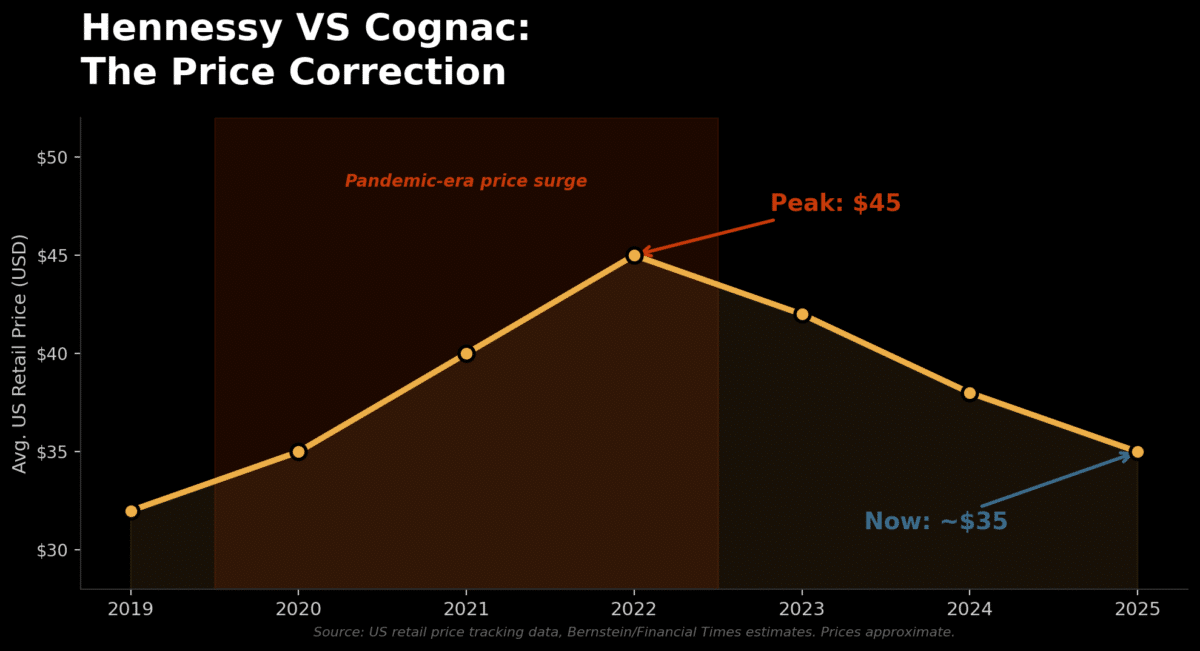
Premium doesn’t go away. It just becomes easier to justify again.
In Australia, that shift is a little less obvious. Taxes and import costs keep a floor under pricing, so you won’t see the same sharp drops as the US. But discounts are creeping back in, helping to bring down prices, even if only by a bit.
At the same time, producers are slowing down production to work through the backlog. It solves today’s problem, but it creates a new one. If demand picks up, the pipeline isn’t there.
That’s the position the industry is in now. Too much stock today, not enough certainty about tomorrow.





















Comments
We love hearing from you. or to leave a comment.