


Updated:
Readtime: 7 min
Every product is carefully selected by our editors and experts. If you buy from a link, we may earn a commission. Learn more. For more information on how we test products, click here.
- The Ferrari Luce is a 1050-hp, quad-motor electric five-seater.
- It weighs 2,260 kilograms and hits 100 km/h in 2.5 seconds.
- Jony Ive designed the radical glasshouse architecture and aerospace-inspired interior.
- Physical accelerometer amplifies mechanical motor frequencies inside the cabin.
- The 122-kWh battery provides 530 kilometres of range and 350 kW charging.
The transition to electric powertrains has forced legacy automakers into uncomfortable compromises, often trading dynamic engagement for raw, straight-line acceleration. That includes Ferrari. While the performance EV market is saturated with heavy vehicles relying on synthesised soundtracks to mask their lack of mechanical character. Ferrari launched the Luce into this tense environment to prove that an 800-volt battery-electric architecture can still adhere to traditional dynamic principles without erasing tactile feedback.
However, the most alarming figure attached to the new Ferrari Luce is not its 1050 CV (1,036 HP) power output, but rather its 2,260 KG kerb weight. Engineering a vehicle of this mass to handle correctly requires immense computational intervention, yet the total package still undercuts the Porsche Taycan Turbo GT on the scales. There are four F80-derived radial-flow permanent-magnet synchronous motors that draw power from a 122-kWh battery pack to deliver serious acceleration. Subsequently, the motors push the five-seater from zero to 100 km/h in an organ-rearranging 2.5 seconds.
Whether this heavy quad-motor setup compromises the agility expected from Maranello remains to be seen. The integration of advanced, independent torque vectoring and a completely new dynamic control system suggests the chassis will fight hard to disguise its physical footprint.
| Detail | |
| Powertrain | Quad Electric Motors (Radial Flux), 122 kWh Battery |
| Power Output | 1050 CV (772 kW, 1,036 HP) / 11,500 Nm (Max Wheel Torque) |
| Transmission | Single-speed with Torque Shift Engagement System |
| Suspension / 0-100km/h | Semi-virtual double wishbone, Active Dampers / 2.5 seconds |
| Starting Price | TBC |
 1/6
1/6What’s New for the Ferrari Luce?
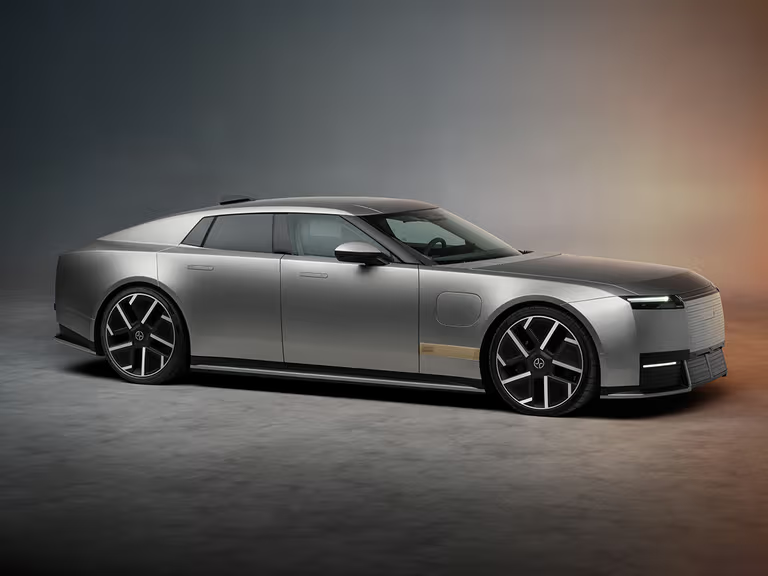
The Ferrari Luce marks the brand’s first venture into a true five-seat configuration, adopting a (very) different four-door layout to package the electric architecture.
Former Apple design chief Jony Ive and Marc Newson spearheaded the aesthetic overhaul, and their LoveFrom collective crafted a shell-like glasshouse flanked by suspended aerodynamic wings to help manage the vehicle’s footprint.
Cabin interaction begins with a Corning Gorilla Glass key. This hardware features a bistable E-Ink display that communicates with the central console during the start-up sequence. Once the vehicle is moving, the driver relies on a new Torque Shift Engagement system. Paddle shifters manage five distinct power delivery states and five regenerative braking levels to simulate the traditional gear-shifting experience.
The engineering team also installed a physical accelerometer on the rear axle to capture actual mechanical vibrations. This setup feeds genuine motor frequencies directly into the cabin, avoiding the synthesised audio tracks that often plague modern electric vehicles.

How the Luce Manages Its 2,260 KG Footprint
Hiding mass requires substantial processing power and extreme structural rigidity. The Ferrari Luce mounts its 210-cell battery pack directly into the floorpan. This integration lowers the centre of gravity by 95 mm compared with the Purosangue while increasing torsional rigidity by 35 per cent. The body-in-white utilises hollow aluminium castings and extrusions to save weight.
Ferrari incorporated an elastically-mounted rear subframe for the first time to isolate the cabin from harsh structural vibrations.
The vehicle dynamics rely heavily on the new Vehicle Control Unit (VCU), which updates actuation targets 200 times per second. Because the car features a motor at every corner, the drivetrain exerts total control over the yaw moment. They’ve called this system Ferrari Lateral Optimisation Wheeltorque (FLOW), which manages the rear virtual differential to maximise traction upon corner exit. It also applies negative torque during corner entry to force the heavy nose toward the apex. Stopping power is handled by massive carbon-ceramic brakes measuring 390 mm up front and 372 mm at the rear, working in tandem with an advanced regenerative system capable of pulling 0.5 g of deceleration.
 1/5
1/5Powertrain Details and Battery Chemistry
The 800-volt architecture utilises four independent motors. The front units spin to 30,000 rpm, generating 105 kW each. The rear motors reach 25,500 rpm and produce 310 kW each. This quad-motor setup yields a peak wheel torque of 11,500 Nm in Launch Control mode. Still, it’s a number that sounds more like a LeBron James ESPN stat than a real-world figure.
Energy is stored in a 122-kWh battery pack co-developed with SK On. The high-nickel pouch cells deliver a peak discharge of 830 kW and support 350 kW of fast charging.
Thermal management ecosystems balance three different fluid circuits (coolant, water, and air) to maintain optimum temperatures during aggressive driving or rapid charging. The system utilises active aero grilles to regulate airflow across the front heat exchangers, shutting them completely when cooling is unnecessary to reduce drag.
 1/10
1/10Jony Ive, LoveFrom, and an Unprecedented Cabin
Bringing an external design firm into the Ferrari ecosystem represents a stark departure from tradition, and we’re not sure that it’s paid off. The LoveFrom collective engineered the new silhouette that ditches the cramped quarters of a mid-engine sports car, and with the absence of a central transmission tunnel, creates an airy cabin wrapped in premium leather and recycled anodised aluminium.
It will appear to be nothing new to those who spent time deep-diving into the interior design with us months ago, but the driver interacts with a multi-layered OLED binnacle display developed exclusively with Samsung.
Physical controls have not been abandoned either, and you’ll find precision-machined mechanical toggles handle the climate functions on a pivoting central control panel. The historic Ferrari yellow remains prominent throughout the interface, alongside launch paint options like Azzurro la Plata and Rosso Fiammante. Infotainment duties fall to a bespoke MyFerrari Luce application utilising Apple Maps and Google Maps EV routing.

Aerodynamics and the Acoustic Approach
The reality is that while function should always follow form, aerodynamic efficiency dictates modern EV range. Here, the Luce claims the lowest drag coefficient in Maranello’s history, based on 6000 CFD simulations and extensive wind tunnel testing.
Like other high-end EVs, the active suspension lowers the front end by 10 mm at speed, while the 24-inch rear turbine-style forged wheels reduce the aerodynamic wake by 5 per cent.
Engineers refused to pump fake internal combustion noises through the 21-speaker, 3,000-watt audio system. They used a physical accelerometer on the rear axle to capture actual gear and motor vibrations. Then, the VCU filters and amplifies this precise frequency like an electric guitar. The system projects the true mechanical signature of the drivetrain both inside the cabin and to bystanders on the street, though the driver can silence it completely by switching the e-Manettino dial to “Range” mode.

Price and Availability
It’s still very new, so Australian delivery timelines for the Ferrari Luce remain unconfirmed following the global unveiling at the Vela di Calatrava in Rome.
Local pricing is yet to be announced by the factory, but buyers should expect a figure well north of traditional grand tourers, given the high-voltage componentry and the vast array of new patents involved. Australian owners will benefit from the standard seven-year routine maintenance program alongside a dedicated eight-year warranty covering the battery and core electric axles.
With the Luce, it seems that Ferrari believes that performance cars are no longer defined by how loudly they idle at a traffic light. They’re instead judged on how effectively software and electricity can manipulate physics to create the illusion of lightness. However, it will be interesting to watch how the new era of the heavy, complex, and immensely powerful electric Ferraris evolves.
















Comments
We love hearing from you. or to leave a comment.