

Updated:
Readtime: 7 min
Every product is carefully selected by our editors and experts. If you buy from a link, we may earn a commission. Learn more. For more information on how we test products, click here.
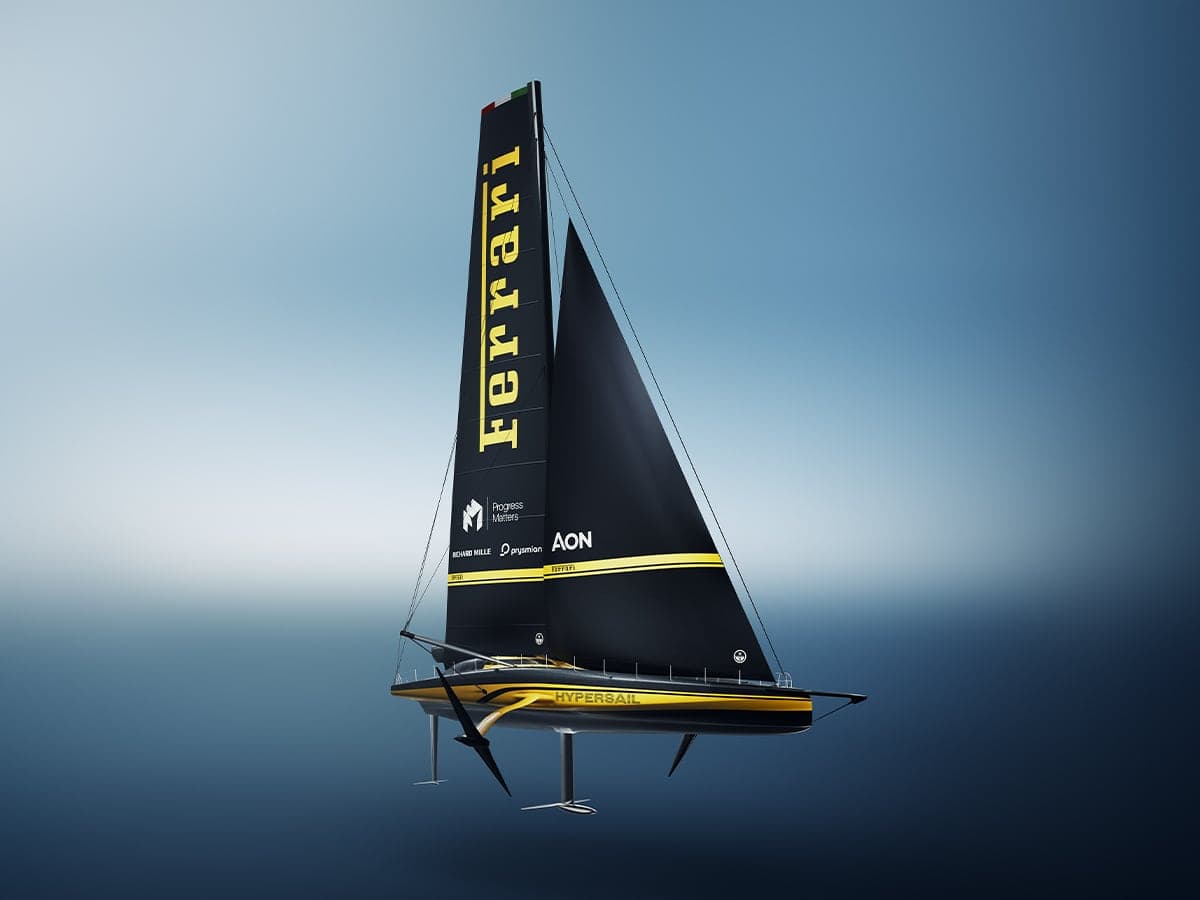
When luxury automakers run out of tarmac to conquer, they either make a watch, create a clothing collection, or turn to the ocean. Well, Ferrari has already done those other things, so they chose the latter by developing the Ferrari Hypersail. While most car-branded speedboats amount to little more than a superficial badge swap and custom leather trim (a phenomenon made famous by Rick Ross’s 1-of-63 ‘Tecnomar for Lamborghini 63’), that wasn’t Ferrari’s motive.
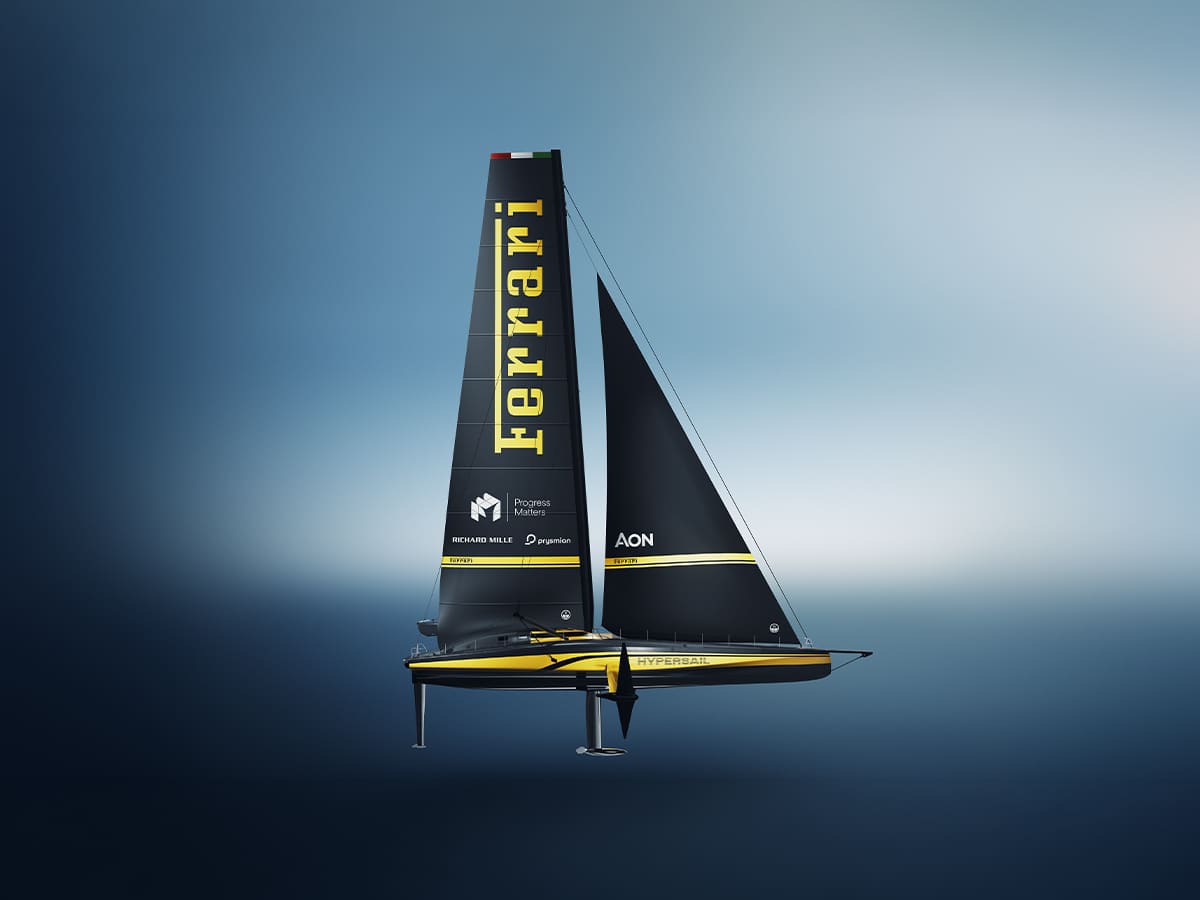
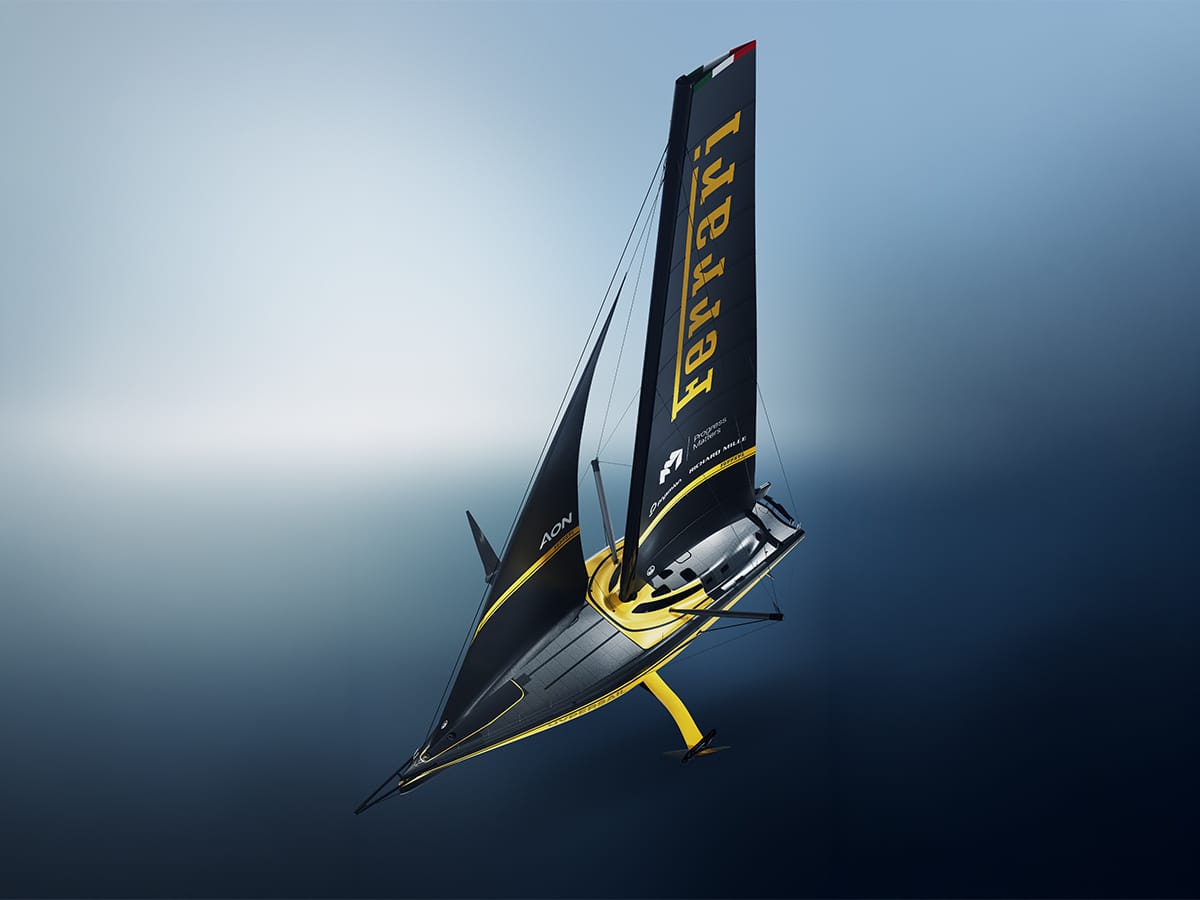
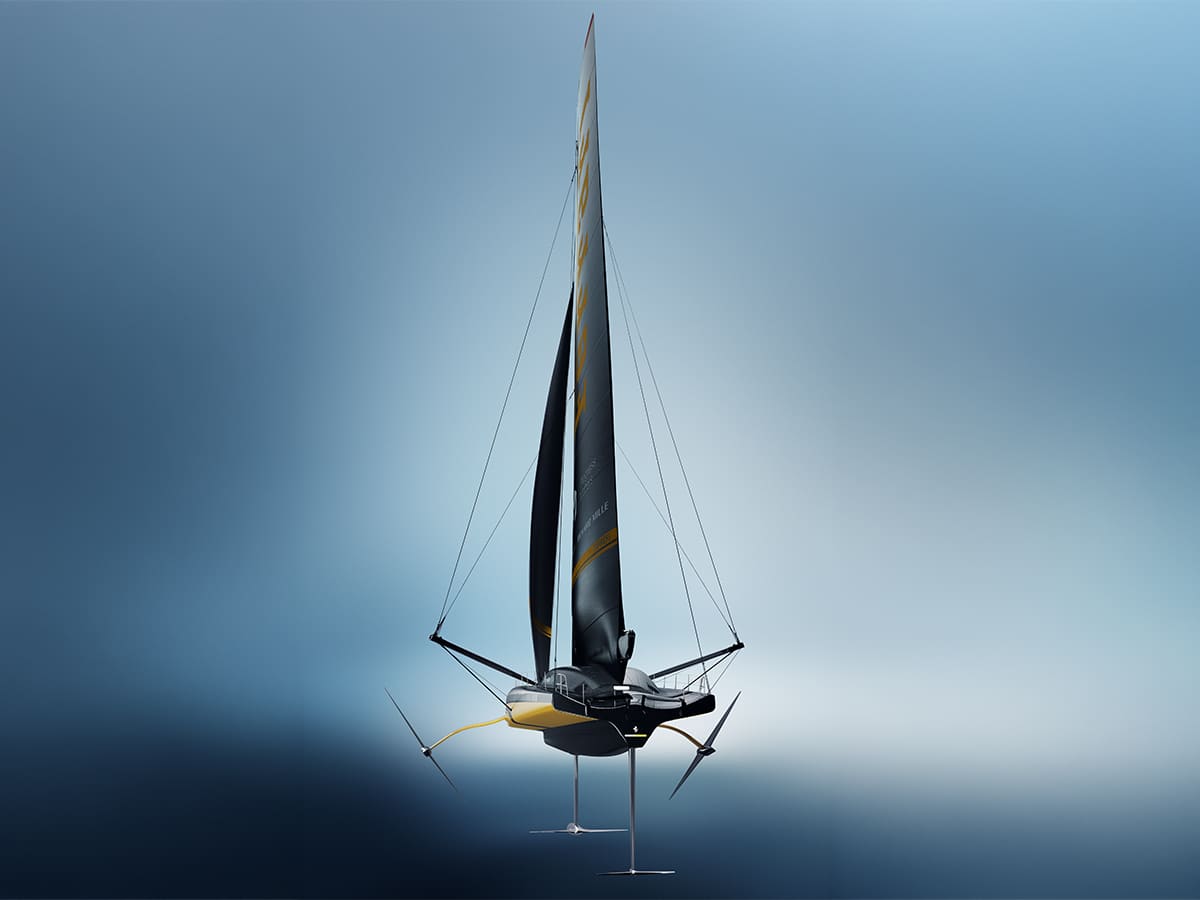
They don’t do superficial branding exercises, so in partnership with renowned naval architect Guillaume Verdier, Maranello created the Ferrari Hypersail. It’s a 100-foot “flying” ocean monohull designed as an open innovation platform to transfer raw Formula 1 and supercar technology directly onto the high seas. Now, the Prancing Horse has pulled back the curtain on the boat’s technological centrepiece: an onboard Energy Management system that turns it into the world’s first foiling ocean racer engineered for 100 per cent energy autonomy.
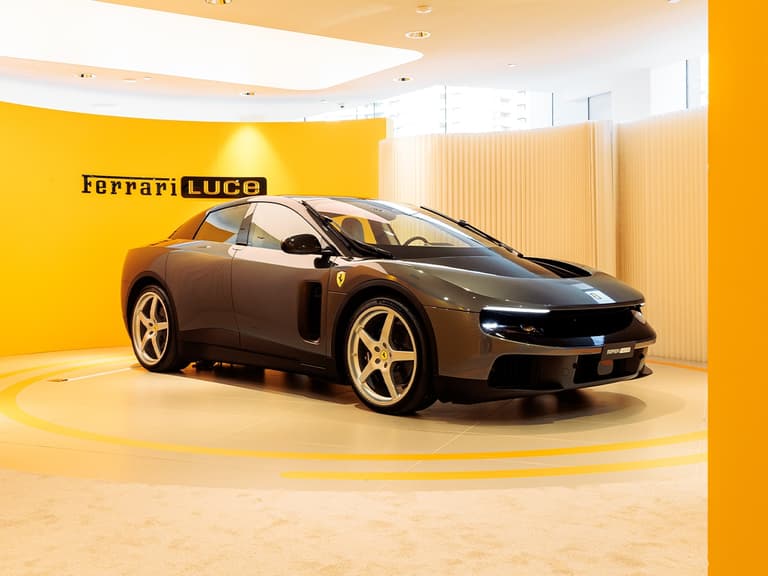
Ditching fossil fuel entirely, the Hypersail combines crew muscle power, solar harvesting, and stern wind turbines with cutting-edge EV hardware borrowed directly from Maranello’s road cars. From “Winch-by-Wire” pedestals driven by Purosangue suspension motors to active foil flight control managed by the 800V rear e-axle from the all-electric Ferrari Luce, this 100-foot yacht proves Ferrari can be just as formidable on water as it is on the racetrack.
Winch-by-Wire and Purosangue Tech
Here are the key technical specifications for the Ferrari Hypersail:
- Vessel type: 100-foot (30-metre) Fully Foiling Offshore Racing Monohull
- Energy management: 100% Self-Sufficient Energy Autonomy (Zero Fossil Fuels)
- Above-deck systems: Winch-by-Wire Pedestals with Purosangue & F80 Active Suspension Motors
- Primary flight control: Active Flight Controller with Dual 800V Battery Architecture
- Macro actuation (Foils/Keel): Powered by the 800V Rear E-Axle from the Ferrari Luce EV
- Micro actuation (Flaps): Dual 48V Electric Motor Hydraulic Pumps
- Solar generation: 100m² Walkable Solar Panels with Specialised Deck Grip
- Wind generation: Configurable/Removable Stern Wind Turbines
- Load management: Up to 9-tonne loads per crew member via Winch-by-Wire
- Development team: Ferrari Tech Team, Ferrari Design Studio (Flavio Manzoni), Guillaume Verdier
- Commercial status: One-off Open-Innovation R&D Prototype (Not for commercial sale)
Okay, we’ll have to get a little technical here. Traditional sailing winches require crew members (“grinders”) to physically crank against escalating mechanical resistance, causing fatigue, erratic cadence, and the inevitable physical slowdowns as loads increase. Ferrari isn’t into this, so they’ve completely rewritten this dynamic by introducing Winch-by-Wire technology. Instead of driving mechanical shafts or hydraulic circuits directly, human muscle power applied to the pedestals is instantly converted into electrical energy, fed into a centralised grid, and redistributed across the sail plan.
By eliminating these spikes in mechanical resistance, grinders can maintain a constant, optimal cranking rhythm at peak metabolic efficiency. This mitigates fatigue and enables a single crew member to manage staggering loads of up to 9 tonnes. The secret driving these pedestals? They utilise the exact electric motors found in the active suspension systems of the Ferrari Purosangue and F80 hypercar.
It’s an approach that Ferrari says stems directly from the “Manuale by-wire” system introduced on the Ferrari 12Cilindri Manuale, where physical mechanical inputs are converted into electronic signals while fully preserving an authentic, tactile analogue feel. On the Hypersail, that generated power is channelled in real time to drive electric winches or power hydraulic pumps for on-deck adjustments.
800V Flight Controller and Ferrari Luce E-Axle
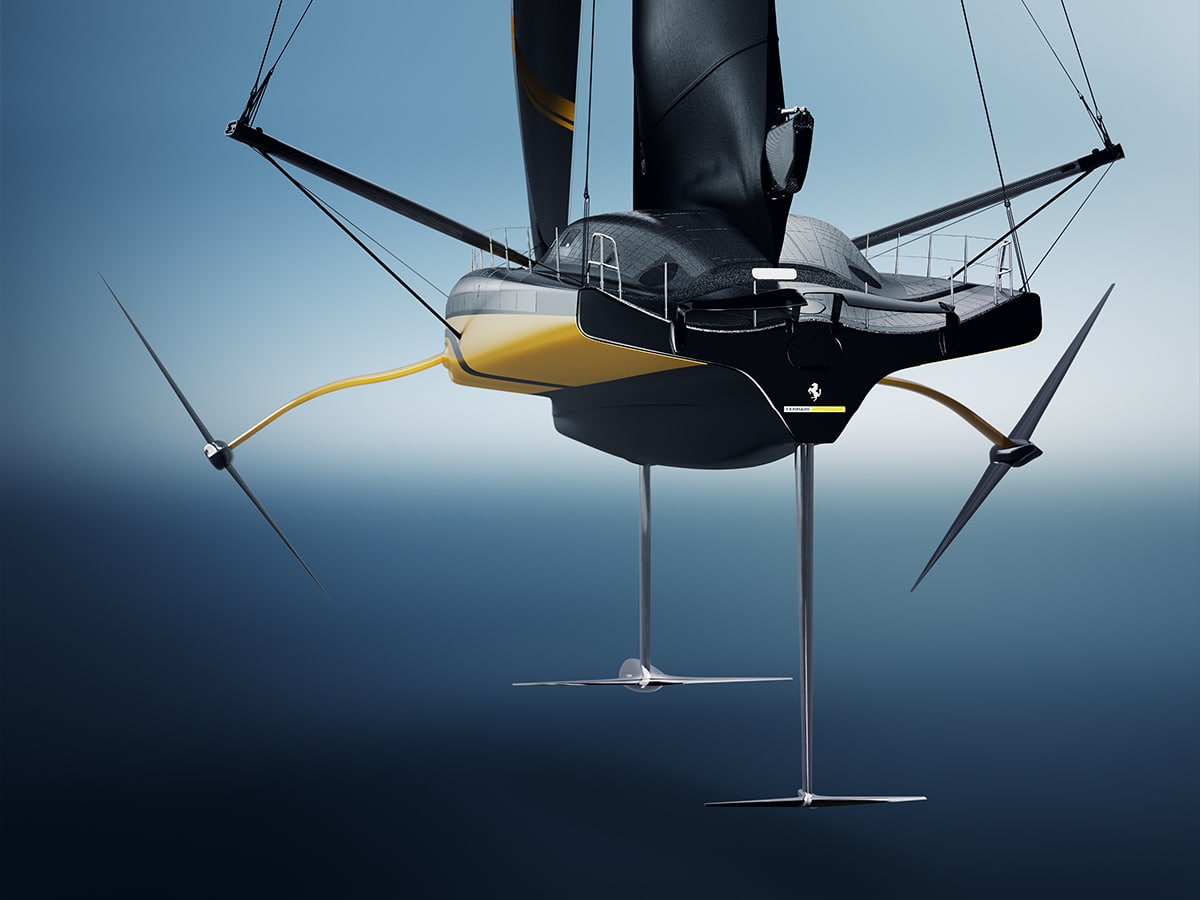
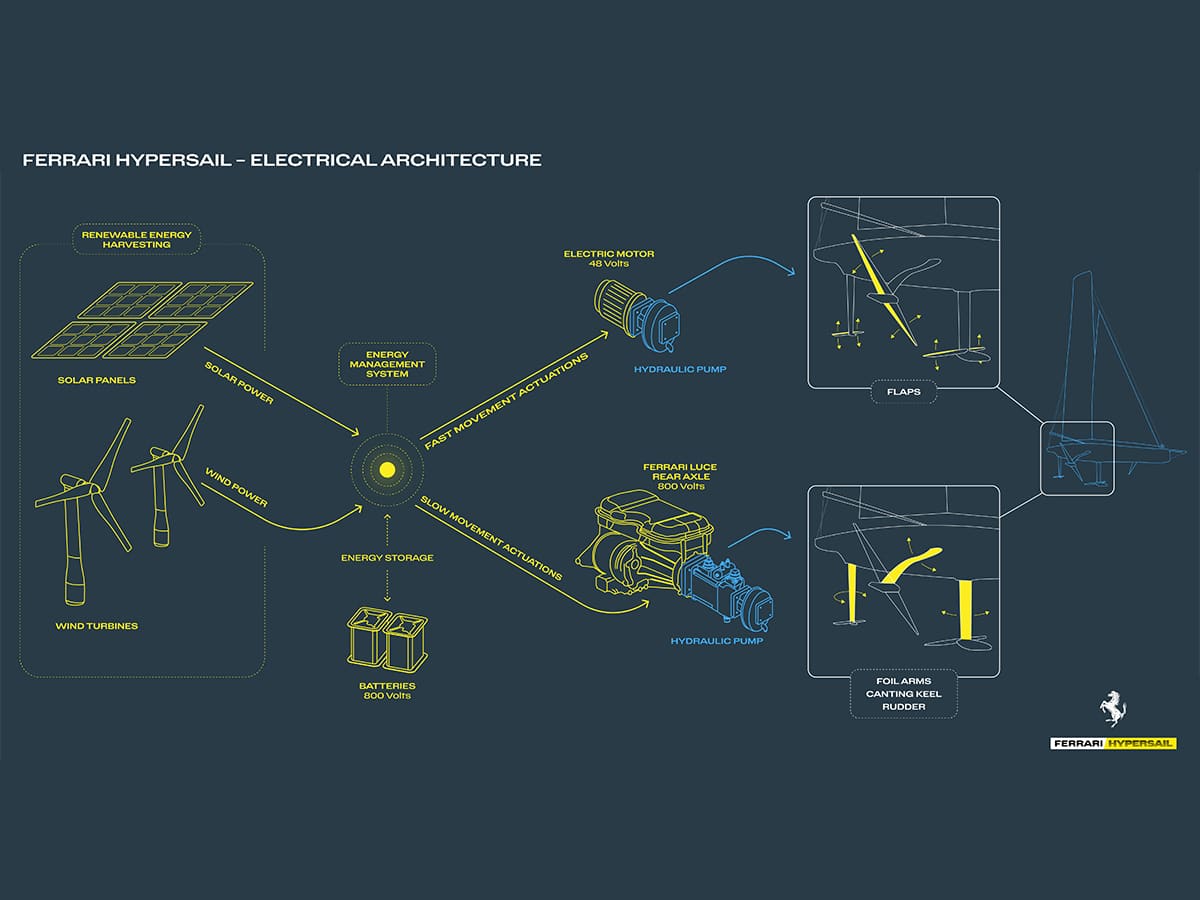
Managing a 100-foot monohull while it “flies” above the water on hydrofoils requires millisecond hydraulic adjustments and high-end electronic stability. Below deck sits the technological core of the vessel, governed by an electronic control unit (ECU) architecture that operates across four distinct voltage levels from 12V to 800V.
To control ride height and foil stability, Ferrari engineers developed an active Flight Controller that manages hydraulic flow across two distinct operating modes:
- Slow Movements: Macro-adjustments of the foil arms and canting keel driven by the high-output 800V rear e-axle borrowed directly from the all-electric Ferrari Luce.
- Fast Movements: Rapid, real-time micro-adjustments of the foil flaps are handled by dual hydraulic pumps driven by agile 48V electric motors.
This dual-tier approach means optimal energy efficiency while ensuring redundant safety in harsh open-ocean conditions. Surplus energy generated while underway is stored in twin 800V high-voltage battery packs, ready to be deployed instantaneously based on the dynamic needs of the vessel.
Solar, Wind, and Energy Autonomy
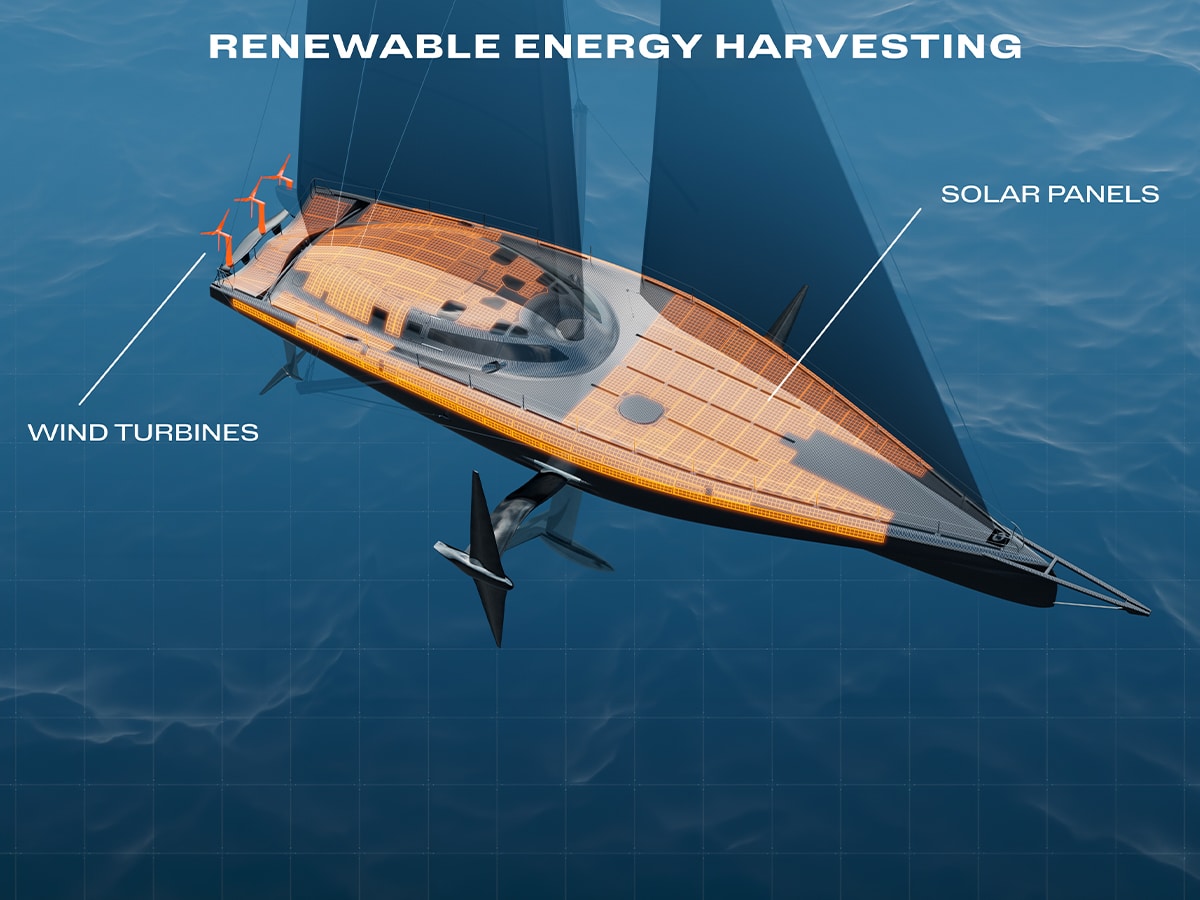
To achieve complete energy independence without relying on fossil-fuel backup generators, the Hypersail harvests energy directly from its environment.
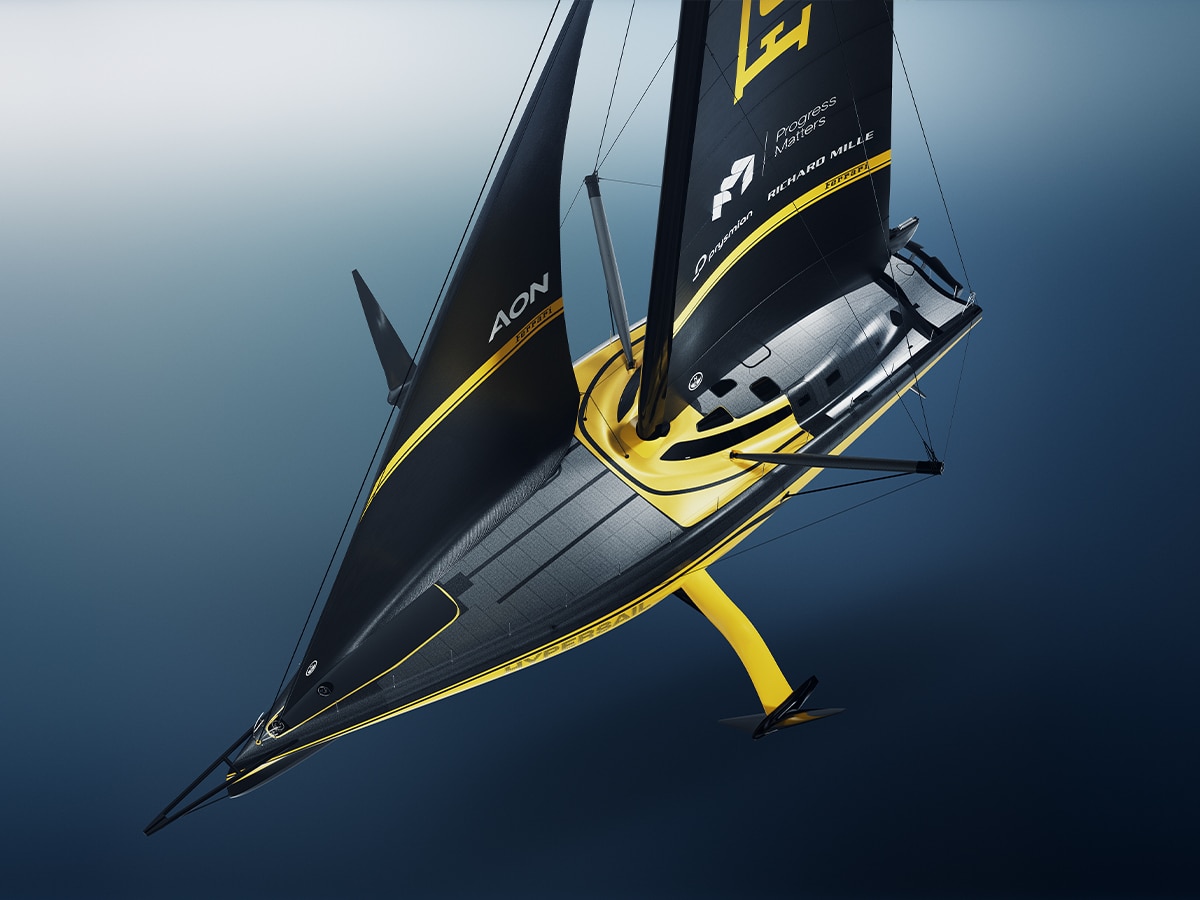
There’s a huge 100-square-metre array of walkable solar panels engineered with a specialised non-slip grip surface. Rather than covering the entire hull, solar mapping simulations were conducted across various latitudes and oceanic routes to place panels strictly in high-yield exposure zones, thus eliminating unnecessary weight.
When we look at the stern, the monohull houses configurable, removable wind turbines. Ferrari engineers conducted extensive intake-angle simulations to strike the precise balance between maximum electrical power generation and minimal aerodynamic drag at high sailing speeds. Combined with crew-generated energy from the Winch-by-Wire pedestals, the monohull generates 100 per cent of its operational power while underway.
Design and Giallo Fly Livery in Maranello’s Maritime Style
Look, we’ve bombarded you with a ton of technical information here, but the truth is that you don’t have to understand how offshore ocean racing works to appreciate the Hypersail. Like with road cars, aesthetics can’t get in the way of physics. The vessel’s design is heavily performance-driven, meaning every volume and surface is carefully considered in relation to the interaction between wind, water, and speed.
It features several stylistic ideas from the road and track cars, including:
- Streamlined hull evokes proportions of the limited-edition Ferrari Monza SP1 and SP2 supercars.
- Exterior graphics on the deck’s coachroof are a direct nod to the Le Mans-winning 499P Hypercar.
- Design lines inspired by the LaFerrari and the newly revealed F80.
- Elongated “F” logo on the sail borrows its visual continuity from the 2023/2024 F1 car’s wing.
- Solar panels integrated into the deck and hull sides will have a specific grip, making them walkable.
Perhaps the coolest feature of the Hypersail is its paint, which is yellow rather than red. Rather than opting for Rosso Corsa, the brand chose what it calls its “second soul,” Nuovo Giallo Fly (Yellow). It first appeared on the 275 GTB, originally inspired by the yellow helmet of driver Luigi Musso. Here, in a nautical context, the “Fly” moniker perfectly links up with the vessel’s foiling nature. It’s contrasted against Grigio Hypersail, a new grey tone that mimics the hull’s raw, lightweight carbon fibre. Finally, the colour separation echoes the 512 BB’s livery.
It’s clear that the Ferrari Hypersail is far more than a passion project. By translating electric motor tech from the Purosangue, manual-by-wire logic from the 12Cilindri, and 800V e-axles from the Luce EV into a 100-foot ocean racer, Maranello has demonstrated that its cutting-edge automotive technology can solve complex maritime challenges. It stands as a remarkable statement of engineering self-sufficiency, and it is a clear warning to the yachting establishment that Ferrari intends to be just as dominant on the water as it is on the track.



















Comments
We love hearing from you. or to leave a comment.