


Updated:
Readtime: 12 min
The Lowdown:
The ice bath, the double espresso, the 5 am alarm… turns out your morning routine might be working against you. Here's what longevity science recommends instead.
Every product is carefully selected by our editors and experts. If you buy from a link, we may earn a commission. Learn more. For more information on how we test products, click here.
- Getting outside for natural morning light is the single most powerful thing you can do to anchor your circadian rhythm and sharpen your focus.
- The first ten minutes of your day calibrate your nervous system, so reaching for your phone first sends a threat signal to your brain before the day has even started.
- Cold plunges and caffeine can be useful tools, but for men running on poor sleep and chronic stress, they may do more harm than good.
- For longevity, consistency in exercise will always outperform perfect timing, and spending a few minutes with your family before you train shouldn’t be treated as a compromise but a focus.
If you scroll through your feed before 8 am, you’ll likely see a parade of shirtless guys plunging into freezing water, downing a double espresso, and sprinting off to “crush the day.” It’s seen as the ultimate morning routine for guys – a badge of honour worn by those who believe that more stress equals more resilience. But if you actually want to live longer, think clearer, and feel better, the science of longevity suggests a very different approach.
Dr Olivia Lesslar, an expert in psychoneuroimmunology and longevity medicine, believes we have completely misunderstood what mornings are meant for. As the Founding Medical Director of EIR LIV, Australia’s first ‘Human Potential Club’ in Sydney, she specialises in solving complex, multi-system conditions by looking at human biology through an evolutionary lens. And according to her, the way most men start their day is sending their nervous system into a state of chaos.
Here’s the blueprint for a morning routine that works with your biology, not against it, according to longevity science.
The Science of Morning Light: How to Reset Your Body Clock
We all know sunlight is good for us. But checking your emails by a sunny window simply doesn’t cut it. Glass filters out essential parts of the light spectrum and alters the directional qualities of light. Your biology evolved over hundreds of thousands of years to receive a very specific, rich environmental signal to start the day.
“Morning light is an ancient biological signal that your nervous system has been interpreting for hundreds of thousands of years,” says Dr Lesslar. “It’s one of the strongest ‘it’s time to start the day’ messages your body receives, which catalyses and initiates hundreds if not thousands of other signals.”
When morning light hits your eyes, it acts as a powerful time-giver, suppressing melatonin production and creating a healthy peak in cortisol. This process regulates your circadian rhythm, boosts alertness, and sets the stage for better sleep later that night. Even on a cloudy day, the ambient light outside is thousands of times brighter than typical indoor lighting, providing the exact environmental message your body needs.
What to do: Step outside within the first few minutes of waking up, even if it’s cloudy. Leave the sunglasses and the phone inside. Let your eyes and skin experience the morning light, and stack your other habits on top of this signal (like drink your coffee outside, stretch, or simply breathe).
Calibration Over Motivation: Stop Reaching for Your Phone First Thing
A lot of men wake up and immediately reach for their phone. Within 60 seconds, they’ve checked their emails, skimmed the news, and at the same time, started mentally rehearsing everything that could go wrong today. What they don’t realise is that they have just told their ancient biological system that the world is a threat, and their body has responded accordingly.
When you first wake, your nervous system is already asking one very important question: “What sort of world have I woken up into?” It doesn’t just listen to your thoughts but also integrates information from your breathing, posture, light exposure, movement, temperature, sounds, and social environment to decide whether today looks safe, demanding, or threatening.
“Your body responds exactly as it evolved to do by allocating resources towards vigilance rather than restoration, creativity or connection,” Dr Lesslar notes. It’s also worth remembering news is often weighted towards pain, suffering, and chaos, because that’s what sells. So, if you’re feeding your nervous system that as its first input of the day, you’ve essentially started the morning on threat alert.
The fix is simple, according to Dr Lesslar. “Open the curtains. Step outside. Take a few slow breaths. Stand upright rather than curling over a screen. Drink some water. Look at the horizon. These actions are not magical – they work because multiple systems are collectively telling your brain the same story: ‘The day has begun. I am safe. I can engage with the world.’”
This is why morning routines can be so powerful. Even for men who wake up feeling anxious because of depression, trauma, chronic stress, poor sleep or other medical conditions, a consistent morning routine gives the nervous system something familiar and predictable to organise around. It’s not a cure, but it is an anchor

Is Your Current Morning Routine Actually Stressing You Out?
What about the cold plunge and the double espresso? While cold exposure and caffeine can be helpful tools that stimulate adaptation, Dr Lesslar warns that context is everything.
“If your nervous system is already waking up in a state of chronic stress, sleep deprivation or burnout, immediately throwing it into an ice bath before flooding it with caffeine isn’t necessarily building resilience,” she says. “It may simply be asking an already overloaded system to do even more.”
From an evolutionary standpoint, your body doesn’t count stressors individually; it integrates them. Poor sleep, hard training, psychological stress, and stimulants all add to your allostatic load, which is the cumulative burden of chronic stress. For a well-rested, metabolically healthy guy, a cold plunge can be an excellent stimulus. For someone surviving on five hours of sleep, already running on cortisol and then using caffeine to override exhaustion, it may simply reinforce the message that the world is relentlessly demanding.
“I’m not against cold plunges or coffee. I use both strategically. But they’re tools, not badges of honour,” says Dr Lesslar. “Longevity is about exposing yourself to the right challenge, at the right dose, at the right time, while giving your body enough recovery to become stronger afterwards.”
Is Your Morning Routine Actually Causing Chronic Stress?
If you’re someone who’s convinced that 5 am is the perfect time to exercise and your whole routine will be thrown out of whack if you don’t hit the gym at 5 am on the dot, there may be some good news for you.
“I think we’ve become a little too obsessed with ‘the perfect time’ to exercise,” says Dr Lesslar. “Rigidity is a stress, very different to discipline, which is a challenge!”
Think about it this way: our ancestors didn’t wake up, check their smartwatch, and debate whether Zone 2 at 6:12 am would produce better mitochondrial adaptations than 7.15 am. They simply responded to the demands of the environment.
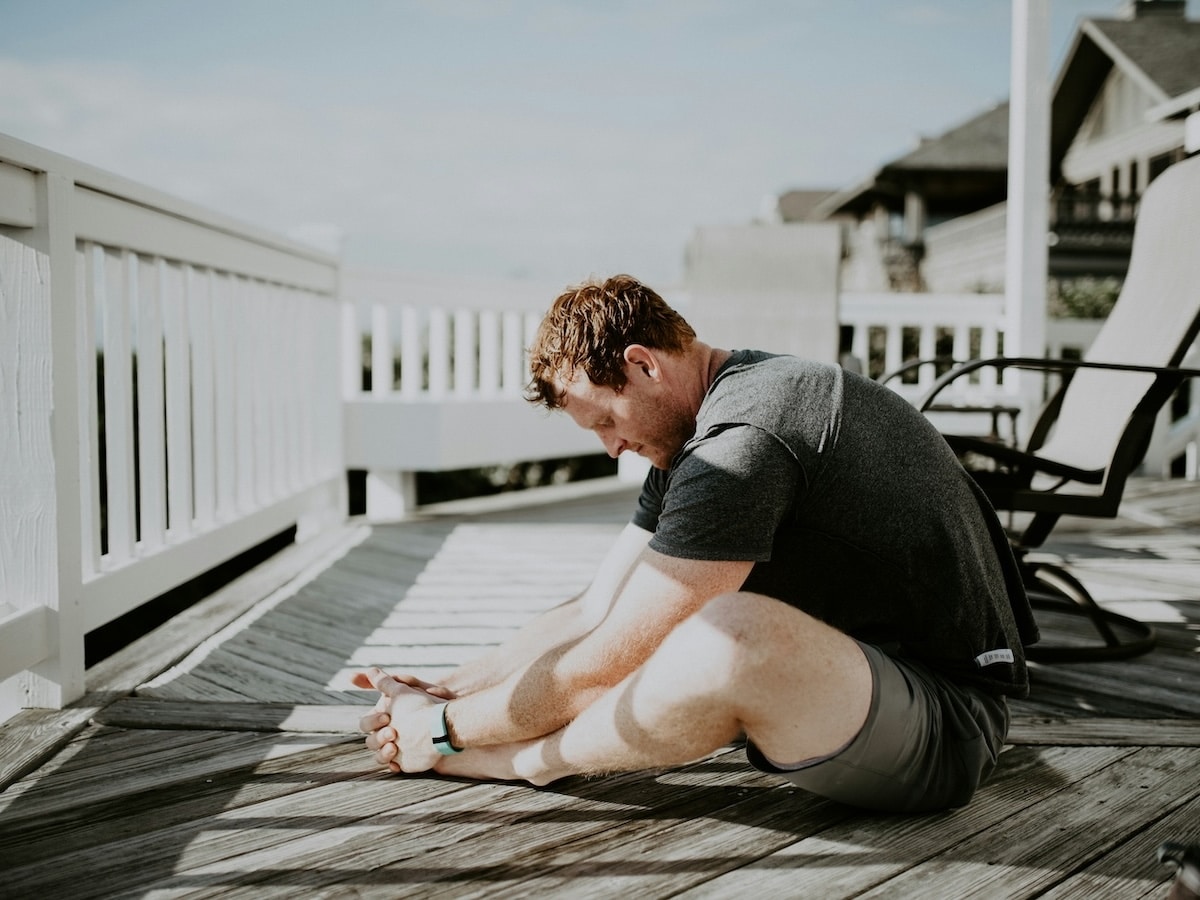
For many men, Dr Lesslar would actually encourage them not to sprint out the front door the moment they wake. “Spend ten or fifteen minutes telling your nervous system that the day has begun. Spend some damn time with your family first – get your priorities straight. Get some natural light into your eyes. Hydrate. Stretch. Appreciate your home. Let your circulation, body temperature and brain gradually transition from sleep into wakefulness.”
This gentler type of transition allows your circadian rhythm, cardiovascular system, and nervous system to switch on together, better preparing you for strenuous activity. And while elite athletes might need strict timing, for longevity, consistency will always outperform optimisation.
“Longevity is built by creating rhythms that your biology, life and family can sustain for decades,” advises Dr Lesslar.

The Truth About Exercise Timing for Longevity
When morning rolls around, you’re mildly dehydrated from breathing and sweating overnight. So, if the first thing you do is reach for a cup of coffee, you’re only further dehydrating your body. That’s why Dr Lesslar advises drinking some water before you chug your coffee. However, it’s not just any old tap water you should be drinking – your cells need the right conditions to use water effectively.
“Water follows minerals, so replacing these (which council typically strips in cleaning our water) often makes far more physiological sense than endlessly pouring in plain water alone.” Research supports this, showing that electrolytes significantly enhance the hydration properties of fluids. Creating mineralised water can be as simple as sprinkling some Celtic sea salt into your water glass.
When it comes to breakfast, protein is crucial, but Dr Lesslar says that while fuel is food, it’s also information. Dr Lesslar uses the frameworks “NOURISH” (external conditions like nutrient density, origin, and seasonality) and “VAGUS” (internal conditions like vagal tone, awareness, and unhurried eating).
“If you’re eating breakfast while answering emails, driving to work or scrolling social media, you’ve already shifted your nervous system into a state of distraction,” she says.
“Taking even ten minutes to sit, chew properly and enjoy your meal is another way of telling your biology that resources are available and there is enough safety to digest, absorb and repair.”
Science even proves that mindful, slow eating activates the vagus nerve, stimulating optimal digestion and helping you feel full.
Optimal Hydration and Nutrition Habits to Support Your Biology
Not everyone has the luxury of being able to take the mornings slowly, so if you only have 15 minutes to set up your day for longevity and focus, Dr Lesslar’s prescription is simple.
- Step outside. Let natural light reach your eyes and skin.
- While you’re outside, try to plant your bare feet on natural materials. Grounding, or earthing, has been shown to improve sleep, normalise cortisol rhythms, and shift the autonomic nervous system towards a parasympathetic state.
- Move slowly, whilst breathing slowly.
- Slow static movements like qigong, tai chi, or some forms of yoga coupled with deep breathing practices offer your brain an opportunity to survey the body and recalibrate where all the joints are in space.
“These practices are useful as a meditative process, oxygenation process, but also to allow the brain to update its schema of the body,” Dr Lesslar explains. “The schema and the practice of updating the schema both send signs of safety to your system.”
The 15-Minute Non-Negotiable Morning Routine for Busy Men
You don’t need a perfect, strict morning routine. You don’t need a 5-step protocol, a cold plunge personal record, or a perfectly timed cortisol spike. What you need to be doing is focusing on giving your body the coherent, ancient signals it expects: light, movement, water, stillness, food. Do that consistently, and you’re not just setting yourself up for a better day ahead, but also building a biology that’s more resilient, adaptive, and healthier.
Morning Routine FAQs
As little as 5 to 15 minutes of morning outdoor light exposure is enough to trigger a circadian response, though up to 30 minutes is ideal depending on your skin tone, cloud cover, and how far you are from the equator. The key is getting outside before 9 am, when the light spectrum is richest in the low-angle wavelengths that most effectively reset your body clock. A walk to get a coffee counts, and so does standing in your backyard or on your balcony.
Reaching for your phone within minutes of waking floods your brain with reactive, unpredictable stimuli before your prefrontal cortex (the part responsible for rational decision-making) has had time to come fully online. Studies link early morning smartphone use to elevated anxiety, increased cortisol, and a reactive rather than intentional mindset that can persist for hours. Take Dr Lesslar’s advice: give yourself at least ten minutes of phone-free time before you engage with the outside world.
You can, but whether you should depends entirely on your baseline stress load. For healthy guys with good recovery capacity, daily cold exposure can build resilience over time. But for those already dealing with burnout, chronic stress, or poor sleep, adding a daily cold plunge to an already overloaded system may simply compound the problem rather than solve it. You could try starting with two to three times per week, pay attention to how your body responds, and increase from there.
Related reads:





























Comments
We love hearing from you. or to leave a comment.