

Updated:
Readtime: 15 min
Every product is carefully selected by our editors and experts. If you buy from a link, we may earn a commission. Learn more. For more information on how we test products, click here.
Australia is not short of supplement brands, or of new ones trying to unseat the incumbents. The premium all-in-one shelf alone has AG1 and IM8 chasing the same customer, and a fresh label arrives most months. What the category has far less of is a brand willing to show its working: what the ingredients cost, why the formulation stops where it stops, and how the product legally reaches an Australian bathroom cabinet at all. On that last point in particular, Keeper Health has taken a path almost no one else has.
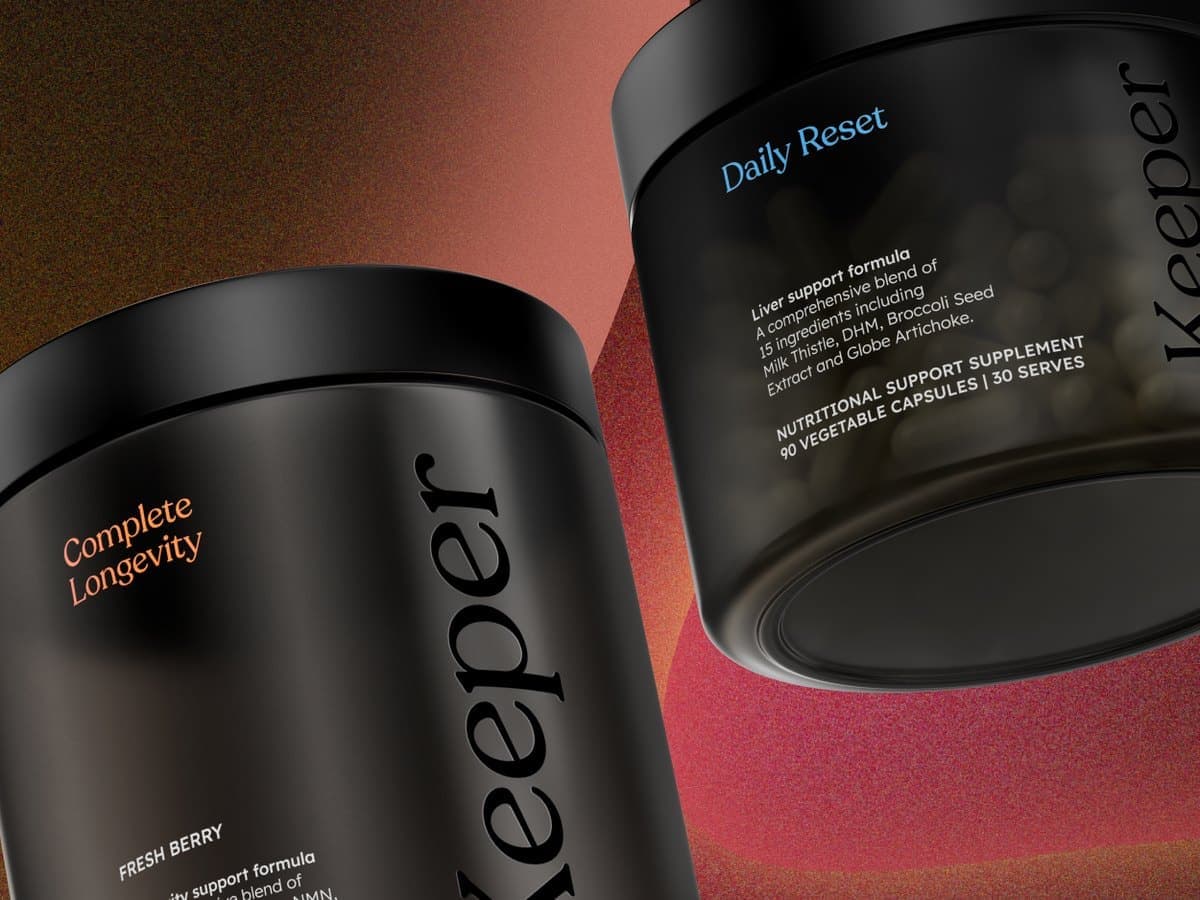
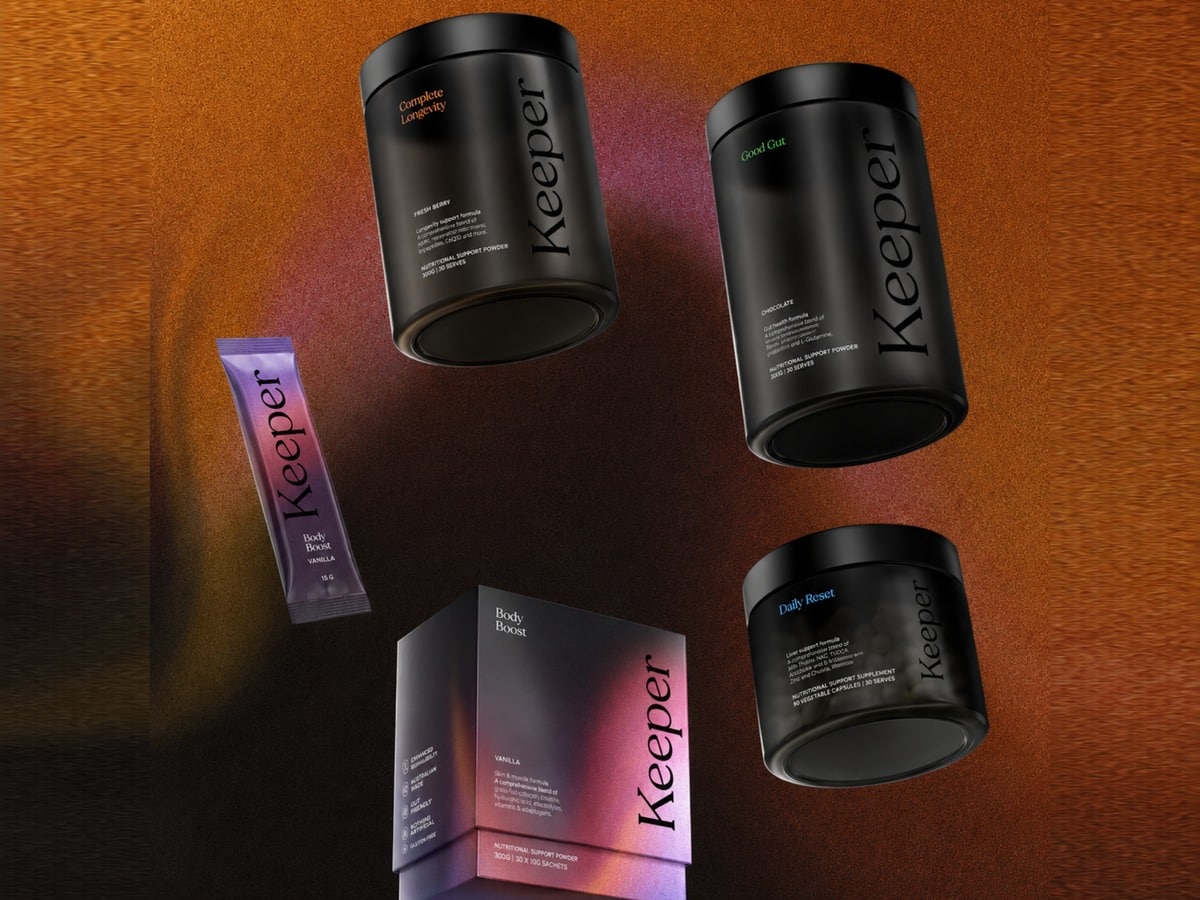
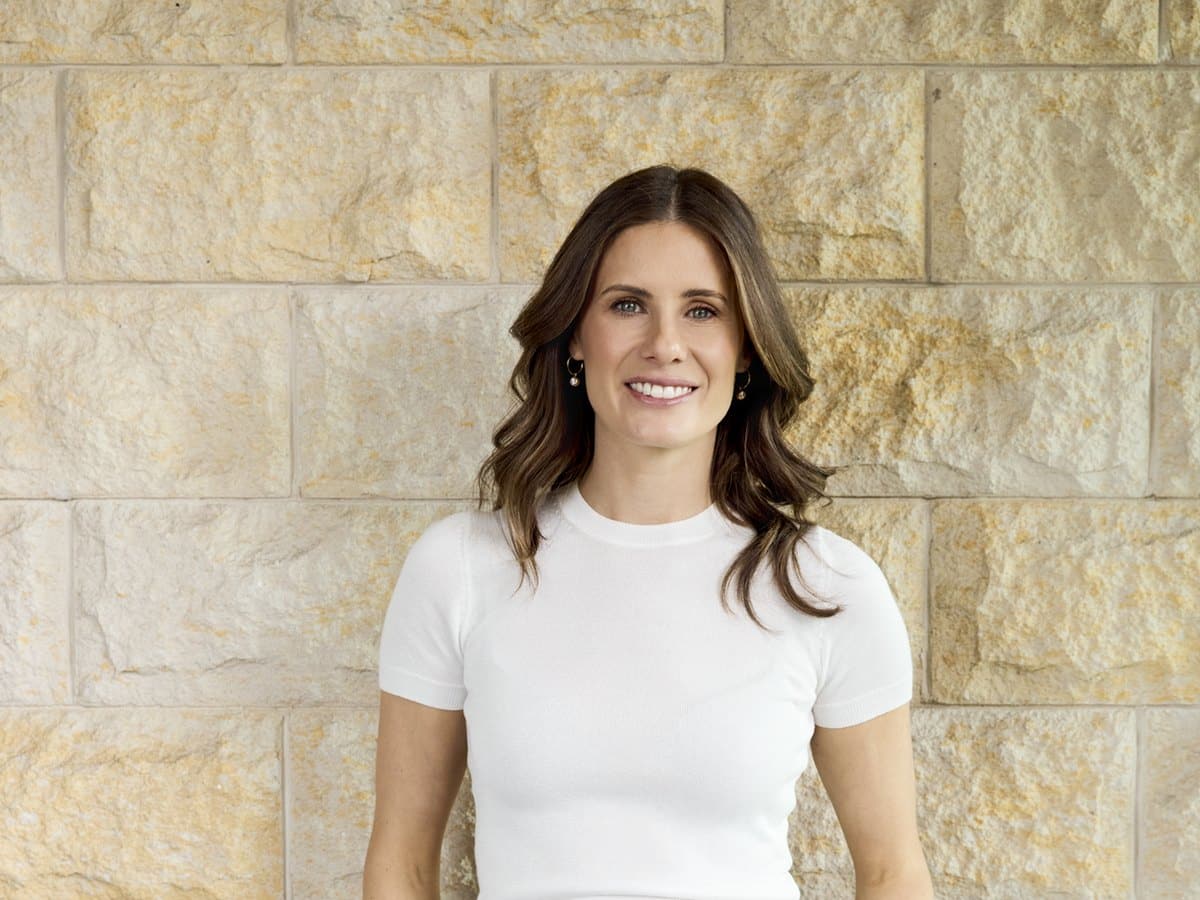
Keeper Health has just launched in Australia with four formulations, Complete Longevity, Body Boost, Good Gut and Daily Reset, covering longevity, skin and muscle, gut health and liver support. The flagship puts 18 active ingredients into a single daily scoop for $99 a month. The brand is family owned and family funded, built by siblings Angus Macintosh and Georgia Macintosh-Reed with Angus’s wife, Sabrina Macintosh. The three of them spent several years learning exactly how hard it is to enter this category.
The prize explains the queue. Australia’s complementary medicines industry was forecast to reach $6.3 billion in 2025, and 74 per cent of Australians use the products, according to Complementary Medicines Australia’s 2025 Industry Snapshot, published in November 2025. Yet, walk into a chemist, and most of the brands looking back at you are the ones that were there ten years ago.
Angus, Georgia and Sabrina have spent the last few years finding out why.

How Keeper Health Started: A Cupboard Full of Half-Used Supplements
The origin story is the least remarkable part, which is probably why it rings true. There was no whiteboard session.
“It definitely was not one moment,” Angus says. After a diagnosis of ulcerative colitis, he became, in his words, “completely obsessed” with what nutrition and supplements could do. “I would read a study and buy another supplement. Listen to a podcast and buy another supplement. Over the years, the collection just kept growing.” One morning, the cupboard was overflowing. “Some were nearly empty, some I had forgotten I even owned, and every few weeks I was placing another order because I had run out of something. I remember thinking, this is ridiculous.”
Georgia, diagnosed with Hashimoto’s, had landed in the same place from a different direction. “My kitchen bench looked like a pharmacy,” she says. “I remember thinking, surely somebody has solved this already?”
Nobody had, at least in a way, what the three of them wanted to buy. Sabrina’s decision to leave her job was the trigger that turned a recurring family-dinner conversation into a business. “Eventually we realised we had reached a point where we either had to stop talking about it or back ourselves and give it a go,” she says. “At the time, it just felt like an exciting side project.”
Angus put a number on the frustration, turning it into an opportunity. He added up what he was spending each month on the ingredients he actually wanted to take: around $500. “Then we realised I was not unusual.”
What It Actually Costs to Launch a Supplement Brand in Australia
The assumption about this category is that it is easy money. Find a contract manufacturer, white-label a formula, design a nice label, and run some ads. Sabrina’s description of the first year suggests otherwise.
“I remember thinking we’d be building a supplement brand,” she says. “Instead, overnight, we found ourselves learning international freight, trademarks, manufacturing regulations, photography, and website development. Every week felt like starting a new job.”
The most expensive lesson was logistics. The team spent months planning to set up a warehouse in Hong Kong before the economy fell apart. “Only a few months before launch, we completely changed direction and moved everything to New Zealand,” Georgia says. “At the time, it felt terrifying. Looking back, it was probably one of the best decisions we made.”
The ingredient list itself is the next problem. Complete Longevity has 18 actives, each with its own testing requirements, specifications, and lead times. “People see one scoop of powder,” Angus says. “We see eighteen carefully selected ingredients that all have to come together in exactly the right way.” Miss on one and the entire production run slips. The bottleneck that nearly beat them was not an exotic longevity compound but the flavouring. “Finding a flavour that tasted great, met our standards and was both natural and organic took far longer than any of us expected,” Sabrina says.
Which brings you to the barrier that quietly does most of the killing: minimum order quantities. Contract manufacturers run minimums because that is what makes a production line viable, which means a brand with zero customers has to commit to inventory, packaging and ingredient costs months before it knows whether anyone wants the thing.
“People often think you can just make a few hundred units and see what happens,” Angus says. “It really doesn’t work like that. You have to back yourself long before you have any proof the market wants what you’ve built.”
Georgia calls it “probably one of the biggest leaps of faith you take”. Sabrina thinks it explains why the category looks the way it does: “When people look at a supplement brand, they usually see the packaging and the marketing. What they don’t see are the years of formulation work, manufacturing, regulatory advice, testing, logistics and capital required before you’ve even sold your first product. It made us realise why so many brands choose the easier path.”
It is the structural difference between this category and, say, craft beer. You can open a nano-brewery on a modest loan and sell your first keg down the road. Supplements offer no equivalent way to start small, which is why so many new labels turn out to be the same contract formula in different packaging.
Georgia adds the second half, which is trust. “People are happy to try a new coffee roaster or a local brewery because the risk feels relatively low. Supplements are different because you’re putting them into your body every day.”

Keeper Health’s Independent Batch Testing and Ingredient Standards
Choosing the ingredients is one problem. Proving that what ends up in the tub matches what is printed on the label is a different one, and it is the part of this category most brands ask you to take on trust.
Georgia’s answer is independent testing. Every production batch is sent to Eurofins for active ingredient content, contaminants, and microbiological safety testing before release. “It is more expensive, and it slows production, but transparency has always felt like the right investment.”
What a supplement brand is permitted to say about those ingredients is a separate constraint, and a tighter one than most readers assume. “There is a huge difference between educating people and making claims,” Sabrina says. “There are ingredients in our formulations that have been studied extensively, but we simply cannot market them in the same way a pharmaceutical company can.”
Why Keeper Health’s Complete Longevity Costs $99 a Month
The claim doing the heaviest lifting in Keeper Health’s marketing is a pricing one, and unusually for this category, the brand has published the workings.
Keeper built a comparison across 54 competitor products, three commonly available single-ingredient options for each of the 18 actives in Complete Longevity, priced from Australian retailers with source links and dose maths on every row. Prorated to match the Keeper’s own daily doses, the average came to $325.20 a month, with a range from $199.11 on the cheapest option per ingredient to $480.05 on the most expensive, and around 28 whole capsules or tablets a day. Complete Longevity is $99. The snapshot is dated 16 July 2026, and prices in this category move.
Angus says the exercise taught them something about why nobody does it. “Supplements are incredibly difficult to compare. Most people naturally look at the price first, but that only tells part of the story. You also need to consider the ingredient forms, doses, serving sizes and, importantly, what isn’t included.”
Georgia is blunt that the spreadsheet was not a pricing exercise. “The comparison exercise wasn’t about validating our pricing. We already knew where we wanted to sit in the market. It was about creating a transparent way for consumers to understand exactly what they were getting for their money.” She positions Keeper against the premium all-in-ones, citing AG1 at around $187 a month and IM8 at around $260 for the same period, both figures Keeper’s own.
The reason they could price that way comes down to who owns the business. Keeper Health is entirely family funded, and Georgia says that was deliberate. “Outside investment can be an incredible way to scale a business, but it also comes with different priorities. We’ve always said we’d rather compromise on our own margins than compromise on the product.”
Angus puts it less diplomatically. “When it’s your own money, there’s nowhere to hide. We’ve never had pressure to reduce ingredient quality to satisfy investors or chase short-term returns.”
That was tested. “We had plenty of people tell us to simplify the formulations or remove some of the more expensive ingredients to improve our margins,” Angus says. The test they applied: “Would we just end up buying that ingredient separately because we still wanted it? If the answer was yes, it stayed in the formulation.”

The Ingredients Keeper Health Decided to Leave Out
In a category where a new hero compound arrives every quarter, the discipline question is what you leave out.
Angus offers a specific rejection, which is more than most brands will do. “Pterostilbene is one example. It is related to resveratrol and has attracted significant interest in longevity circles, but some human studies have shown increases in LDL cholesterol at certain doses. We decided the potential upside did not justify including it in a daily formulation.” His definition of evidence-informed: “looking at the totality of the evidence rather than chasing headlines”. Sometimes, he says, the answer is not “never” but “not yet”.
Sabrina, who runs brand and marketing, is the one who has to live with those calls. “We get pitched the trend every few months. A retailer, a customer, or someone on the team convinced the next hype ingredient is the thing that’ll move units. The honest answer is we’ve said no to marketing angles that would have been easy wins. If Angus won’t put it in the formula, I’m not going to build a campaign around it. That discipline is harder to hold onto in marketing than it sounds, because hype sells, but it’s not why anyone stays a customer.”
Her read on the design brief is the sharpest line any of them offer. Supplement branding, she says, is either clinical or woo, “and both are actually a way of avoiding the harder job, which is proving the product works. We wanted something you’d be proud to leave on your kitchen bench, but where the second you turned it over, the dose list did the convincing instead of the design. If the packaging has to work that hard to make you trust it, the product probably doesn’t.”
What the Keeper Health Founders Got Wrong
Ask what they would change, and Sabrina, disappointingly for the genre, says nothing. “I wouldn’t trade the lessons for a smoother run. If anything, I’d probably just worry less.”
The more useful answer is what they misjudged. Angus thinks they overinvested in quality and does not regret it: “We wanted to build something we’d still be proud of in ten years’ time.” Sabrina names the underinvestment. “We probably underestimated how much content we’d need. Once you launch, people want education, recipes, videos, founder stories, customer support and social content almost every day.”
And the assumption that turned out to be flat wrong is the one every good product founder gets wrong. “I think we assumed that if we built a genuinely great product, people would naturally find their way to us,” Sabrina says. “What we underestimated was just how noisy this category is. Building the product is only half the challenge.”
What Is Next for Keeper Health
Not more products, according to Georgia. “We spent years developing these four products, so right now our biggest opportunity isn’t launching more. It’s introducing more people to what we’ve already built.” International expansion is on the horizon, but “we’ll only grow as quickly as we can maintain the standard we’ve set for ourselves”. Any new product has to clear the same filter: solve a real problem, genuinely simplify someone’s routine.
As for the longevity boom that Keeper Health has launched into the middle of, Angus is warier than you would expect from someone selling into it. “Some people think longevity is just another wellness trend, and honestly, I have some sympathy for that. There is a lot of noise in this space.” His own definition is deliberately unglamorous. “Longevity has never meant living forever, and it’s definitely not about avoiding ageing. It’s about improving the quality of the years you’ve got.”
Whether Keeper Health is the brand that changes what that shelf looks like is an open question, and a $6.3 billion category has swallowed better-funded attempts. But the reason so few labels get as far as a first production run is no longer a mystery. It is sitting in a warehouse in New Zealand, in a 54-row spreadsheet, and in the several years of work that go into a single tub before it is sold.
Keeper Health Products, Prices and Specs
Keeper Health sells directly through its own site, individually or as a bundled starter kit. The prices below are the brand’s own Australian-dollar RRPs, and the specifications are transcribed from its published nutrition panels, both current as of 24 July 2026. All four ship from New Zealand into Australia.
Keeper Health Complete Longevity
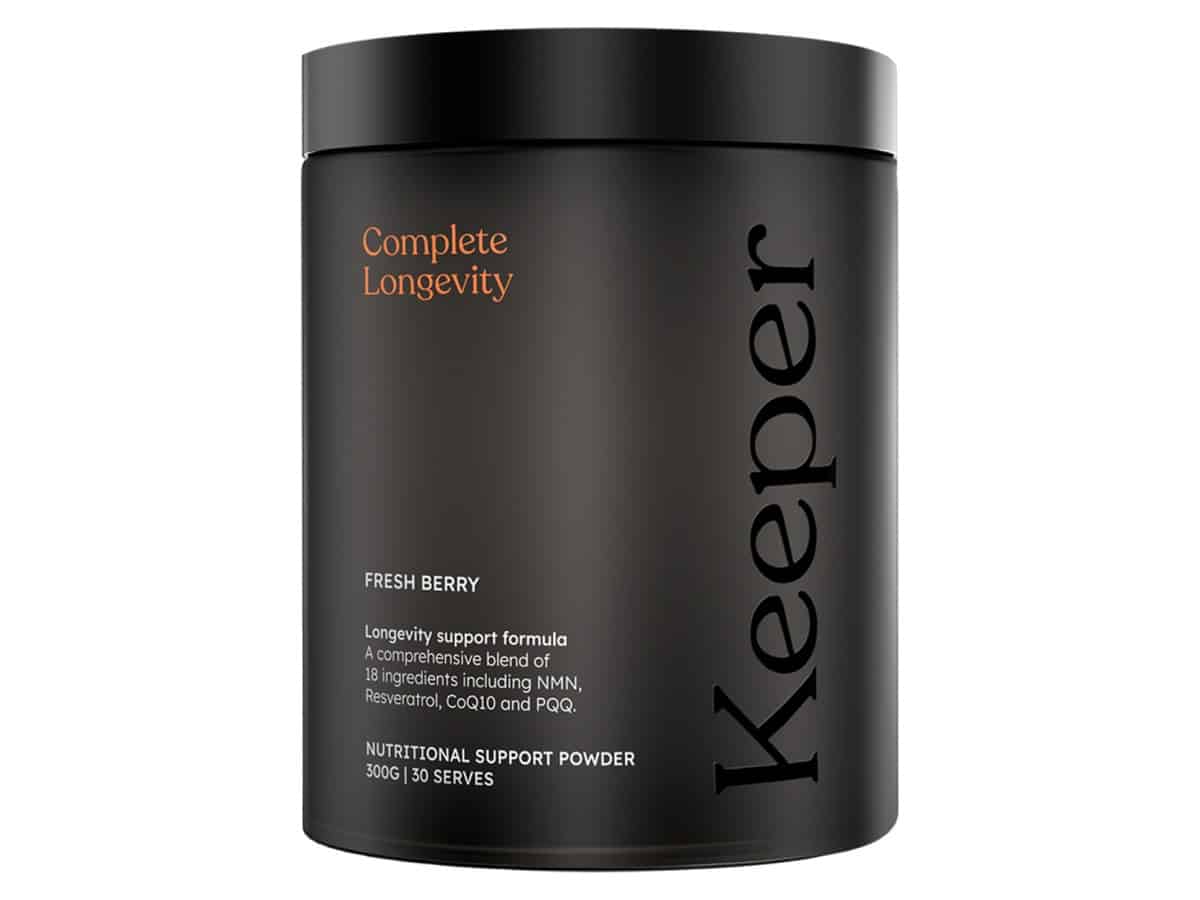
The flagship is the product around which the brand’s entire pricing argument is built. One 10 g scoop of fresh berry powder a day delivers 18 actives, headlined by the NAD+ precursors NMN and NR, alongside resveratrol, spermidine, fisetin, apigenin, CoQ10, PQQ, and Ca-AKG. This is the formulation Keeper compared against 54 single-ingredient equivalents to arrive at its $325.20 monthly figure. A travel sachet format costs $10 more than the tub.
- Price: $99 for the tub, $109 for travel sachets, RRP AUD
- Format: 300 g powder, 30 serves, one daily scoop
- Flavour: Fresh Berry
- Actives: 18, including NMN, NR, resveratrol, spermidine, fisetin, apigenin, CoQ10, PQQ and Ca-AKG
- Testing: Every batch tested by Eurofins for active content, contaminants and microbiological safety
- Ships from: New Zealand
Keeper Health Body Boost
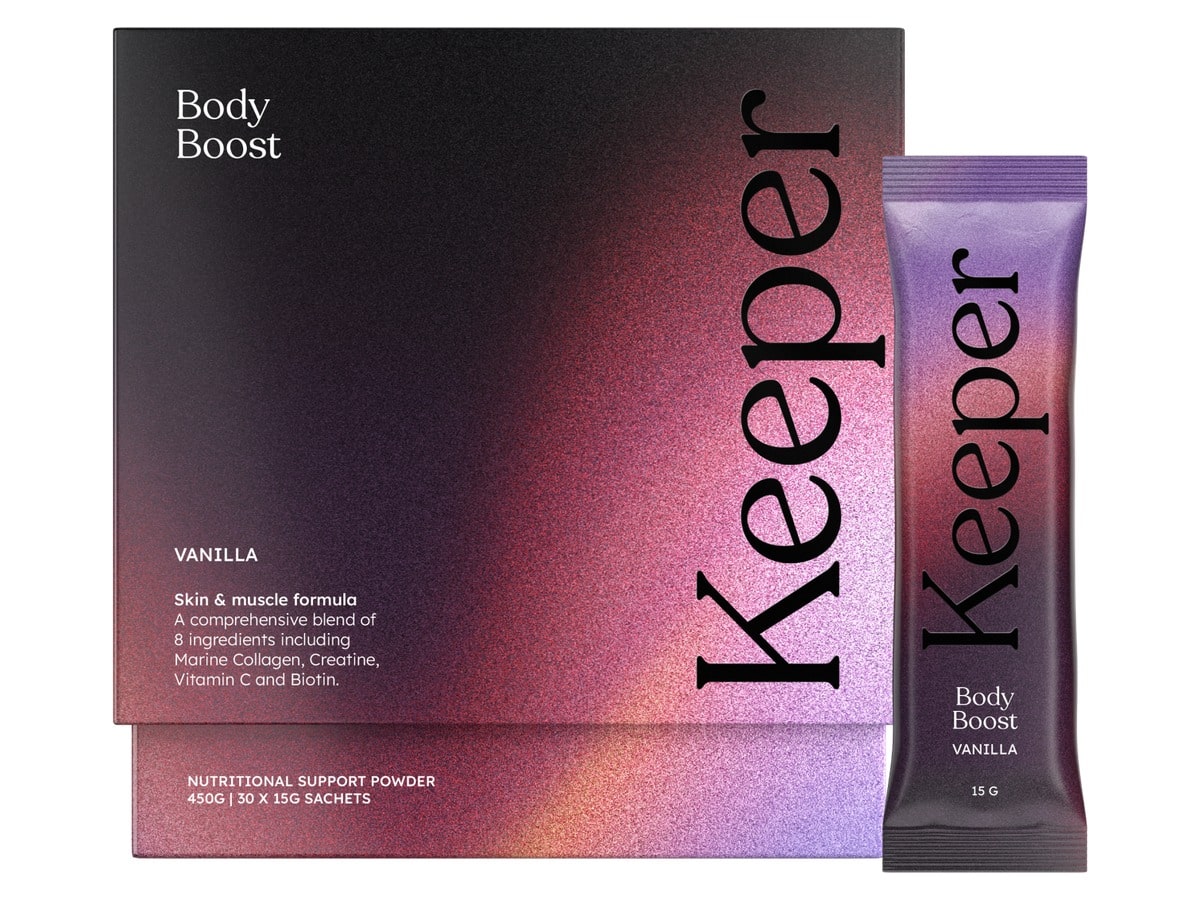
The skin, hair and muscle formulation is the only one in the range that comes as single-serve sachets rather than a tub. Each 15 g vanilla sachet carries 5 g of Type I marine collagen and 5 g of creatine monohydrate, plus HMB, D-ribose, hyaluronic acid, vitamin C, zinc and biotin. Eight actives make it the shortest ingredient list Keeper sells, and the most conventional.
- Price: $99, RRP AUD
- Format: 30 sachets of 15 g, 450 g total, 30 serves
- Flavour: Vanilla
- Actives: 8: marine collagen (Type I, from fish) 5 g, creatine monohydrate 5 g, HMB 1,000 mg, D-ribose 500 mg, vitamin C 250 mg, hyaluronic acid 150 mg, zinc 20 mg, biotin 1,000 mcg
- Allergens: Contains fish. Processed in a facility that also handles milk, soy, wheat and egg
- Ships from: New Zealand
Keeper Health Good Gut
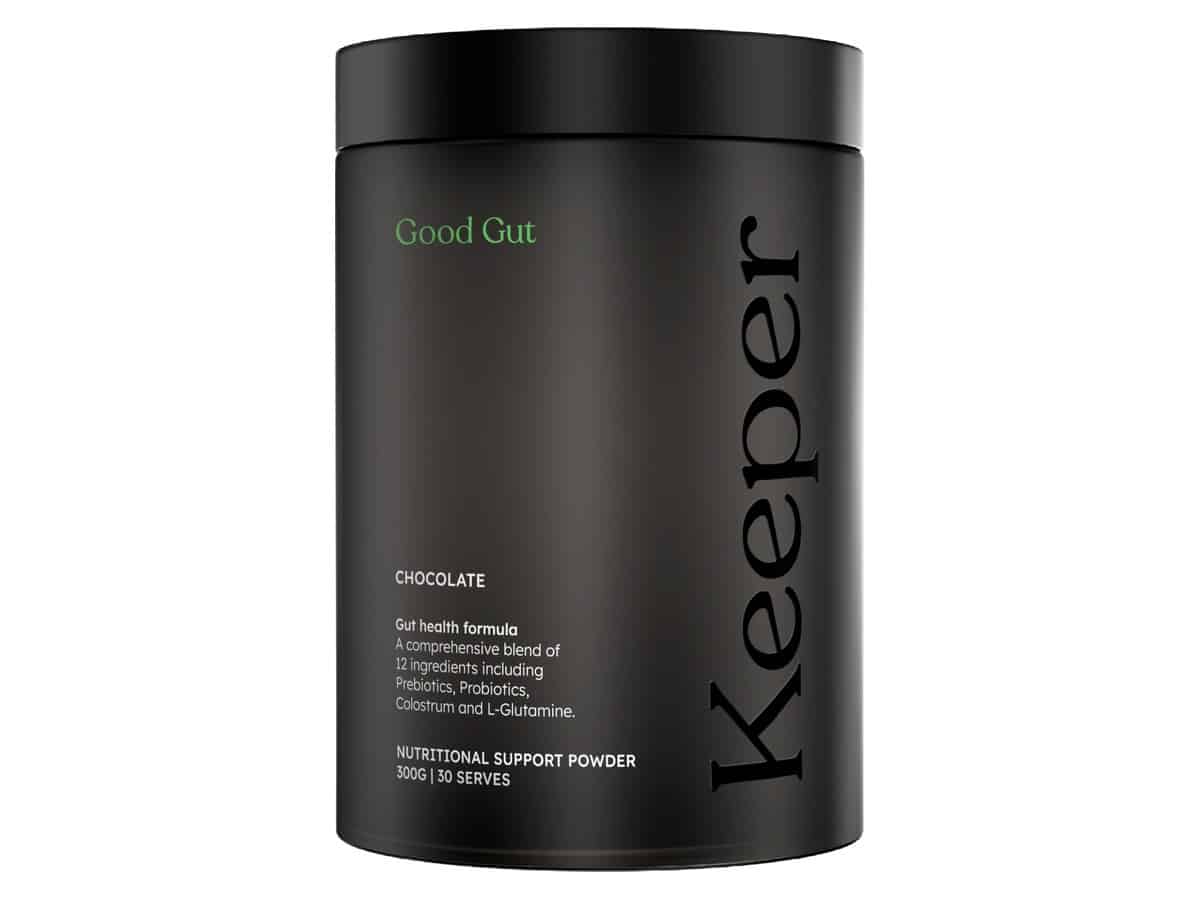
The gut formulation is the most crowded corner of the supplement aisle. A 10 g chocolate scoop contains 12 actives, built around 2,500 mg of bovine colostrum and 1,500 mg of L-glutamine, with prebiotic fibres in pectin, inulin and slippery elm, and two probiotic strains, including Akkermansia muciniphila, which has drawn significant research interest over the past few years. For a sense of how this corner of the market performs day to day, our Ferm Wellness GUT+ Digest review covers a single-product Australian rival.
- Price: $79, RRP AUD
- Format: 300 g powder, 30 serves, one 10 g scoop
- Flavour: Chocolate
- Actives: 12: colostrum (bovine) 2,500 mg, L-glutamine 1,500 mg, pectin 1,000 mg, slippery elm bark 650 mg, inulin 600 mg, ginger root 500 mg, marshmallow root 500 mg, Akkermansia muciniphila 500 million AFU, Bacillus coagulans 1.2 billion CFU, quercetin 50 mg, zinc L-carnosine 10 mg, aloe vera 2.5 mg
- Allergens: Contains milk, from the bovine colostrum
- Ships from: New Zealand
Keeper Health Daily Reset
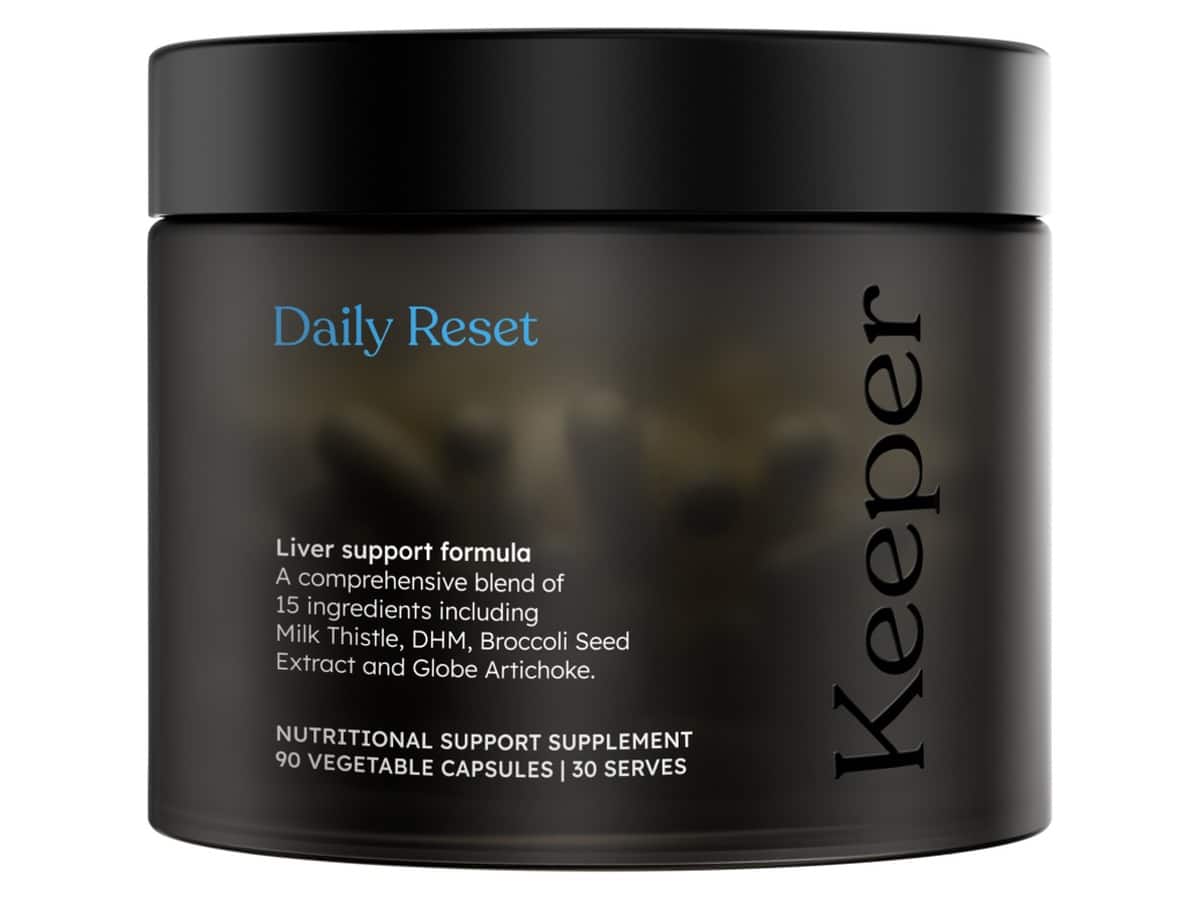
The only capsule product in the range and the cheapest thing Keeper sells. Three vegetable capsules a day deliver 15 actives aimed at liver support and the body’s own detoxification pathways: taurine, milk thistle, broccoli seed extract standardised to 10 per cent glucoraphanin, globe artichoke, DHM, and a full activated B complex with folate as 5-MTHF.
- Price: $69, RRP AUD
- Format: 90 vegetable capsules, 3 per serve, 30 serves
- Actives: 15: taurine 500 mg, milk thistle 300 mg, broccoli seed extract (10% glucoraphanin) 250 mg, globe artichoke 200 mg, DHM 200 mg, vitamin C 100 mg, mustard seed extract 15 mg, vitamins B1, B2, B3, B5, B6 and B12, folate (5-MTHF) 300 mcg, selenium 50 mcg
- Ships from: New Zealand
All four are also sold together as the Keeper Starter Kit, which bundles the range at $315.35 against $346 bought separately.
Disclosure: Man of Many received product samples prior to this interview. No payment was exchanged, and Keeper had no approval rights over this article.























Comments
We love hearing from you. or to leave a comment.