

Updated:
Readtime: 8 min
Every product is carefully selected by our editors and experts. If you buy from a link, we may earn a commission. Learn more. For more information on how we test products, click here.
Australian men are undergoing a massive shift in how they view themselves, but it’s coming at a cost, according to the inaugural Man of Many Male Confidence Index, with Gen Z rewriting the rulebook on emotional openness, while Gen X is staring down a midlife ‘confidence cliff’ and Millennials find themselves in the ‘Goldilocks zone’.
The Male Confidence Index, a scientific study conducted by Man of Many in conjunction with Fifth Quadrant research, surveyed 2001 Australians aged 18-64 about their confidence in five key areas; finance and career, health and wellbeing, relationships and belonging, identity and societal role, and self-perception and life direction.
The results were stark, showing a national baseline confidence score of 63/100, but significant fluctuations across age and gender groupings.
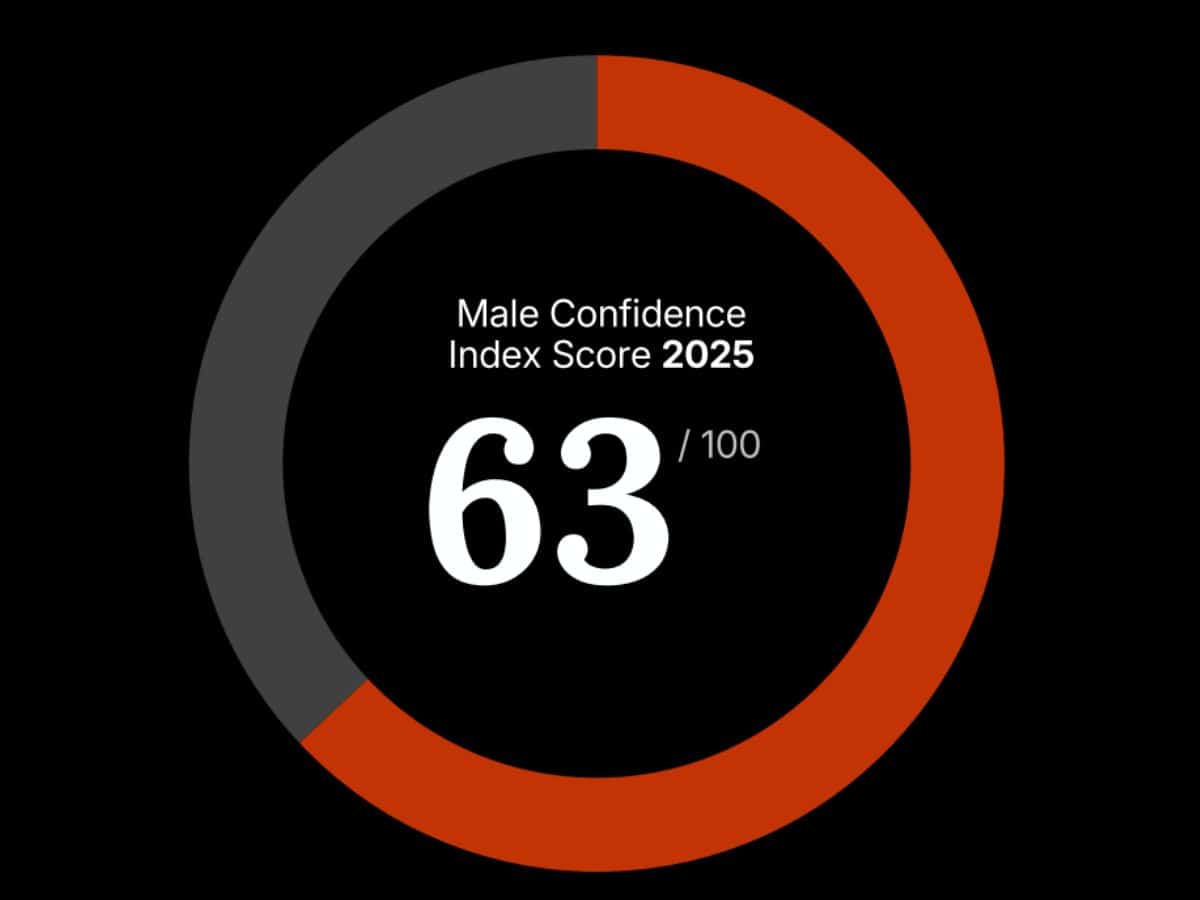
“Sixty-three is not a disastrous score, but it’s not exactly where we want to be either,” says Nick Rassool from Fifth Quadrant. “Think of it as if you were to wake up in the morning and your mobile phone is immediately on a 63% battery.”
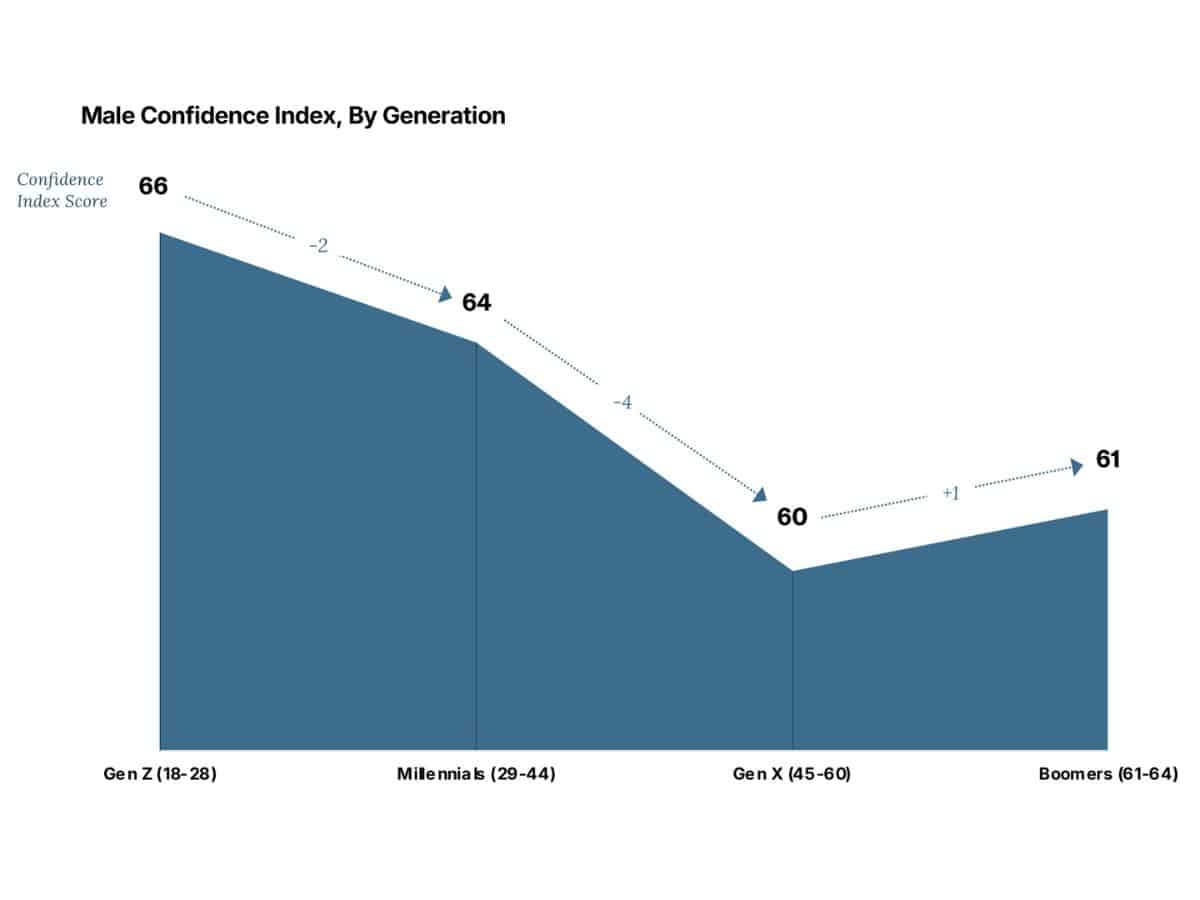
Beneath this baseline score sits a generational curve: Gen Z men scored 66/100, declining steadily through Millennials (64/100) to reach a midlife low among Gen X (60/100), before edging up slightly among Baby Boomers (61/100).
The results indicate that only 19% of men could be considered ‘thriving’, while 45% are ‘holding steady’. That means 36% are either in the process of building stability (22%) or are facing challenges (14%).
Carly Dober, principal psychologist at Enriching Lives Psychology, says confidence is a crucial attribute for men trying to make their way through an increasingly complex – and often isolating – world.
“Confidence is simply an innate belief in yourself or your abilities, thinking that you are potentially a good person, a good friend, a good partner, skilled at what you do,” she told Man of Many. “When people experience low self-confidence, it can be a cause and consequence of many mental health-related issues.”
The mid-life confidence cliff
Perhaps the most stark result to come from the Male Confidence Index is the “mid-life confidence cliff”, which shows a clear turning point in men’s confidence across all life domains, reaching its lowest point among Gen X men.
The result shows a quieter contraction in confidence, rather than a sudden collapse, but indicates that Gen X men are facing unique challenges when it comes to their own wellbeing that extend beyond the standard burdens of middle age.
“For Gen X men, yes they do have responsibilities; mortgages, kids, school fees, ageing parents, careers that are plateauing. Those are all very real issues. However, these are issues also for millennials. So it’s not just a life stage thing here,” said Rassool.
The survey showed the largest gaps appear when it comes to resolving conflicts and expressing personal needs, something that Gen X men were never really trained to do, Rassool says.
“Gen X men grew up in the eighties. Emotional openness wasn’t necessarily as big a thing back then. You didn’t talk about your feelings. You didn’t ask for help. You just got on with things. Now, your boss might want you to be open about your feelings in team meetings. Your partner might want you to be vulnerable. Your kids expect emotional availability, but Gen X men are sitting there going, ‘I’ve just not been trained for this’.”

Dad 2.0: Rise of the emotionally available father
However, the Index also points to a potential ‘redemption arc’ for Gen X men, who are choosing to be more emotionally open with their children. Gen Z men, who are most likely to have Gen X parents, report the highest overall confidence (66/100) and are reshaping what strength looks like. Sixty per cent feel comfortable showing vulnerability, 57% can express their identity without fear of judgment, and 51% speak openly about issues affecting men. These figures are significantly higher than older generations.
The research shows 64% of Gen Z men say they felt able to express emotions openly with their fathers growing up, compared to just 30% of Gen X men, suggesting a broader change in how confidence, care and connection are being shaped in everyday life across the generations.
Similarly, 64% of Gen Z men said their upbringing helped shape their confidence positively, compared to 51% of Gen X. According to the study’s authors, this presents a unique snapshot of the ways Gen X men were raised, and how they are choosing to parent their own children.
“Why are Gen X fathers parenting differently? It’s because they know the consequences,” said Rassool. “They know what it cost them. They grew up without the emotional connection and now they’re feeling the consequences: low confidence and inability to ask for help, struggling to show vulnerability, and they don’t want that for their sons,” said Rassool.

The Millennial trap: Comfortable, for now
Despite facing many of the same challenges in terms of work and careers, Millennial men are faring better than Gen X men on most measures, but that doesn’t mean things will always be easy for them.
“If there’s a concern for millennials, it’s complacency”, said Rassool. “While they’re feeling comfortable at the moment, they’re in the middle of the road. As they age into that Gen X bracket, will they also fall off the same midlife cliff or do they already have the skills that they’ve built up over time to navigate challenges in mid-life?”
Dober says many Millennial men are at a tipping point when it comes to their futures.
“The generational agreement was that future generations have it better than previous generations, right? Australia is a nation where we try to look after our young, but Millennials were the last generation to just creep in, where elder Millennials often have it better than their parents, but younger Millennials don’t. And successive generations after that are worse off than their parents and grandparents across many key measures.”

Gen Z confidence “built on quicksand”
Despite having the strongest overall score across the generations, Gen Z men face their own challenges when it comes to wellbeing, with the highest reported scores of anxiety, alongside higher levels of confidence.
“On paper, across all the different domains that we assess, Gen Z are killing it”, said Sam Antrobus from Fifth Quadrant. “From relationships and wider societal belonging, mental health, financial confidence, they’re doing really well.
“But there’s a catch, and that is that they’re the most anxious generation. And the reason for that is that they’re spending so much time online.”
Thirty seven per cent of Gen Z men spend over two hours daily on social media and 55% of these heavy users say it boosts their day-to-day confidence. However, these same users are significantly more likely to compare themselves to others (66% vs 47% of light users), feel body image insecurity (58% vs 72%) and worry about being ‘cancelled’ (55% vs 48%).
Heavy social media users also report lower confidence in managing emotions (49% vs 68%), recovering from setbacks (52% vs 68%) and asking for help when needed (47% vs 56%), suggesting digital confidence doesn’t extend evenly across all areas of wellbeing.
The research shows 78% of Gen Z men agree that some male influencers promote unrealistic expectations, with creators and influencers (53%) cited more often than any other source as shaping how younger men think about masculinity.
Gen Z men are getting “constant feedback on everything”, said Antrobus, and it’s showing up in the form of higher anxiety. This digital feedback loop is driving a search for an ‘off switch’: nearly half of Gen Z men (48%) report using recreational drugs to manage stress, while Millennials are more likely to turn to alcohol (49%).
“ constantly feeding a culture of comparison,” said Antrobus. “Gen Z are more in touch with their emotions, but there’s this balancing act because there’s the fragility around the anxiety that they’re getting from this online life that they’re leading.”
“We can think of Gen Z’s confidence as built on quicksand. So it feels good in the moment, but it’s not solid. And yes, they have the highest score overall for confidence, but it’s also the most fragile”.
Dober said the study highlights the need for more government support for mental health services, especially those targeting men, which can give them the tools they need to grow and mature over time.
“Social confidence is a trait that can be increased. For those who are finding it impacting their mental health, they need to be accessing evidence-based public care and not putting it off because they can’t afford it or because they can’t find someone. I don’t think that’s good enough and again, when men are struggling, I think something has to be done.”
Whether it’s a policy shift or a personal one, the Index makes one thing clear: the old ways of ‘just getting on with it’ are no longer enough to keep the battery charged.



























Comments
We love hearing from you. or to leave a comment.