

Updated:
Readtime: 8 min
Every product is carefully selected by our editors and experts. If you buy from a link, we may earn a commission. Learn more. For more information on how we test products, click here.
- TUDOR built its first dedicated manufacturing facility in Le Locle, Switzerland.
- The 5,500-square-meter hub employs 150 specialists for highly efficient watch assembly.
- Watchmakers work in autonomous four-person cells rather than static assembly lines.
- The brand maintains no backstock, with every assembled watch already allocated.
- A dedicated METAS testing room ensures strict precision and anti-magnetic standards.
- The connected Kenissi facility uses RFID tags to track movement production.
By day three of Watches and Wonders 2026, the artificial lights and endless carpet of the convention centre had done their damage to my system. It could have been the severe sleep schedule, the endless glasses of Veuve Champagne, or the ominous-looking bowl of cured Mackerel that I had for lunch on Tuesday, too. So when the chance came to jump on a bus heading north to the Jura Mountains with a handful of die-hard TUDOR collectors, I didn’t hesitate.
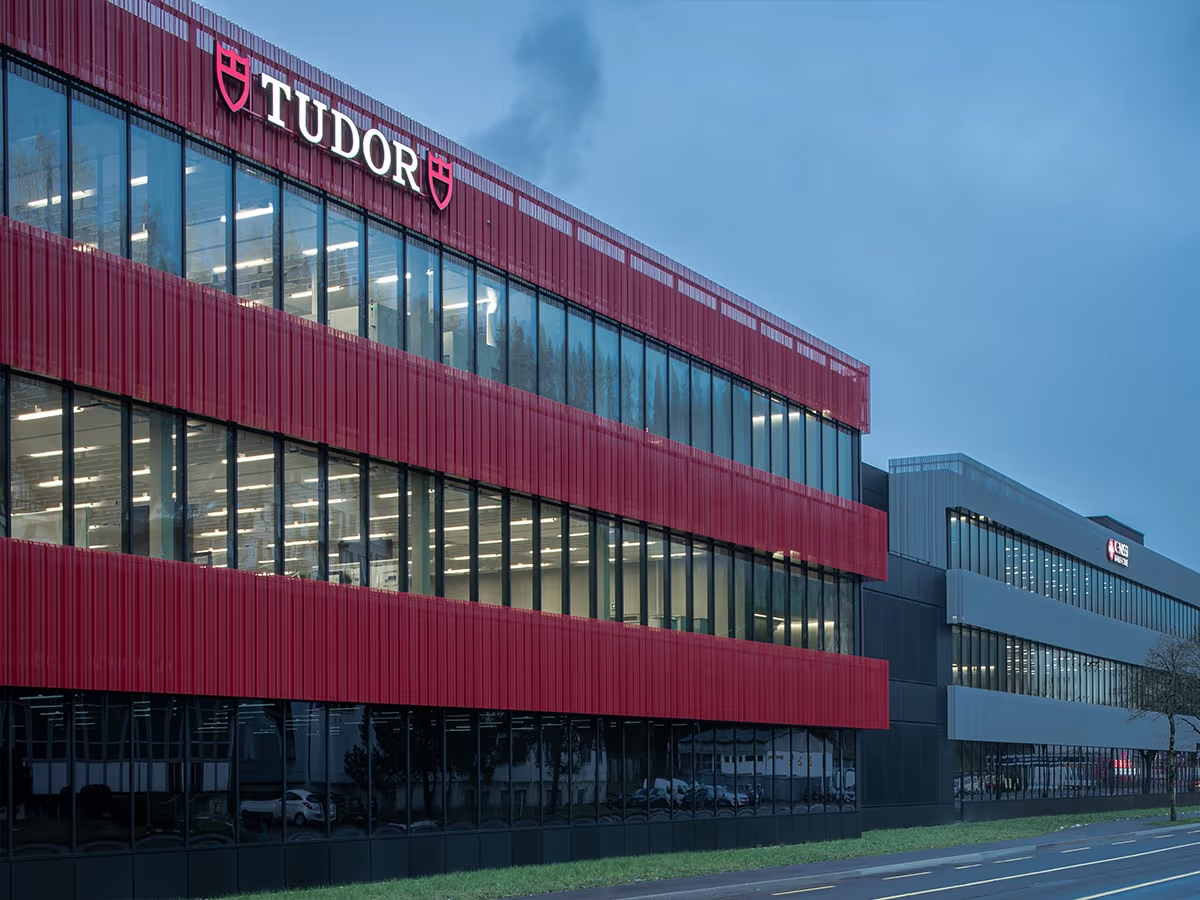
Our destination was the Canton of Neuchâtel in the Jura Mountains, specifically the town of Le Locle, to get a firsthand look at TUDOR’s first fully dedicated industrial facility in its nearly 100-year history.
Le Locle is a quiet town of about 10,000 people, but its horological footprint is highly regarded. The region, including the neighbouring town of La Chaux-de-Fonds, has been a UNESCO World Heritage site for nearly two decades. It pivoted from agriculture to watchmaking back in the 1800s, and the dedication to the craft runs so deep that, after historical fires destroyed much of the town, it was rebuilt with parallel streets that combined workshops and residential housing purely to maximise watchmaking efficiency.
TUDOR’s parent group already owned undeveloped industrial land right next to a heritage Rolex facility inaugurated 50 years ago, making it the logical site for this new manufacture. Construction began in 2018 with the goal of moving assembly out of Geneva and closer to their suppliers in the Jura Mountains. With three years of work, the 5,500-square-meter, five-level facility was completed in 2021. Layered entirely in TUDOR red, it’s a serious structure that puts 150 specialists under one roof and bridges the gap between highly automated manufacturing and traditional bench watchmaking. Most importantly, it leaves you with an understanding of how and why TUDOR’s watches are accessible yet offer such high levels of precision.
| Detail | |
| Location | Le Locle, Switzerland (Jura Mountains) |
| Facility Size | 5,500 square meters (completed 2021) |
| Workforce | 150 specialists under one roof |
| Assembly Style | Autonomous four-person cross-trained cells |
| Movement Partner | Kenissi (physically connected facility) |
| Key Certification | METAS Master Chronometer (on-site testing) |
 1/13
1/13The Assembly Floor
Our first stop was the TUDOR assembly line. Here, the watchmakers assemble the watches by hand in an environment designed to mitigate dust ingress thanks to an HVAC system that maintains a continuous flow of positive air pressure from the ceiling to the floor.
The main takeaway for me here was that, unlike many legacy manufacturers, TUDOR doesn’t maintain a vault full of assembled backstock.
Every watch from the line is already allocated and destined for a client’s wrist shortly after completion. This requires a flexible floor, which the brand achieves by organising its watchmakers into autonomous cells rather than a long, static assembly line. Having spent some time in car manufacturing at Lamborghini, it shares more than a few things in common here regarding how parts are picked and sent down the assembly line, minus the giant, vaulted robot we couldn’t photograph.
Once the parts have been picked, teams of four watchmakers work at identical, ergonomically optimised benches. Here, the cells handle three specific steps in chronological order: dial fitting, hand fitting, and casing. Watchmakers are cross-trained so any single cell on the floor can assemble any reference from the Black Bay, Pelagos, Glamour, or 1926 collections.
 1/14
1/14Testing and Certification
Once watches are assembled by the watchmaker, every watch passes TUDOR Performance Control, which dictates that fully assembled watches equipped with a Manufacture Calibre run at an accuracy of (-2/+4) seconds per day, while those with third-party calibres must hit (-4/+6).
This was the most impressive element of the tour for me. While the watches don’t appear to be as “handmade” as those from other brands (in the sense that the metal isn’t turned in the same building as the watches are assembled), this is the only way that TUDOR can sell such a high-quality watch to the consumer at such an affordable price. If they were making these watches the way they were decades ago, they would cost $20,000 or more.
It’s clear the brand is focused on accuracy, doubling down with METAS Master Chronometer certification for this year. Securing this certification requires the movement to be Swiss Made and COSC certified, after which METAS (Federal Institute of Metrology) demands an incredibly strict set of parameters:
- Precision: The watch must run within a 5-second variance per day (0/+5).
- Anti-Magnetism: Timekeeping must remain accurate even when exposed to 15,000 gauss.
- Waterproofness: Hyperbaric water tanks are used to verify that the case meets ISO standards.
- Power Reserve: The brand’s claimed autonomy is thoroughly verified.
So important is this process to TUDOR that the brand has a room dedicated to housing a representative from the Swiss government’s national metrology institute in the same room they test the watches.

The Kenissi Integration
Our tour concluded in the Kenissi facility, which is physically and visually connected to TUDOR. Like I mentioned, this is TUDOR’s movement production arm, established in 2010 to build industrial capacity for high-performance calibres, and it debuted its first movement at Baselworld in 2015.
While it supplies TUDOR, it has also quietly become an industry powerhouse, forming alliances with Chanel and supplying calibres to Breitling, Norqain, Fortis, TAG Heuer, Bell & Ross, and Ultramarine.
Walking into the Kenissi production room, it mirrors the TUDOR assembly line, but with a slight Silicon Valley tech-hub feel. You can tell they’re not too fussed about the beauty of the manufacturing process, looking for efficiencies at every stage to create the best movement they can afford to make. One example is the RFID-TAG system that the brand uses to manage the sheer volume and complexity of production.
- Every mainplate is mounted to a specific insert that is embedded with an RFID tag.
- These tags route the calibres down the line, ensuring total traceability.
- The system collects assembly data, allowing engineers to analyse and tweak the production.
Once a movement completes its journey and passes a fully automated test cycle on the line, it’s boxed up and sent out to the Official Swiss Chronometer Testing Institute (COSC) before returning to TUDOR for assembly.

Our Main Takeaway
Riding the bus back down the mountains, it was obvious that this facility is a statement of intent.
When Hans Wilsdorf founded Montres TUDOR SA in 1946 the goal was to deliver the reliability of a Rolex at a more accessible price. Taking total control of their movement production and building a highly modernised assembly floor proves they’re actively engineering that idea for the next century of watchmaking.
It’s true that there are more beautiful manufacturers to visit, but I walked away from this with an appreciation for the sheer amount of watch you’re getting for the price.























Comments
We love hearing from you. or to leave a comment.