


Updated:
Readtime: 9 min
Every product is carefully selected by our editors and experts. If you buy from a link, we may earn a commission. Learn more. For more information on how we test products, click here.
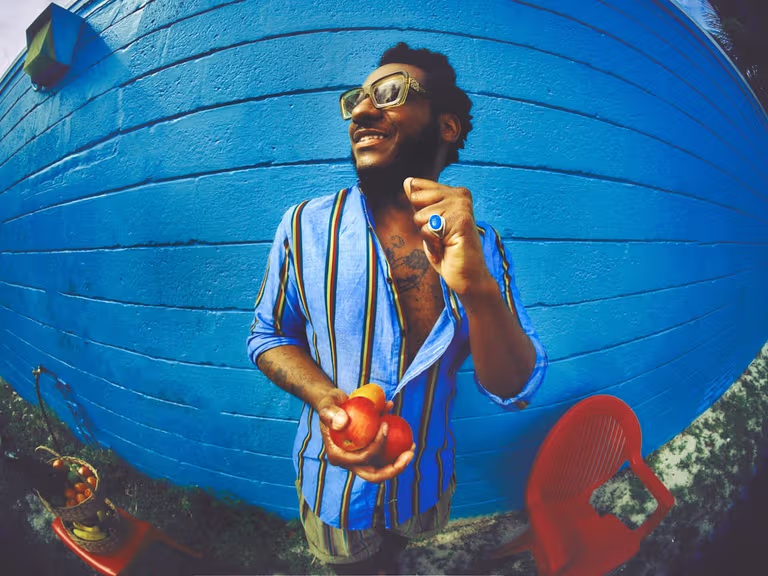
When Kai Lenny paddles out at Nazaré after a long summer, the first thing he asks himself is a fairly straightforward question: Is this even rideable? Is it survivable? Looking at an 80-foot wall of Portuguese water will do that to a person. Then again, the Hawaiian waterman was quite literally named for this environment, his given name translates directly to “ocean” in Hawaiian. Kai is the youngest person ever inducted into the Surfers’ Hall of Fame, a seven-time world stand-up paddle champion, and the winner of the 2020 Nazaré Tow Surfing Challenge. His track record in heavy water is unmatched. But even with that resume, entering a lineup like this requires a total mental reset. Once he gets his first wave under his belt and watches a few other guys survive the drop, the panic recedes, and the calculus changes from sheer survival to performance.
Speaking with Kai over a video interview on his way to his next big break, he’s entirely pragmatic about the adrenaline. Rather than trying to fight the fear or let it freeze him, he uses that baseline nervous system spike to extract a level of focus you simply cannot replicate in a standard gym. Operating on a razor’s edge forces the brain to speed up to match the water’s velocity. The result is a massive distortion of time. What is actually a 10-to-12-second ride stretches out to feel like a full, gruelling minute.
“Your brain is so focused, and in such a primal state that it’s processing all this information so quickly, it feels like an eternity when you drop into these waves,” Lenny says. “You’re like, will I ever get to the bottom? You’re going over this chop, and you see the shadow of the wave coming from behind. It’s really intense, but those are the moments that make you feel the most alive, for sure.”
Reality of the Hold-Down
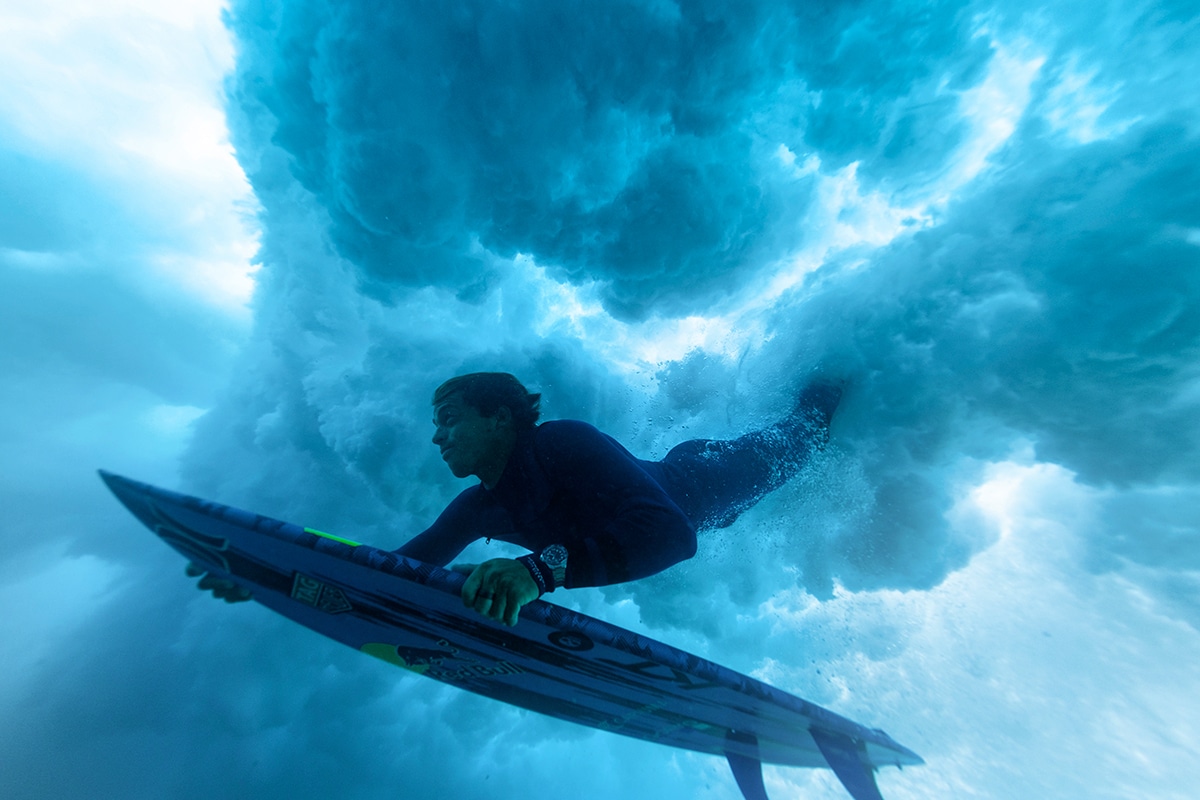
The real test of that psychology happens when the momentum shifts and the wave wins. When a multi-ton lip catches a surfer and drives them into the dark, human instinct screams at you to struggle. Lenny does the exact opposite. He shuts his eyes and goes entirely limp, fully aware that trying to fight an unstoppable force is the quickest way to get tweaked or tear a shoulder out of its socket. Down there, time dilates even further.
“Ten seconds underwater feels like a minute,” Lenny explains. “And then sometimes your hold-downs can be close to a minute, and that feels like 10 minutes. Honestly, it just feels like it’s never going to end. It’s so dark, and I just don’t even open my eyes. I keep them closed. If you try to rush it, you sometimes expend a lot more energy than if you just stay relaxed. Being relaxed is super counter-intuitive for that fight-or-flight sensation that you’re experiencing.”
“All the strings of fear no longer bind me. The objective is clear: Win. Always meant to, and everything will work out the way it’s supposed to.”
That flatline composure is backed by a quiet sense of fatalism. When Lenny prepares for a session, he completely strips away any mental projection of a worst-case scenario. “If you’re going to wipe out, you don’t even want to think about it because you’re like, well, I know what’s going to happen. Why dwell on a possibility? I want to focus on what I want the outcome to be.”
Even with that discipline, the physical toll is brutal. The sheer thrashing can make a surfer feel as if they are actively losing a limb or being thoroughly bruised and beaten up by a monster. Lenny recalls coming up to the surface with his Lycra and heavy neoprene wetsuits completely shredded by the pure friction of the aerated whitewash, left wondering how his body was intact.
Yet, he admits the view from the channel is often worse than being inside the blender yourself. “It’s honestly more scary watching your friend or someone else wipe out because you think to yourself, how could the human body even handle that? When it’s happening to yourself, you’re not seeing what sort of monster is chewing you up. You don’t know sometimes until you see the video later on of how big that wave was.”
Fluid Dynamics and When Surfboards Meet Formula 1
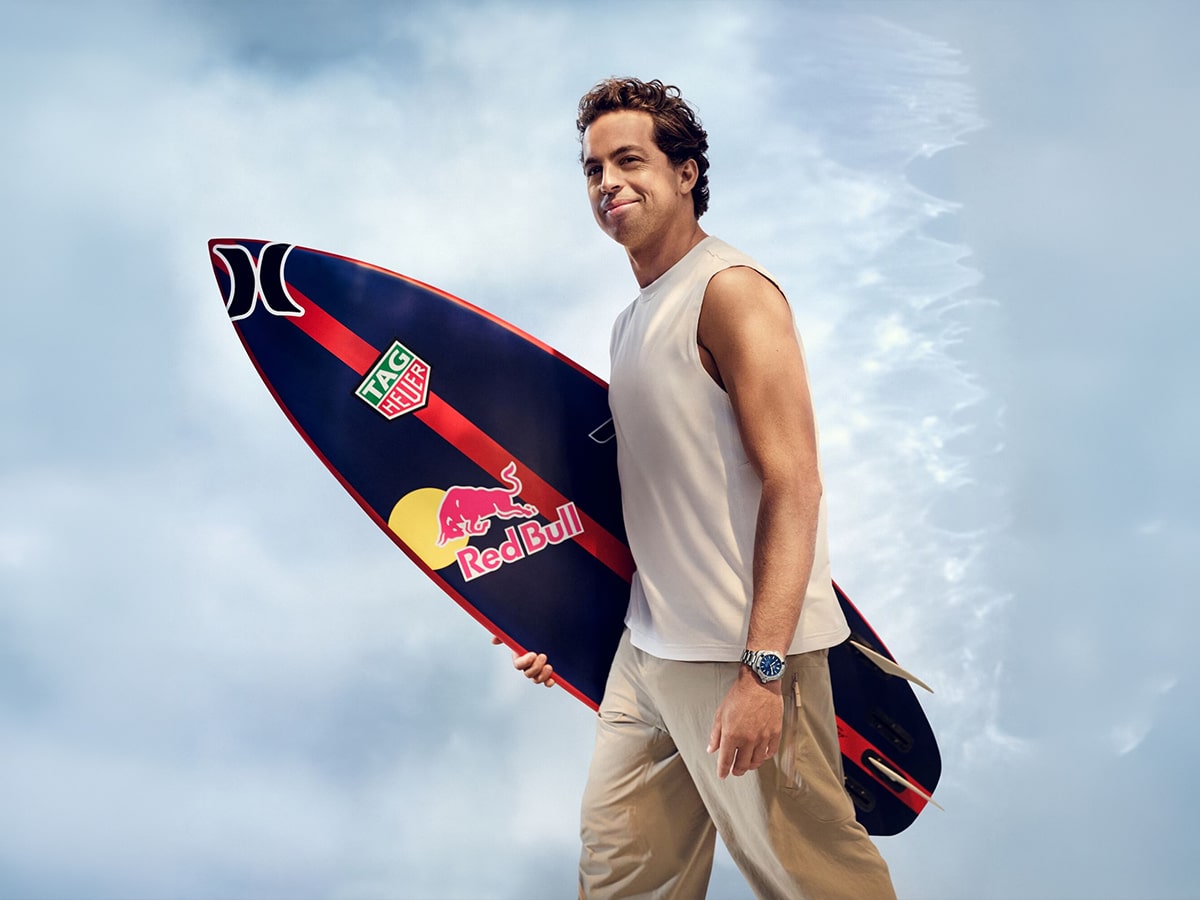
To keep his equipment ahead of those forces, Lenny looks entirely outside the traditional surfing landscape, drawing a direct parallel between high-performance hydrofoils and Formula 1 cars. To him, the two disciplines are chasing the exact same scientific goals, just in different fluids. Both require immense athleticism to command a highly technical piece of hardware that allows a human to do things that would otherwise be impossible.
“I look at Formula 1 as an inspiration because they’re able to spend hundreds of millions of dollars per year on development,” Lenny says. “A lot of the stuff they do for the aerodynamic packages can directly be put into fin foil shape, or hydrofoil shape. Many airfoils are used in underwater hydrodynamic profiles. They’re doing the R&D for the hundreds of millions of dollars, and maybe they find something that can directly work for us and our $500 surfboard.”
This obsession with technical development has allowed Lenny to build a career out of hunting the “grey areas” between established sports. Where others saw limits, he saw transitions. Kitesurfing emerged to bridge the gap between traditional surfing and windsurfing, offering extended flight time and access to more accessible wind conditions. Then came the wing, followed immediately by the foil.
By mounting a hydrofoil to the bottom of a shorter board, Lenny effectively redefined how humans interact with ocean energy. He can now cross vast stretches of open ocean between Hawaiian islands, connecting unbroken swells that traditional surfboards couldn’t even catch.
“You’re riding a McDonald’s tray sometimes downwind, and it’s the most remarkable feeling,” Lenny laughs. “Within surfing, between longboarding, stand-up paddling, and shortboarding, the foil allowed you to surf terrible waves anywhere in the world, but feel like you’re doing something high-performance. That makes it always entertaining because there’s always something around the corner. Just when you think it’s all been sort of invented, something new comes out, and you’ve got to learn it.”
Pure Utility of the TAG Heuer Aquaracer Solargraph
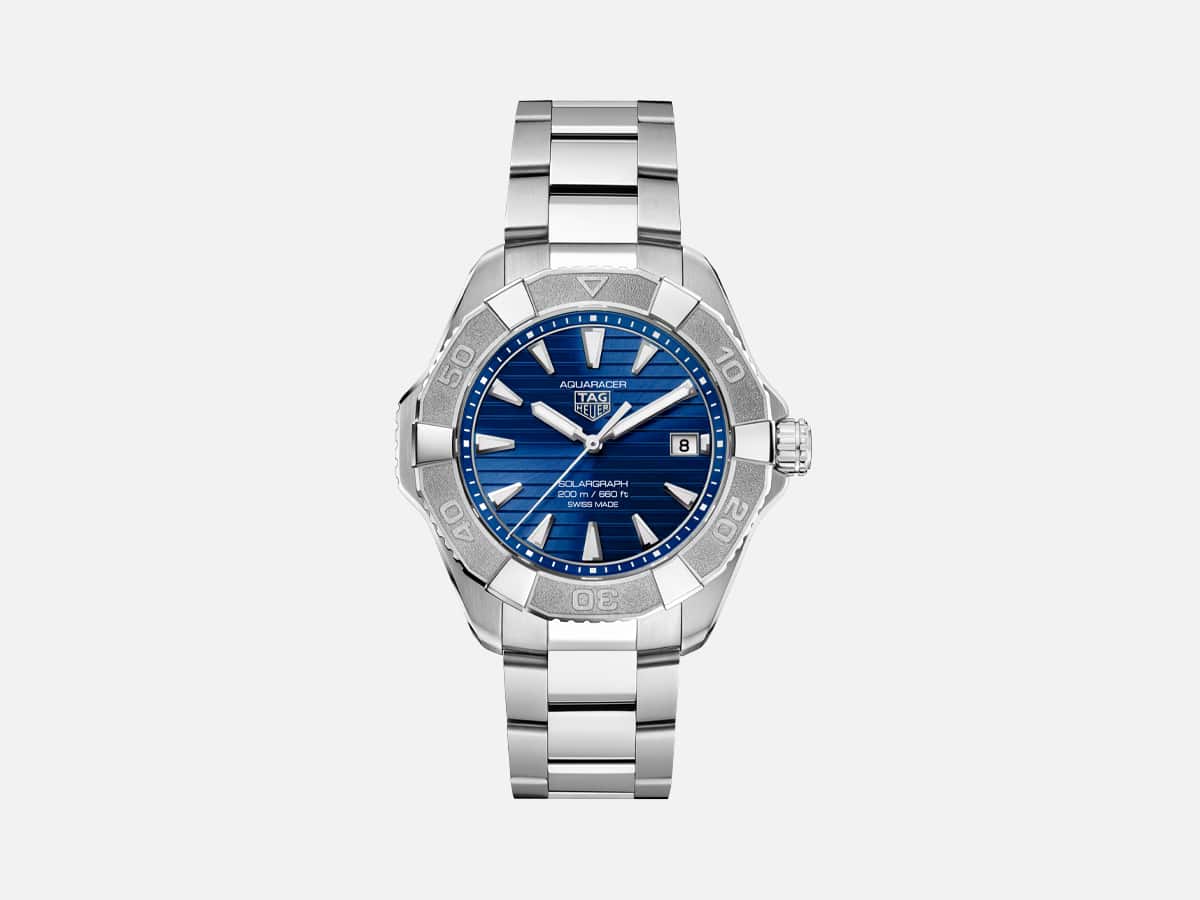
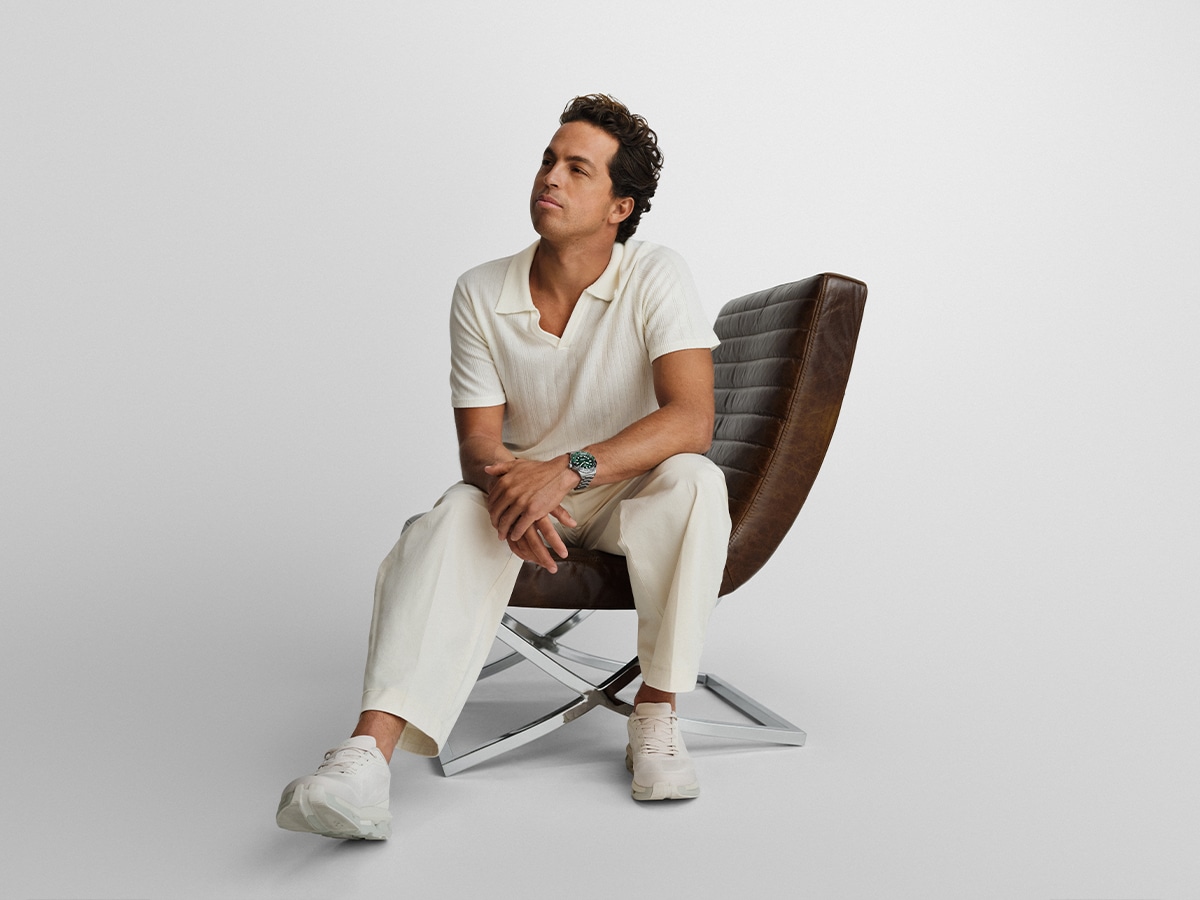
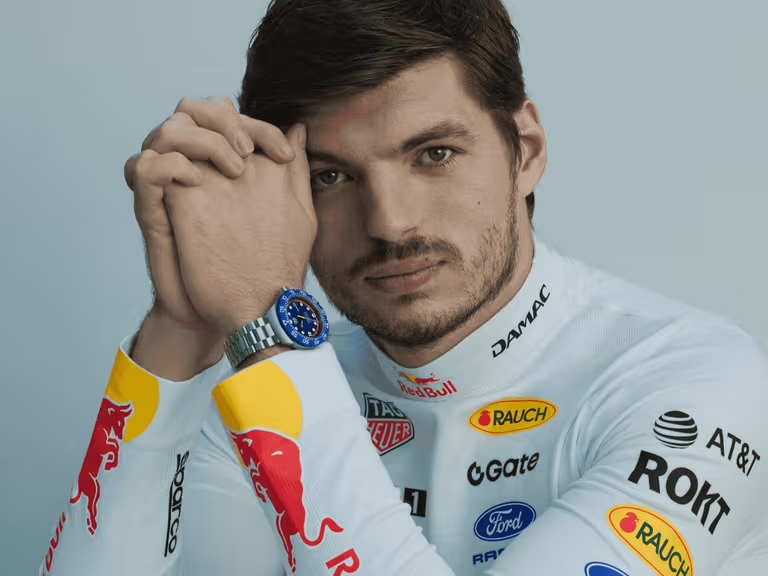
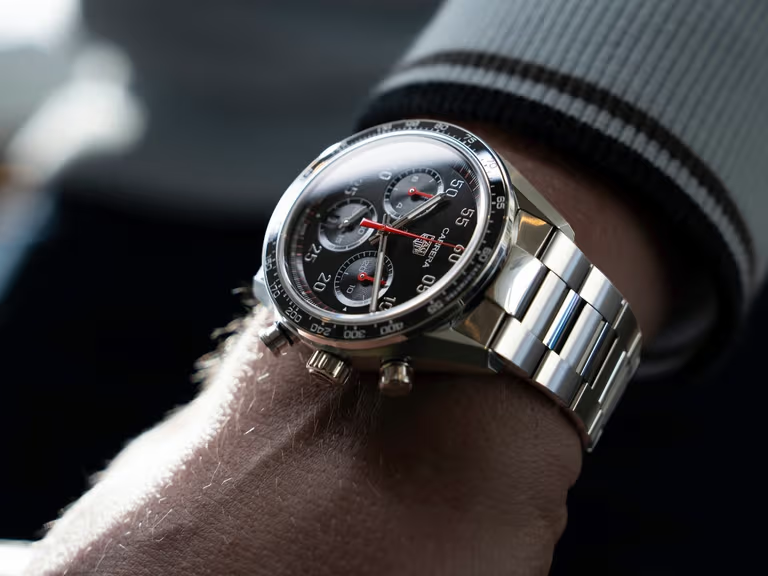
When you are managing a 10-minute mental timeline under thirty feet of churning white water, gear stops being a lifestyle statement and becomes standard-issue safety equipment. It’s the pragmatic foundation of Lenny’s alignment with TAG Heuer, represented on his wrist by the Aquaracer Professional (from AUD$3,850).
In Lenny’s world, hardware either performs or it gets left on the beach. The Solargraph focuses heavily on elemental utility, swapping out the liability of regular battery changes for the solar-powered Calibre TH50-00 quartz movement, developed in close partnership with manufacturer La Joux-Perret. It takes just two minutes of direct sunlight to power the watch for a full day, while a total charge of less than twenty hours keeps the movement running for six months in complete darkness. For a guy who spends his entire life exposed to the elements – frequently paired with a set of TAG Heuer Vingt-Sept sport sunglasses – the watch is completely self-sustaining.
“It’s a performance thing more than it is sort of like a token thing. It’s something that actually makes the product better, rather than just being a hype category. They’re not giving up any durability or strength by doing such things.”
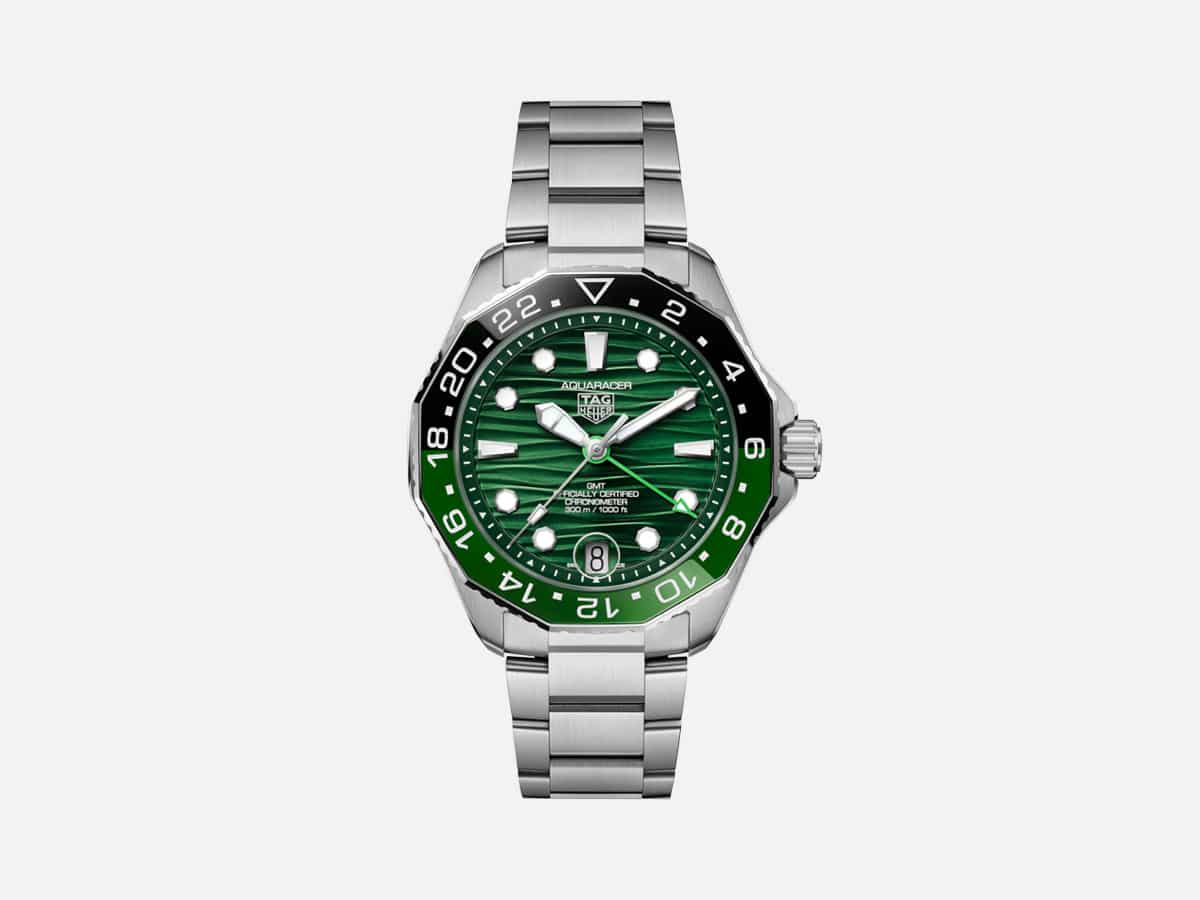
The construction is entirely tailored to high-impact marine environments. The 40mm case is machined from Grade 2 titanium with a heavy, sandblasted finish, striking the ideal balance between extreme tensile strength to withstand massive depth pressure and not adding unnecessary swing-weight to his pop-up. The unidirectional bezel retains the signature Aquaracer rider tabs, giving Lenny enough mechanical leverage to turn the bezel even when wearing thick 3mm neoprene gloves. The polar blue three-row titanium bracelet features a robust folding clasp with a double safety push-button extension system, ensuring it stays locked down during severe thrashing.
Most importantly, the dial design addresses the pitch-black reality of a heavy wipeout. The black sunray-brushed dial is broken up by ice-blue accents, with the hands, indexes, and a central polar-blue lacquer second hand heavily coated in Super-LumiNova. It ensures total, immediate legibility the exact second the lights go out underwater.
Open Ocean as the Next Surfing Frontier
With his gear dialled, Lenny is already looking toward the next logistical challenge. While the world’s most dramatic, photogenic waves break safely against shallow coastlines, he’s looking at thousands of miles of open ocean. To him, the final frontier of big-wave surfing lies in the deep, completely unassisted blue.
“I definitely think it’d be… I have it on a list of goals to do, for sure,” Lenny says of his plans to tackle rogue open-ocean swells. “Out in the middle of these oceans where the swells are 50 feet consistently, if you get a rogue wave that comes together, you have an 80-to-100-foot swell that pops up.”
The logistics of riding those waves are entirely different from standard coastlines. Out there, the swells aren’t hitting reefs and stopping, they’re a continuous chain of moving ocean energy.
“When you ride swells in the open ocean, you’re not riding one continuous swell,” Lenny explains. “You’re riding one, and as soon as that swell kind of dissipates a little bit, it turns into another one. So over a course of a distance, you could ride hundreds of 50-foot waves, more waves than your entire career in one session, possibly. The hydrofoil allows you to maybe do that, whereas in the past it would have been impossible because of the speed at which they’re travelling, the slope that they do have, and also the in-between when the wave isn’t at its highest peak.”
It’s an incredibly hazardous concept – stepping off the back of a commercial cargo ship into the deep ocean void, hundreds of miles away from any jet ski rescue crew. But if anyone is going to pull it off, it’s the man named after the water itself. And when he finally makes that leap, he’ll be checking his left wrist to time exactly how far the ocean takes him.



















Comments
We love hearing from you. or to leave a comment.