


Updated:
Readtime: 10 min
Every product is carefully selected by our editors and experts. If you buy from a link, we may earn a commission. Learn more. For more information on how we test products, click here.
Try as I might, achieving anything approximating a decent sleep at 35,000 feet has always been a rare feat. Diazepam, I respect from a safe distance. Scotch is permanently off the menu thanks to an extended stretch of sobriety.
Which leaves me with the reality faced by anyone who often crosses the planet from Australia: even the best seat in the house can still feel like a battle with gravity, noise, and inevitable in-flight movie brain jam.
For decades, premium aviation revolved around a remarkably simple promise: give the passenger a bit more legroom, a slightly better cut of beef, and a seat that reclines. First class was the final frontier, the ultimate expression of physical comfort above the clouds.
Yet in 2026, a profound shift has occurred. Today’s most ambitious airlines are no longer simply designing better hardware. They are engineering total ecosystems – enclosed suites, dedicated sleeping nooks, and biometric wellness rituals. The modern first-class cabin is built around a singular, hyper-luxurious premise: that the journey should leave you feeling more restored than when you actually departed. Welcome to the era of the flying sanctuary.
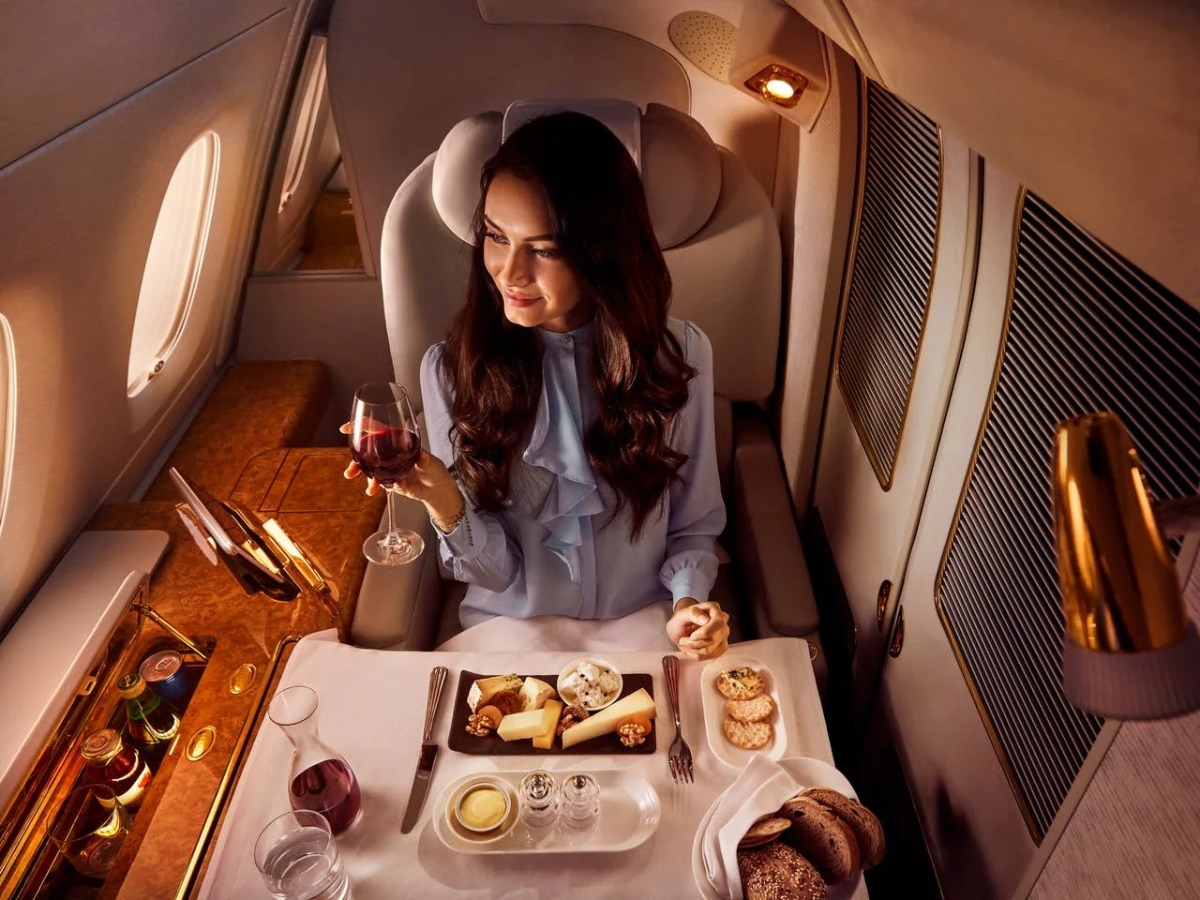
The Architecture of Isolation: Redefining In-Flight Privacy
The most valuable commodity at 35,000 feet is no longer just space, seat-width and a better wine list – it’s total, unadulterated separation.
Borrowing heavily from the playbook of private aviation and ultra-luxury hospitality, today’s first-class cabins have turned privacy into a high-stakes engineering challenge. The goal? Creating an absolute sense of calm, sovereignty, and personal territory inside a metal tube hurtling forward at 900 km/h.
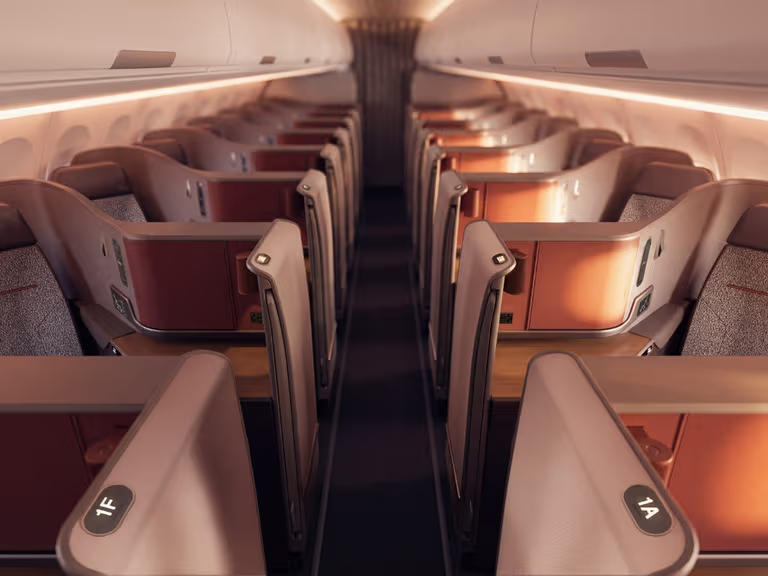
Fully enclosed suites have transformed the traditional first-class seat into something closer to a boutique hotel setup. Sliding doors, high walls, and carefully meticulously controlled sightlines construct a boundary between passenger and aircraft: enclosed domains where one can perhaps forget they’re even on a plane at all.
Airlines now conceptualise the passenger journey as a master architect might – modified lighting to support sleep cycles, hidden-yet-accessible storage, service that anticipates and doesn’t interrupt. The result is a sort of mile-high cocoon designed to insulate passengers from the small frictions that even traditional first-class travel still entails.
Related: Your Guide to Qantas’ Project Sunrise, The World’s Longest Non-Stop Flights
The Pre-Flight and In-Flight ‘Master Routine’ (The Transit Blueprint)
The Pillars of the Sky: 2026 Editor’s Elite Picks
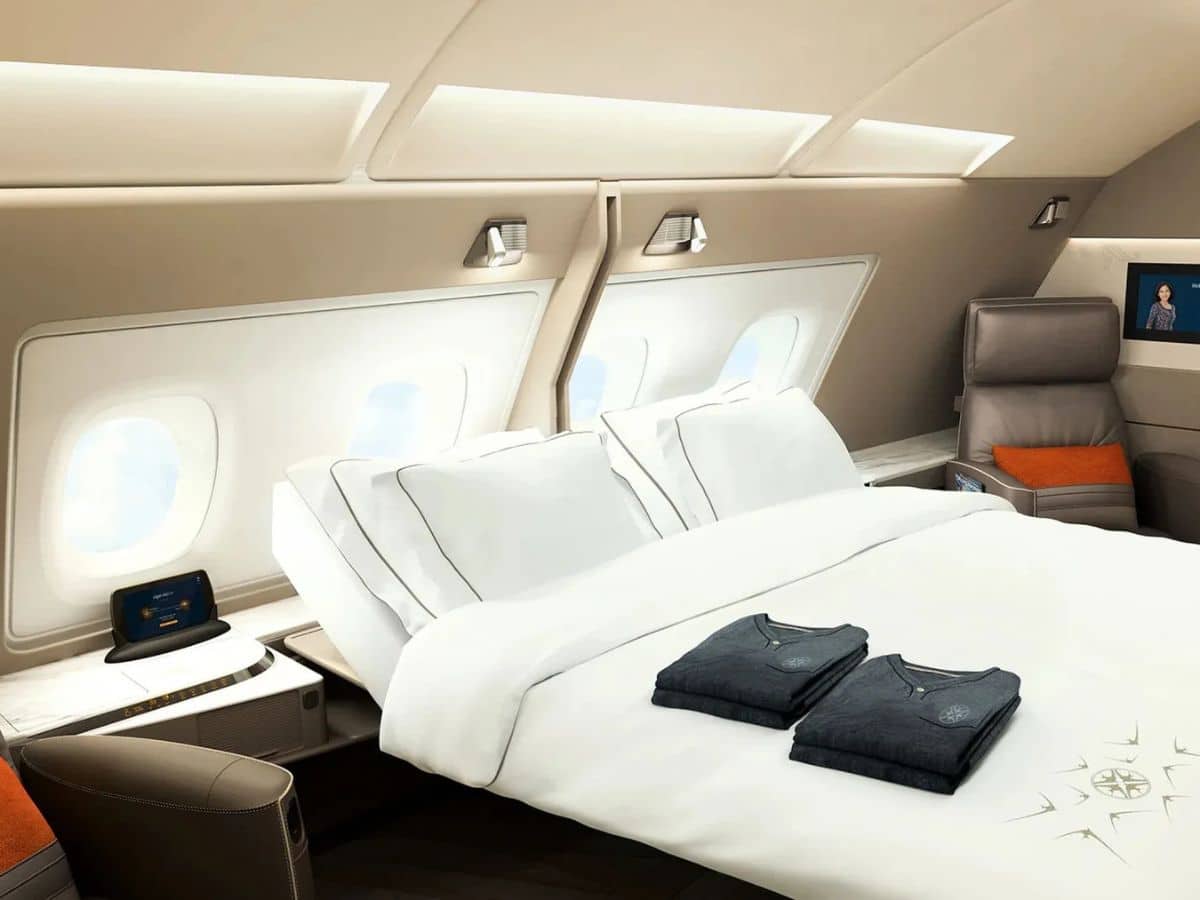
Singapore Airlines: The Benchmark for Architectural Space
Arguably the purist’s choice, Singapore Airlines’ overall standard has always sung with well-earned poise and ease. Its flagship Suites continue to be defined by a smart use of space: a private room that hits all the benchmarks for underrated luxury.
Prioritising separation and functionality, the Suites offer dedicated spaces for dining, lounging, and sleeping – everything has its place and every interaction feels deliberate. This balance creates an ambience of calm that makes any long-haul flight feel considerably shorter than it is.
The separate bed, complete with dedicated mattress topper rather than a converted seat, is a unique highlight.
Singapore Airlines First Class Key Stats
- Price: From ~ USD 9,000 to 18,000+ (routes vary) (approx. AUD 13,000–26,000+)
- Aircraft: Airbus A380-800
- Cabin Layout: 6-suite ultra-premium cabin (Upper Deck)
- Best For: Spatial design, minimalist luxury, and uninterrupted rest
- Stand-Out Feature: Standalone plush bed completely separate from the leather lounge chair (can be converted into a double bed for couples traveling together).
- Cons: Massive variation in experience if an aircraft swap occurs (Suites are strictly exclusive to the A380), no onboard showers, limited route availability.
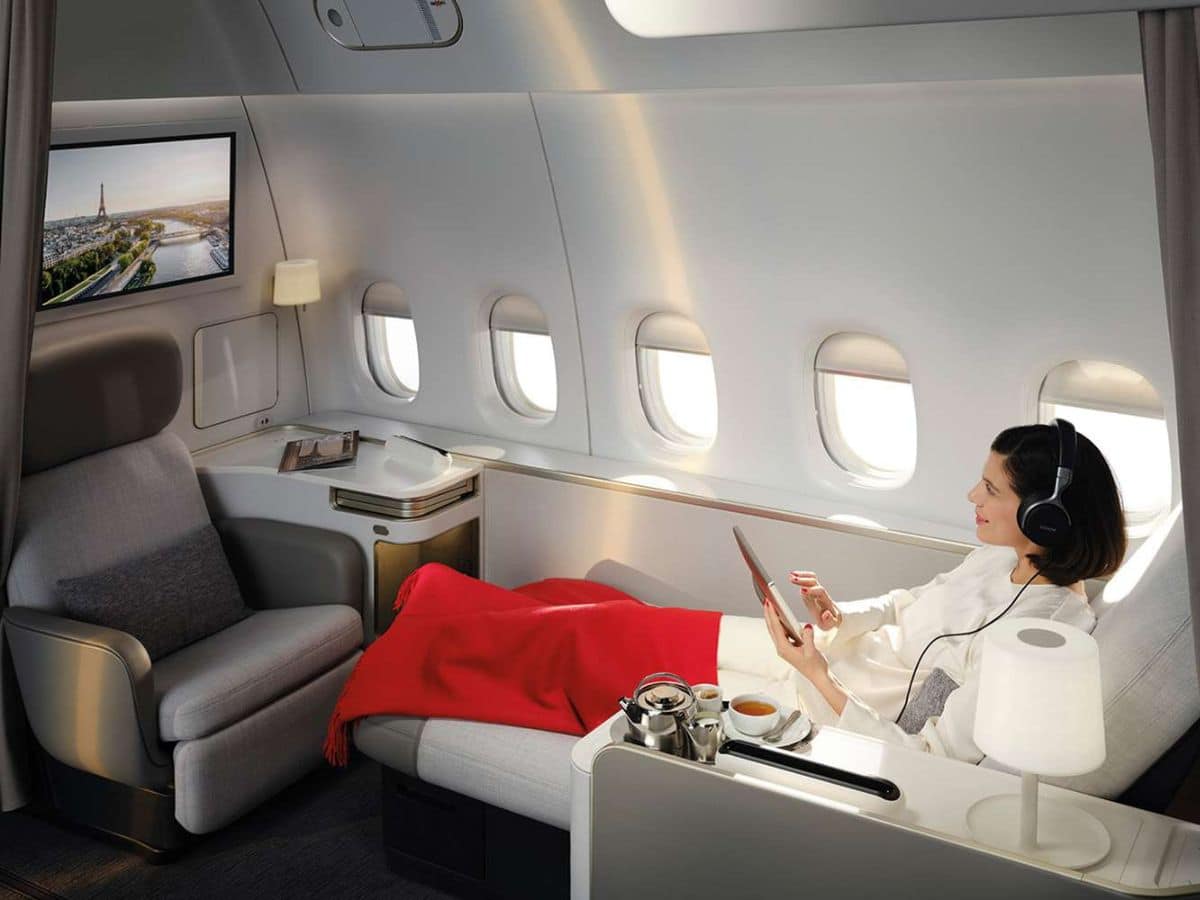
Air France La Première: The Haute Couture of Hospitality
Air France approaches luxury from a different angle. Where Emirates and the like emphasise physical privacy and spectacle, La Première focuses on service as an art form.
The airline’s flagship first-class product has developed a reputation for delivering something increasingly rare in modern aviation: elegance without overt display. The cabin itself is understated by contemporary luxury standards, yet every interaction feels carefully considered. Service arrives with a natural ease rather than scripted precision, while dining remains one of the strongest offerings in the sky, drawing heavily from France’s culinary traditions, served, for example, with fine Limoges porcelain, premium linen, and beveled crystal glassware.
Air France First Class Key Stats
- Price: From ~ USD 10,000 to 20,000+ (routes vary) (approx. AUD 14,500–29,000+)
- Aircraft: Boeing 777-300ER (select routes)
- Cabin Layout: 4-suite cabin (1 row in a 1-2-1 configuration)
- Best For: French luxury and white-glove service
- Stand-Out Feature: Exclusive La Première lounge and private airport tarmac escort via luxury vehicle.
- Cons: High cost, heavy reliance on the ground experience, limited tech/suite automation, no onboard showers.
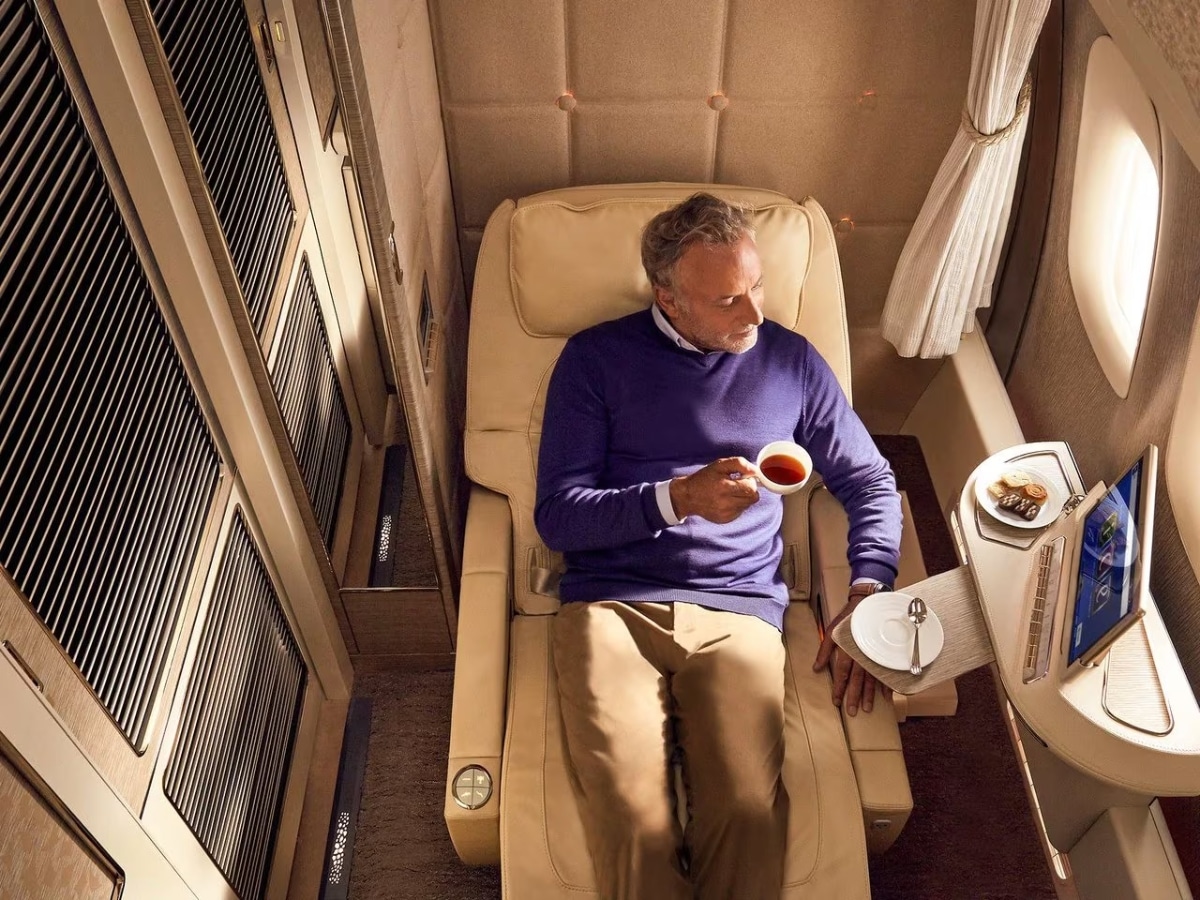
Emirates: The Masterclass in Privacy and Opulence.
Emirates were the pioneers of modern private opulence in the sky, introducing the first enclosed private suites in 2003 on their Airbus A340-500s.
The carrier’s flagship cabins remain some of the most recognisable in the world, synonymous with excellent service and unique features, including private suites, thoughtful storage, personalised climate controls, and a fully separated personal space.
Perhaps slightly more ‘theatrical’ than other offerings, every element here is ultimately designed to reinforce the sensation that the passenger has truly entered a private domain. The floor-to-ceiling doors create a degree of visual isolation unmatched by most competitors.
Emirates First Class Key Stats
- Price: From ~ USD 11,000 to 22,000+ (routes vary) (approx. AUD 16,000–32,000+)
- Aircraft: Boeing 777-300ER (“Game Changer”) or Airbus A380
- Cabin Layout: 6 fully enclosed suites (Boeing 777) or 14 private suites (Airbus A380)
- Best For: Ultimate visual isolation and high-end automotive-inspired design
- Stand-Out Feature: NASA-inspired “Zero-Gravity” seat positioning and high-tech virtual windows for middle suites (777 Game Changer), or the iconic onboard Shower Spa (A380).
- Cons: Aesthetic can border on overly theatrical for design minimalists; extreme product inconsistency across the massive fleet if you don’t book the specific “Game Changer” 777 or retrofitted A380s.

The Shift Towards Hyper-Personalisation
The defining trend of premium aviation right now has very little to do with square footage. Instead, it’s the rise of the boutique experience.
By shrinking first-class cabins to just a handful of seats, airlines have unlocked the ability to offer predictive, highly personalized service that mimics a private charter. True luxury is no longer just about what you are given; it’s about what you never have to ask for.
The new standard of luxury in the skies is knowing whether a passenger prefers an espresso or a flat white, remembering exactly how they take their steak, and reading their body language to know if they want a chat or fifteen hours of absolute silence.
Value vs Hype: Is First Class Really Worth the Cost?
For leisure travellers, the equation becomes more complicated. Beyond a certain point, the law of diminishing returns applies. The jump from economy to business class can feel transformational. The leap from business to first class is often more nuanced, focused on privacy, exclusivity, and finer details rather than outright comfort.
For travellers regularly crossing continents, the ability to arrive fully rested rather than merely transported may be the single greatest luxury of all.
The Verdict
As ever, value is a subjective matter, and it’s all relative. For some people, the most enjoyable part about flying is just that: The flying through the air at 35,000 ft and 900km/h. Insulate a traveller too completely from the experience and, at some point, the aircraft risks becoming just another luxury hotel room with a (very) nice view.
Still, the novelty of first class has obvious appeal. The prospect of disappearing behind a sliding door and spending fifteen hours blissfully detached from the wider cabin is enough to tempt even the most sceptical traveller.
The real risk, however, may be the return journey. Once you’ve crossed an ocean inside your own private sanctuary, going back to ordinary flying could prove far more difficult than the jet lag itself.
Common Questions About Flying First Class
For sheer space and architectural design, Singapore Airlines remains the industry benchmark with its Airbus A380 Suites, which feature a separate lounge chair and standalone bed. However, if your priority is absolute visual isolation, Emirates’ fully enclosed Boeing 777 “Game Changer” suites offer unmatched floor-to-ceiling privacy, while Air France La Première leads the industry for bespoke, white-glove ground service and fine dining.
For long-haul routes out of Australia, the leap from business to first class is defined by exclusivity, personal territory, and hyper-personalized service rather than standard physical comfort. While modern business class provides a lie-flat bed, first class offers fully enclosed private suites, dine-on-demand menus to completely bypass jet lag, and significantly higher crew-to-passenger ratios. For ultra-frequent or premium business travellers who need to land ready for immediate productivity, the premium is often justified.
Emirates and Singapore Airlines offer the best visual privacy in modern aviation. Emirates leads with its fully enclosed suites featuring floor-to-ceiling sliding doors and high-tech virtual windows for middle suites. Singapore Airlines achieves total isolation through massive individual rooms on its A380 fleet, allowing travellers to effectively wall themselves off from the rest of the aircraft for the duration of a long-haul flight.



















Comments
We love hearing from you. or to leave a comment.