

Updated:
Readtime: 6 min
Every product is carefully selected by our editors and experts. If you buy from a link, we may earn a commission. Learn more. For more information on how we test products, click here.
IWC Pilot’s Venturer Vertical Drive at a Glance:
- Engineered from scratch for human spaceflight in partnership with Vast
- Innovative crownless design uses a rotating bezel and rocker switch
- 44.3mm white zirconium oxide ceramic case with Ceratanium accents
- Equipped with the new Calibre 32722 featuring a 120-hour power reserve
- Officially certified for the upcoming Haven-1 commercial space station
Most pilot’s watches spend their lives nowhere near a cockpit, but in case a little space travel is in your future, IWC just built the perfect watch for orbit.
The Pilot’s Venturer Vertical Drive (Ref. IW328601) has been designed from the ground up for human spaceflight, right down to how you physically interact with it. If you thought IWC’s other Watches and Wonders 2026 novelty, the fully luminous Perpetual Calendar Ceralume, was pushing boundaries, this takes things to another stratosphere entirely.
But getting to space is part of the challenge. Rocket launches subject equipment to intense vibration and forces of up to 4g. Once you’re in space, everything changes. Vacuum, radiation, and temperature swings that can move from over 100°C in direct sunlight to well below -100°C in the shade. No one can hear you scream, but at least you’ll know what time it is.

How the IWC Pilot’s Venturer Vertical Drive Works Without a Crown
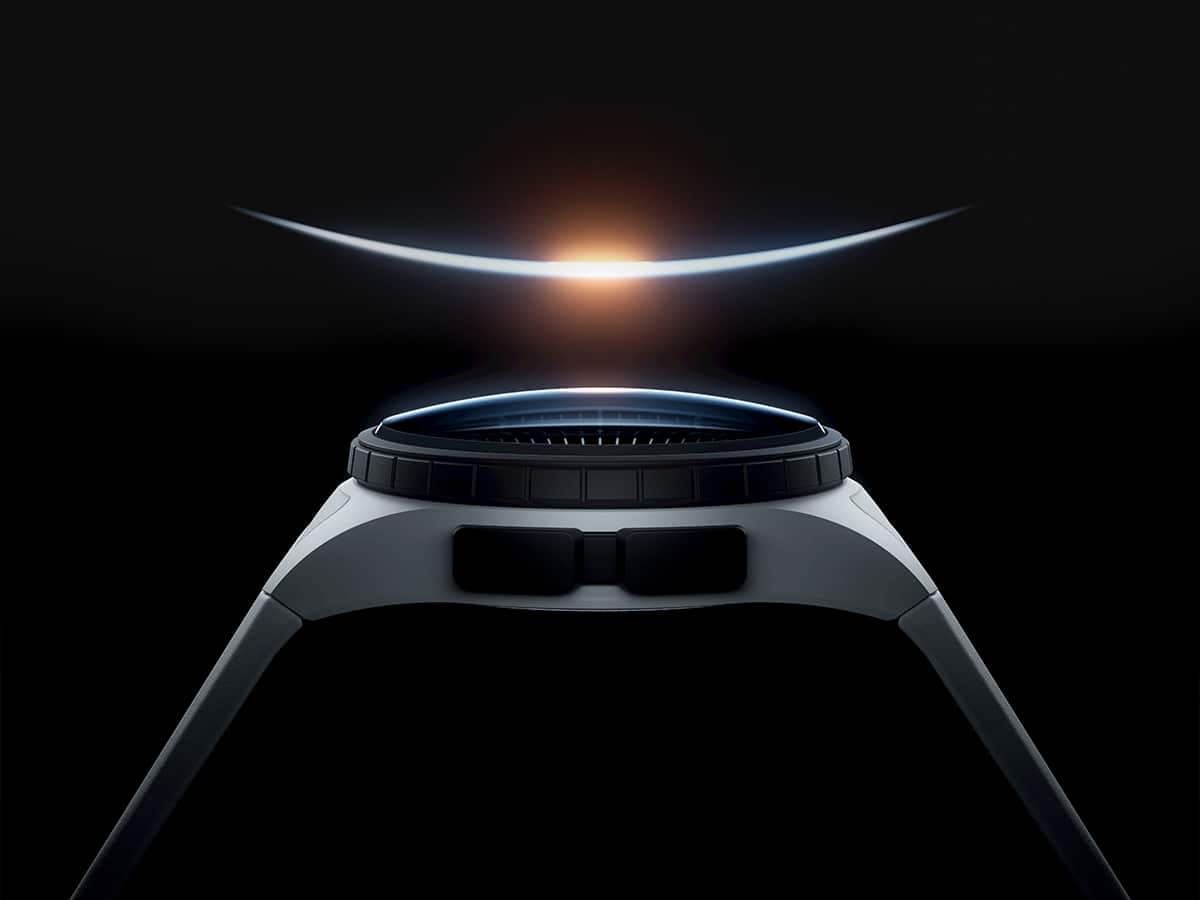
If it isn’t evident enough from the images, there is no crown on this watch. No, IWC has cleverly integrated every function via a patent-pending rotating bezel and a prominent rocker switch on the left side of the case. IWC calls this the “Vertical Drive” clutch system.
Try adjusting a traditional, fiddly crown while wearing a pressurised, thick EVA space glove, and you will immediately see the problem this solves.
Using the rocker switch, the wearer can toggle between winding the movement or setting the two different time zones. You can even wind the watch by turning the Ceratanium bezel counter-clockwise.


It’s Built for the Haven-1 Space Station
Getting to space is only part of the challenge. Rocket launches subject equipment to intense vibration and acceleration forces of up to 4G. Once you are in orbit, everything changes: you’re dealing with vacuum conditions, intense UV radiation, and temperature swings that can range from over 100°C in direct sunlight to -150°C in the shade.
IWC partnered with commercial space company Vast to put the Venturer through rigorous vibration and pressure testing at their Long Beach, California headquarters. The watch was secured to a platform that generated rapid directional changes and forces up to 10G, well above those of a typical launch ascent.
Having survived completely intact, it earned official certification as the first IWC watch for use on Haven-1, the world’s first commercial space station set to launch in 2027. “IWC’s dedication to engineering excellence, delivering uncompromising accuracy, reliability, and astronaut-focused design, aligns perfectly with Vast’s human-centric approach to developing Haven-1,” noted Max Haot, Vast CEO.
To survive these extremes, the chunky 44.3mm case is made from white zirconium oxide ceramic, a material with a Vickers hardness rating second only to diamond. The bezel and caseback, which features a specialised engraving of a space vehicle, utilise IWC’s proprietary Ceratanium, combining the lightness of titanium with the scratch resistance of ceramic.
Even the strap can withstand an orbital strike. The integrated white FKM (fluorinated rubber) construction offers excellent thermal insulation and is designed to resist aggressive UV exposure without degrading.

Reading Time at 16 Sunrises a Day
The matte black, reflection-free dial strips everything back to the essentials, utilising a 24-hour display that reflects how time works in orbit. When you are circling the Earth every 90 minutes, you experience up to 16 sunrises and sunsets a day. Traditional AM and PM markers aren’t useful anymore, so astronauts stick to a fixed reference, such as UTC.
It features a dedicated outer hand pointing to the 24-hour scale, and a central hour hand that can be moved in one-hour increments to display a second time zone (like your home time on Earth).
Visually, it’s impressive, but we wouldn’t go so far as to call it stunning. The black triangular hour and minute hands are coated with green Super-LumiNova, while the arrow tip of the 24-hour hand glows blue. The blue second hand points to a matching blue inner ring, another subtle nod to the Earth’s horizon as seen from space.
It’s all driven by IWC’s newly engineered Calibre 32722, an automatic movement equipped with a massive 120-hour power reserve, an integrated GMT module, and a date window at 3 o’clock.

IWC Pilot’s Venturer Vertical Drive is the Ultimate Cockpit Instrument
While all of that functionality feels highly exclusive to space travel, it harkens back to the origins of the Pilot’s watch. These tool watches were historically large, legible, and easy to operate under pressure. The Venturer is what it looks like when that utilitarian ideal is pushed back to its logical extreme, just in a very different cockpit, one that’s heading into outer space.
“These emerging players operate much like brands, deliberately harnessing the power of design to inspire people and spark enthusiasm for their bold visions,” explains Christian Knoop, Creative Director at IWC Schaffhausen. “With its rounded edges and black and white colour scheme, it embodies our vision of a modern space watch and carries IWC’s tool watch legacy into the 21st century.”
Besides actual astronauts, no one on planet Earth technically needs a watch that can operate in zero gravity. But that’s the point. Designing for an environment this unforgiving forces you to make decisions you would never make otherwise. We might not be booking orbital flights just yet, and we’re not sure that heading to outer space is the answer to saving our beautiful planet Earth, but for AUD$45,400, this IWC is ready when we are.


IWC Pilot’s Venturer Vertical Drive Key Specifications
- Reference: IW328601
- Movement: IWC-manufactured Calibre 32722 (automatic)
- Power reserve: 120 hours (5 days)
- Functions: Hours, minutes, seconds, GMT, 24-hour display, date
- Case material: White zirconium oxide ceramic
- Bezel and caseback: Ceratanium (blackened titanium) with space vehicle engraving
- Dimensions: 44.3 mm diameter, 16.7 mm thickness
- Dial features: Matte black, green Super-LumiNova hands, blue Earth-horizon accents
- Operation: Patent-pending Vertical Drive bezel-controlled system with side rocker switch
- Strap: Integrated white FKM (fluorinated rubber)
- Water resistance: 100 metres (10 bar)




















Comments
We love hearing from you. or to leave a comment.