

Updated:
Readtime: 7 min
Every product is carefully selected by our editors and experts. If you buy from a link, we may earn a commission. Learn more. For more information on how we test products, click here.
- Illicit cigarettes are now widely available across Australia
- Some smokers are shifting back from vaping to tobacco
- Quit support can cost more than black-market cigarettes
- Smoking still causes 66 deaths per day nationwide
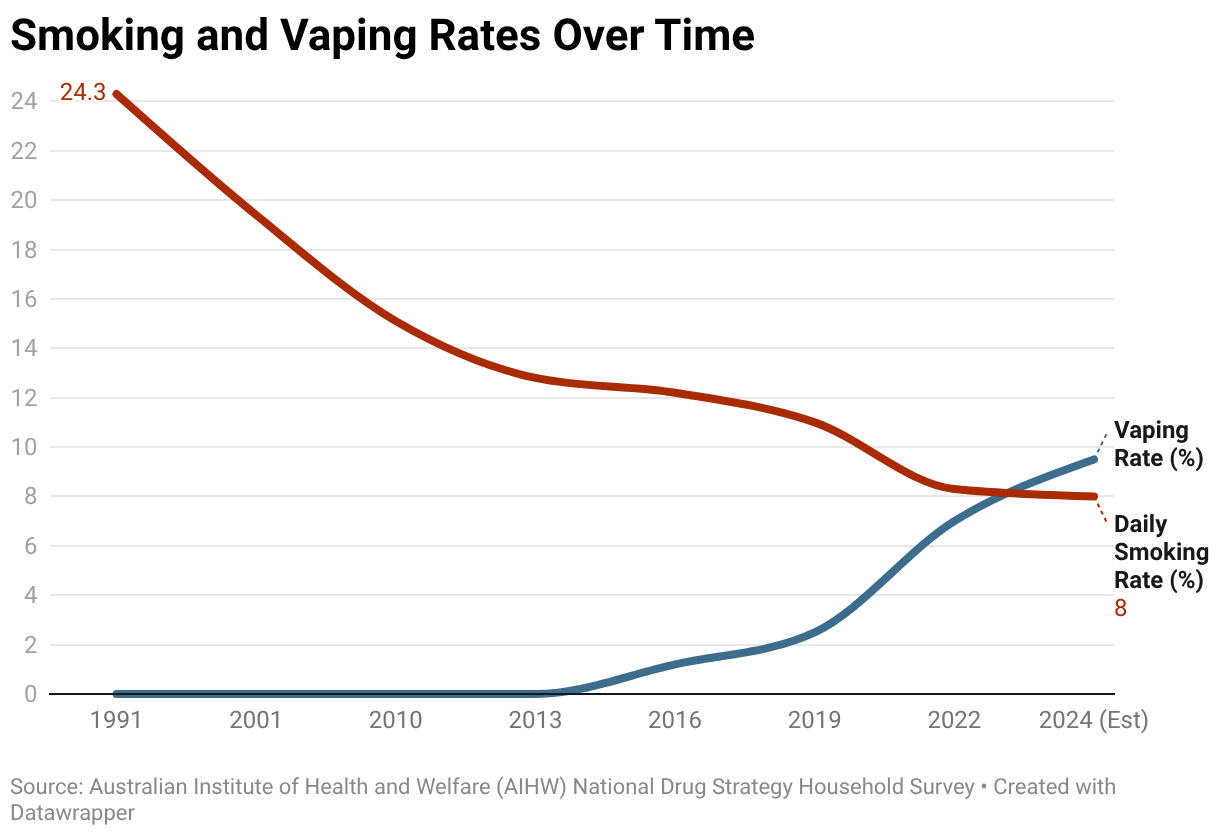
For years, the trajectory was clear. Smoking rates in Australia were falling. Fewer people lighting up outside pubs, fewer packs on tables, fewer reasons to start. Higher taxes, plain packaging, and public health campaigns all made lighting up feel increasingly out of step.
By the early 2020s, daily smoking had dropped to just over 8 per cent of the population, down from nearly a quarter in the early ’90s. But that progress has started to slow. Recent tracking from the Australian Institute of Health and Welfare shows that while smoking rates are at an all time low, vaping use is on the rise. The most recent data – from 2022 – showed 7% of Australians using vapes, up from 2.5% in 2019. It’s a fair bet it’s risen more since then.
Because while legal nicotine has become more controlled, the alternatives haven’t disappeared – in fact, they’ve become increasingly popular. And you’ll find them under the counter or out the back.
The Rise of the Easy Option
Walk into the right tobacconist now and you don’t need to look very hard. In some places, it’s barely even hidden. Cheap cigarettes are still available, often sold without the packaging, pricing, or restrictions that define the legal market. A legal pack can push past $50. Illicit alternatives can be picked up for closer to $15.
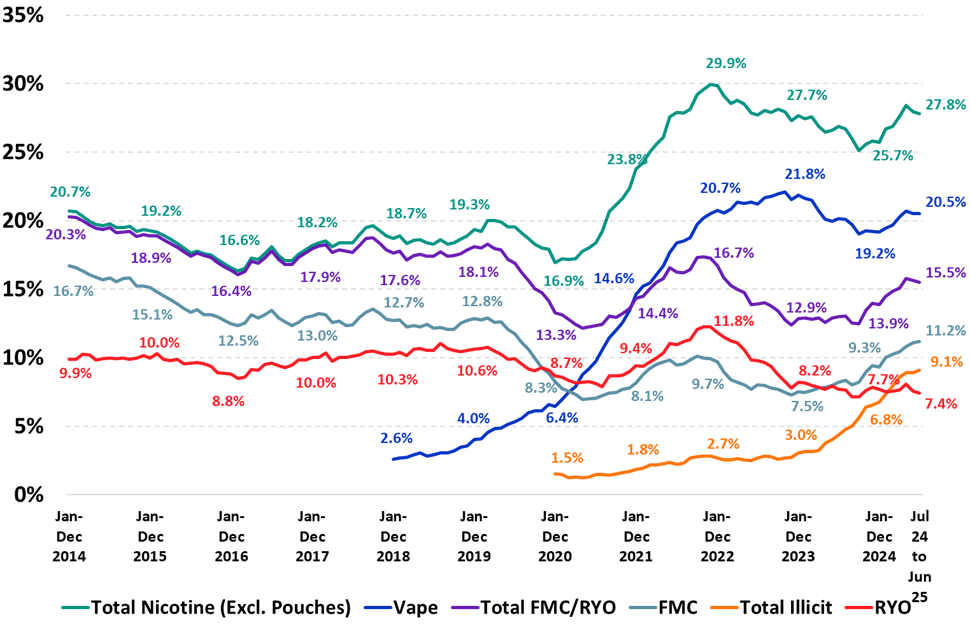
Wastewater analysis from the University of Queensland suggests untaxed tobacco consumption has surged in recent years. While general tobacco use has declined, nicotine from vaping and other products increased from 5.4 per cent to 26.3 per cent, pointing to a rapid expansion of the illicit market that isn’t fully captured in traditional sales data.
Postdoctoral Research Fellow Dr Zhe Wang, from the Queensland Alliance for Environmental Health Sciences, said rising cigarette prices may be pushing some users toward illicit alternatives.
“There is concern that illegal vaping and tobacco use is increasing due to the rising cost of cigarettes.”
Associate Professor Phong Thai said while smoking rates continue to decline overall, the growth of the illicit market risks slowing that progress.
“The illicit tobacco market could slow progress towards Australia’s goal of reducing smoking prevalence to 5 per cent or less by 2030.”
What’s Getting Through
At the border, the scale is overwhelming. In just three months between October and December 2025, the Australian Border Force intercepted more than 467 tonnes of illicit tobacco, representing around $1 billion in unpaid duty. Australia collects roughly $15–17 billion annually in tobacco excise.
Shipments are disguised as everything from juice bottles to gym equipment. Millions of cigarettes hidden in cargo containers. Travellers bringing in kilos at a time through airports. It’s happening at scale, across multiple entry points, and from all over the world.
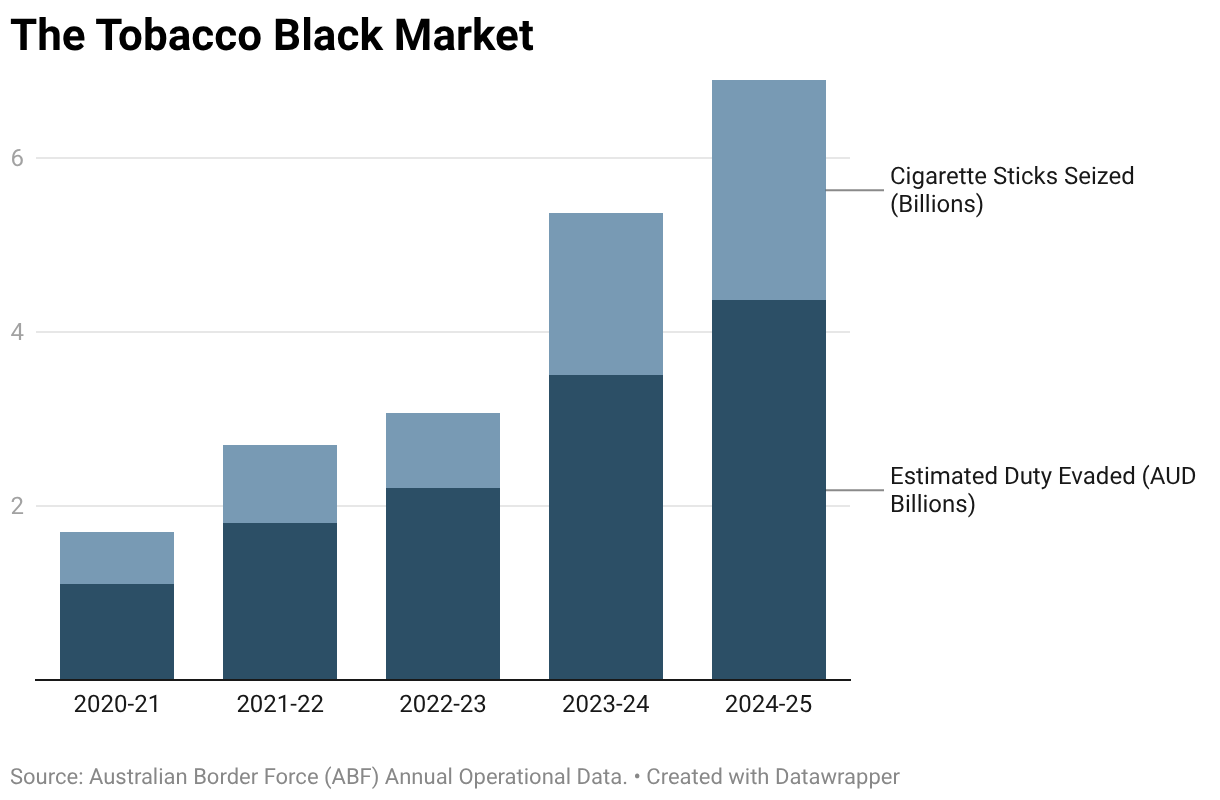
And those are just the seizures. Even the agencies involved acknowledge they’re only catching a fraction of what’s coming in. For every shipment that gets stopped, plenty more gets through.
Which helps explain what’s happening on the ground.
“Cheap smokes are everywhere with a now ridiculously ubiquitous retail distribution network,” acknowledges Assistant Minister for Customs Julian Hill
When Quitting Costs More Than Smoking
At the same time, the path out hasn’t necessarily become easier. For heavy smokers, the most effective approach is usually a combination of nicotine replacement therapies. Patches alongside gum, lozenges, or sprays. Used properly, it works. But it ain’t cheap.
A full combination can run over $200 a month – not a whole lot cheaper than smoking in the first place.
Data from the Australian Institute of Health and Welfare shows relapse is more common than most people realise. A large portion of people who stop smoking end up starting again within a few years. Not because they don’t understand the risks, but because nicotine doesn’t work like that. Around three in five Australians (61.5%) who attempt to quit smoking end up relapsing within just three years.
Which means small shifts in cost or access don’t just affect new users. They affect people who were already trying to stop.
University of Notre Dame researcher Lisa Wood said some smokers are already questioning the logic.
“Some people have said to me, ‘If the government really wanted me to quit, then why is it so expensive to get the support?’ It’s a mixed message.”
The Shift No One Really Planned For
Layered over the top of that is what’s happening with vaping. The move to restrict access, shifting vapes into a pharmacy-led model with tighter controls, was designed to curb youth uptake and bring nicotine consumption into a more regulated space.
But behaviour hasn’t neatly followed policy. In mid-2024, Australia effectively shut down the retail vaping market. Sales were heavily restricted, nicotine vapes were pushed into pharmacies, and import pathways tightened.
What had been a fast-growing, consumer-facing category suddenly became much harder to access. The intent was clear – to rein in a product category that had started to look uncomfortably similar to the one it was meant to kill. Now, health authorities are scrambling to stay ahead of the surging market for illegal tobacco and unregulated vapes.
Before disposables took over, vaping in Australia sat closer to a hobbyist space. Refillable devices, specialist retailers, people actively trying to reduce nicotine or move away from cigarettes altogether. It required effort. And for a lot of people, that effort made quitting possible.
When the policy shifted, it didn’t just target one part of the market. It swept across all of it.
Independent retailers shut down. Importers pulled back. Long-running businesses either closed or moved offshore. South Australian company VapourEyez, one of the more established names in the space, expanded into New Zealand as local restrictions tightened.
What was left behind wasn’t a clean break from nicotine. It was a system that had become harder to navigate, just as demand remained. And when that happens, behaviour tends to shift.
The Youth Impact
For a lot of people, vaping wasn’t just a trend. It was how they actually got off cigarettes. Even when it was clunky, harder to figure out, and required a bit of effort, it gave people a way to step down their nicotine and eventually walk away.
That’s a big part of why it worked. Disposables stripped that away. Roy Morgan data released in 2025 suggests smoking rates among young Australians have ticked up since tighter restrictions on vaping sales were introduced, breaking from the long-term downward trend.
Among 18 to 24-year-olds, the combined rate of smoking and vaping has climbed back to around 28 per cent, the highest of any age group. Within that, cigarette use has started ticking up again after years of steady decline.
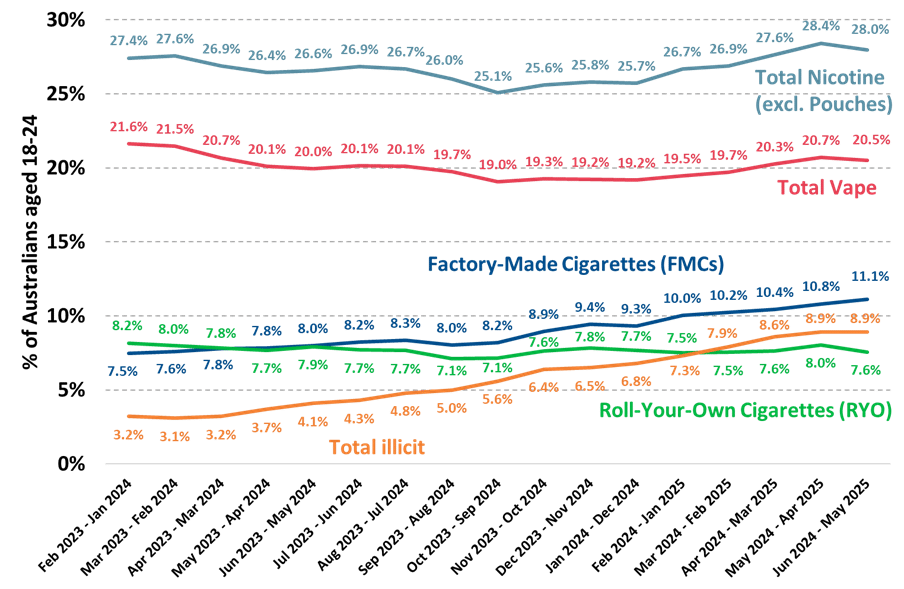
University of Queensland researcher Cheneal Puljevic said there are already signs that some users are moving in the opposite direction.
“Many people who are vaping have now switched to tobacco because vapes are harder to get and more expensive, and that is also a policy failure.”
Higher taxes discourage smoking. Tighter controls limit access to nicotine products. Regulation is meant to reduce harm.
On their own, each piece makes sense, but together, it’s a mess. Legal products are more expensive and more tightly controlled. Quitting support exists, but can be costly and limited in scope. Meanwhile, illicit cigarettes are cheap, widely available, and easy to access.
The goal might have been to stop new generations from taking up a product that we know is incredibly harmful, but take a look at the queue for any nightclub in the Sydney CBD, and you can see that it’s had the opposite effect.
The information provided in this article is for general informational purposes only and does not constitute medical advice. Smoking and vaping carry significant health risks. If you are looking to quit, we strongly recommend consulting with a healthcare professional to develop a plan tailored to your needs.
Support Resources:
- Quitline: Call 13 7848 (13 QUIT) for free, confidential coaching and support.
- Quit.org.au: Visit Quit Victoria or your state-specific Quit website for digital tools and resources.
- GP Consultation: Speak to your local doctor about Medicare-subsidised nicotine replacement therapies (NRT) and prescription options.




























Comments
We love hearing from you. or to leave a comment.