

Updated:
Readtime: 19 min
Every product is carefully selected by our editors and experts. If you buy from a link, we may earn a commission. Learn more. For more information on how we test products, click here.
Christopher Nolan is perhaps the defining director of our time. The auteur is the master of IMAX-scale blockbusters, non-linear storytelling, and innovative practical effects. He builds puzzles in which time runs backwards, trucks flip, and cities fold. The score hits you in the chest, and endings cut to black.
Whether it’s a dream heist, a superhero morality play, or a three-hour drama about atomic guilt, every beat, ticking clock and cross-cut is there for a reason. Sometimes it’s brilliant. Sometimes it’s a bit much, but it’s never accidental.
We’ve seen every one of his films (most of them multiple times), and after careful consideration, here’s how we think the official ranking for each of Christopher Nolan’s films land, based on cultural and on-screen impact, technical craft, innovative storytelling, and just a bit of personal preference, because these things are always subjective.
Every Christopher Nolan Film Ranked
12. Tenet (2020)
Armed with only one word, Tenet, a CIA operative enters a world where time runs both ways.
Verdict: Nolan pushing the boundary so hard the frame almost cracks.
Tenet is bold. You can’t accuse it of playing safe. A spy thriller built around time inversion, where characters and objects move backwards through events happening forwards, is exactly the kind of high-concept setup Nolan gravitates toward.
The opera house opener is chaos in the right way. The Tallinn highway sequence, with cars flipping and un-flipping across lanes of traffic, remains one of the most technically impressive action scenes of the last decade.
But here’s the problem. It’s hard to care. Characters explain entropy, reverse bullets and temporal pincer movements like they’re reading from a physics manual. By the time you reach the final battlefield sequence, with soldiers running forwards and backwards through collapsing buildings, you’re not feeling tension. You’re just confused.
Even the fight choreography reflects that mindset. After years of shaky-cam chaos becoming the norm, Nolan went the other way. The airport hallway fight between the Protagonist and his inverted self is meticulously designed, every movement and angle crystal clear.
But because the emotional stakes never quite land, you admire the mechanics more than you feel the moment, even if you follow it the first time around.
- Personal Standout: The cargo plane crash at the airport. Nolan bought a decommissioned 747 and drove it into a hangar rather than faking it digitally. You feel the scale immediately. Big. Physical. Built for impact.
- Why It Still Matters: It’s the point where Nolan’s ambition slightly outruns the payoff. Even when it misses, it’s fascinating to watch.
- Where to watch it: Tenet is available on Stan.
11. Following (1998)
A young writer starts following strangers for inspiration and ends up pulled into a criminal underworld.
Verdict: Scrappy, stripped-back and already bending time to his will.
Following is Nolan before the budgets, before IMAX, before Hans Zimmer. Shot on weekends with friends and barely any money, it’s rough around the edges. Performances wobble. The production is sparse. But it’s unmistakably Nolan.
The story unfolds out of order. Identity is slippery. Obsession drives everything. You can already see the timeline tricks that would define Memento and The Prestige. It’s small, but it’s not minor.
The roughness shows in places. Some scenes linger. Dialogue can feel stiff. You’re watching a filmmaker still learning how to command the frame. But the intent is already fully formed.
- Personal Standout: The final reveal that the protagonist has been orchestrating the manipulation from the start. The timeline snaps into place. The personas shift. It’s the first glimpse of Nolan’s love for pulling the rug out from under you.
- Why It Still Matters: Nolan’s obsession with structure wasn’t something he developed later, it was there from day one.
- Where to watch it: Following is available to rent on Apple TV.
10. The Dark Knight Rises (2012)
Eight years after the Joker’s chaos, Batman is dragged out of exile to face Bane and a city on the brink.
Verdict: Big, bold and occasionally buckling under its own ambition.
Following The Dark Knight was always going to be impossible. Nolan didn’t go smaller. He went wider. Gotham under siege. Bruce Wayne broken. A nuclear clock ticking overhead. The opening plane hijack alone is classic Nolan spectacle.
Heath Ledger’s death inevitably changed the trilogy’s trajectory. The Joker was chaos with no ideology. Bane, by contrast, is controlled, structured and driven by belief rather than anarchy. Tom Hardy’s performance leans into that. The reworked voice became one of the most quoted villain deliveries of the decade. It’s theatrical. It’s strange. It works.
The scale delivers. The football stadium implosion. The stock exchange heist. The bridges cut off from the mainland. Gotham genuinely feels like it’s collapsing. But the cohesion doesn’t always keep pace. Plot threads pile up. The pacing lurches. The final Talia al Ghul reveal lands softer than it should.
Bruce Wayne’s physical and psychological breakdown gives the film something grounded to hold onto, with Christian Bale playing him like a man who has already paid for being Batman.
- Personal Standout: Bane breaking Batman’s back in the sewer. Not just beating him. Dismantling him. “Your mind or your body.” For a superhero film, it lands with real brutality.
- Why It Still Matters: Not the cleanest Nolan film. Still a bold way to close the trilogy on his own terms.
- Where to watch: The Dark Knight Rises is available on HBO Max.
9. Insomnia (2002)
A detective sent to a small Alaskan town to investigate a murder finds himself slowly unravelling under guilt and exhaustion.
Verdict: A straight thriller where guilt, not time, does the unravelling.
Insomnia is the least flashy film in Nolan’s catalogue. No fractured timelines. No dream layers. Just a murder investigation set under a sun that refuses to go down.
Al Pacino plays a detective who accidentally shoots his partner in the fog and then chooses to cover it up, slowly unravelling under guilt and exhaustion. Robin Williams, cast against type, is unsettling in a quiet, controlled way. The endless daylight becomes its own antagonist.
It’s a remake, and you can feel Nolan working inside an existing framework rather than constructing his own. That keeps it a notch below his most personal work. But stripped of time tricks and structural games, it confirmed he could handle stars and studio pressure with a straight thriller.
- Personal Standout: The fog chase. Two men circling each other in near-whiteout conditions, unsure who’s hunting and who’s being hunted.
- Why It Still Matters: It’s the dark horse of his catalogue, proof he doesn’t need to bend time to bend the pressure.
- Where to watch: Insomnia is available to stream on Stan.
8. Batman Begins (2005)
After witnessing his parents’ murder, Bruce Wayne trains with the League of Shadows before returning to Gotham to fight crime as Batman.
Verdict: The grounded reboot that made Batman feel dangerous again.
Before Batman Begins, superhero films were glossy or camp. Nolan dragged it into something dirtier. Gotham wasn’t neon. It was grimy, corrupt and grounded. The suit felt tactical. The Batmobile looked like military hardware. Bruce Wayne felt like a damaged adult rather than a comic-book archetype.
The film’s real strength is patience. The first hour takes its time. Bruce training in the mountains. Learning fear. Failing. Getting back up. Nolan builds the psychology of Batman instead of rushing to the cape.
Scarecrow fits that tone. Not a grand monologuing villain, but a clinical operator weaponising fear. Cillian Murphy plays him with unsettling restraint, letting the mask and the toxin do the talking. It’s a performance that’s easy to overlook in this trilogy, but crucial to its grounded edge.
The final act doesn’t quite match that build-up. The train climax gets choppier, and compared to what followed, Batman Begins feels more like groundwork than peak execution. But what groundwork it is.
- Personal Standout: When Batman calls in “backup” and the sky fills with bats. It’s dramatic. Slightly ridiculous. Completely committed. Nolan leans into the myth instead of apologising for it.
- Why It Still Matters: It changed what superhero films were allowed to be.
- Where to Watch: Batman Begins is available on HBO Max.
7. Memento (2000)
A man with short-term memory loss attempts to track down his wife’s murderer using notes and tattoos.
Verdict: The moment Nolan announced himself.
Memento unfolds backwards, which sounds like a trick until you realise it’s the whole point. The black-and-white scenes move forward. The colour scenes move backward. When they finally meet, you understand you’ve been walking toward the beginning the entire time.
The structure puts you inside Leonard’s head. Every time he wakes up, you wake up with him. No context. No memory. Just notes, tattoos and Polaroids. You’re piecing things together the same way he is, never fully sure which version of events to trust.
And that’s where it gets uncomfortable. By the end, Leonard chooses to frame Teddy, knowingly writing himself a lie so he can keep chasing something that feels like purpose. The mystery might be solved, but the truth is optional. The film plays you the same way Leonard plays himself. You only see it clearly once it’s already happened.
- Personal Standout: The revelation that Leonard may have already found the killer and chosen to lie to himself anyway. The timeline doesn’t just reverse. Your trust does.
- Why It Still Matters: It marked the moment Nolan showed he could design a film as precisely as he directs one.
- Where to Watch: Memento is available on Paramount+
6. Dunkirk (2017)
Allied soldiers are surrounded by the German Army and evacuated during a fierce battle in World War II.
Verdict: A war film built like a ticking clock.
Dunkirk is stripped back. Minimal dialogue. No sweeping backstories. Nolan splits the story across three timelines. One week on land. One day at sea. One hour in the air. At first they feel separate. Then they collide.
What makes it work is perspective. You never get comfortable. One minute you’re on the beach with thousands of soldiers waiting and hoping. The next, you’re on a small civilian boat heading straight into danger. Then you’re in a Spitfire cockpit watching the fuel gauge drop. Each thread feels tight and contained. When they converge, the scale hits harder.
Sound does most of the heavy lifting. Hans Zimmer builds the score around a ticking watch and the Shepard tone, a rising effect that keeps the tension climbing without ever truly resolving. Even the quiet moments feel like they’re about to snap.
Visually, it’s clean and exposed. Real planes banking low over open water. Real ships taking hits. No digital gloss smoothing the edges. Some viewers wanted more character backstory. That’s fair. But Dunkirk isn’t about a single hero. It’s about pressure, survival and scale.
- Personal Standout: The final Spitfire glide. Engine dead. Silence. Tom Hardy‘s pilot coasting over the beach before landing and setting the plane on fire. It’s restrained, and that restraint makes it land harder.
- Why It Still Matters: It proved blockbuster tension doesn’t require more explosions.
- Where to Watch: Dunkirk is available on Netflix.
5. Oppenheimer (2023)
The story of J. Robert Oppenheimer and his role in developing the atomic bomb.
Verdict: A historical epic that burns with thriller intensity.
Oppenheimer is three hours of moral weight, cross-cut between colour and black-and-white timelines, building toward a moment everyone already knows is coming. The film moves between Oppenheimer’s rise, the Trinity test and the later security hearings that dismantle his reputation, creating a portrait of a man and the system that eventually eats him.
The Trinity sequence is the centrepiece. Nolan withholds the blast. Lets the silence stretch until the theatre feels suspended. Then the shockwave rolls across the desert like the physical echo of a decision that can’t be undone. It isn’t about spectacle. It’s about consequence.
The film doesn’t stop there. The hearings. The political manoeuvring. The quiet revenge carried out in closed rooms. Conversations that feel polite on the surface but loaded underneath. The exchanges with Einstein by the lake reframe the entire project. Trinity wasn’t closure. It was ignition.
Cillian Murphy carries the film with hollowed-out intensity. You see brilliance, ego and doubt sharing the same space behind his eyes. It’s monumental. Just not as tightly coiled as the films above it.
- Personal Standout: Edward Teller pushing for the hydrogen bomb. Not satisfied with splitting the atom. Already thinking bigger. More destructive. It reframes Trinity instantly. “Then we’ll get not kilotons, but megatons.” The bomb wasn’t the ceiling. It was the floor.
- Why It Still Matters: A dense, three-hour historical drama about atomic guilt, and it still became a global event.
- Where to Watch: Oppenheimer is available on Apple TV.
4. Interstellar (2014)
A team of explorers travel through a wormhole in space to ensure humanity’s survival.
Verdict: A cosmic epic where emotion nearly overwhelms the science.
Interstellar swings big. Space travel. Black holes. Time dilation. A father and daughter separated by decades.
The docking sequence alone justifies its place here. The Endurance spinning out of control. Zimmer’s organ score accelerating. Cooper muttering, “No time for caution,” as the ship tears itself apart around him. It’s chaos, but it’s controlled chaos.
Then there’s the video message scene. Cooper watching decades of his children’s lives pass in minutes. The camera doesn’t flinch. Nolan lets the moment sit. It’s one of the rare times he leans fully into emotion without structural distraction.
The science matters here too. The black hole visuals were developed using real theoretical physics and complex simulations. Gargantua doesn’t just look impressive. It feels real.
The stumble is subtlety. The idea that love can transcend space and time isn’t the issue. The monologue explaining it lands heavier than it needs to.
- Personal Standout: “They’re not mountains. They’re waves.” What looks like distant peaks are walls of water, each one stealing years back on Earth. Awe. Terror. One wrong move and decades vanish.
- Why It Still Matters: Original, science-driven blockbusters could still dominate without leaning on an existing franchise.
- Where to Watch: Interstellar is available on ABC iView.
3. The Prestige (2006)
Two stage magicians engage in a battle to create the ultimate illusion.
Verdict: A duel of egos disguised as a magic trick.
The Prestige is disciplined. No bloat. No overexplaining. Just obsession escalating until it consumes everything in its path.
Structurally, it’s a perfect fit. A story about deception told through layered diaries and shifting perspectives. You think you’re ahead of it. You’re not. Every reveal works because the groundwork was laid quietly, often in plain sight.
Christian Bale and Hugh Jackman don’t play heroes. They play men hollowed out by rivalry. The applause stops mattering. The win becomes everything. The cost becomes unbearable.
And then there’s David Bowie as Nikola Tesla. He doesn’t play Tesla like an eccentric scientist. He plays him like a myth wandering through someone else’s story. Slightly detached. Slightly unknowable. It’s exactly the right energy for a film about illusions becoming real.
This is a film that trusts its audience. It never stops to explain itself. It just lets the trick land.
- Personal Standout: The cloning reveal and the tanks beneath the stage. By the time you understand the cost of The Transported Man, the opening line about watching closely lands differently. The trick was never the magic. It was the sacrifice.
- Why It Still Matters: It’s the Nolan film that rewards repeat viewings the most.
- Where to Watch: The Prestige is available for free on SBS On Demand.
2. The Dark Knight (2008)
Batman faces the Joker, who plunges Gotham into chaos.
Verdict: The blockbuster that raised the bar for superhero cinema.
The Dark Knight didn’t just raise the bar for comic book movies. It reset expectations. Suddenly, seriousness wasn’t a liability. A superhero film could tackle surveillance, chaos and a city coming apart and still dominate the box office.
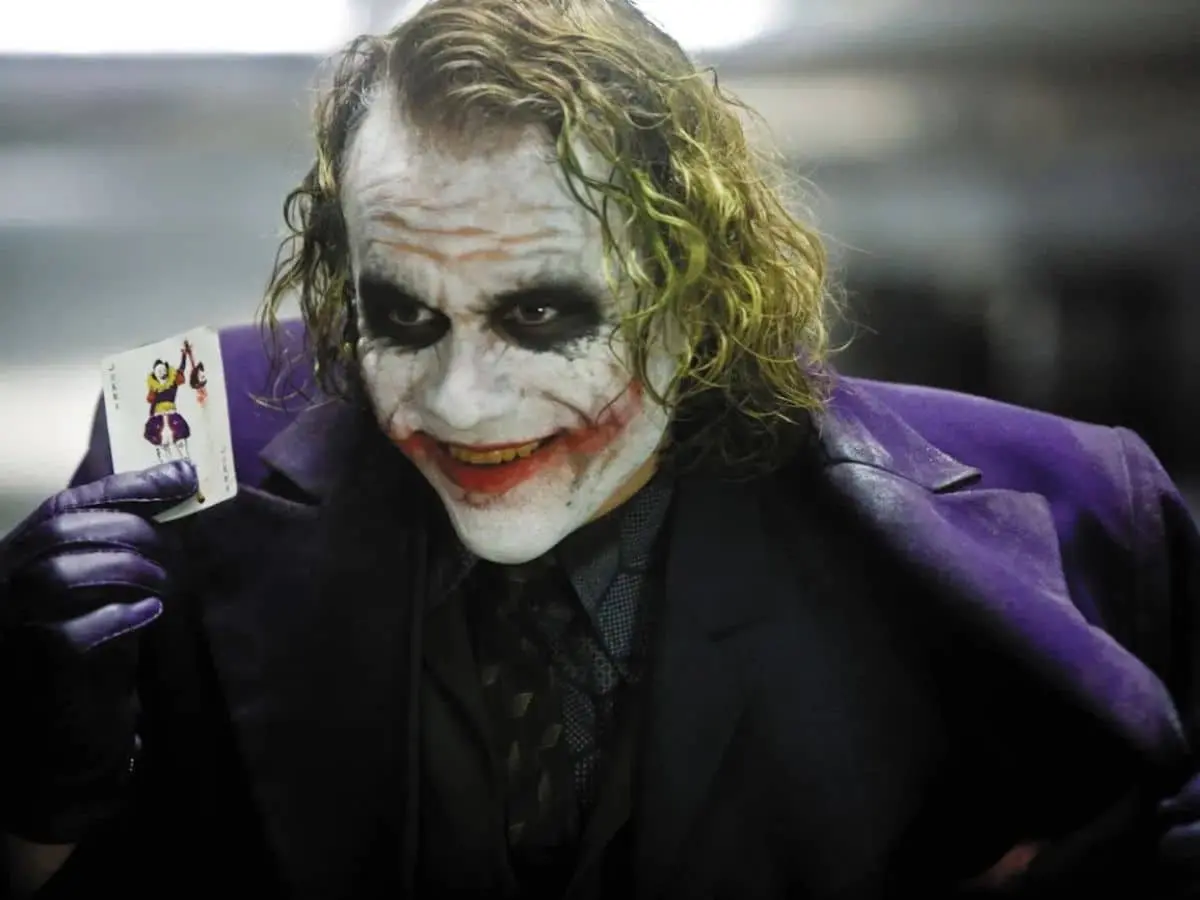
Heath Ledger’s Joker is the obvious centrepiece. Not because he’s loud, but because he’s unstable. There’s no ideology you can pin down. No clean motive. He’s chaos in human form, and every scene tilts slightly when he enters it.
The pencil trick tells you everything in seconds. The hospital explosion lingers because it almost doesn’t work. The interrogation scene crackles with tension because you think Batman has the upper hand. He doesn’t.
The opening bank robbery, shot in IMAX, recalibrated scale. The truck flip in downtown Chicago was real. A concealed piston rig punching the trailer upward and sending it end-over-end in one take. You feel the weight of it.
Where it edges toward imperfection is compression. Harvey Dent’s fall into Two-Face carries the weight of an entire sequel’s worth of tragedy. It’s powerful. It’s also fast.
The Dark Knight might be the greatest comic book film ever made. It just isn’t the most Nolan film Nolan has made.
- Personal Standout: The interrogation scene. Two men in a room. No music. Just ideology colliding. “Even to a guy like me, that’s cold.”
- Why It Still Matters: Superhero films could carry real thematic ambition and still feel urgent rather than collapsing under their own seriousness.
- Where to Watch: The Dark Knight is available on Binge and HBO Max.
1. Inception (2010)
A thief is given the task of planting an idea into a CEO’s mind.
Verdict: The purest Nolan film.
Inception is a heist film built on rules, layers and time pressure, with every layer moving at its own tempo. The hotel corridor floats. The snow fortress plays like a war film. The van falls in slow motion. The cross-cutting in the final act stacks all of it together, yet you’re never lost. You always know what the kick is, what’s at stake and where you are inside the labyrinth.
What makes it truly impressive is how it handles exposition. There are a lot of rules. Dream levels. Kicks. Totems. Limbo. In lesser hands, it becomes a lecture. Here, it’s folded into the heist planning, so you’re not being talked at, you’re being briefed.
The rotating hallway fight reset expectations for action choreography. Built practically, with gravity shifting in real time, it isn’t just clever. It feels physical.
Hans Zimmer’s score doesn’t sit underneath the film. It drives it. The slowed-down Edith Piaf motif tying the kicks together mirrors the structure itself, sound reinforcing design.
And then the ending. The spinning top. The wobble. The cut to black. Not a twist, but a question that leaves you suspended between certainty and doubt.
The Dark Knight may be the most culturally important film Nolan has made. But Inception is the one that feels most like him. Time bending. Moral ambiguity. Emotional stakes tied to memory and guilt. Large-scale spectacle built on precise structure. It’s everything he had experimented with before, sharpened and unified into one clean execution.
- Personal Standout: The Paris folding sequence. The city bending back on itself as Cobb explains the rules of the dream. It’s the moment the film declares its ambition without apology.
- Why It Still Matters: An original idea could dominate globally at blockbuster scale without needing to simplify itself for the audience.
- Where to Watch: Inception is available on Netflix.
Christopher Nolan Movies By The Numbers
| Film Title | Year | Box Office (Global Gross) | Tomatometer Score |
| Following | 1998 | $240,495 | 82% |
| Memento | 2000 | $40.0 Million | 93% |
| Insomnia | 2002 | $113.8 Million | 92% |
| Batman Begins | 2005 | $373.7 Million | 85% |
| The Prestige | 2006 | $109.7 Million | 77% |
| The Dark Knight | 2008 | $1.006 Billion | 94% |
| Inception | 2010 | $839.0 Million | 87% |
| The Dark Knight Rises | 2012 | $1.081 Billion | 87% |
| Interstellar | 2014 | $733.2 Million | 73% |
| Dunkirk | 2017 | $530.4 Million | 92% |
| Tenet | 2020 | $365.3 Million | 70% |
| Oppenheimer | 2023 | $975.0 Million | 93% |
| The Odyssey | 2026 | TBD (Coming July 17) | TBD |
The Bigger Picture
There are directors who make films. And then there are directors whose name is the film. Nolan sits in that category.
The Dark Knight reset what superhero films could be and helped ignite the IMAX revolution. Inception turned structural complexity into blockbuster entertainment. Oppenheimer made a three-hour historical drama feel like an event. Even Interstellar, indulgent at times, tied spectacle to something deeply human. At his best, he makes scale feel deliberate.
But even the misses are interesting to watch unfold. Nolan doesn’t just make big films. He builds puzzles at blockbuster scale. Time runs backwards. Trucks flip. Cities fold. The score tells you when the kick is coming. Then it cuts to black.
Sometimes it’s brilliant. Sometimes it’s a bit much. It’s never accidental.
FAQs about Christopher Nolan’s filmography
While The Dark Knight Rises holds the record for the highest unadjusted global gross ($1.085 billion), many analysts argue The Dark Knight is the more impressive feat. When adjusted for inflation, the 2008 film’s $1.006 billion haul would be worth approximately $1.59 billion today, significantly outperforming its sequel’s adjusted total of roughly $1.53 billion. The Dark Knight also sold more individual tickets and had a deeper cultural impact on the superhero genre.
No, that title still belongs to Inception (2010) in terms of profitability and cultural footprint. While Oppenheimer ($977 million) eventually surpassed Inception ($839 million) in raw global box office numbers, Inception remains his most successful original concept when accounting for the 2010 economy. However, Oppenheimer holds the unique record of being the highest-grossing biopic of all time, surpassing Bohemian Rhapsody.
Industry analysts believe so. Because The Odyssey (releasing July 17, 2026) features a massive ensemble cast including Matt Damon, Tom Holland, and Zendaya, it has broader “four-quadrant” appeal than the R-rated Oppenheimer. Additionally, it is the first film in history shot entirely on IMAX 70mm cameras, which has allowed Universal to charge premium ticket prices. Early “advance ticket” sales have already broken records, suggesting a billion-dollar run is highly likely.




















Comments
We love hearing from you. or to leave a comment.