

Updated:
Readtime: 5 min
Every product is carefully selected by our editors and experts. If you buy from a link, we may earn a commission. Learn more. For more information on how we test products, click here.
After turning a three-hour biopic into a box office event, Christopher Nolan is heading further back than anyone expected. His next film, The Odyssey, adapts Homer’s foundational epic into what’s shaping up to be one of the most technically ambitious studio films of the decade. The first trailer has now dropped, and it makes one thing clear. This one is all about scale, myth, and endurance.
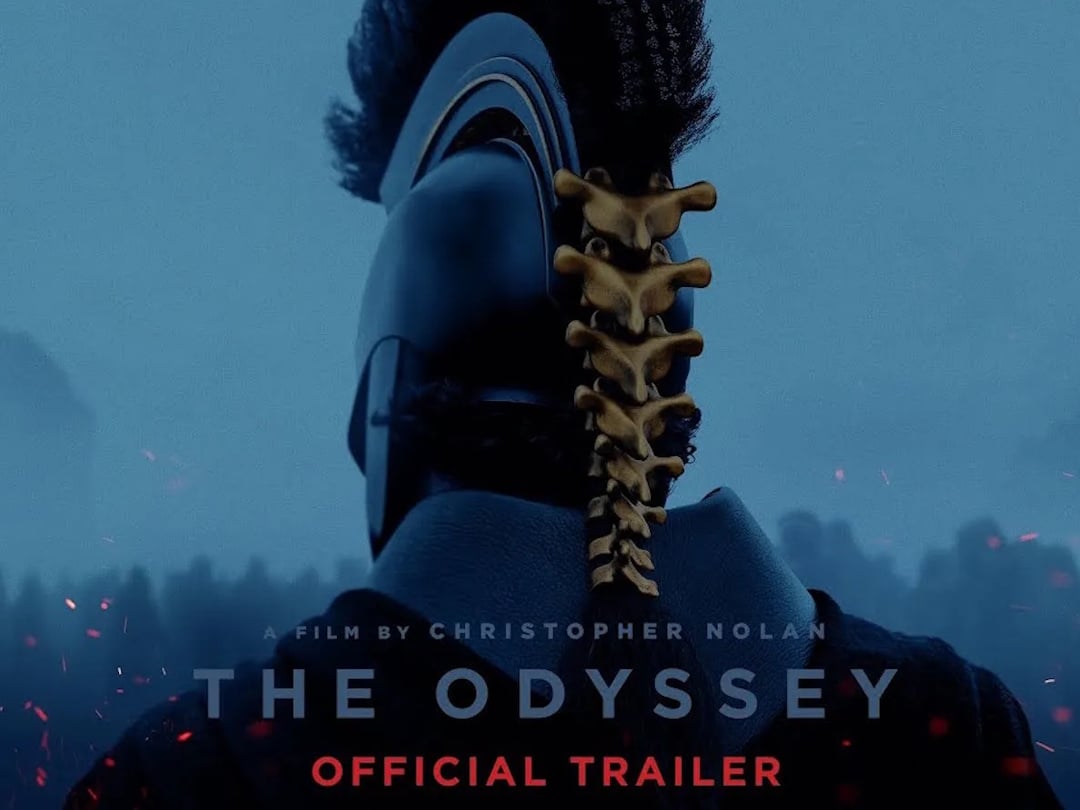
What Happens in the Trailer
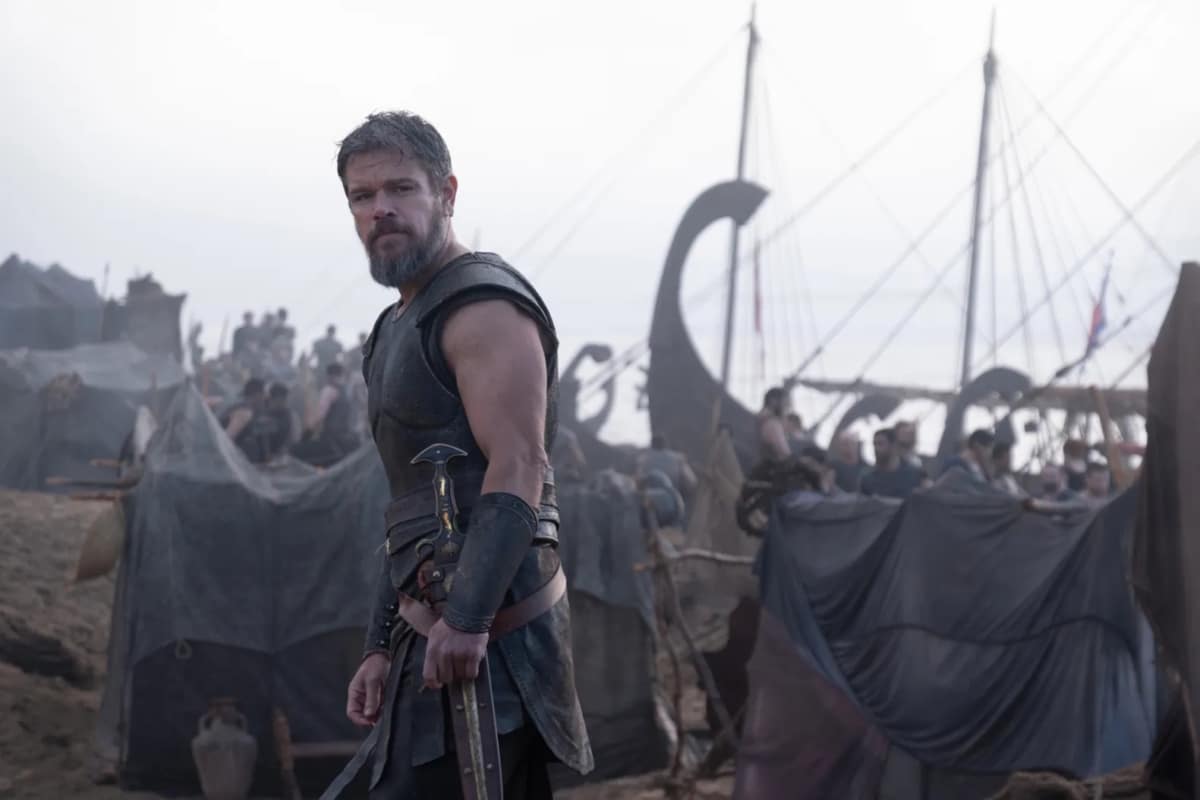
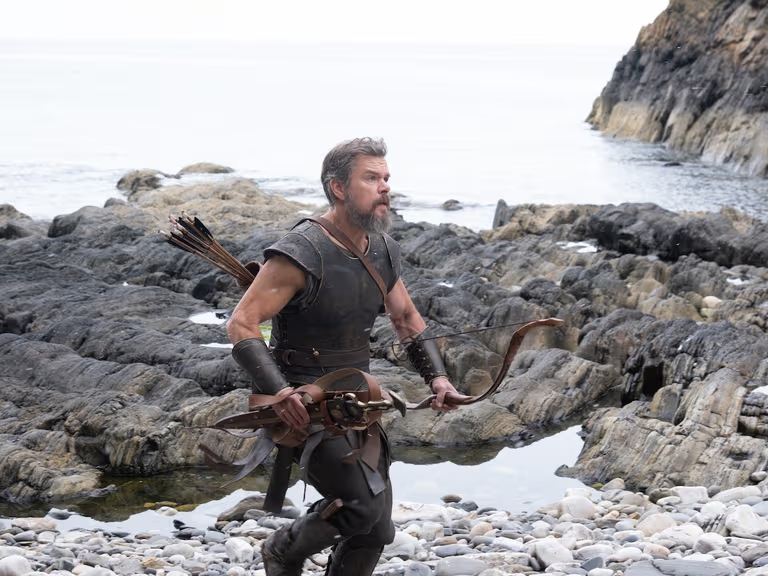
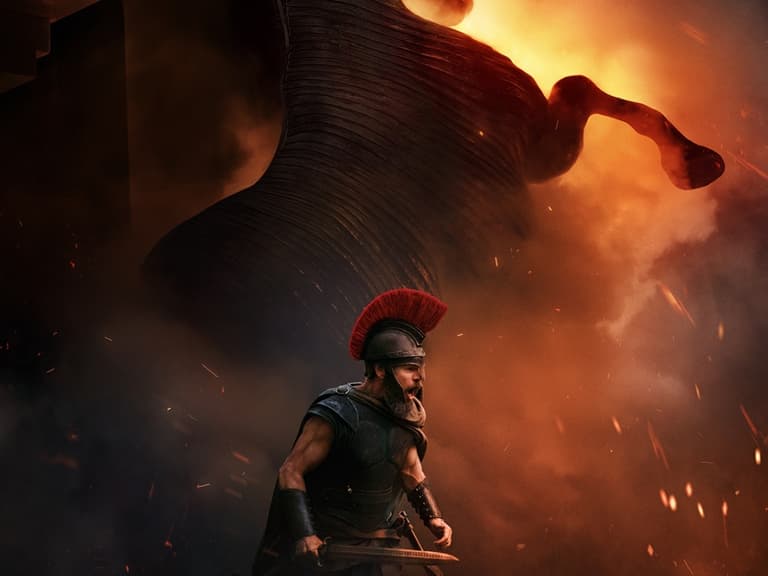
The trailer opens in the aftermath of the Trojan War. Scorched earth. Abandoned armour. Victory that feels closer to exhaustion than triumph. Over these images, Matt Damon’s Odysseus reflects on the toll it’s taken. “After years of war, no one could stand between my men and home,” he says. “Not even me.”
From there, the footage shifts between brutal ocean crossings and flashes of Homer’s epic myth. Ships are swallowed by violent seas. A Cyclops silhouette briefly fills the frame. Divine forces hover at the edges, less like guides and more like almighty obstacles.
One exchange cuts through everything else. Penelope’s plea is simple. “Promise me you’ll come back.” Odysseus’ answer is anything but. “What if I can’t?”
There’s no tidy plot outline, no exposition dump. As with Nolan, the trailer is about mood, movement and consequence. You’re meant to feel the journey before you understand it.
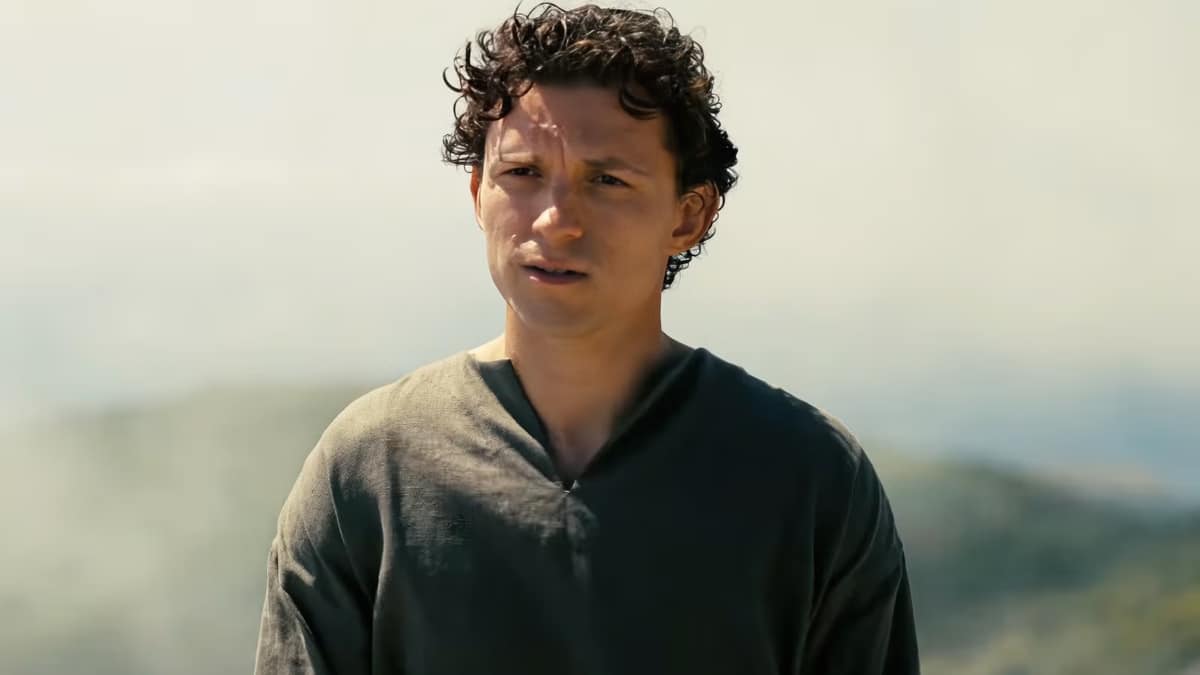
Cast and Key Characters
- Matt Damon as Odysseus, king of Ithaca and veteran of the Trojan War
- Tom Holland as Telemachus, his son, searching for answers
- Anne Hathaway as Penelope, holding the kingdom together in Odysseus’ absence
- Zendaya as Athena, Odysseus’ divine protector
- Robert Pattinson as Antinous, one of Penelope’s most aggressive suitors
The supporting cast includes Charlize Theron, Lupita Nyong’o, Jon Bernthal, Benny Safdie, Elliot Page, Mia Goth, John Leguizamo, Himesh Patel, Bill Irwin, Samantha Morton, Jesse Garcia and Will Yun Lee. Specific mythological roles beyond the leads have not yet been officially confirmed.
The Creative Team Behind It
This is a classic Nolan production, with most of his trusted collaborators back on deck.
- Director and writer: Christopher Nolan
- Producer: Emma Thomas via Syncopy
- Cinematography: Hoyte van Hoytema
- Music: Ludwig Göransson
- Editing: Jennifer Lame
- Studio: Universal Pictures
If you liked how Dunkirk felt in your chest or how Oppenheimer trusted the audience to keep up, expect similar confidence here.
How the Film Is Being Made
This is where The Odyssey starts to separate itself.
The film is the first narrative feature shot entirely on IMAX 70mm film, using newly developed cameras that are lighter and quieter than previous generations. Nolan has avoided mixing formats, committing fully to large-format photography from start to finish.
What that means in practical terms is scale. IMAX 70mm uses a much taller aspect ratio than standard cinema formats, allowing significantly more vertical image on screen. You see more sky, more sea and more body in the frame. Characters feel smaller against landscapes, and environments feel overwhelming rather than decorative. For a story about men tested by gods, oceans and time itself, that extra visual real estate keeps Odysseus visibly small against the world he’s trying to survive.
Principal photography ran from February to August 2025, spanning Morocco, Greece, Italy, Iceland and Scotland. More than two million feet of IMAX film stock were reportedly used. The production budget is understood to be around US$250 million, making this Nolan’s most expensive film to date.
For Australian audiences, this also means IMAX screenings won’t just be the premium option. They’ll be the version Nolan designed the film around, with standard sessions inevitably losing some of that vertical scale.
Release Date
The Odyssey is scheduled for a global theatrical release on 17 July 2026, including Australia. IMAX screenings will be central to the rollout.
Why This One Feels Different
For Nolan, The Odyssey isn’t a genre flex. It’s a gap he’s been circling for years. Speaking to Empire, he framed the project as a response to something missing in modern cinema. Big myth, treated seriously, with the weight and credibility of an A-budget production. He pointed to the Ray Harryhausen films he grew up with and noted that while the imagination was there, he’d never seen mythological storytelling tackled with the physical scale and conviction a full Hollywood IMAX production could bring.
Nolan calls The Odyssey “bedrock storytelling,” something that contains a little of everything. Gods, monsters, war, homecoming, survival. To do it justice, he leaned hard into physical filmmaking.
“We shot over two million feet of film,” said Nolan, describing months spent on location with the cast playing Odysseus’ crew. “We got them out there on the real waves, in the real places. It’s vast and terrifying and wonderful and benevolent, as the conditions shift.”
For Matt Damon, reuniting with Nolan after Interstellar and Oppenheimer left another lasting impression. He described the film as “exactly what you want of a summer movie,” adding that it “should be the most massively entertaining film” and that it “should feel mythic.” Scenes were worked out on the ground, often close to shooting, with Nolan having to figure things out in real time. If the script called for danger or chaos, Damon said, that’s what the set delivered. “Chris doesn’t hide the ball.”
Taken together, it paints a picture of a film built the hard way. Real locations, real scale, and a director willing to put his cast and crew in the middle of it. For a story that’s endured for thousands of years, that kind of commitment feels fitting.

















Comments
We love hearing from you. or to leave a comment.